Weather Markets bots
Bots and tools that trade temperature and climate markets by pitting forecast models against market prices.
Poly Research & Robotics
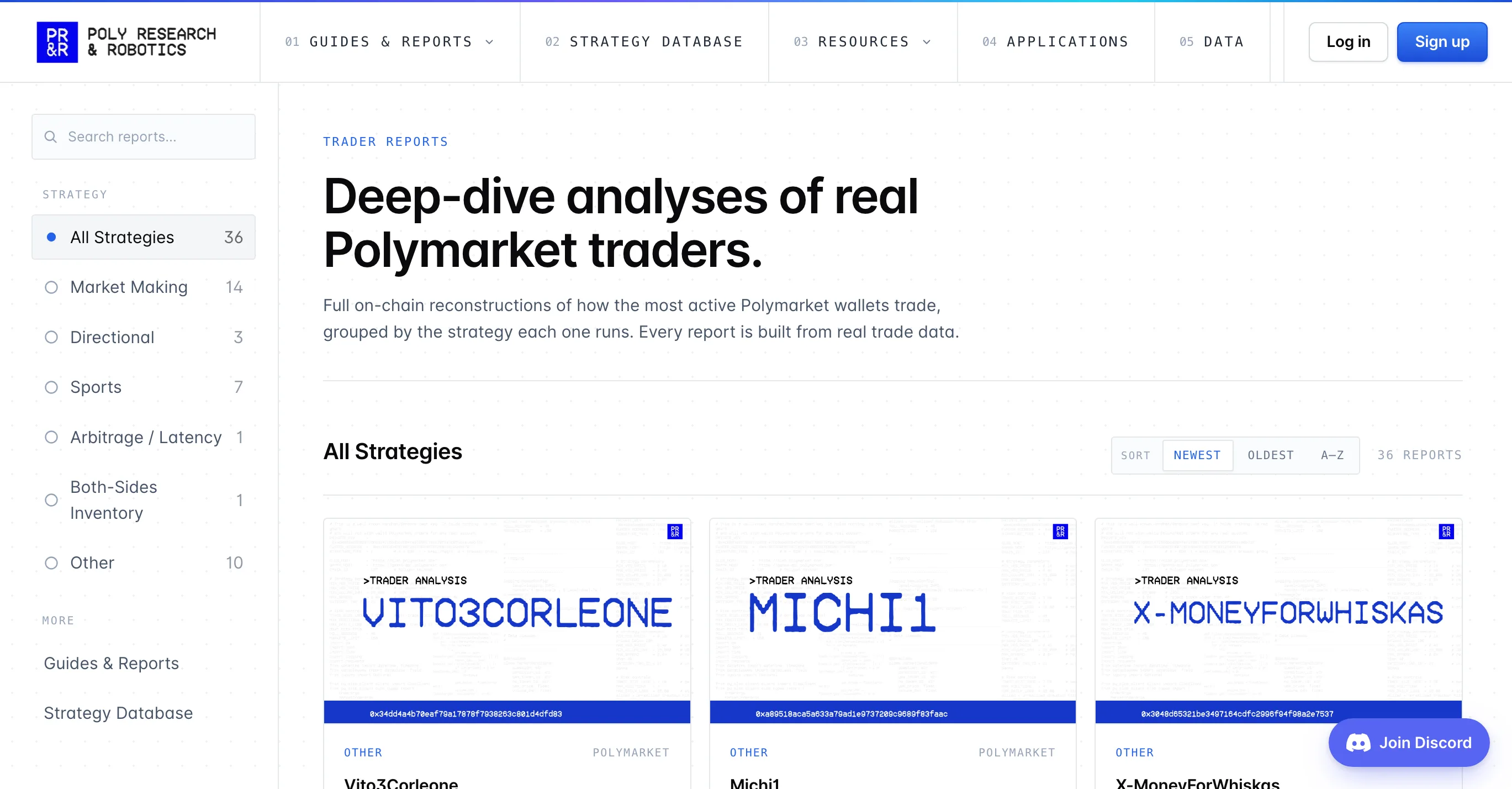
Free community and toolset for people who write their own Polymarket bots, paid for by a store of historical market data. Poly Research & Robotics, PR&R for short, runs a Discord of about 2,000 members and publishes build guides written to be worked through with an AI coding agent, 36 reports that take apart how individual high-volume accounts trade, a live monitor for the crypto Up or Down windows and a self-hosted bot for those windows that it describes as open source. Guides and reports are open to read and the monitor runs without an account; the bot and the dataset samples need a PR&R account with your Discord linked to it. The store sells one-second order-book history for crypto, weather, tennis and competitive-gaming markets in packs from $5 to $75.
PolyTraderBot
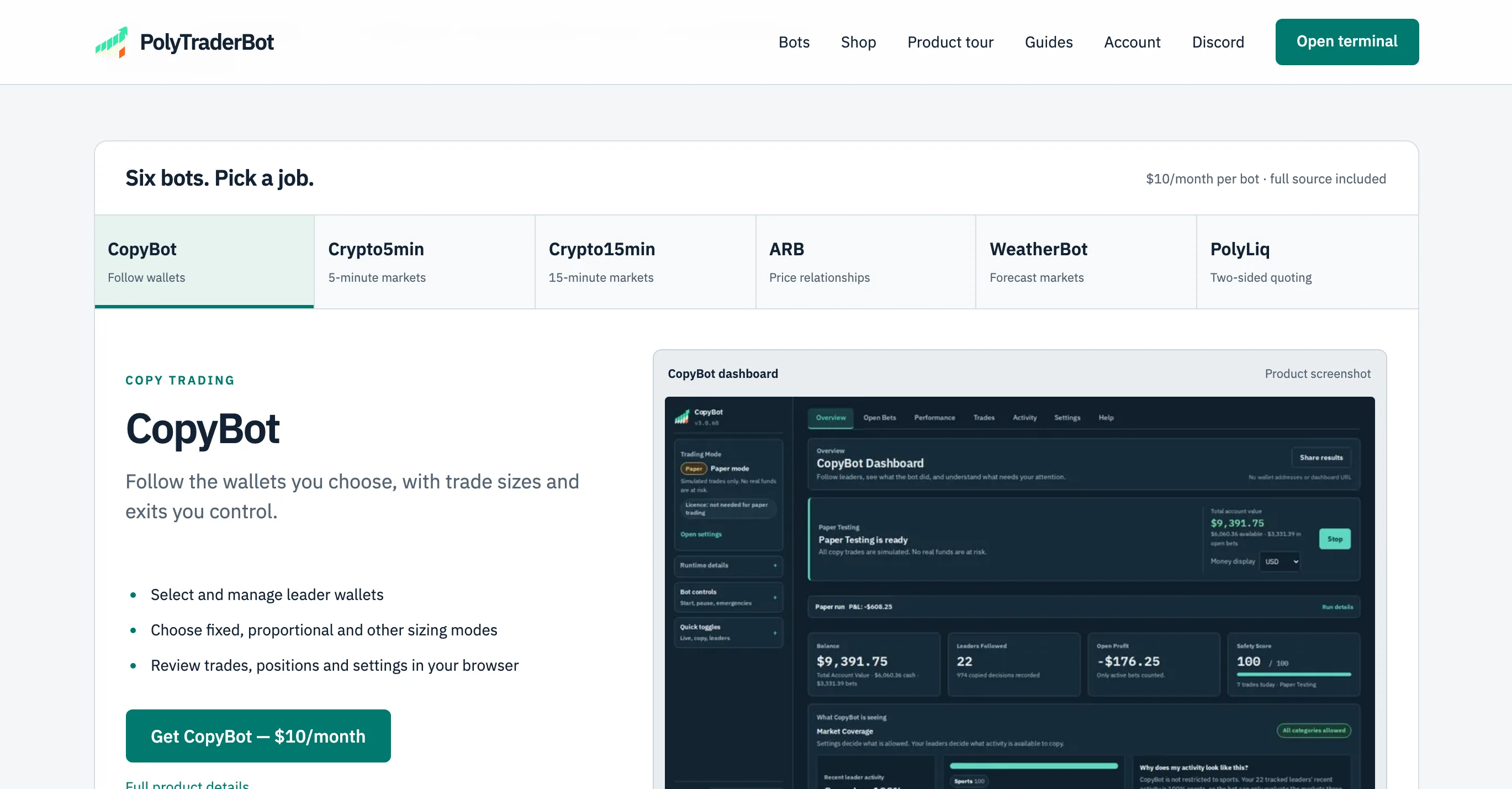
Six self-hosted Polymarket bots from one developer, sold separately at $10 a month each and delivered as full source with a browser dashboard, tests and a Docker setup for your own PC or VPS. CopyBot follows wallets you choose, or candidates it ranks from Polymarket's public leaderboard, with fixed, proportional or Kelly-fraction sizing, ten-plus individually switchable guards and exits that follow the leader out. Crypto5min and Crypto15min trade the 5- and 15-minute up/down windows on BTC, ETH, SOL, XRP, DOGE, BNB and HYPE from tree-based models retrained every 60 or 90 minutes. ARB scans the order books for binary YES and NO asks that sum to less than $1 after fees. WeatherBot prices temperature buckets from a weighted blend of Open-Meteo models, NWS, NOAA and Met.no forecasts and compares the result with the live asks. PolyLiq rests two-sided quotes in the markets that pay Polymarket's liquidity rewards, or takes over the resting orders you placed yourself. Every bot starts with real orders switched off, keeps the wallet key in a local env file and, from the current releases, updates itself from its own dashboard. The vendor advertises no returns; a free Polymarket terminal from the same developer is in beta on the same domain.
Virae AI
AI trading terminal for Polymarket, in private beta: market discovery with live trending topics and order-book prices, a whale leaderboard ranking tracked wallets by PnL, volume, win rate and Sharpe with one-click copy tasks, and seven trading Agents across four strategy types — end-of-round BTC/ETH price-distance, pre-market maker ladders, weather-model probabilities and Musk tweet counts. Agents watch every eligible round and only place orders when sizing, liquidity and entry rules all pass; each ships with recorded paper performance clearly labelled as simulation, and the strategy-evaluation core is open source on GitHub. Turnkey-backed non-custodial wallets, web app plus Telegram bots, and a separate Solana memecoin terminal.
PillarLab
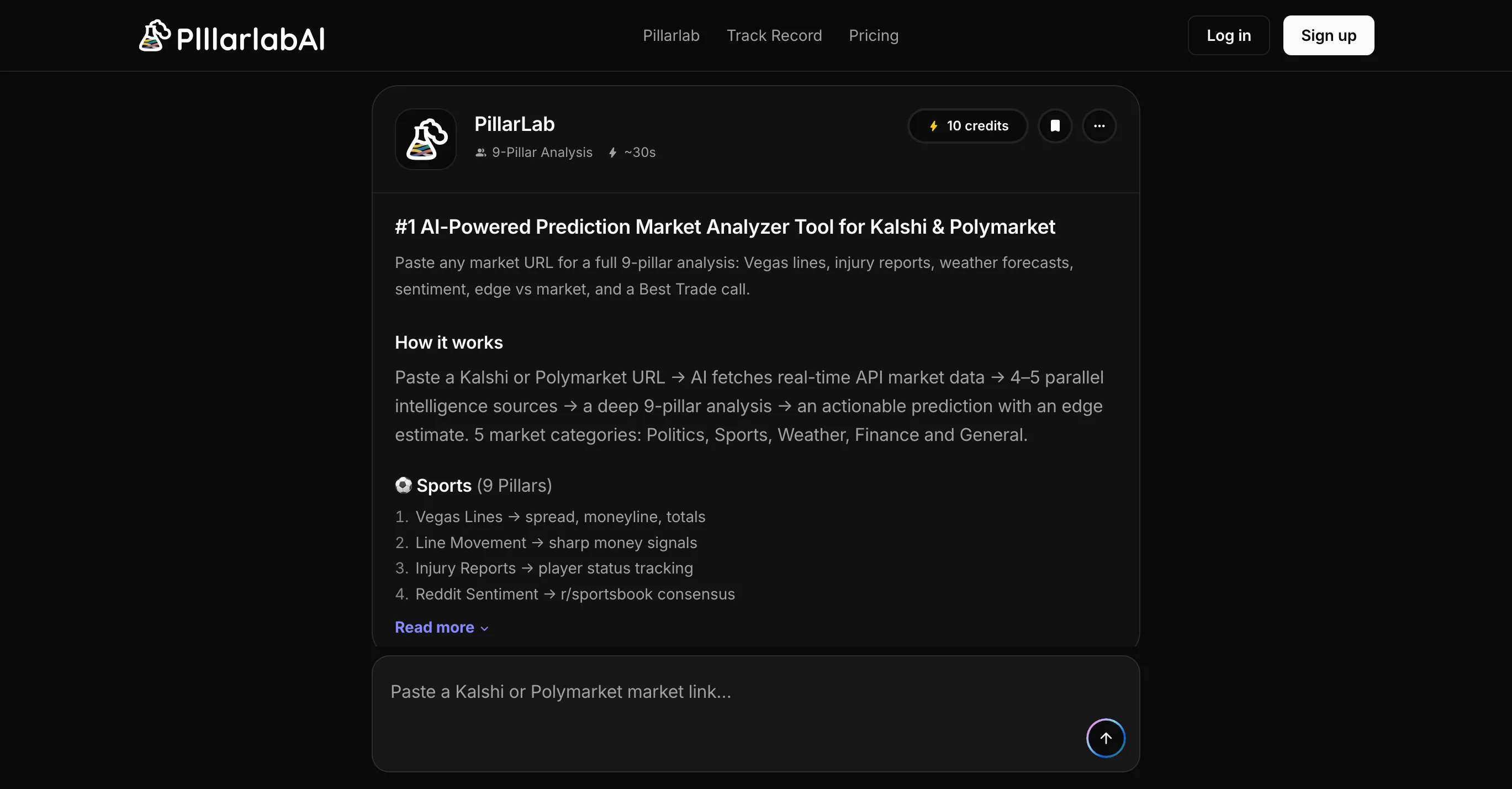
AI market analyzer for Kalshi and Polymarket. Paste a market URL and it pulls live market data plus four or five parallel intelligence sources, then returns a nine-pillar breakdown and a Best Trade call with an edge estimate in about 30 seconds. The nine pillars are tailored per category: Vegas lines, line movement and injury reports for sports; GFS/ECMWF/NWS forecast consensus and ensemble spread for weather; polls-versus-odds divergence for politics; technicals, institutional flows and macro for finance. Every category ends on a contrarian check.
PolymarketAlpha
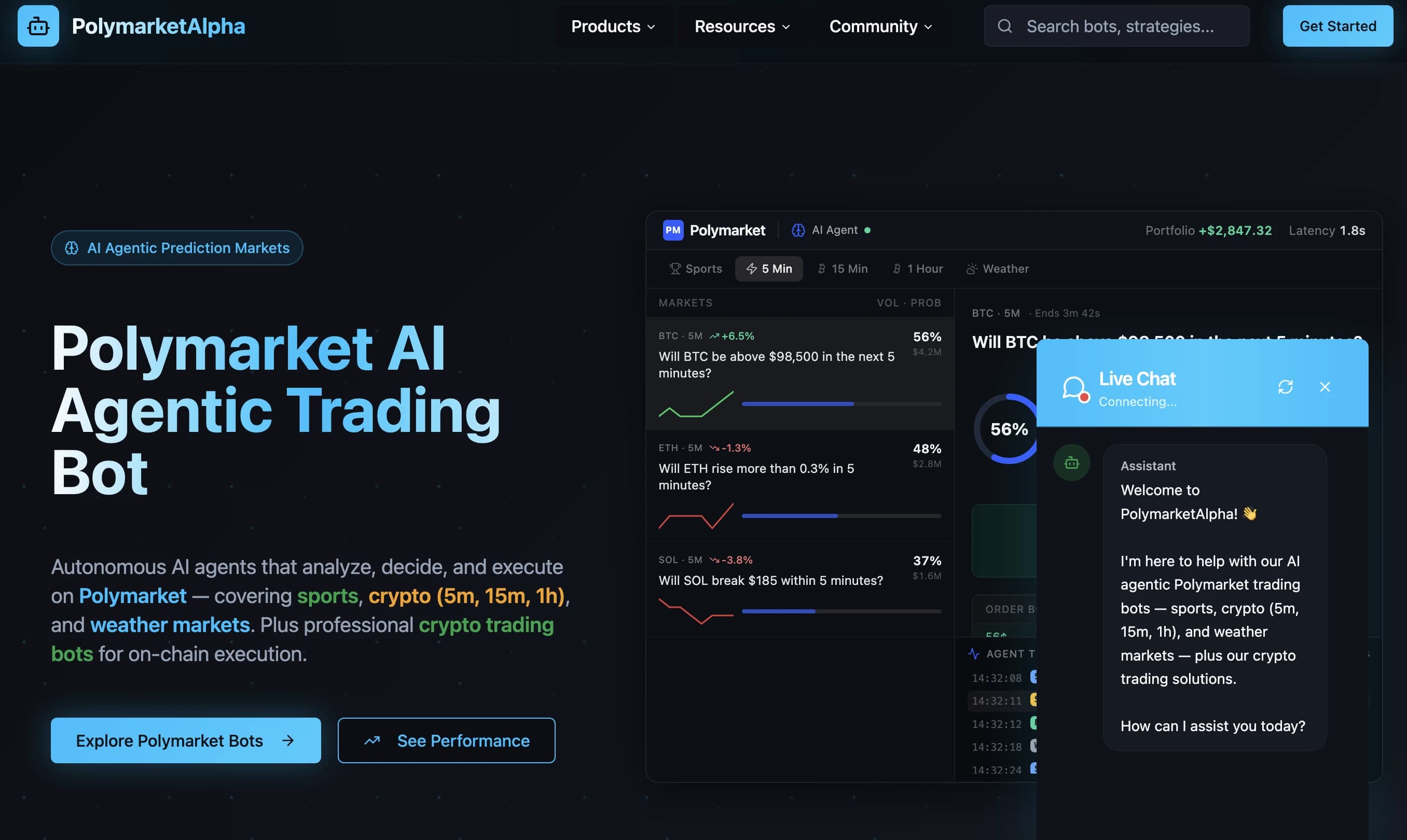
Autonomous AI agents that scan, analyze and execute on Polymarket across sports, crypto (5m, 15m, 1h) and weather markets — no manual intervention. Backed by a custom-built desk that also ships professional on-chain Solana bots (MEV, arbitrage, sniping and market making).
PolyBot
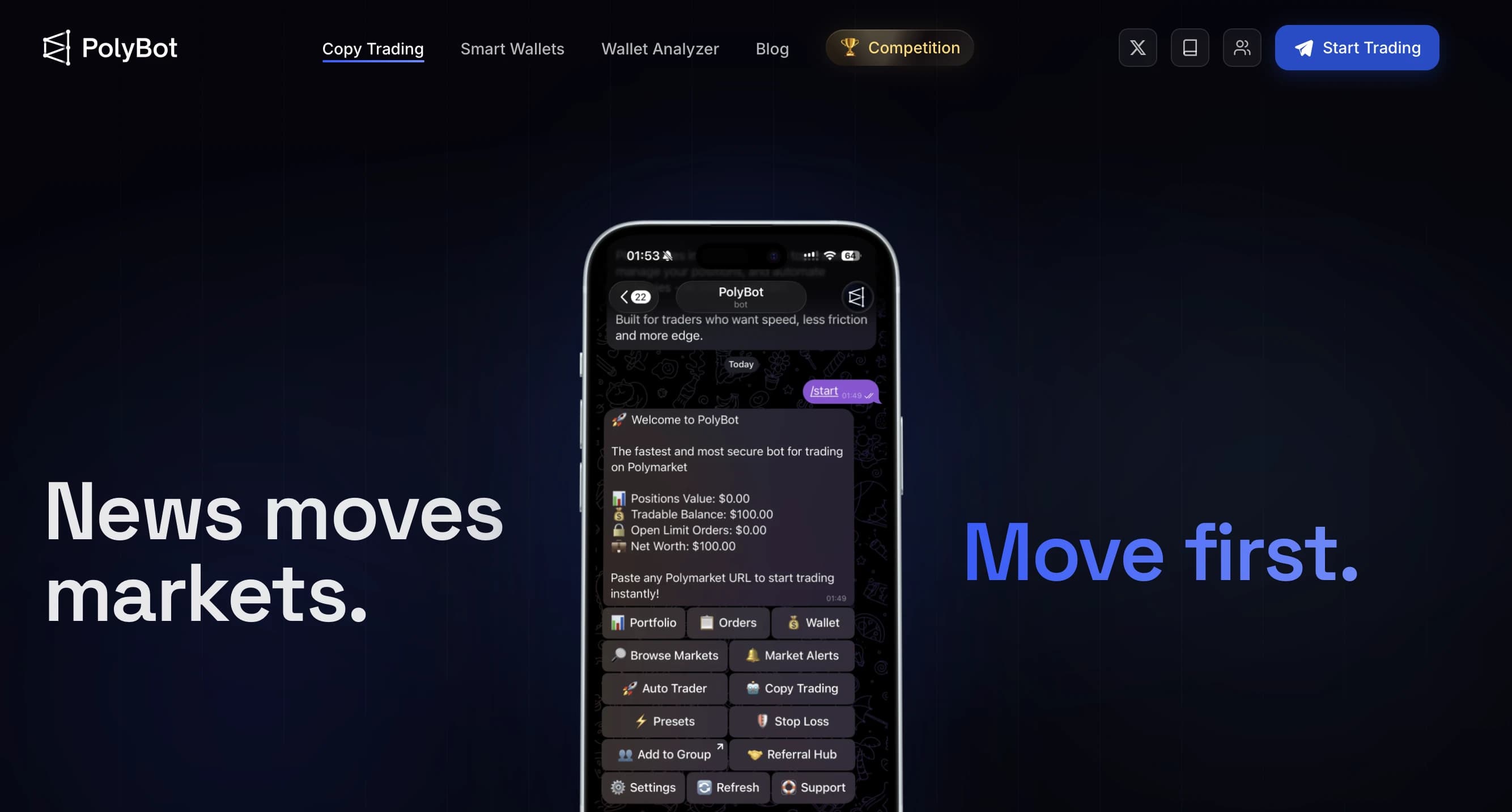
Telegram trading bot for Polymarket. Copy top wallets automatically, or build custom strategies with trigger prices, take-profit, stop-loss and trailing stops — orders route through your own non-custodial Safe wallet at a flat 1% fee.
Climate Sight
Weather analytics for climate prediction markets. Aggregates institutional feeds (NOAA, NWS, Synoptic) into professional forecasts across 40+ global cities, with ML-powered buy signals to flag high-probability trades on Kalshi, Polymarket and Robinhood.
PolyEdge
Scanner that finds mispriced Polymarket markets by comparing live order-book prices against objective data. Weather Edge pits meteorological forecasts against prices, Sports contrasts bookmaker odds, and you can upload your own probabilities for quarter-Kelly bet sizing with a 5% portfolio cap.
Poly Helper
Browser extension that upgrades Polymarket without leaving its interface — 25+ context panels: live crypto and stock stats, sports intel with live scores, bookmaker odds comparison across 19 sportsbooks with automatic edge detection, polls vs market price on election events, top-holders PnL, a tracker to follow top traders, breaking-news X feed, LP-rewards calculator and TradingView-style charts. Polymarket Builders Badge — supported and approved by Polymarket.
Predict & Profit
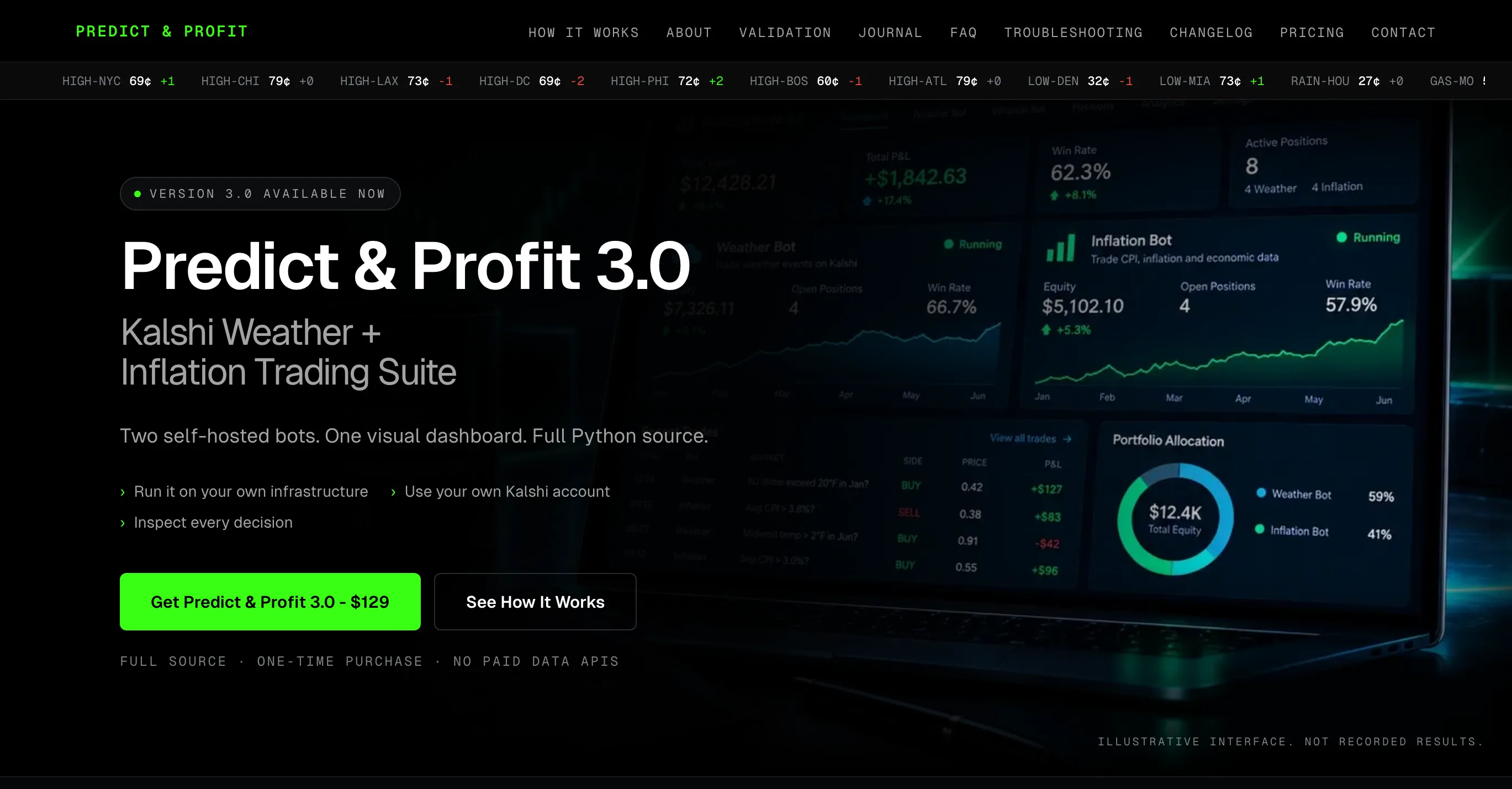
Self-hosted Python suite for Kalshi weather and inflation markets — two bots, a monitoring dashboard and one shared risk engine, installed and managed as a single system. Version 3.0 prices temperature contracts from NOAA's National Blend of Models, the calibrated station-level guidance published for exactly the stations Kalshi settles on, at 0.75 weight; GFS, AIGEFS, ECMWF IFS, AIFS and HRRR hold the remaining 0.25 as a disagreement check rather than as the model. Settlement stations come from Kalshi's own series metadata across 20 cities — Chicago settles on Midway, Houston on Hobby — and any market NBM does not cover is skipped, which rules out every same-day contract, because NBM coverage starts at forecast hour 24. The inflation half scores CPI, Core CPI and PCE against the Cleveland Fed's nowcast and an internal weighted one. Candidates then pass a four-signal gate — spread 30%, volume 20%, order-book imbalance 25%, model mispricing 25% — and the author says over 95% of scanned contracts are rejected. There is no public performance record: the trade log the earlier version published was retired with 3.0, and the site now publishes release and validation status instead of a P&L scoreboard.
How weather bots trade prediction markets
Weather is the rare corner of prediction markets where the edge is openly published every few hours. Kalshi lists daily high-temperature contracts across US cities and Polymarket carries weather and climate events — and both are priced by traders who, mostly, checked one forecast app. A weather bot instead pulls entire model ensembles: NOAA's GFS runs 31 physics simulations with perturbed starting conditions, ECMWF runs 51, and the new AI families built on models like GraphCast add dozens more. When 120 of 160 ensemble members clear a temperature threshold that the market prices at 40 cents, the gap between model consensus and market price is the trade.
The discipline is in the filter, not the forecast. Good weather bots trade only when independent model families agree, size positions to the edge, and sit out when the ensembles disagree — which is most of the time. They also respect resolution mechanics: contracts settle on specific weather-station readings, so the bot must model the same station the market settles on, not the city average.
What to look for in a weather trading bot
Ensemble breadth first: a bot reading one model is a coin flip with extra steps, so look for multiple independent model families and an explicit agreement threshold before it trades. Then check the boring safety math — weather books are thin, so fee and slippage assumptions, per-city exposure caps and daily loss limits decide whether a real forecasting edge survives execution. Finally, prefer authors who publish a live, settled-trade track record; weather resolves daily, so a seller with no verifiable results has chosen not to show them.
Frequently asked questions
- Why would weather markets be beatable at all?
- Because most participants price them from a single consumer forecast, while ensemble systems publishing 30–50 member runs are freely available. The bot's edge is aggregating more independent forecasts than the marginal trader — publicly available data, applied more thoroughly.
- What data do weather bots actually use?
- Mostly free government ensembles: NOAA's GFS and its AI-enhanced variant, ECMWF's IFS and AIFS, plus station observations for nowcasting. No paid API is required — which is why several bots in this category ship as source code with no subscription.
- Doesn't everyone running the same models erase the edge?
- Slower than you'd think. The edge comes from the gap between ensemble consensus and the price set by casual traders, and more model-driven volume narrows but rarely closes it — weather books are small enough that sophisticated capital stays limited.
Guides to weather markets
All guidesNews, sentiment and AI-agent bots on Polymarket: from headline to order
How event-driven bots turn headlines, transcripts, forecasts and an LLM's read of the news into Polymarket orders; why speed matters less than being right about resolution; what the official Polymarket Agents framework gives you; and where these bots quietly lose.
4 minAug 21, 2026Trading Polymarket weather markets with forecast models: where the edge is, and how the rule eats it
Daily temperature and weather markets are priced by people with a weather app and resolved by a specific station's reading — which is why model-driven bots like them. How ensemble forecasts turn into a probability, when to trade the gap, the 1.25% fee, and the resolution details (station, rounding, time zone, source) that turn a correct forecast into a losing trade.
4 minAug 21, 2026