Arbitrage bots
Bots that exploit price differences between correlated or mispriced markets, closing the spread for low-risk profit.
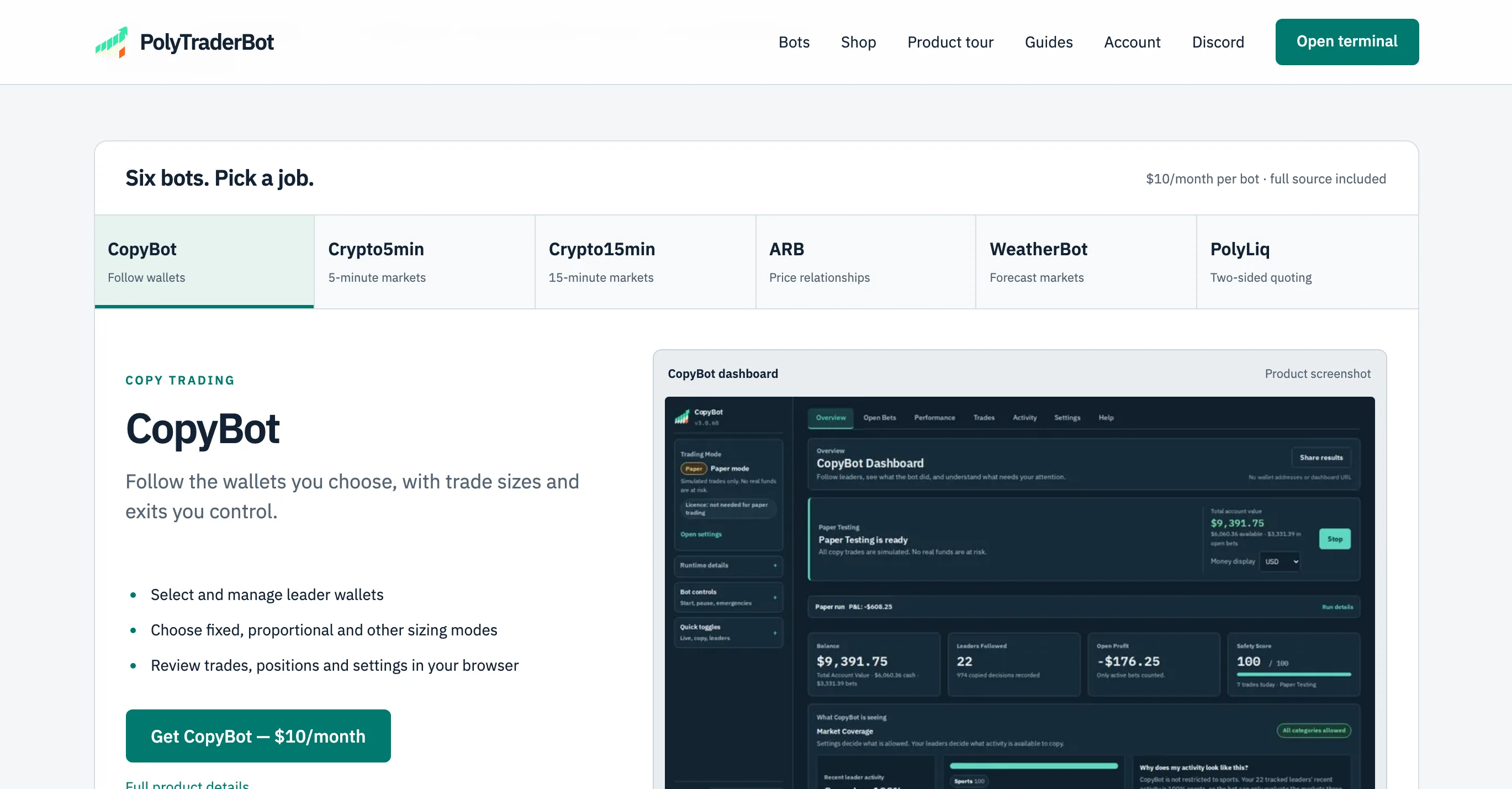
PolyTraderBot
Six self-hosted Polymarket bots from one developer, sold separately at $10 a month each and delivered as full source with a browser dashboard, tests and a Docker setup for your own PC or VPS. CopyBot follows wallets you choose, or candidates it ranks from Polymarket's public leaderboard, with fixed, proportional or Kelly-fraction sizing, ten-plus individually switchable guards and exits that follow the leader out. Crypto5min and Crypto15min trade the 5- and 15-minute up/down windows on BTC, ETH, SOL, XRP, DOGE, BNB and HYPE from tree-based models retrained every 60 or 90 minutes. ARB scans the order books for binary YES and NO asks that sum to less than $1 after fees. WeatherBot prices temperature buckets from a weighted blend of Open-Meteo models, NWS, NOAA and Met.no forecasts and compares the result with the live asks. PolyLiq rests two-sided quotes in the markets that pay Polymarket's liquidity rewards, or takes over the resting orders you placed yourself. Every bot starts with real orders switched off, keeps the wallet key in a local env file and, from the current releases, updates itself from its own dashboard. The vendor advertises no returns; a free Polymarket terminal from the same developer is in beta on the same domain.
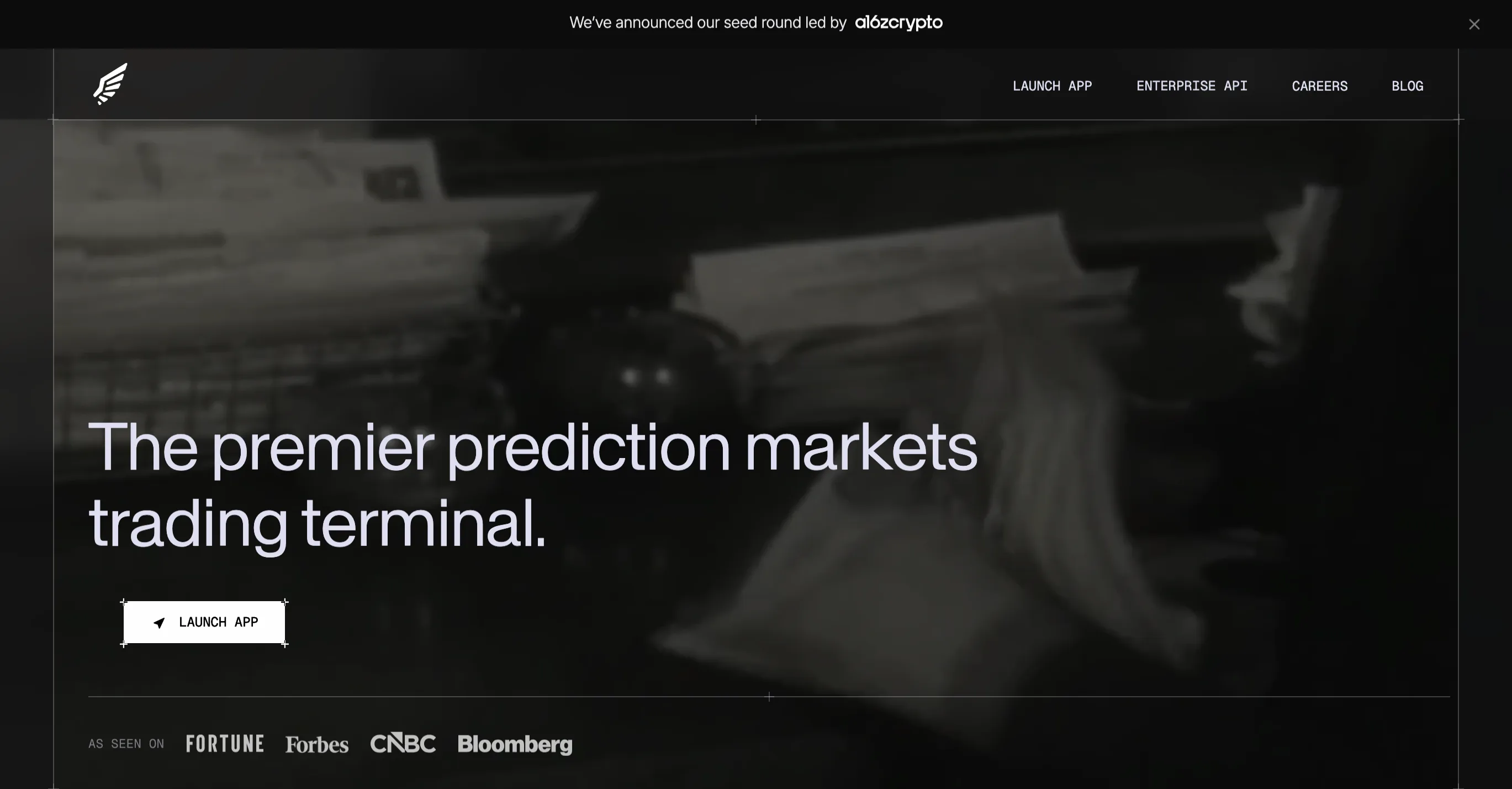
Kairos
Cross-venue trading terminal that merges Kalshi, Polymarket and Predict.fun into one order book. Matching contracts on different exchanges are shown as a single instrument with a composite ladder and a global best bid and offer, so you can see which venue is actually cheapest before you send, and an order to the NBBO endpoint routes to whichever book shows that price. Feeds are ingested next to the venues and merged in the browser with no polling interval; the ticket carries GTC, GTD, FOK, FAK and IOC time-in-force, post-only and slippage caps, with batch cancel and a per-venue kill switch. A bots panel runs parameterised templates — market making, cross-venue arbitrage, dip buying — against recorded books first and promotes the same config to live. The same engine is exposed as a REST and WebSocket API with scoped keys, IP whitelisting and a free read-only market-data tier. Built by a team from high-frequency trading firms and exchanges and backed by a $2.5M seed led by a16z.
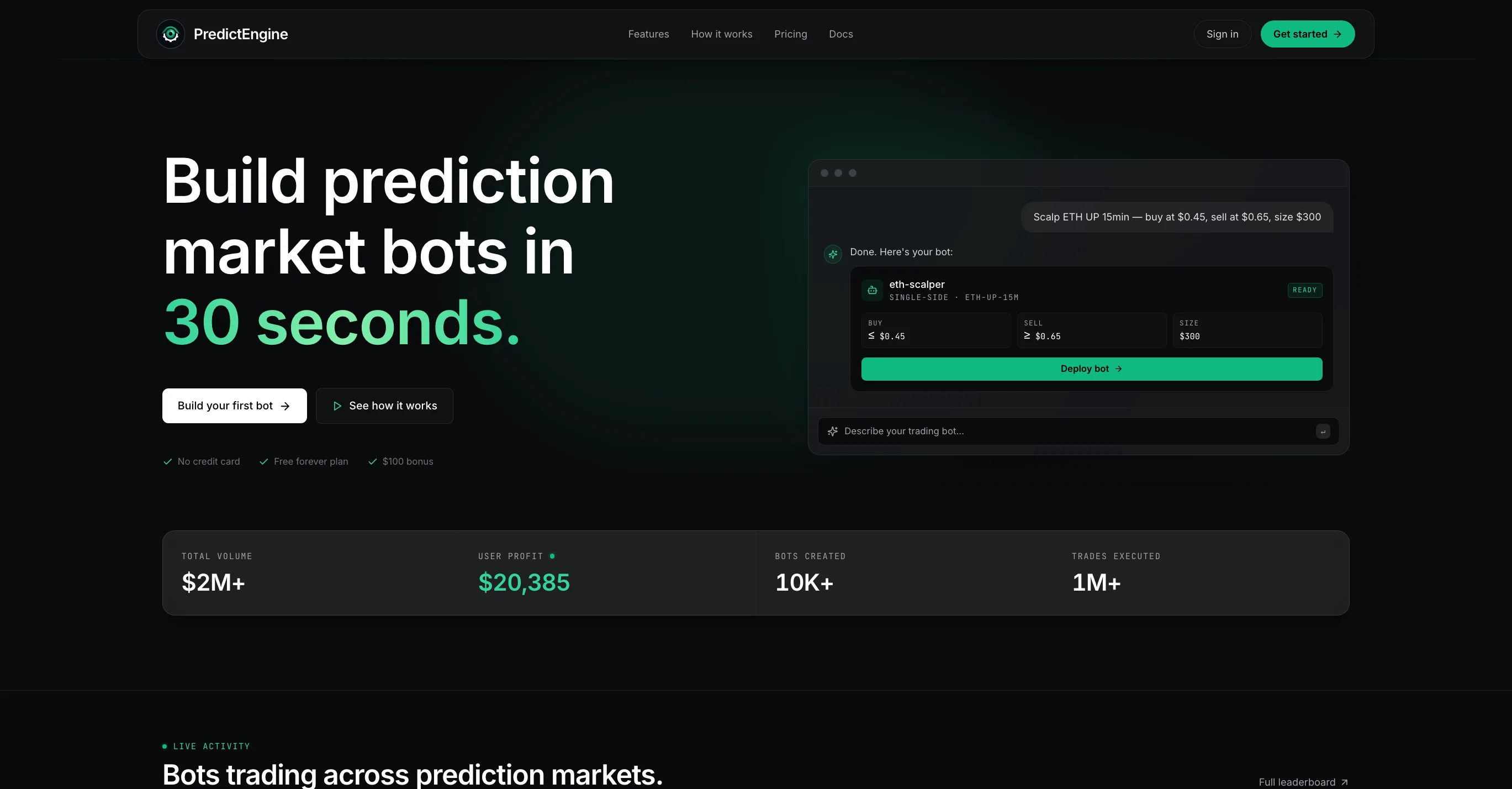
PredictEngine
No-code bot builder that hosts and runs Polymarket strategies for you. You describe a rule in plain English — “buy BTC UP when it dips below $0.40” — or pick a template, and the platform writes the bot, provisions a dedicated Polygon wallet, signs the orders and keeps it running 24/7 on its own infrastructure, with a dashboard, a Discord bot and a mobile terminal to watch it. Templates cover single-side entries, cross-market arbitrage, copy trading that mirrors chosen wallets, market making and sports value against bookmaker lines; a marketplace lets users publish bots for others to run. The free plan runs five live bots; $9 a month unlocks the AI builder, 25 bots and backtesting; $49 adds an unlimited builder and 25% lower trading fees. The docs list Limitless and Predict.fun alongside Polymarket. The wallet is generated and encrypted on their side and the private key is exportable at any time.
CloddsBot
Open-source AI trading agent that runs on your own machine and takes orders in natural language over Telegram, Discord, WebChat and eighteen other channels. Powered by Claude, it covers ten prediction markets — Polymarket, Kalshi, Betfair, Smarkets, Drift, Manifold, Metaculus, PredictIt, Opinion.xyz and Predict.fun — plus perpetual-futures exchanges and Solana and EVM DeFi. The Polymarket layer is real code rather than a wrapper: an EIP-712 order signer with unit tests, a CLOB client exposing 60-plus methods, real-time data and user WebSocket feeds, a large-trade tracker, and round-based discovery of the 5-minute BTC and the 15-minute, hourly, 4-hour and daily crypto windows with four automated strategies, alongside cross-venue arbitrage detection, copy trading and DCA bots. MIT-licensed at github.com/alsk1992/CloddsBot: 2,700 stars, 460-plus commits from one primary author, v1.9.1 released Sep 12, 2026, installed with one npm command on Node 22.
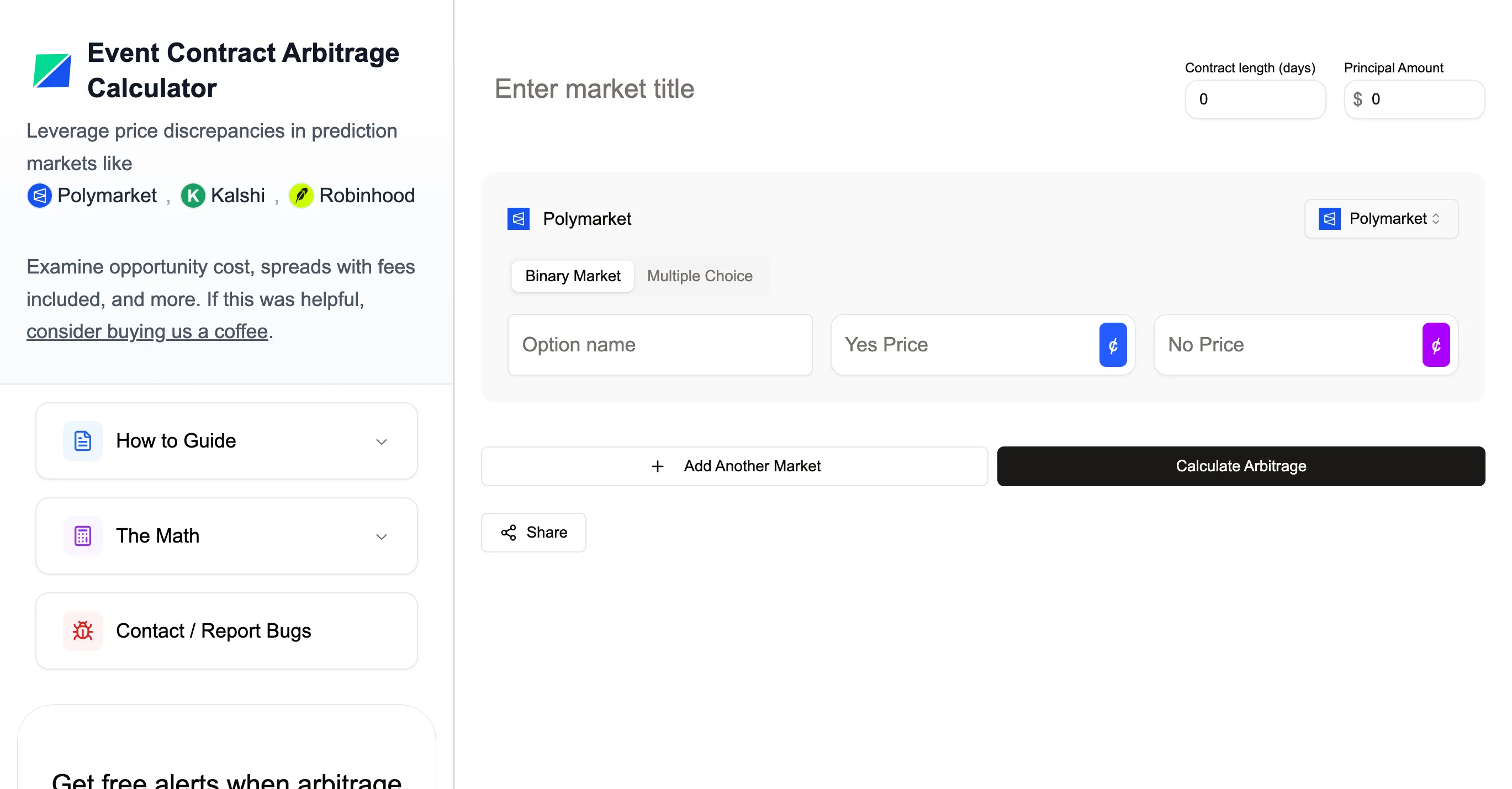
EventArb
Free cross-platform arbitrage calculator for event contracts. Punch in YES/NO prices for the same event on Polymarket, Kalshi or Robinhood and it does the math each venue's fee schedule implies — whether buying opposite sides locks in a profit, what the spread nets after fees, and the opportunity cost of parking capital until resolution. Supports binary and multiple-choice markets, side-by-side venue comparison, shareable links and free email notifications when opportunities open.
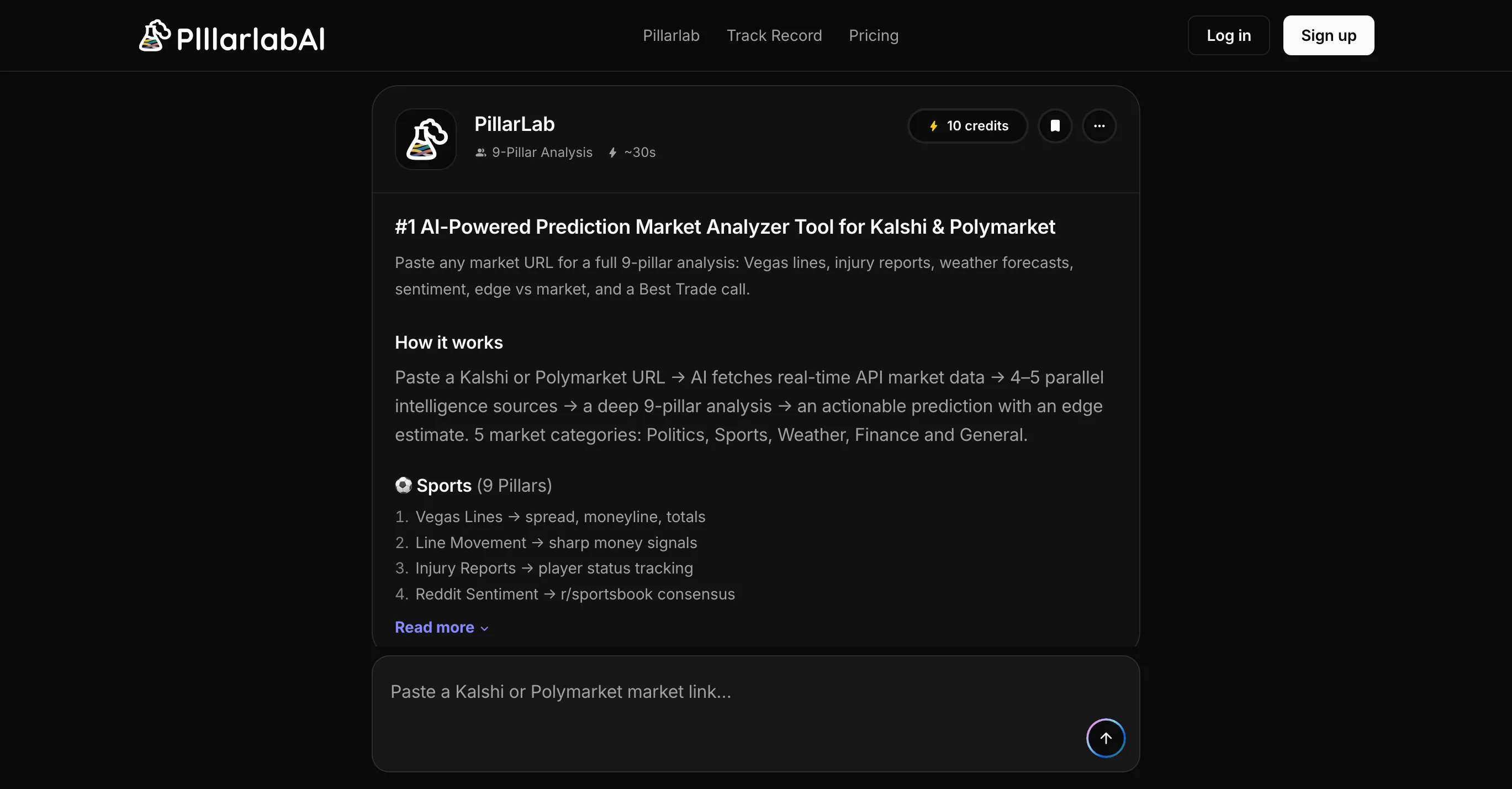
PillarLab
AI market analyzer for Kalshi and Polymarket. Paste a market URL and it pulls live market data plus four or five parallel intelligence sources, then returns a nine-pillar breakdown and a Best Trade call with an edge estimate in about 30 seconds. The nine pillars are tailored per category: Vegas lines, line movement and injury reports for sports; GFS/ECMWF/NWS forecast consensus and ensemble spread for weather; polls-versus-odds divergence for politics; technicals, institutional flows and macro for finance. Every category ends on a contrarian check.
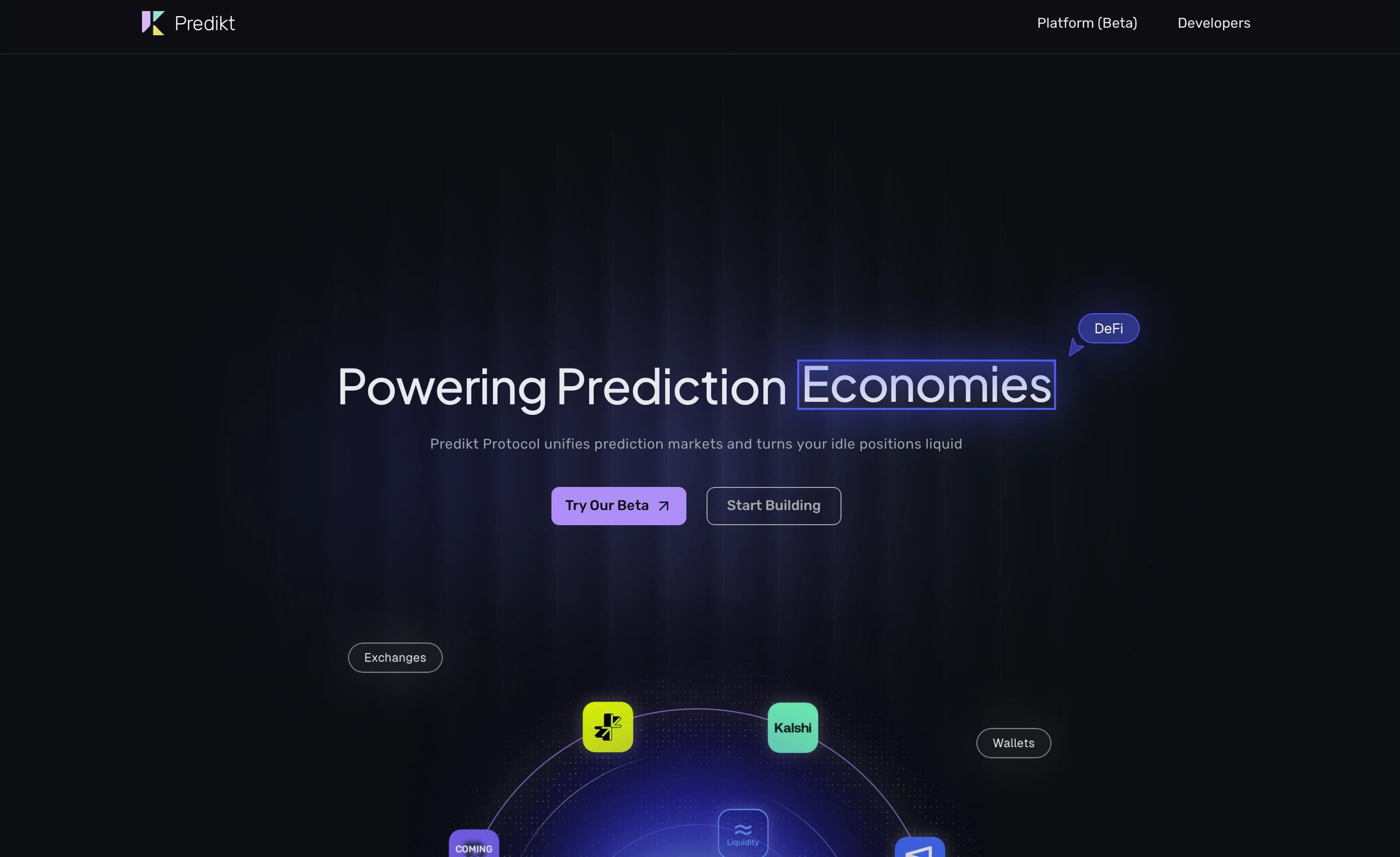
Predikt
DeFi infrastructure protocol that unifies prediction markets into one layer. Aggregates 500k+ markets across venues, tokenizes idle positions into composable DeFi assets, and routes execution through a solver-based, intent-driven engine — all behind a single API and SDK. Cross-chain (Solana & Sui); largely in beta.
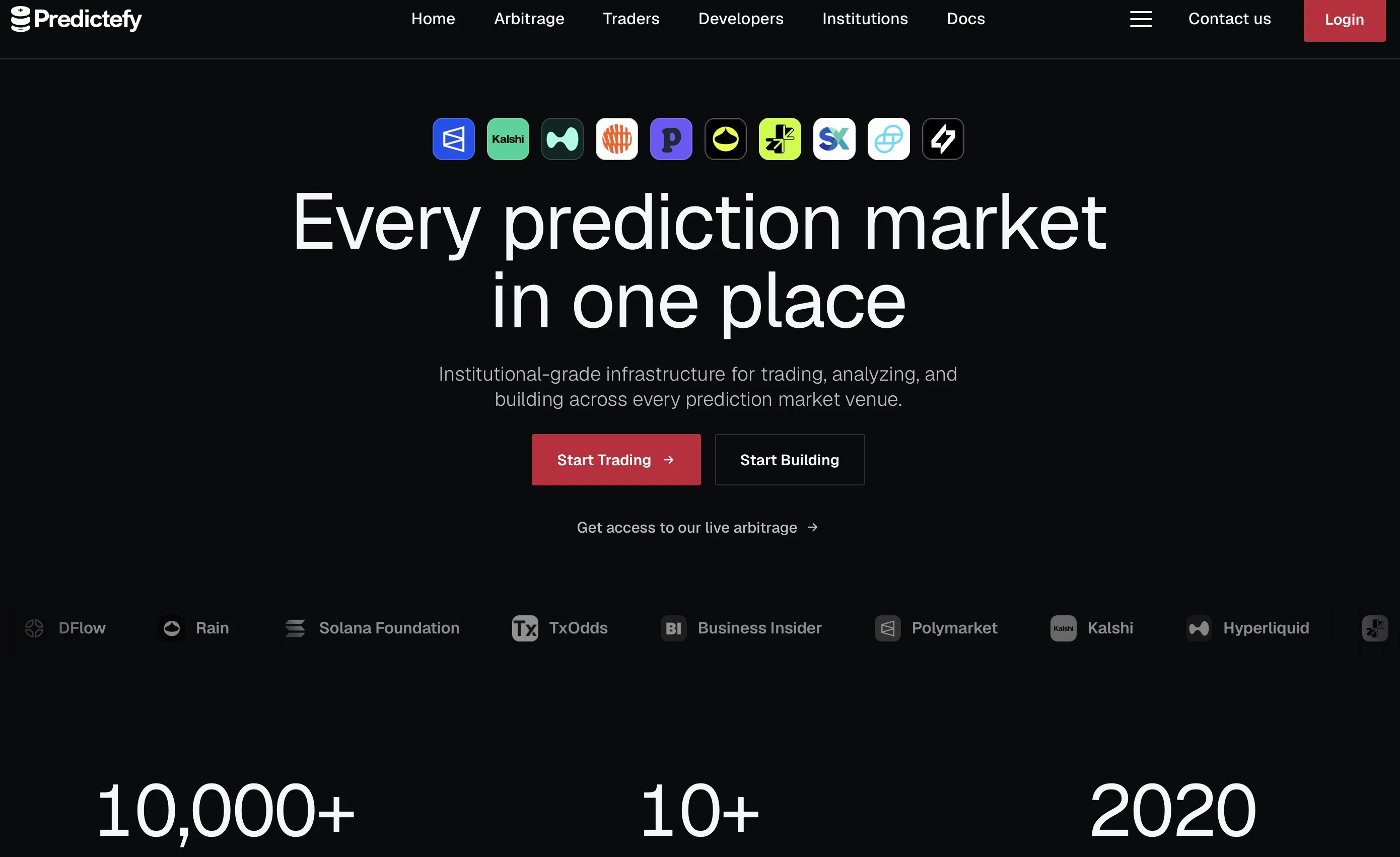
Predictefy
Institutional-grade infrastructure across every prediction market venue. Matches identical markets on Polymarket, Kalshi, Hyperliquid, Limitless and more, then streams cross-venue arbitrage — spread, size, liquidity and route — in real time. Ships a market-data API, SDK, smart order router, MCP server and agent CLI, plus historical data back to 2020.
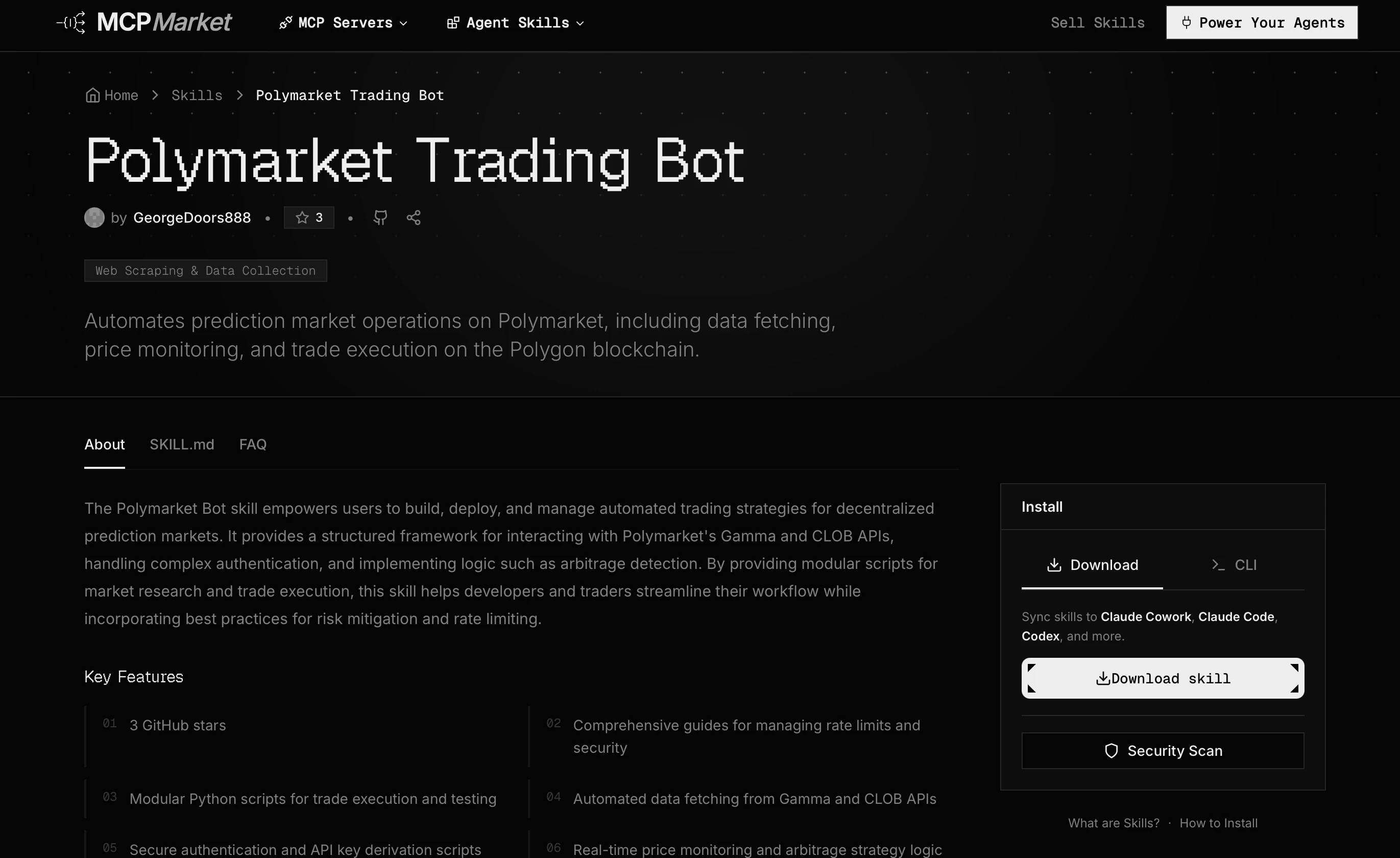
Polymarket Bot Skill
Claude Code skill that turns an AI coding agent into a Polymarket bot builder. Ships modular Python scripts for the Gamma and CLOB APIs — market research, price monitoring, arbitrage detection and trade execution — with built-in auth, key derivation and rate-limit handling. Installs into Claude Code, Cowork, Codex and other agents.
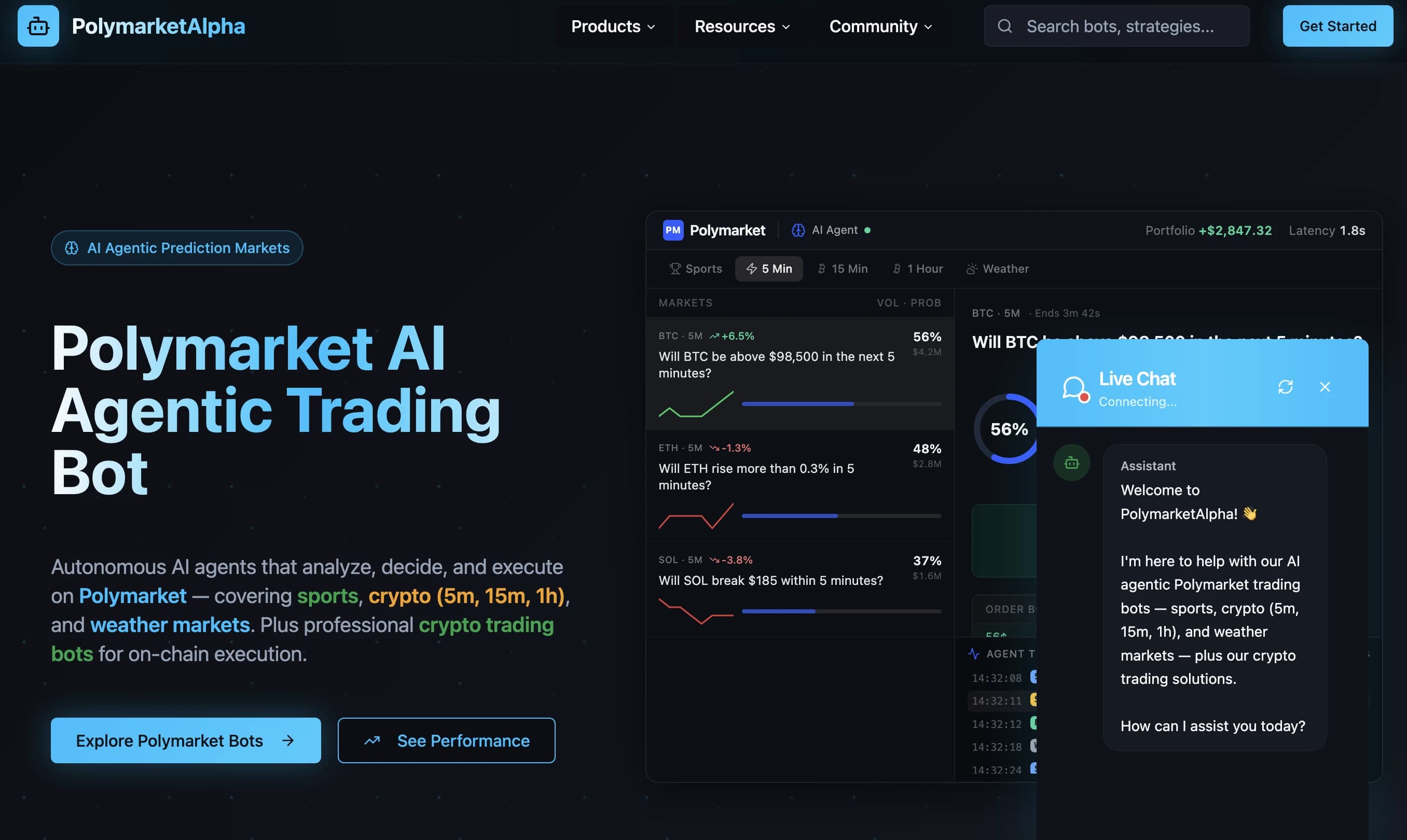
PolymarketAlpha
Autonomous AI agents that scan, analyze and execute on Polymarket across sports, crypto (5m, 15m, 1h) and weather markets — no manual intervention. Backed by a custom-built desk that also ships professional on-chain Solana bots (MEV, arbitrage, sniping and market making).
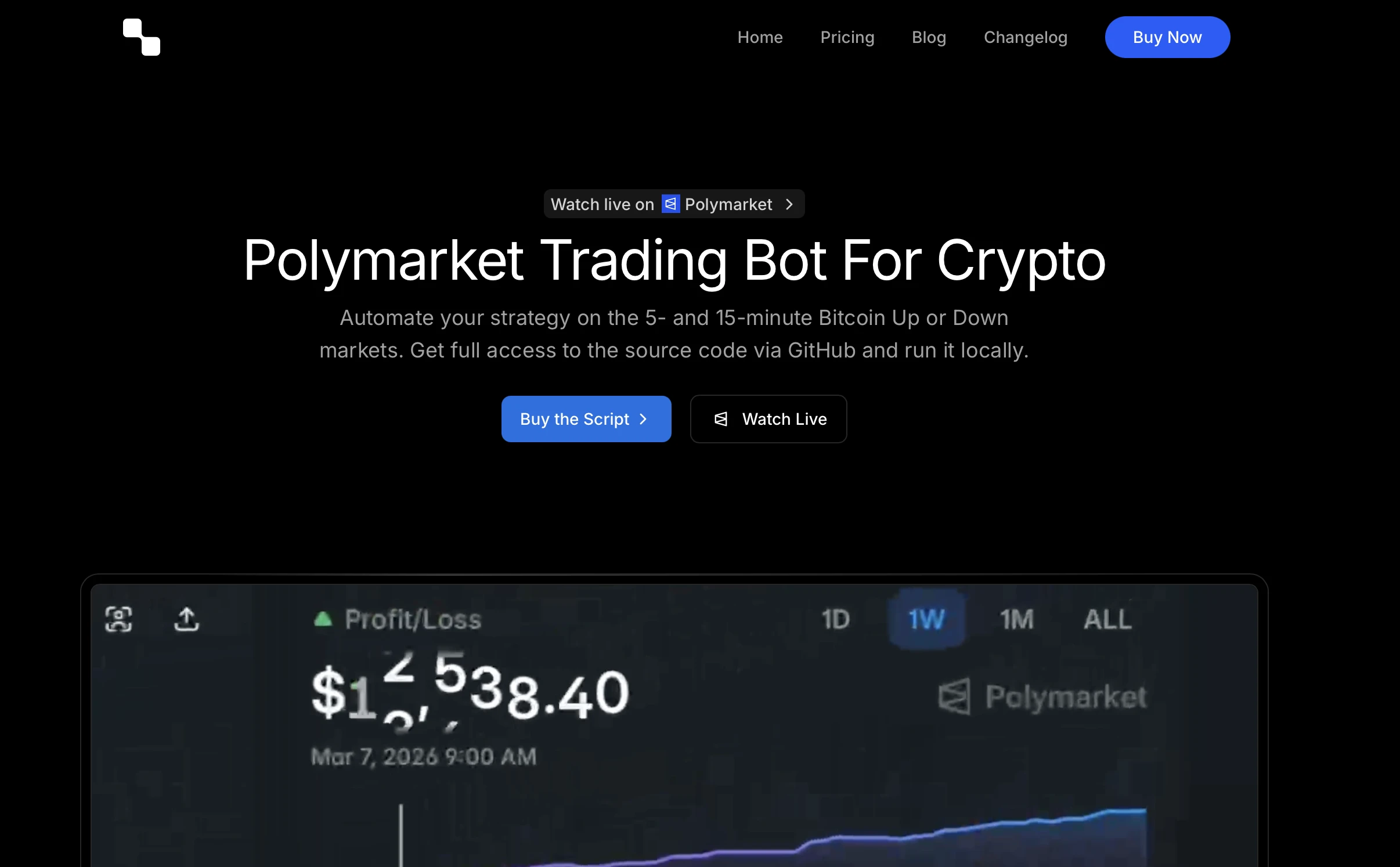
PolymTradeBot
Automated Python bot for Polymarket's 5- and 15-minute Bitcoin & Ethereum up/down markets. Trades live or in paper mode with configurable risk controls, self-hosted from full source.
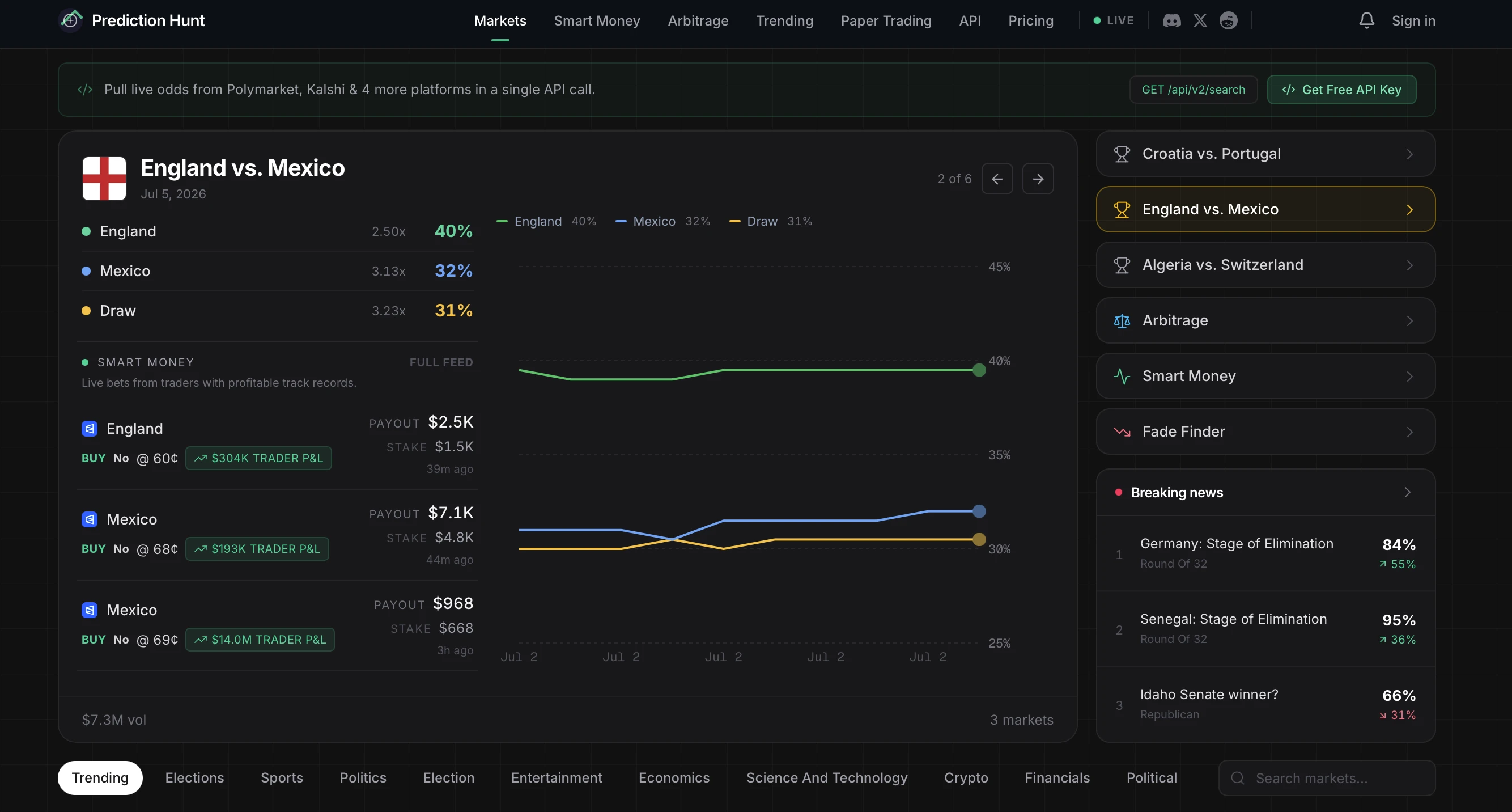
Prediction Hunt
Odds aggregator and tools directory for prediction markets. Compares side-by-side pricing for the same market across Polymarket, Kalshi and PredictIt to surface arbitrage, and hosts a community-curated directory of prediction-market tools.
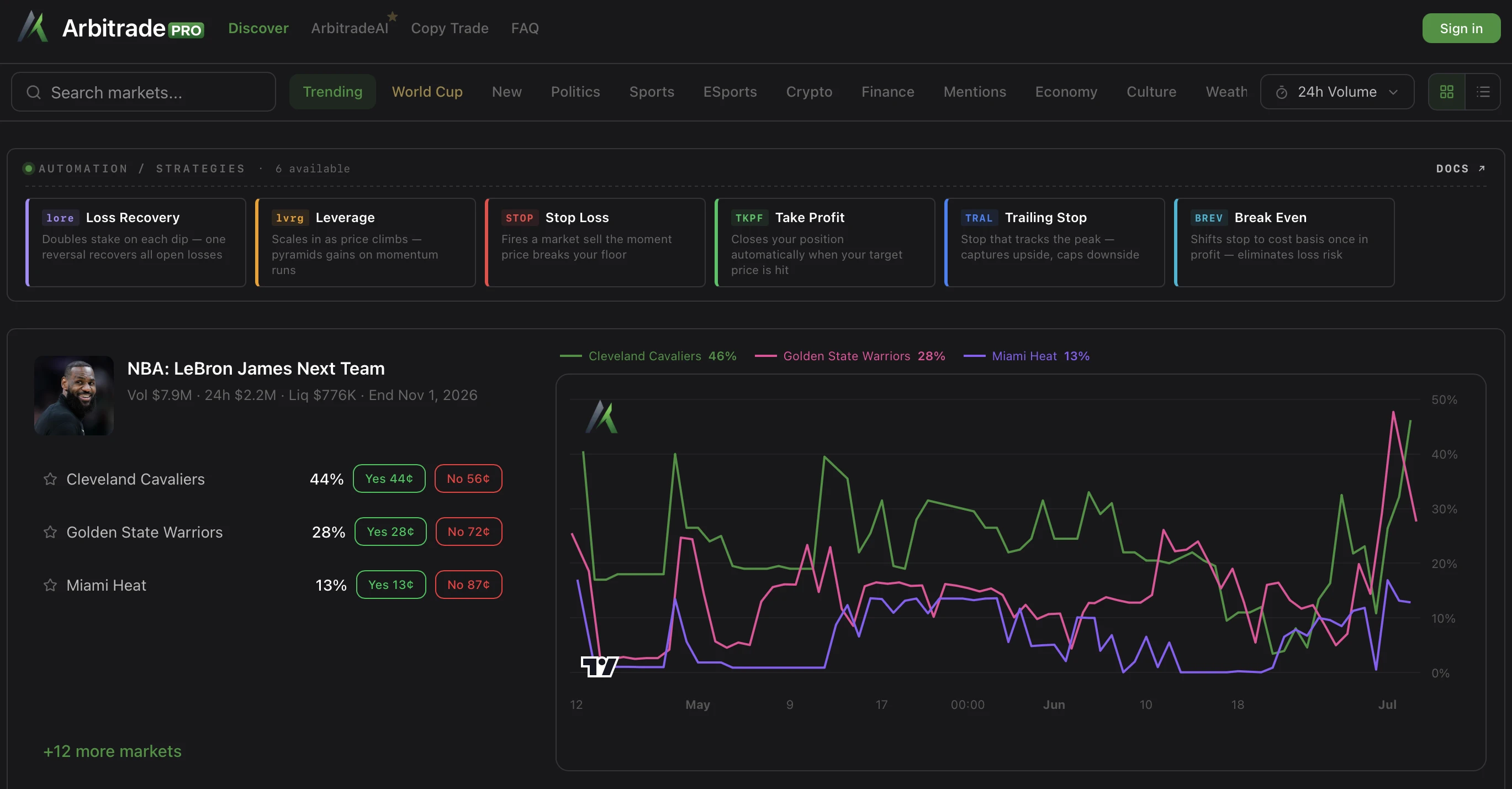
ArbiTrade Pro
Web-based automated arbitrage platform for prediction markets. Scans for price inefficiencies across correlated and cross-platform markets and manages the trades to capture the spread.
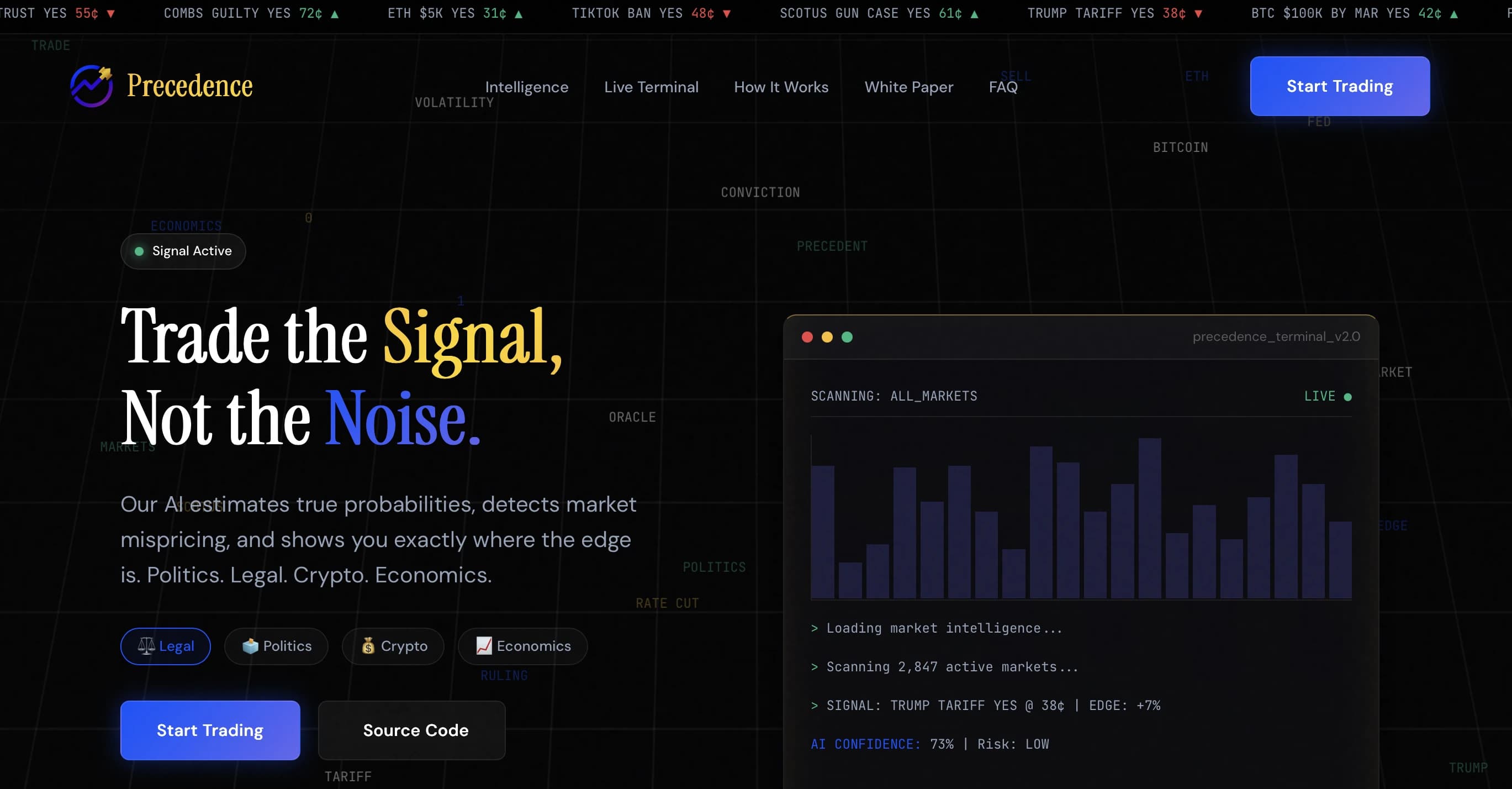
Precedence
AI trading terminal for Polymarket. Estimates true probabilities, detects mispricing and shows where the edge is across thousands of markets — with gasless Smart Wallet execution on Polymarket's order book and UMA-verified settlement.
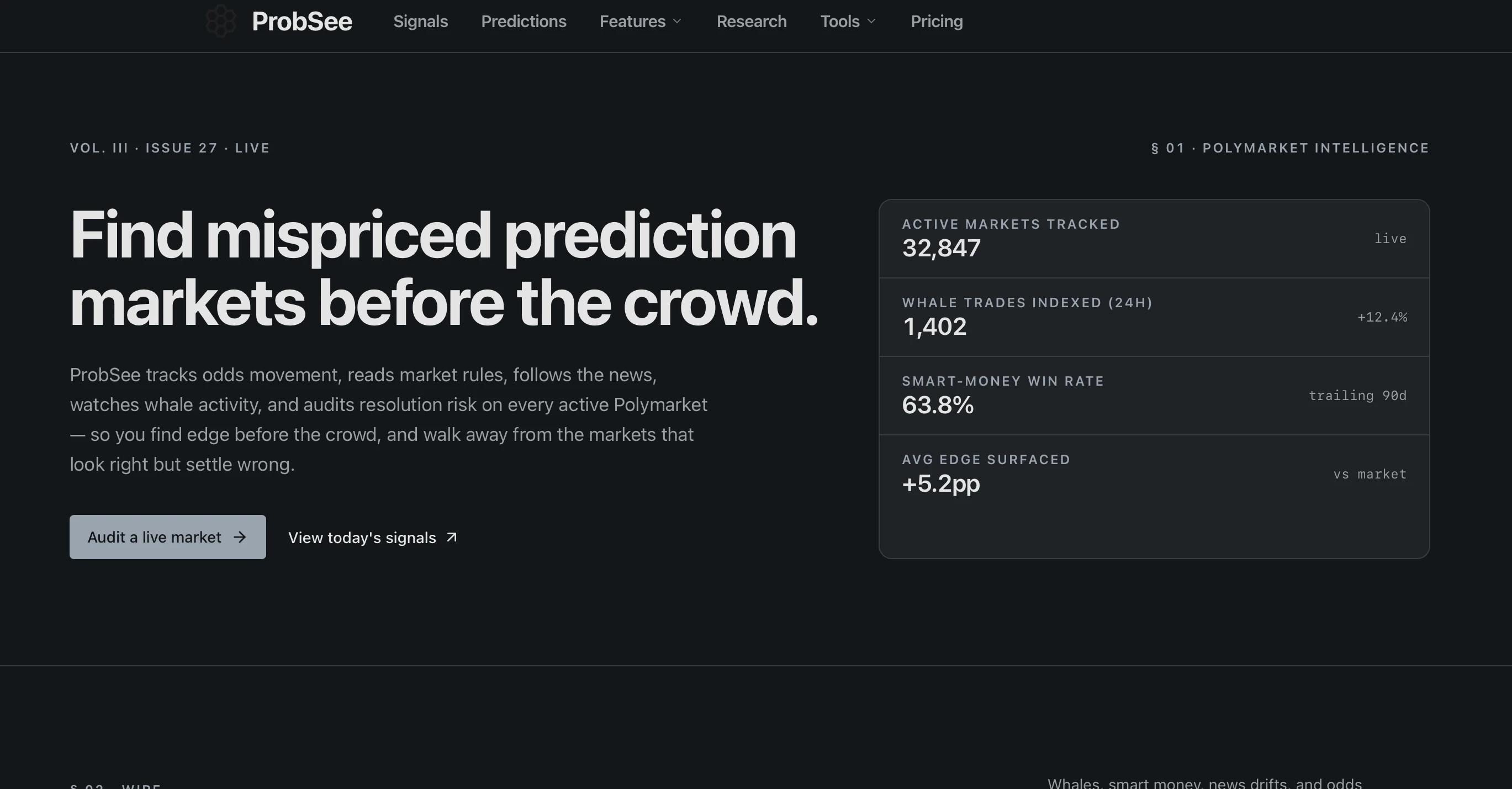
Probsee
Probability and odds analytics for prediction markets. Probsee surfaces implied probabilities and market data to help Polymarket traders read the odds and spot mispriced markets.
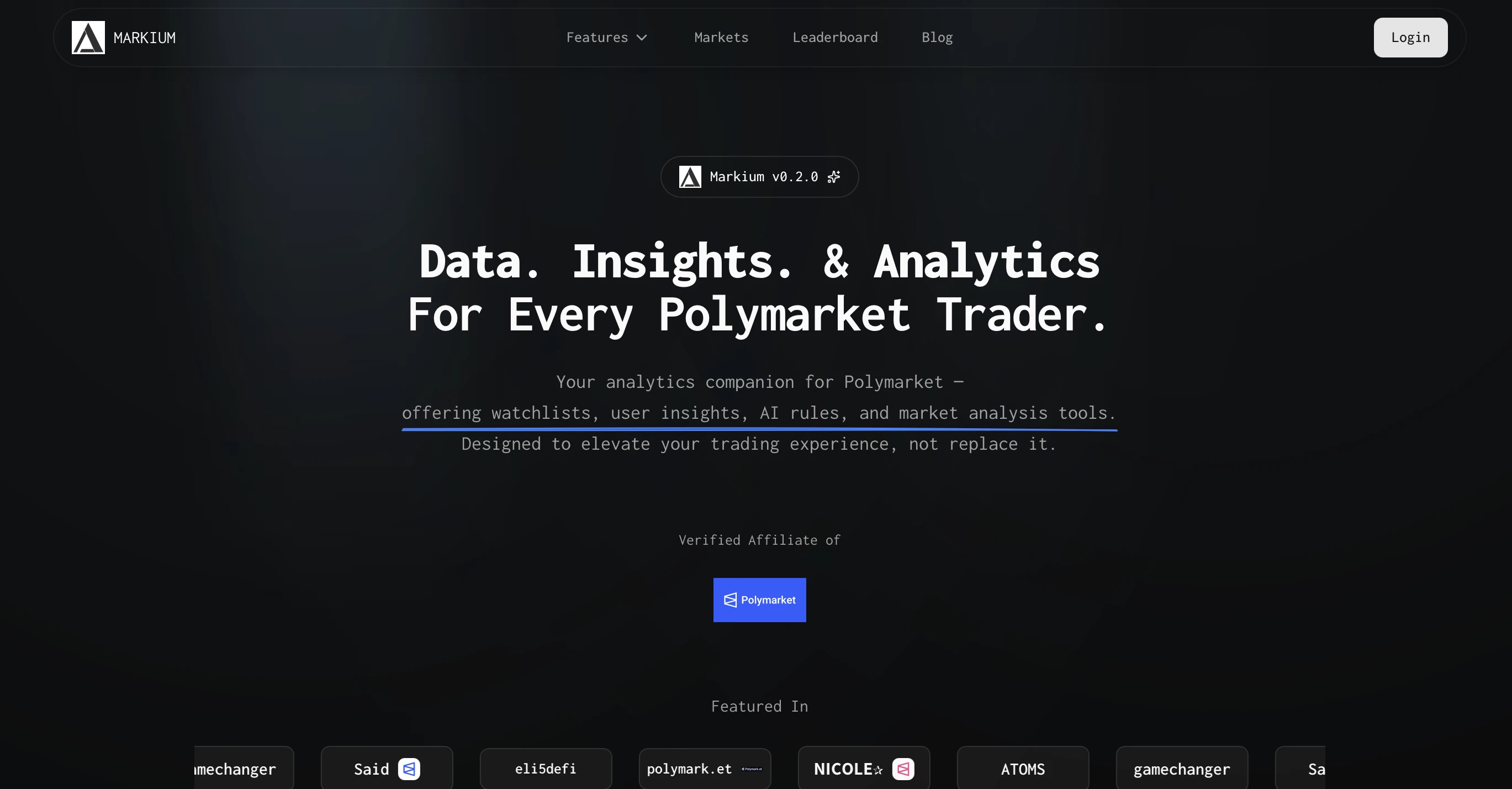
Markium Pro
Data analytics and trading platform for prediction markets. Aggregates markets across Polymarket and beyond, then layers on wallet analytics, trader leaderboards and watchlist alerts so you can track the smart money and spot mispriced markets in one place.
Alphascope
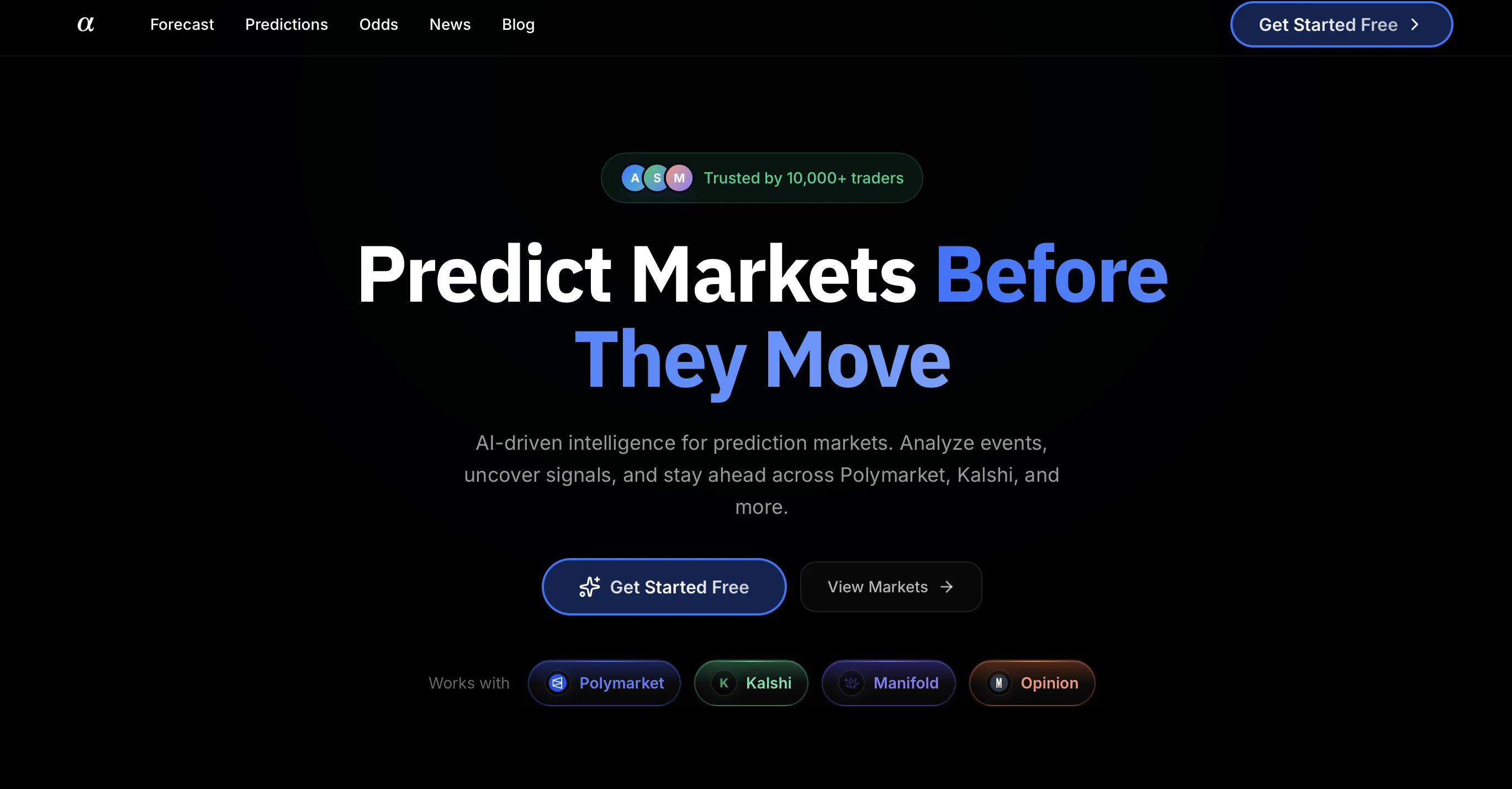
AI research workspace for prediction markets across Polymarket, Kalshi, Manifold and Opinion. Generates AI probability forecasts, ranks breaking news by market impact, charts real-time probabilities with news markers and flags cross-platform arbitrage — all from one dashboard.
Rainmaker
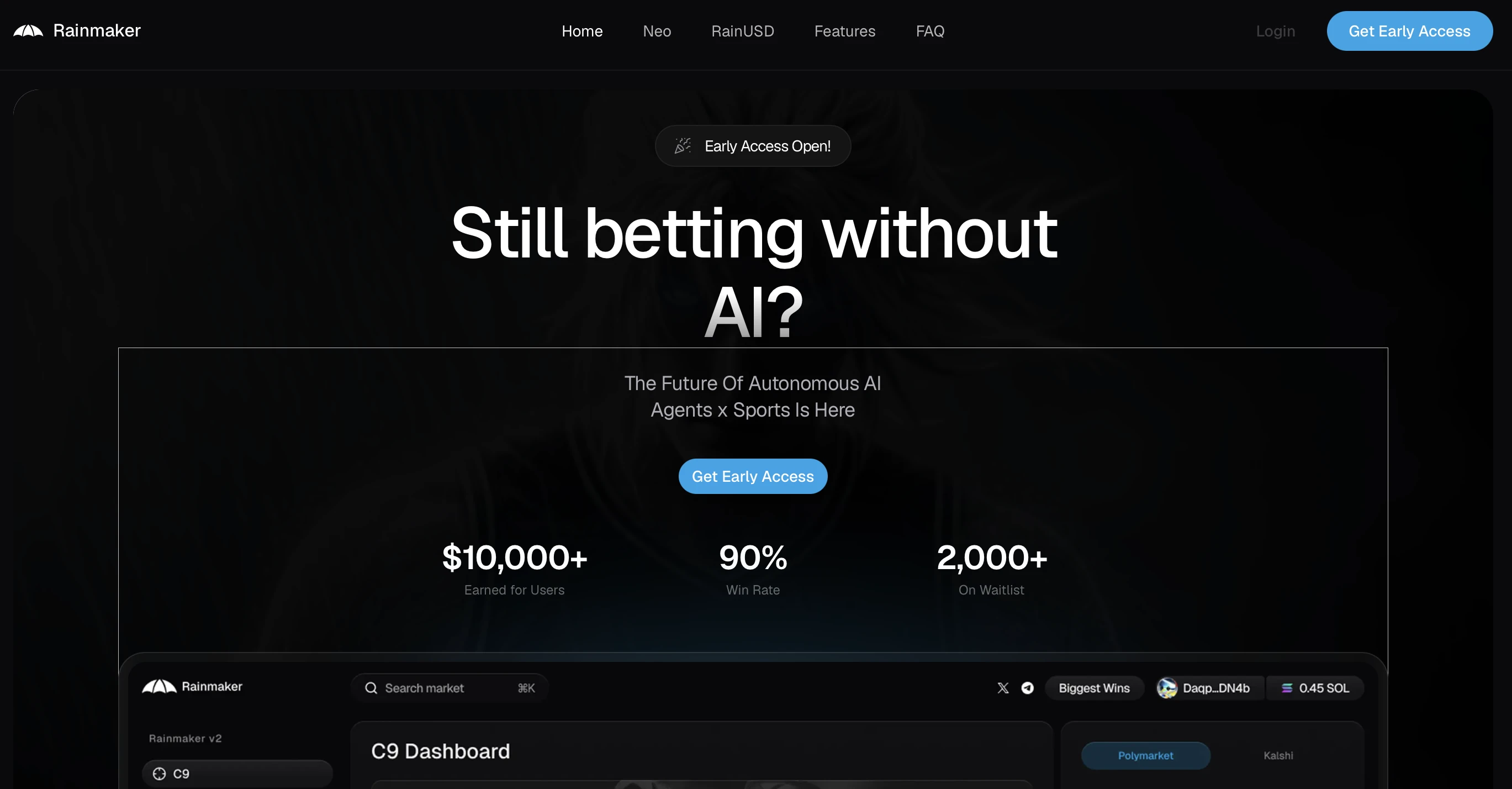
AI-agent terminal that unifies arbitrage, copy-trading and analytics across Polymarket, Kalshi and Novig. Its Cloud9 agents snipe arbitrage between venues, score and replicate winning traders, and mine analytics — with a focus on sports markets (NFL, NBA, NCAA).
PolyEdge
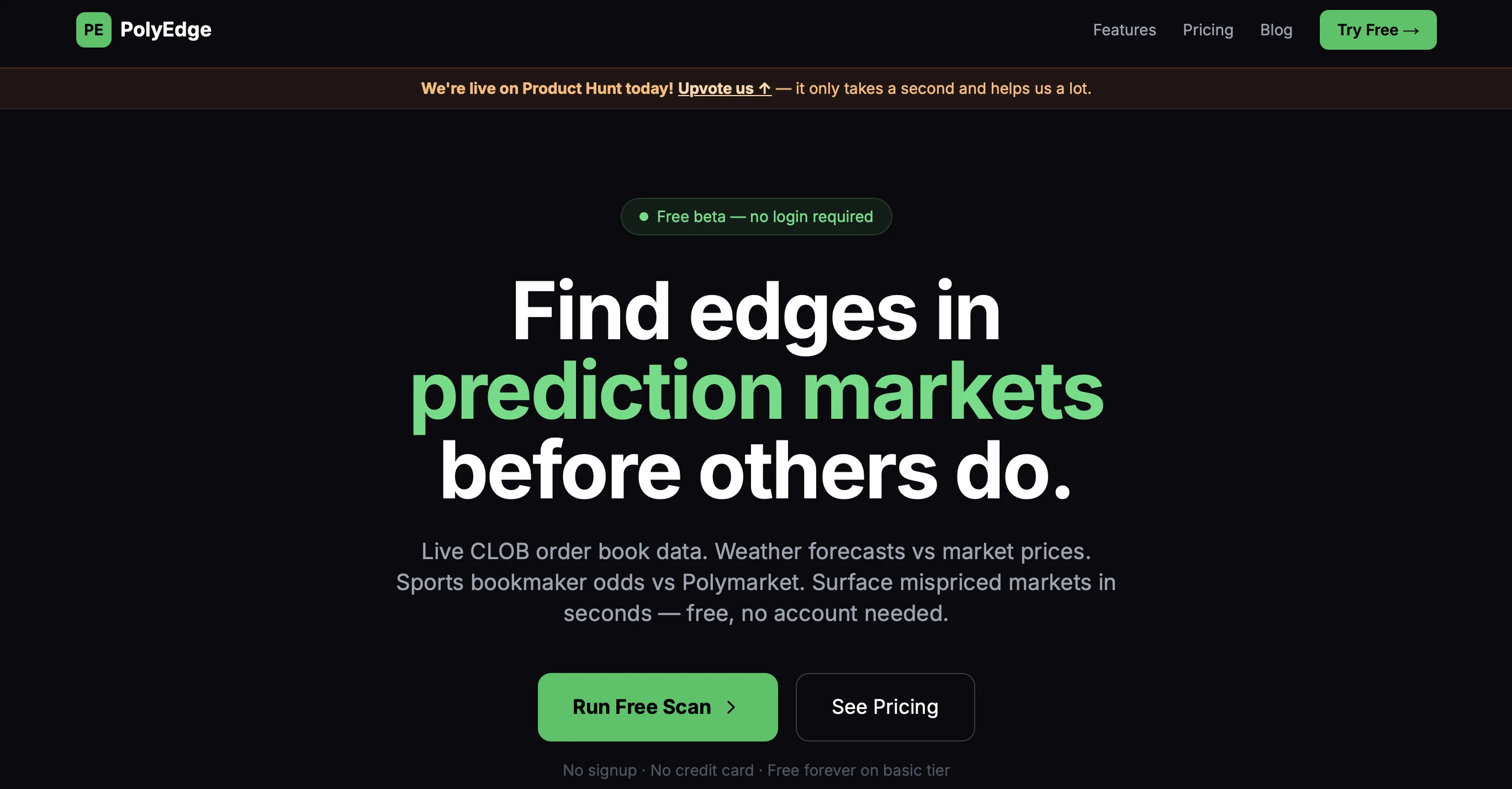
Scanner that finds mispriced Polymarket markets by comparing live order-book prices against objective data. Weather Edge pits meteorological forecasts against prices, Sports contrasts bookmaker odds, and you can upload your own probabilities for quarter-Kelly bet sizing with a 5% portfolio cap.
Prediction Pilot
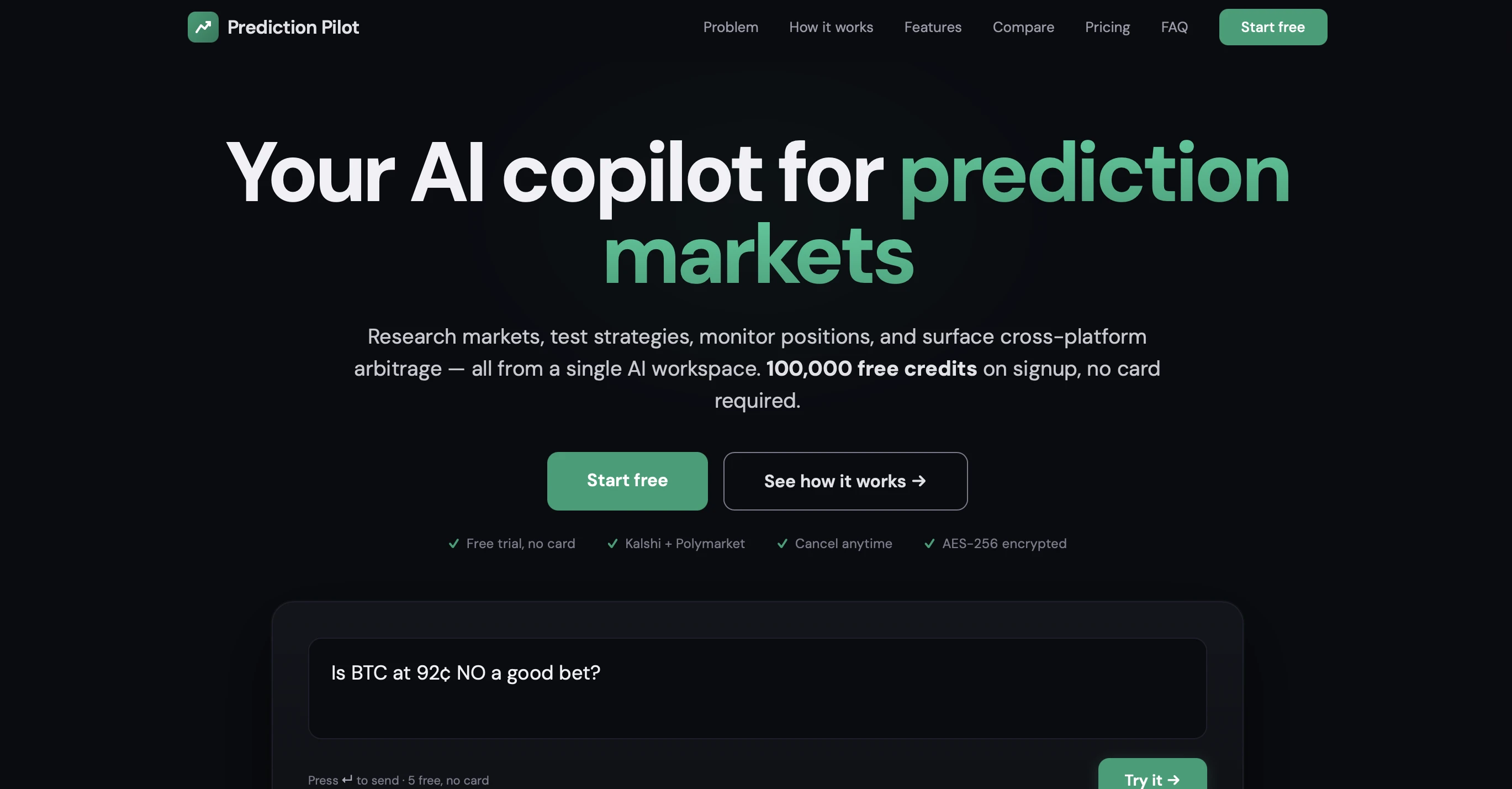
AI assistant for prediction-market research and monitoring. Ask questions in plain English, scan Kalshi's order books live, backtest ideas on 90 days of settled data, monitor open positions with real-time P&L, and get scheduled alerts — plus cross-platform arbitrage detection between Kalshi and Polymarket.
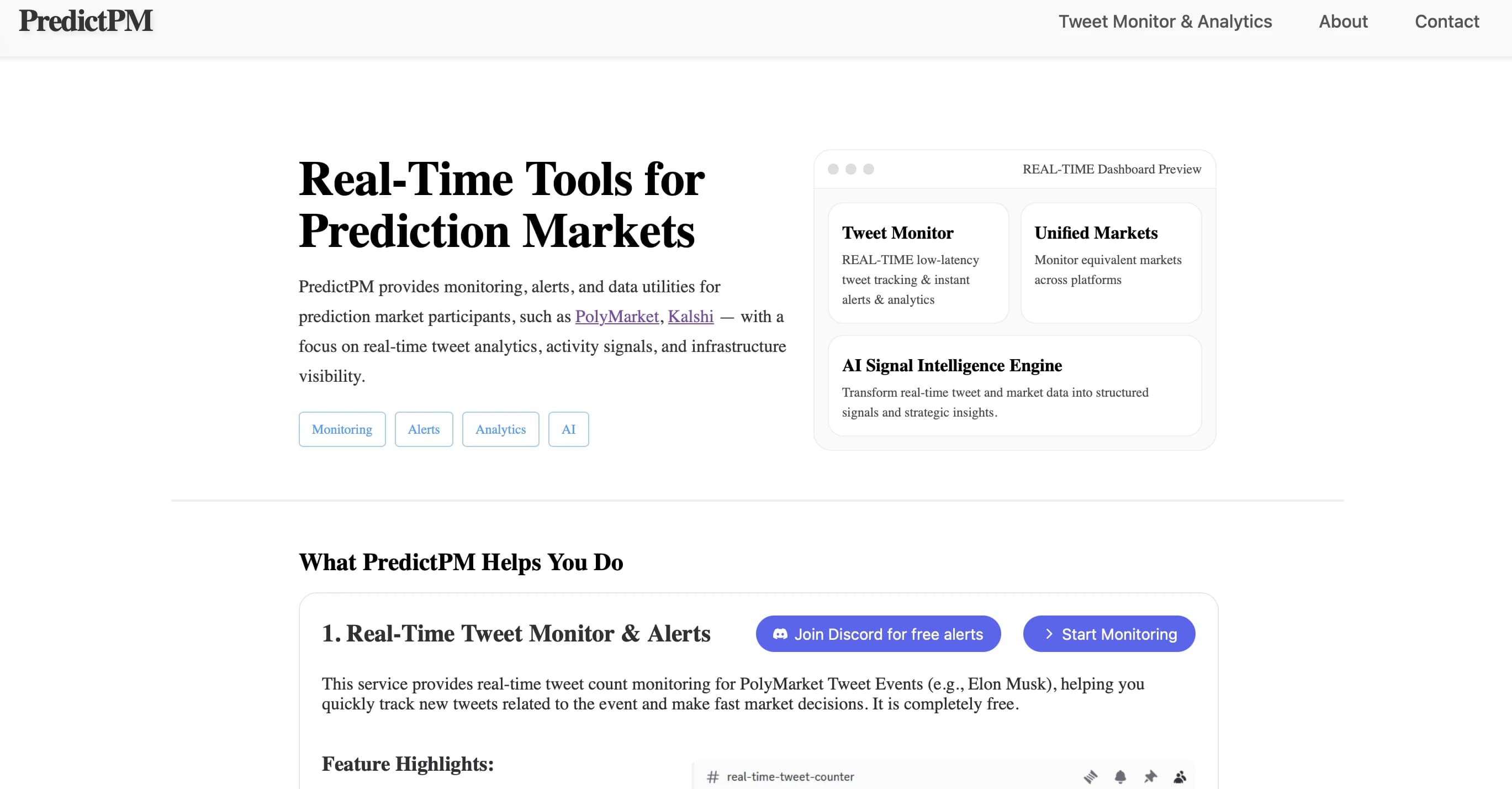
PredictPM
Real-time social and market monitoring for prediction markets. Tracks tweets with ~2-second alert latency, monitors equivalent markets across Polymarket and Kalshi at once, and runs AI signal intelligence over tweet and market data to surface structured, strategic insights.
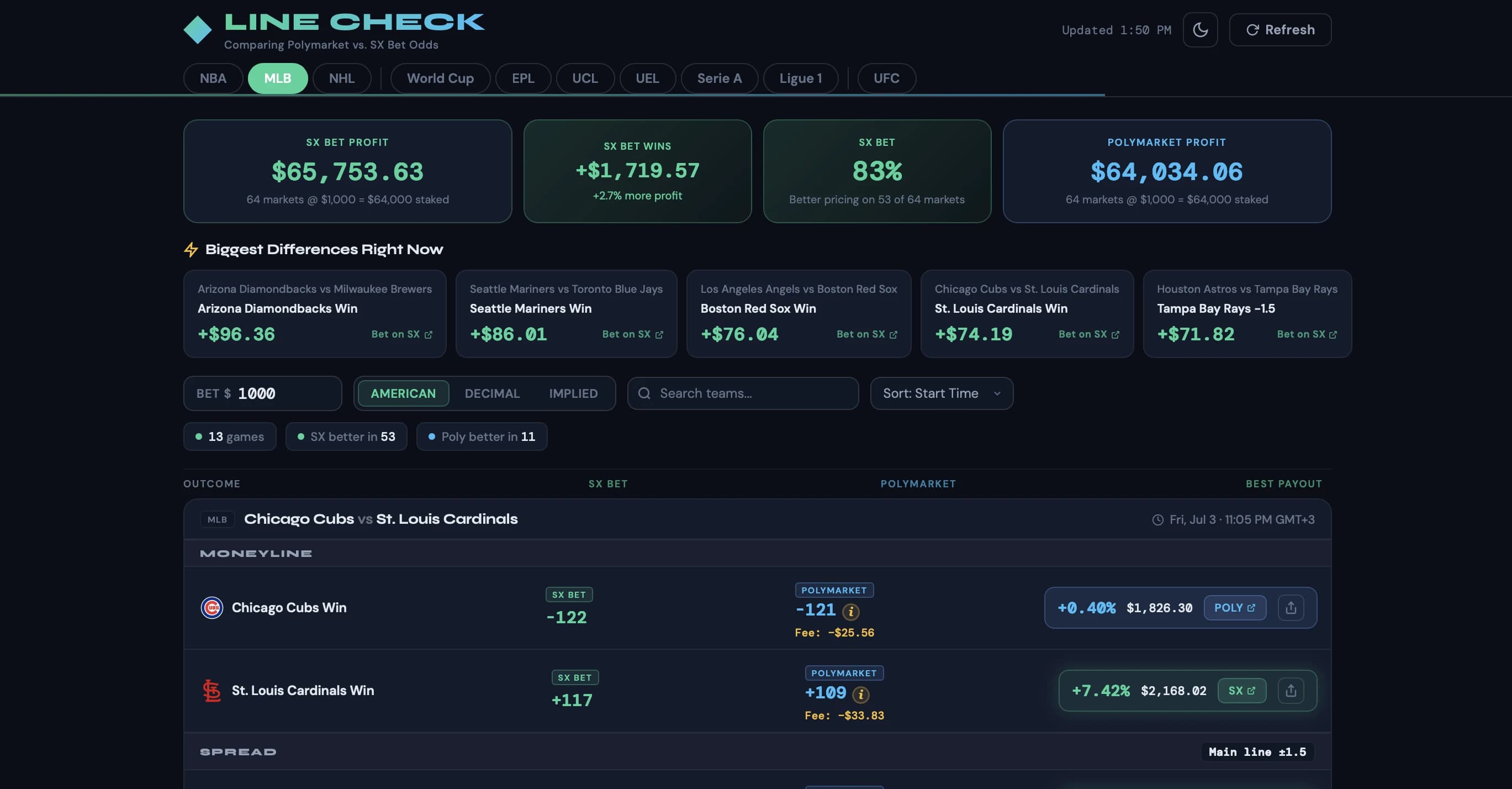
Line Check
Odds-comparison tool that pits Polymarket against SX Bet side by side. Shows American, decimal and implied-probability formats, highlights the best-edge opportunity and optimal payout, and lets you size a custom bet across NBA, MLB, NHL, UFC and major soccer leagues.
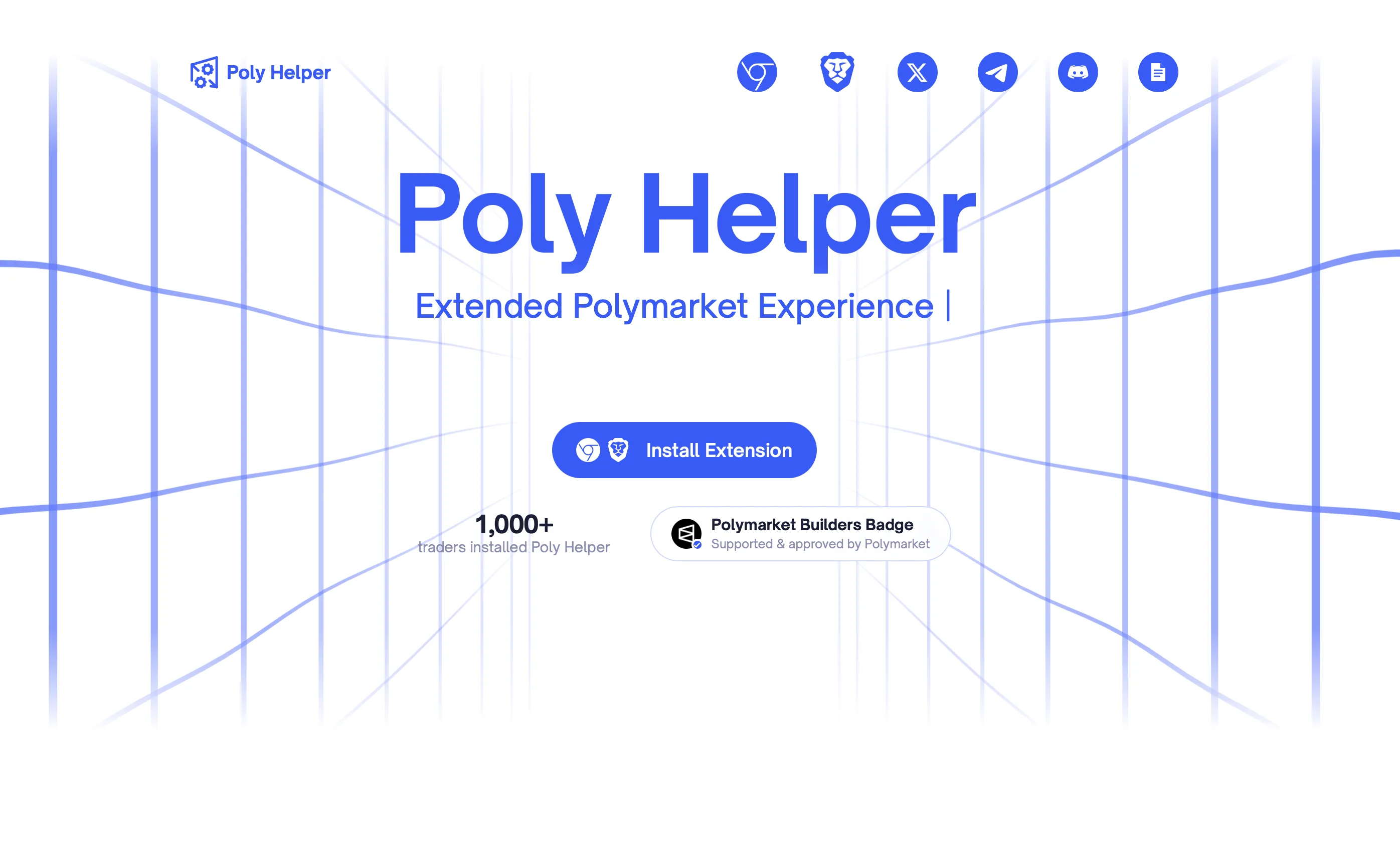
Poly Helper
Browser extension that upgrades Polymarket without leaving its interface — 25+ context panels: live crypto and stock stats, sports intel with live scores, bookmaker odds comparison across 19 sportsbooks with automatic edge detection, polls vs market price on election events, top-holders PnL, a tracker to follow top traders, breaking-news X feed, LP-rewards calculator and TradingView-style charts. Polymarket Builders Badge — supported and approved by Polymarket.
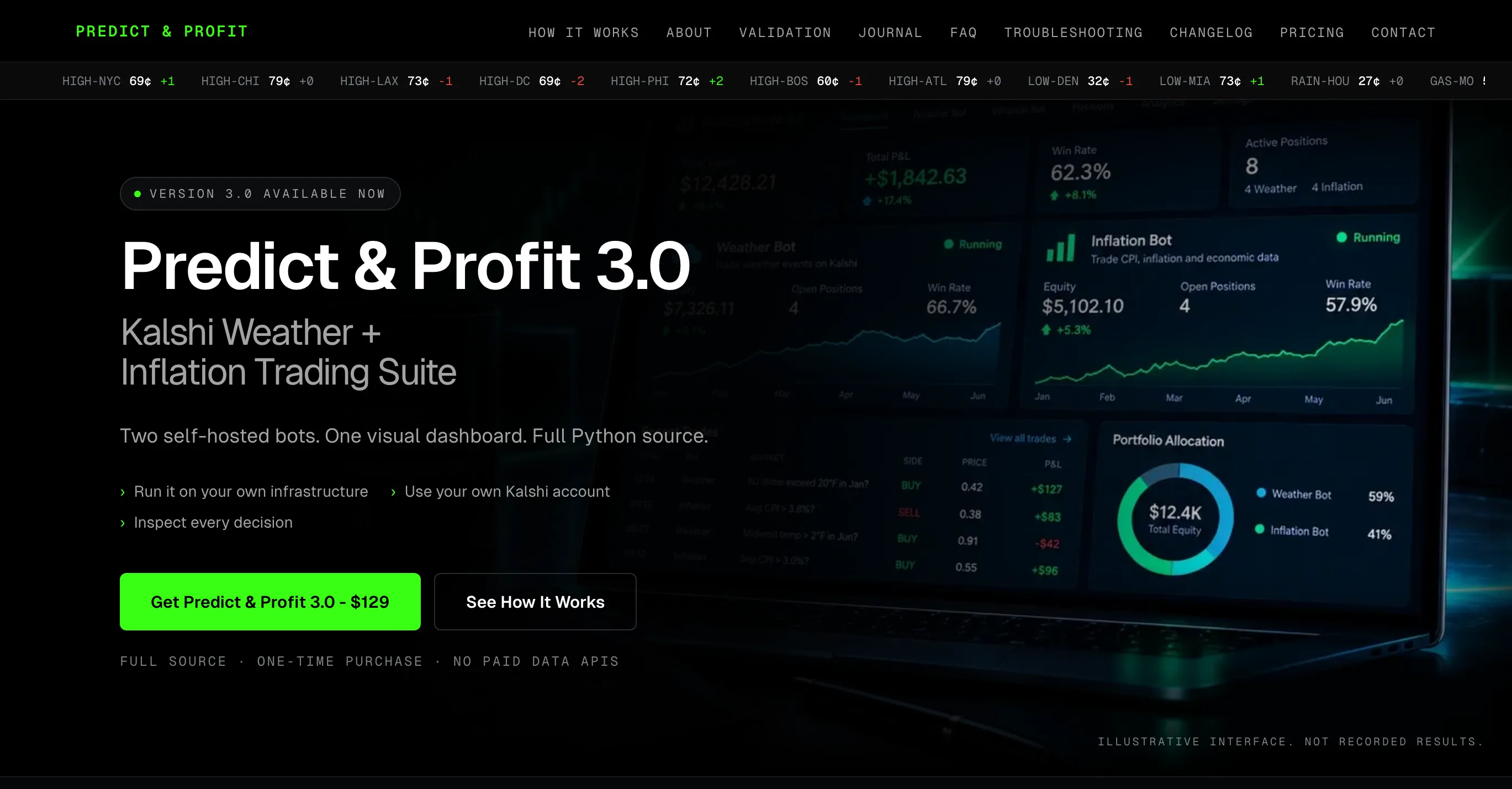
Predict & Profit
Self-hosted Python suite for Kalshi weather and inflation markets — two bots, a monitoring dashboard and one shared risk engine, installed and managed as a single system. Version 3.0 prices temperature contracts from NOAA's National Blend of Models, the calibrated station-level guidance published for exactly the stations Kalshi settles on, at 0.75 weight; GFS, AIGEFS, ECMWF IFS, AIFS and HRRR hold the remaining 0.25 as a disagreement check rather than as the model. Settlement stations come from Kalshi's own series metadata across 20 cities — Chicago settles on Midway, Houston on Hobby — and any market NBM does not cover is skipped, which rules out every same-day contract, because NBM coverage starts at forecast hour 24. The inflation half scores CPI, Core CPI and PCE against the Cleveland Fed's nowcast and an internal weighted one. Candidates then pass a four-signal gate — spread 30%, volume 20%, order-book imbalance 25%, model mispricing 25% — and the author says over 95% of scanned contracts are rejected. There is no public performance record: the trade log the earlier version published was retired with 3.0, and the site now publishes release and validation status instead of a P&L scoreboard.
How arbitrage bots work on Polymarket
An arbitrage bot hunts for prices that disagree: YES and NO shares on the same market summing to less than $1, the same event listed on two venues at different odds, or a multi-outcome market whose probabilities add up past 100%. When it finds one, it buys both sides and locks in the difference regardless of how the event resolves.
On Polymarket that means watching the order book over WebSockets and racing to capture gaps before other bots close them. Individual edges are usually a few cents per share, so returns come from volume and speed rather than any single big win — which is why arbitrage bots run around the clock.
What to look for in an arbitrage bot
Speed and fee math decide everything: a 2-cent edge disappears into slippage if the bot executes slowly, and into fees if the pricing model ignores them. Favor bots with direct CLOB integration, explicit partial-fill handling and published reaction times. Cross-venue arbitrage additionally requires capital parked on both venues and rules for what happens when one venue resolves a market differently — read that part of the strategy before funding it.
Frequently asked questions
- Is arbitrage on Polymarket really risk-free?
- Nearly, but not quite. Legs can fill partially, the price can move between your two fills, and a cross-venue pair can be stuck if the venues resolve differently or at different times. Good bots manage these execution risks; nothing eliminates them entirely.
- How much does a single arbitrage trade make?
- Typically a few cents per share after fees. The strategy compounds through frequency — hundreds of small, near-riskless captures — which is why speed and uptime matter more than any one opportunity.
- Do arbitrage opportunities still exist on Polymarket?
- Yes. New markets, breaking news and thin order books create mispricings every day. But competition is real: the fastest, lowest-fee bots capture most of them, so an arbitrage bot's edge is engineering, not the idea itself.
Guides to arbitrage
All guidesWhat is a Polymarket trading bot? How they work, what they do, and what they can't
A plain-English explainer: what a Polymarket bot actually is, the seven things every one of them does, the main types — copy trading, arbitrage, market making, minute-market and news bots — what they cost, and the limits nobody puts on the landing page.
6 minAug 21, 2026How to build a Polymarket trading bot: a step-by-step guide
From an idea to a bot that runs unattended: picking a strategy you can actually test, the architecture (discovery, data, strategy, risk, execution, reconciliation), paper trading, deployment, and the mistakes that sink first bots — using Polymarket's APIs and unified SDKs as they are in 2026.
6 minAug 21, 2026The Polymarket API explained: CLOB, Gamma, Data API and WebSockets — and what changed in V2
A map of every Polymarket API a bot touches — Gamma for discovery, the CLOB for prices and orders, the Data API for positions and trades, WebSockets for live updates — plus authentication, order types, the taker-fee formula, rate limits and the 2026 V2 changes that broke older bots.
6 minAug 21, 2026Polymarket arbitrage: the four kinds, why the edge vanishes, and what it costs to chase
What arbitrage means on a prediction market — outcome sets priced under a dollar, multi-outcome books that don't sum, the same event priced differently on Kalshi — why those gaps appear, the fee and capital maths that decide whether a bot can take them, and the execution risks (legging, resolution mismatch) that turn a sure thing into a loss.
5 minAug 21, 2026Market making on Polymarket: spreads, rebates, liquidity rewards and the inventory risk nobody mentions
How a market-making bot quotes both sides of a Polymarket book and gets paid three ways — the spread, maker rebates on takers' fees, and the liquidity rewards program — and the inventory risk that eats all three: adverse selection, resolution, and the trader who knows more than your bot.
4 minAug 21, 2026Sports trading on Polymarket with bots: odds feeds, latency, the matching delay and the 1.25% fee
How sports bots get a number (bookmaker odds de-vigged into a probability, or a model), why live markets are a latency race that Polymarket slows down on purpose, what the 1.25% taker fee at the mid does to thin edges, where resolution bites, and which tools in the catalog actually help.
4 minAug 21, 2026