Miramarket vs Robin Markets
Miramarket and Robin Markets are both filed under Platforms & Tools and Hedging. Both are trading platforms; Miramarket is free to use with a per-trade fee, Robin Markets is priced on its own site. Below: the facts side by side, where the two actually differ, and when each one is the better pick.
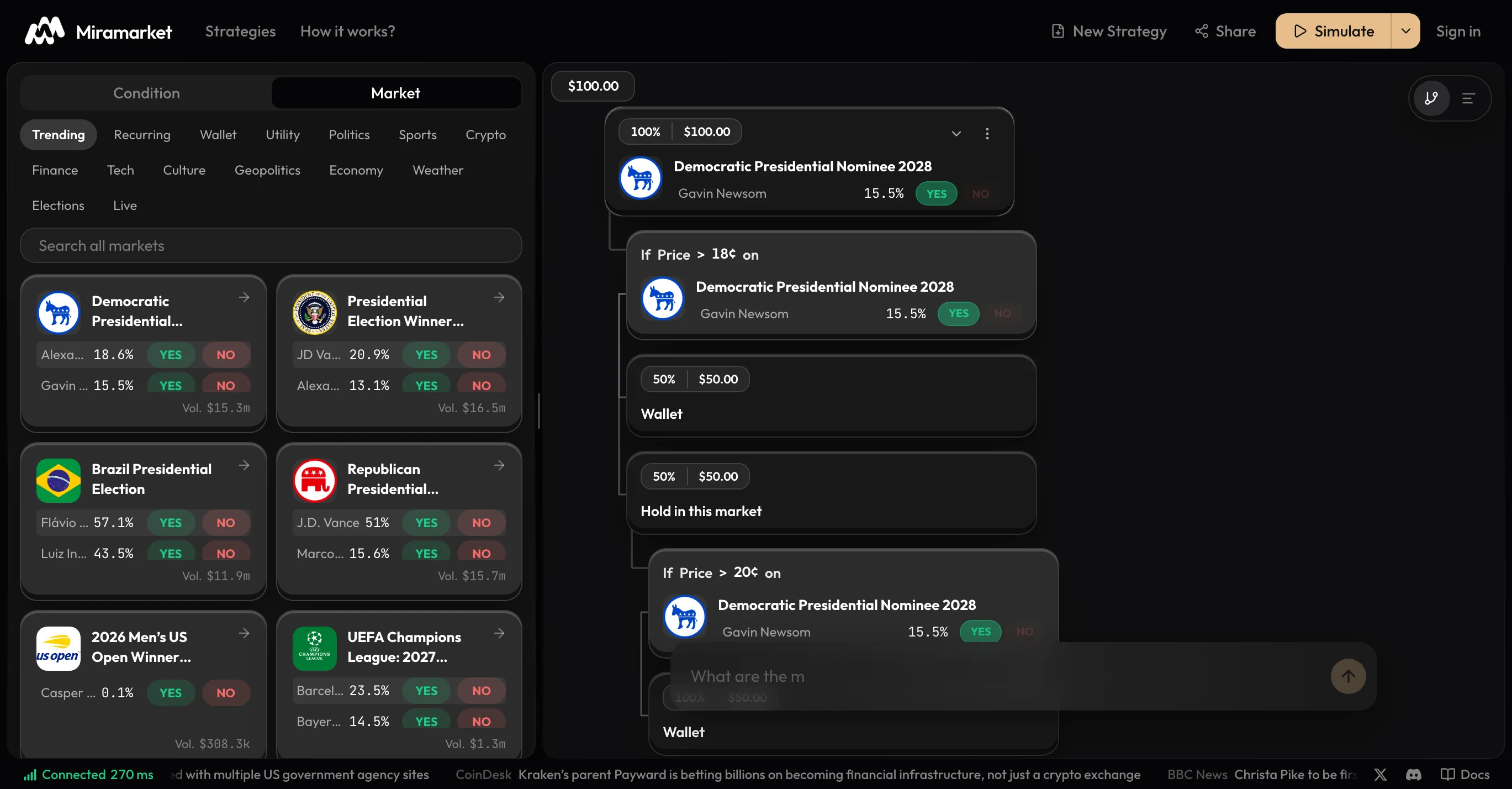
No-code builder for conditional Polymarket strategies: lay out markets, conditions and actions on a canvas or describe them in plain English, simulate, then Run Live.
Compared with Robin Markets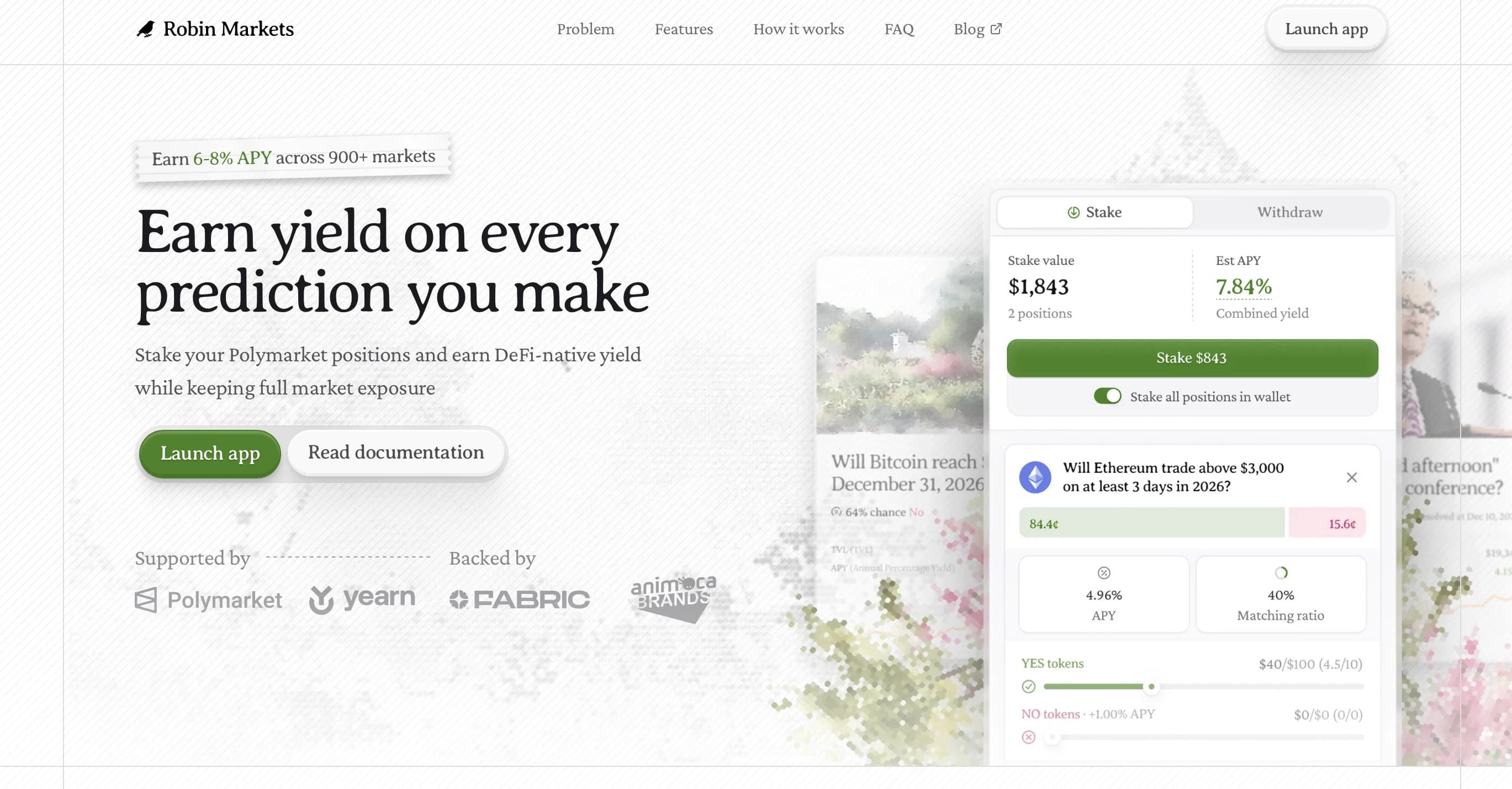
DeFi yield layer for Polymarket positions.
Compared with MiramarketAt a glance
| Fact | Miramarket | Robin Markets |
|---|---|---|
| Type | Trading platform | Trading platform |
| Category | Platforms & Tools | Platforms & Tools |
| Also listed in | Hedging | Market Making, Hedging |
| Pricing | Free to use, fee per trade | Pricing on site |
| Price | free · fee rate unpublished | 6%+ APY |
| Risk rating | Medium risk | Medium risk |
| Markets | Polymarket — every active market, grouped and NegRisk outcomes included and Recurring market series, with the current window tracked automatically | Polymarket and DeFi yield |
| Source | Source not published | Source not published |
| Runs in Telegram | No | No |
| Listed since | Sep 27, 2026 | Jul 3, 2026 |
Highlighted rows differ
Key differences
- Miramarket is free to use with a per-trade fee (free · fee rate unpublished); Robin Markets is priced on its own site.
- They cover different markets: Miramarket lists Polymarket — every active market, grouped and NegRisk outcomes included and Recurring market series, with the current window tracked automatically, Robin Markets lists Polymarket and DeFi yield.
- Only Robin Markets is filed under Market Making.
- Robin Markets has been listed since Jul 3, 2026; Miramarket joined on Sep 27, 2026.
Choose Miramarket if…
- you trade Polymarket — every active market, grouped and NegRisk outcomes included and Recurring market series, with the current window tracked automatically
Choose Robin Markets if…
- you trade Polymarket and DeFi yield
- your focus is Market Making
What Miramarket does
No-code builder for conditional Polymarket strategies: lay out markets, conditions and actions on a canvas or describe them in plain English, simulate, then Run Live. Conditions watch a price, ROI or P&L threshold, a time before close or a date, or how a market resolves; actions buy a YES or NO side, hold, or send their share back to the wallet, with allocations that must add up to 100%. Eleven templates cover take-profit and entry ladders, bracket and reversal exits, barbells that pair a conviction leg with a protective one, and bolt-ons that trade one market off a catalyst or a move in another; a recurring filter keeps an action pointed at the live window of a repeating market series. The AI assistant drafts, explains and edits the tree, and a CLI on npm posts the same strategies as JSON from a terminal or an AI coding agent. Accounts run on Privy wallets you delegate to Miramarket, so a live run can sign while you are away.
Features- Visual canvas of markets, price / time / resolution conditions and buy, hold or wallet actions, with percentage splits per decision
- Plain-English drafting: describe the rules and the AI assistant builds, explains or edits the tree for you to review
- Eleven templates, from Take-Profit Ladder, Bracket Exit and Armed Reversal Exit to Conviction and Managed Barbells and Resolution and Price Bolt-Ons
- Simulate mode that validates and runs a strategy without placing orders; Run Live behind sign-in, a confirmation step and a regional check
- Share links for strategies; the canvas locks during an active run, and the CLI can pull a running strategy and change only its future steps
- A rule engine, not a strategy: nothing here carries an edge of its own, and a template runs whatever thresholds and side you leave in it — the docs warn at every step that a reversed comparison or the wrong side executes just as faithfully. Where it earns its keep is the exits and rotations a manual trader misses while asleep: bank half on a rise and let the rest ride, hedge into a related market when a thesis fades, roll a position into the next meeting's contract before the first one resolves.
- Custody is delegated rather than absent. Signing in creates a Privy wallet, and before the first live trade you delegate it to Miramarket — the CLI docs list that step by name — which is what lets a run sign an order when its condition fires. The homepage's “does not custody your funds” is about who owns the balance; the signing permission still sits with a server, hence the custody line.
- Very early. Polymarket's builders Data API attributes $334 of volume to Miramarket, on eleven days since Aug 22, 2026, never more than two users in a day. Without an account we could exercise the builder itself — templates applied to live markets, and the prices on its market cards matched Polymarket's order book — but Simulate, the AI assistant and Run Live all stop at a sign-in we did not create.
What Robin Markets does
DeFi yield layer for Polymarket positions. Stake your YES/NO tokens and earn a guaranteed 6%+ APY while keeping full market exposure — Robin pairs opposite sides into delta-neutral positions, claims the collateral and routes USDC into DeFi lending across 900+ markets.
Features- Stake Polymarket positions and earn yield
- Guaranteed 6% APY minimum
- +1% APY for balancing scarce market sides
- Keep full market exposure while staked
- On-chain and verifiable across 900+ markets
- Pairs YES and NO tokens from different users into delta-neutral positions.
- Claims the underlying USDC collateral from those paired positions.
- Routes the collateral into DeFi lending protocols to generate yield.
More head-to-heads
Every fact on this page is taken from the two listings as their authors publish them; POLBOTS verifies neither performance nor claims and has no stake in either tool. Nothing here is financial advice.