Kalshi trading bots & tools
24 listings that work with Kalshi, the CFTC-regulated event-contract exchange. 9 of them trade for you — open-source toolkits, hosted strategy bots, AI agents and automatic copiers — and the rest are terminals you trade from by hand and the research, data and arbitrage tools that read Kalshi's books. Most also cover Polymarket; the markets line on each card says which venues it reaches.
Bots that trade on Kalshi for you
9Software that decides and sends the orders itself once you connect a Kalshi API key: self-hosted repos, hosted no-code bots, AI agents and copiers. Each card says whether the key stays on your machine or on their server.
Kalshi AI Trading Bot
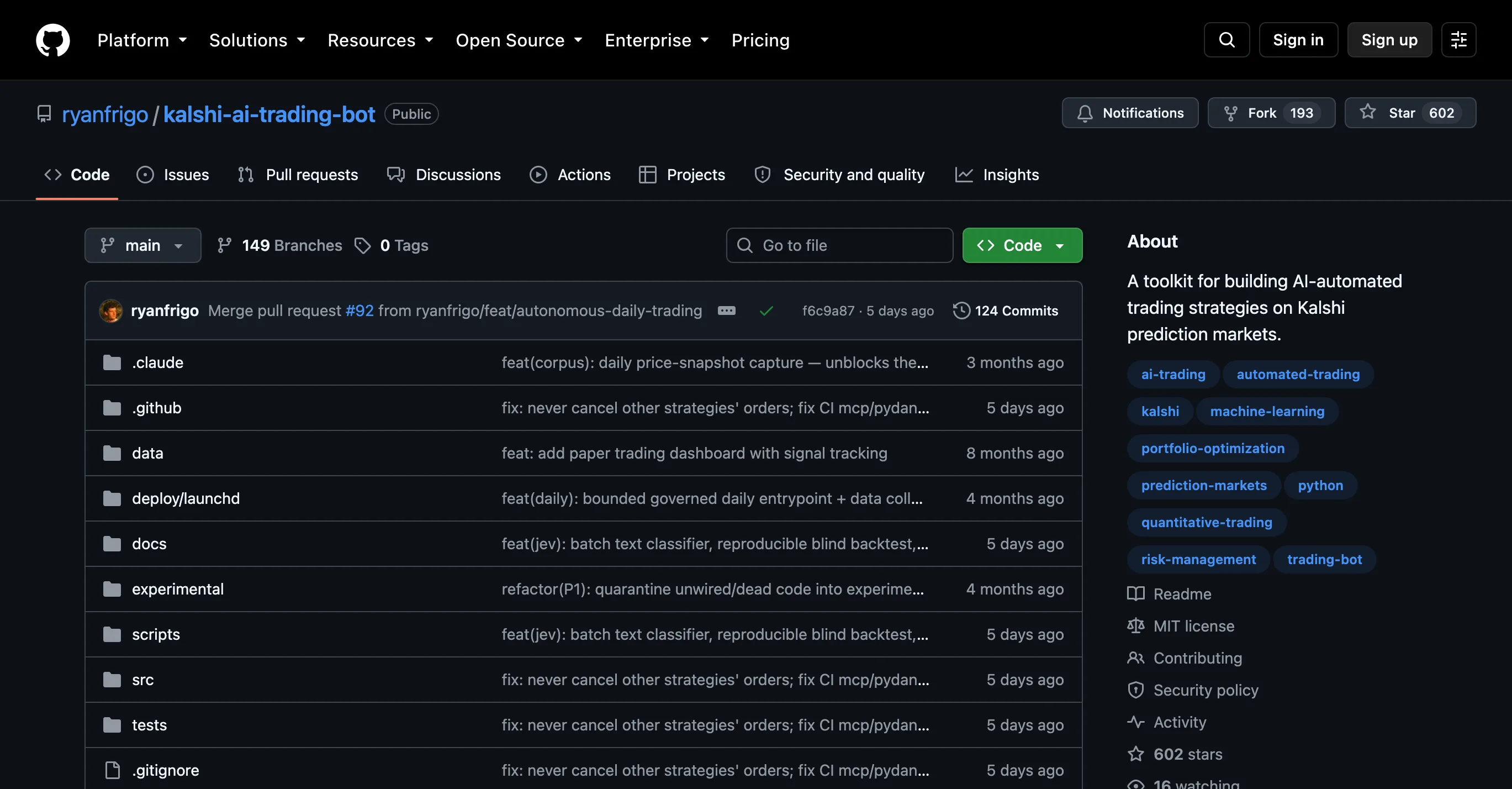
Open-source Python toolkit for automated trading on Kalshi, built around the question most bot repos skip: do you actually beat the book? An LLM reads each candidate market with a news summary, scores a probability through any model on OpenRouter, and the trade is sized at quarter-Kelly under a risk governor with a daily-loss limit and a drawdown kill switch. Every decision goes into a local journal; the edge harness then pulls Kalshi's own settlements, scores your settled trades by Brier score, log-loss and realised win rate against the price you paid, and refuses to call it an edge on fewer than ten trades that resolved after you bought. A policy step turns that record into a pre-trade gate that blocks categories you have lost money in. Ships a paper mode, a Streamlit dashboard, a Claude skill and an MCP server; MIT-licensed at github.com/ryanfrigo/kalshi-ai-trading-bot.
Octagon
AI research for Kalshi and Polymarket, with an open-source command-line client that trades on Kalshi. For every active contract Octagon publishes a research report that sets its model's probability against the live price — a short answer, the drivers behind recent moves, cited sources, a price chart and past resolutions — and the reports are free to read on the site. Subscribers get the same engine through an API, an MCP server and the Kalshi Trading Bot CLI: an MIT-licensed terminal app that runs deep research on a market, computes the gap between model and book, sizes it at half-Kelly through a five-gate risk check and places the order from your own Kalshi account. Octagon AI Inc. was founded in 2023 by Ken So and says it is backed by AI Fund, Andrew Ng's venture firm.
CloddsBot
Open-source AI trading agent that runs on your own machine and takes orders in natural language over Telegram, Discord, WebChat and eighteen other channels. Powered by Claude, it covers ten prediction markets — Polymarket, Kalshi, Betfair, Smarkets, Drift, Manifold, Metaculus, PredictIt, Opinion.xyz and Predict.fun — plus perpetual-futures exchanges and Solana and EVM DeFi. The Polymarket layer is real code rather than a wrapper: an EIP-712 order signer with unit tests, a CLOB client exposing 60-plus methods, real-time data and user WebSocket feeds, a large-trade tracker, and round-based discovery of the 5-minute BTC and the 15-minute, hourly, 4-hour and daily crypto windows with four automated strategies, alongside cross-venue arbitrage detection, copy trading and DCA bots. MIT-licensed at github.com/alsk1992/CloddsBot: 2,700 stars, 460-plus commits from one primary author, v1.9.1 released Sep 12, 2026, installed with one npm command on Node 22.
Kreo
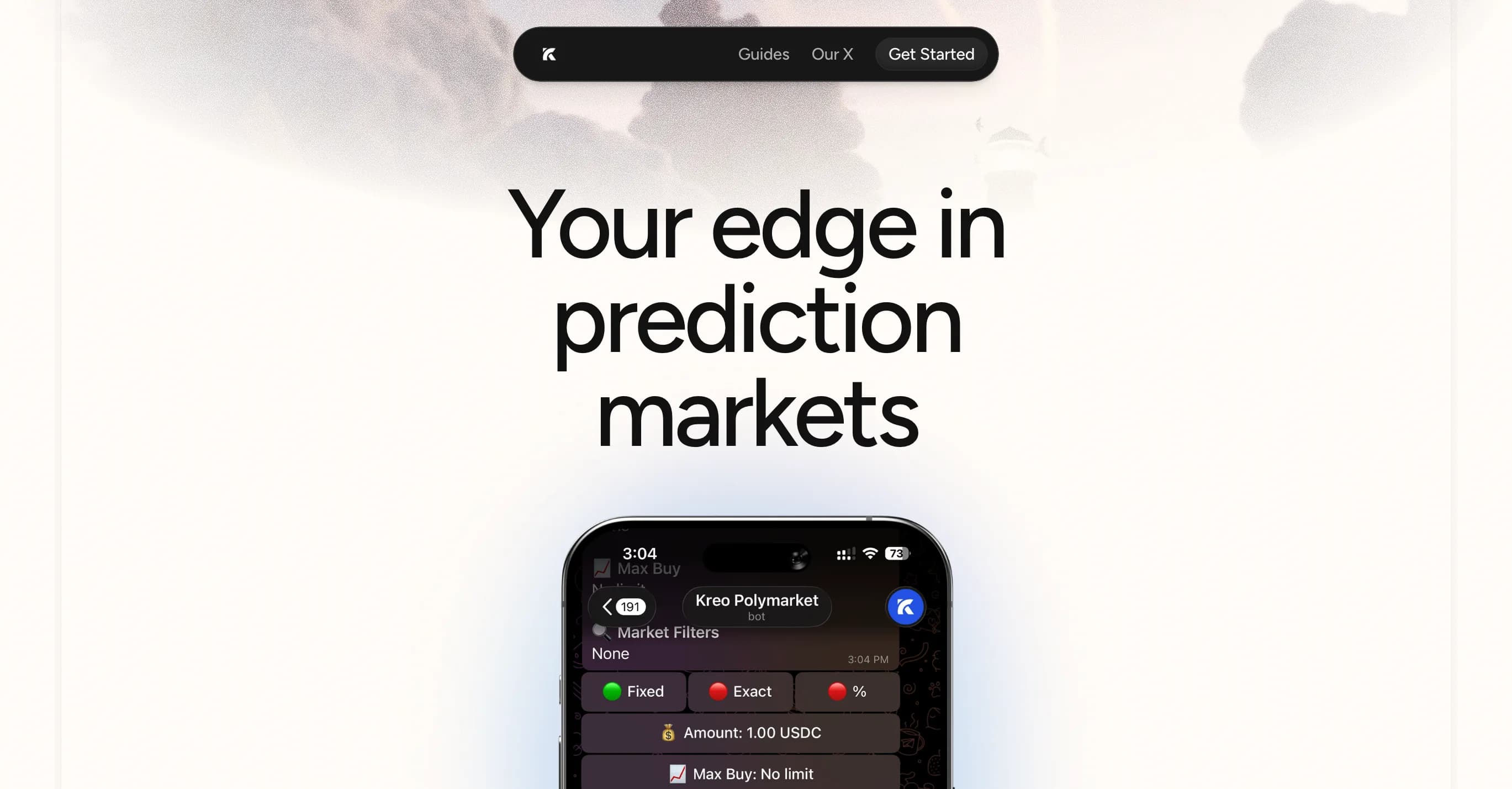
Telegram bots for Polymarket and Kalshi built around copy trading. Each copy task follows one wallet with its own buy mode — fixed amount, exact copy, a percentage of the leader's size or portfolio-weighted — under minimum and maximum buy, daily, total and per-market spend caps, category and price-range filters, slippage tolerance, stop-loss and take-profit, a monitoring mode that watches without buying, and a schedule; bulk settings edit dozens of tasks at once. Auto Trade runs rule-based entries on the crypto Up/Down windows and on sports, with presets, an auto-hedge that takes the other side when the pair is net-positive after fees, and up to 10x on selected markets. Around it: a wallet tracker, unusual-activity and new-market alerts, charts, parlays, and a backtest and portfolio lookup. Polymarket wallets are Gnosis Safes secured by Privy enclaves with the owner key exportable; deposits by crypto or card. Fees follow a bell curve per share, from 0.3¢ at the extremes to 1.75¢ at 50/50, with cashback tiers.
Sonist
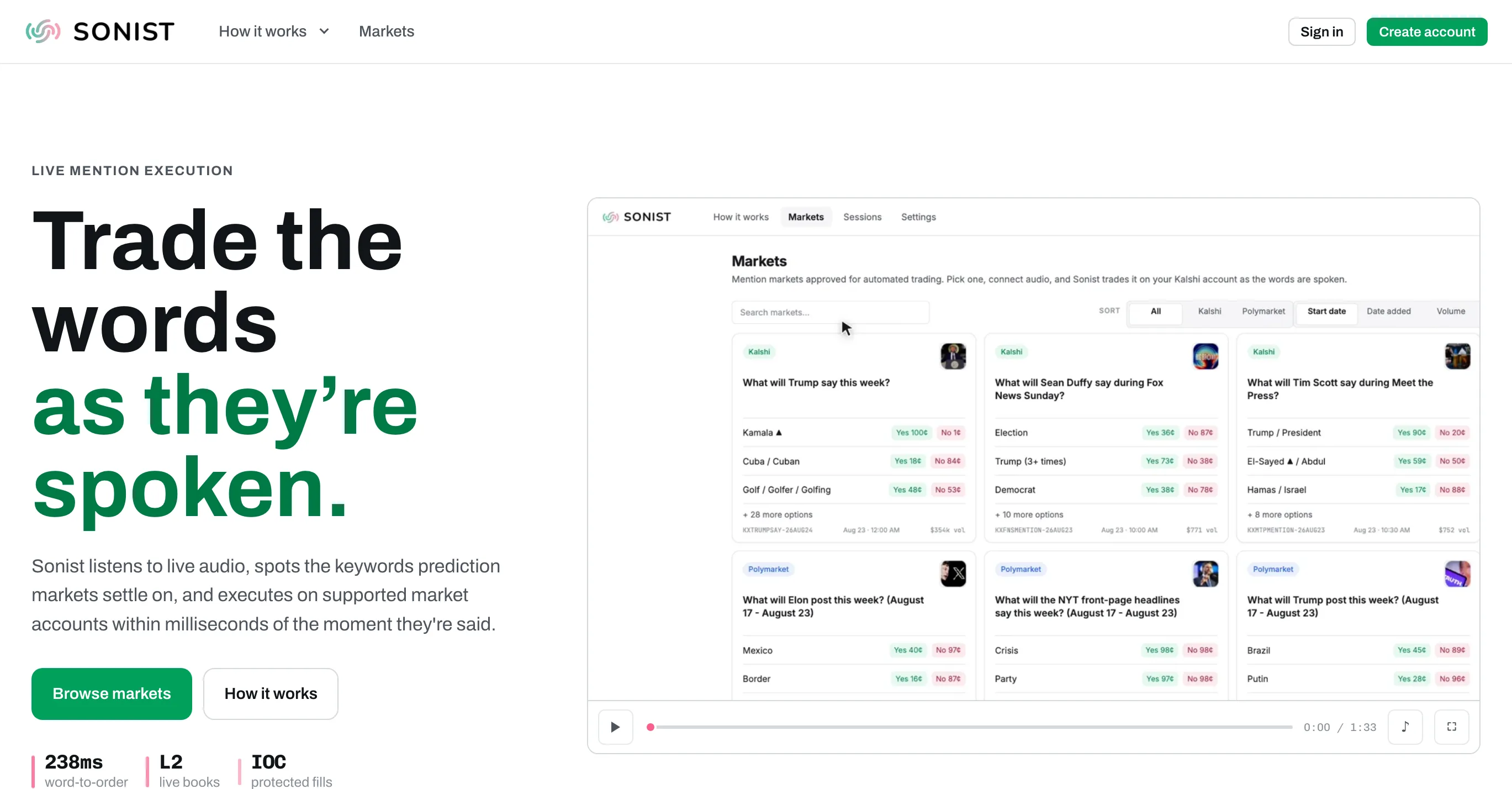
Mention-market trading software that listens to a live broadcast and buys the contract the moment a tracked word is said. Sonist pulls the mention markets from Kalshi and Polymarket onto one board — 53 approved events the day we checked it, 36 on Kalshi and 17 on Polymarket — each contract already carrying its keywords, its aliases and the count that settles it. Point a session at a stream URL, your microphone or your device audio and Sonist transcribes word by word; when a keyword clears its threshold it fires an immediate-or-cancel order on your own exchange account, under a contract cap and a maximum price in cents that you set before the session starts. The board re-marks over a websocket as the book moves, every detection and every skipped signal is logged with its reason, and one control flattens the position. Pro adds local speaker diarization, so a mention only counts when the voice that matters says it — the Fed governor rather than the anchor quoting him.
Predict & Profit
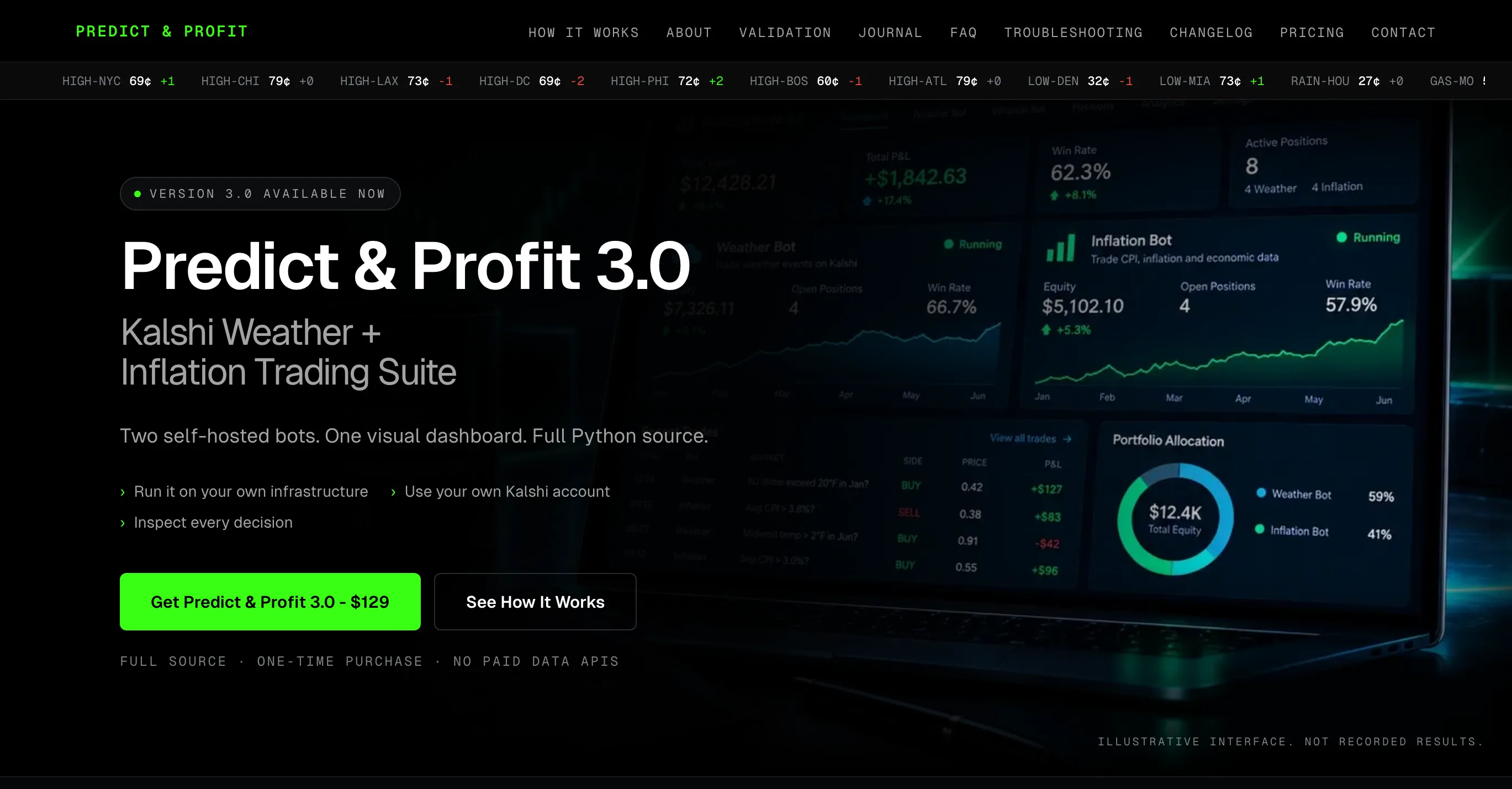
Self-hosted Python suite for Kalshi weather and inflation markets — two bots, a monitoring dashboard and one shared risk engine, installed and managed as a single system. Version 3.0 prices temperature contracts from NOAA's National Blend of Models, the calibrated station-level guidance published for exactly the stations Kalshi settles on, at 0.75 weight; GFS, AIGEFS, ECMWF IFS, AIFS and HRRR hold the remaining 0.25 as a disagreement check rather than as the model. Settlement stations come from Kalshi's own series metadata across 20 cities — Chicago settles on Midway, Houston on Hobby — and any market NBM does not cover is skipped, which rules out every same-day contract, because NBM coverage starts at forecast hour 24. The inflation half scores CPI, Core CPI and PCE against the Cleveland Fed's nowcast and an internal weighted one. Candidates then pass a four-signal gate — spread 30%, volume 20%, order-book imbalance 25%, model mispricing 25% — and the author says over 95% of scanned contracts are rejected. There is no public performance record: the trade log the earlier version published was retired with 3.0, and the site now publishes release and validation status instead of a P&L scoreboard.
Rainmaker
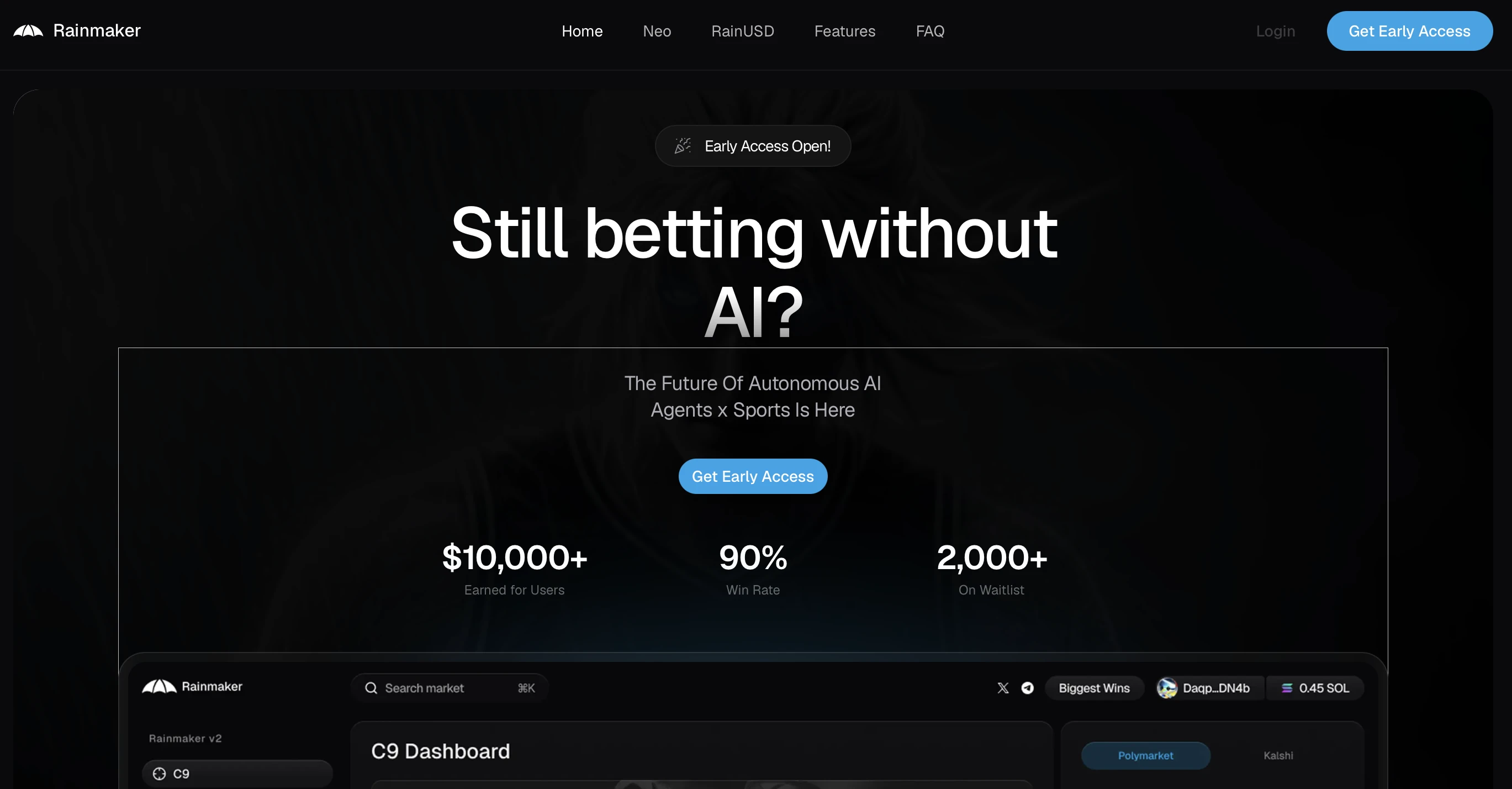
AI-agent terminal that unifies arbitrage, copy-trading and analytics across Polymarket, Kalshi and Novig. Its Cloud9 agents snipe arbitrage between venues, score and replicate winning traders, and mine analytics — with a focus on sports markets (NFL, NBA, NCAA).
Shadow Markets
Copy-trading platform for prediction markets across Polymarket and Kalshi. Deposit funds, pick top traders by win rate, profit and volume, and the system mirrors their trades proportionally — with portfolio, P&L and redemption tracking built in. Free and in early beta.
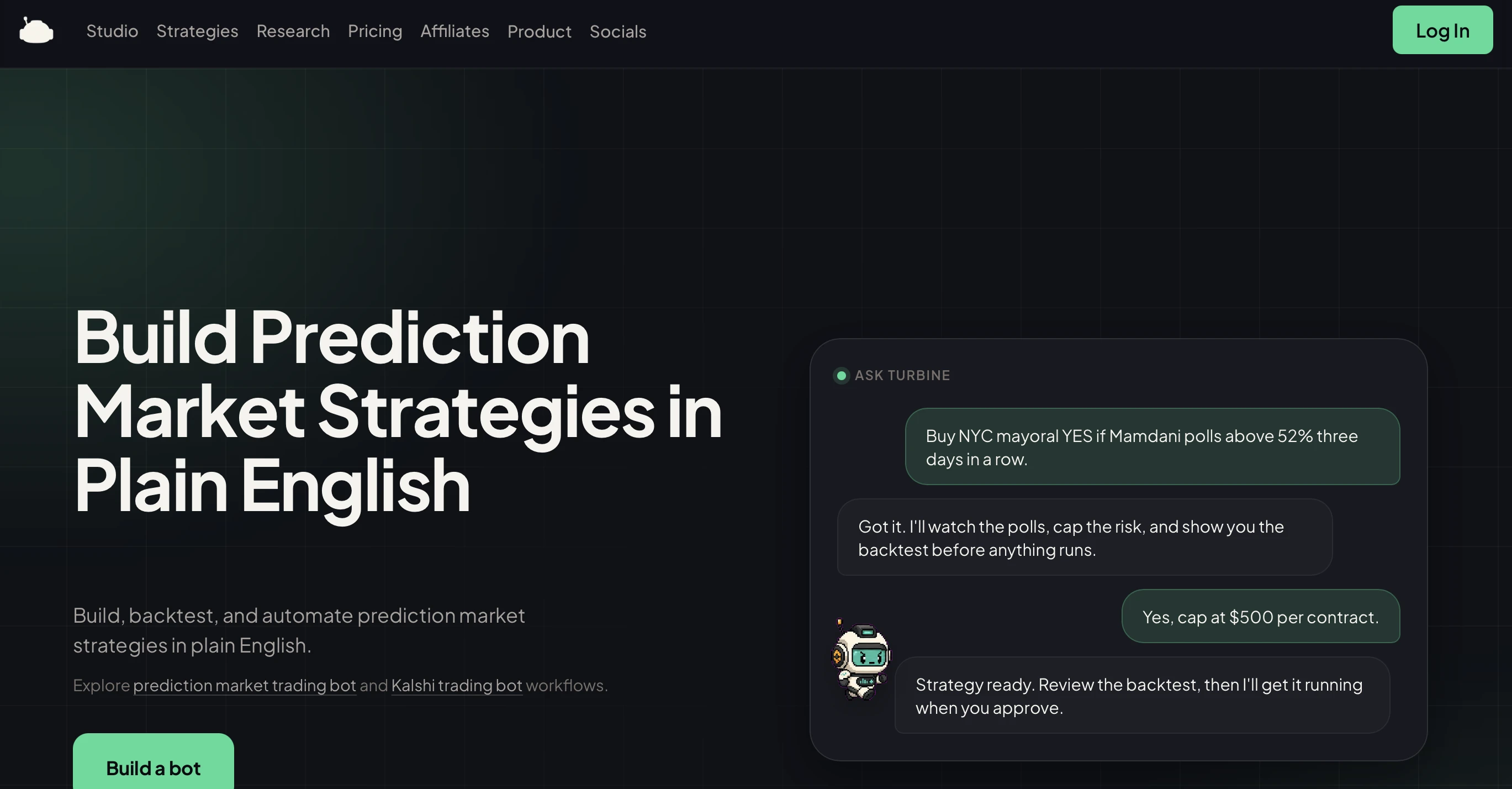
Turbine
Build, backtest and deploy automated prediction-market strategies in plain English — no code. Describe a strategy, Turbine writes the rules, backtests them on 30 days of market data with fees and bid/ask modeled, then runs it 24/7 in a cloud sandbox. Covers Kalshi and Polymarket.
Terminals that trade Kalshi by hand
5Trading front ends that put Kalshi next to Polymarket and other venues in one screen. You place the orders; the terminal adds the cross-venue view, order types and tracking.
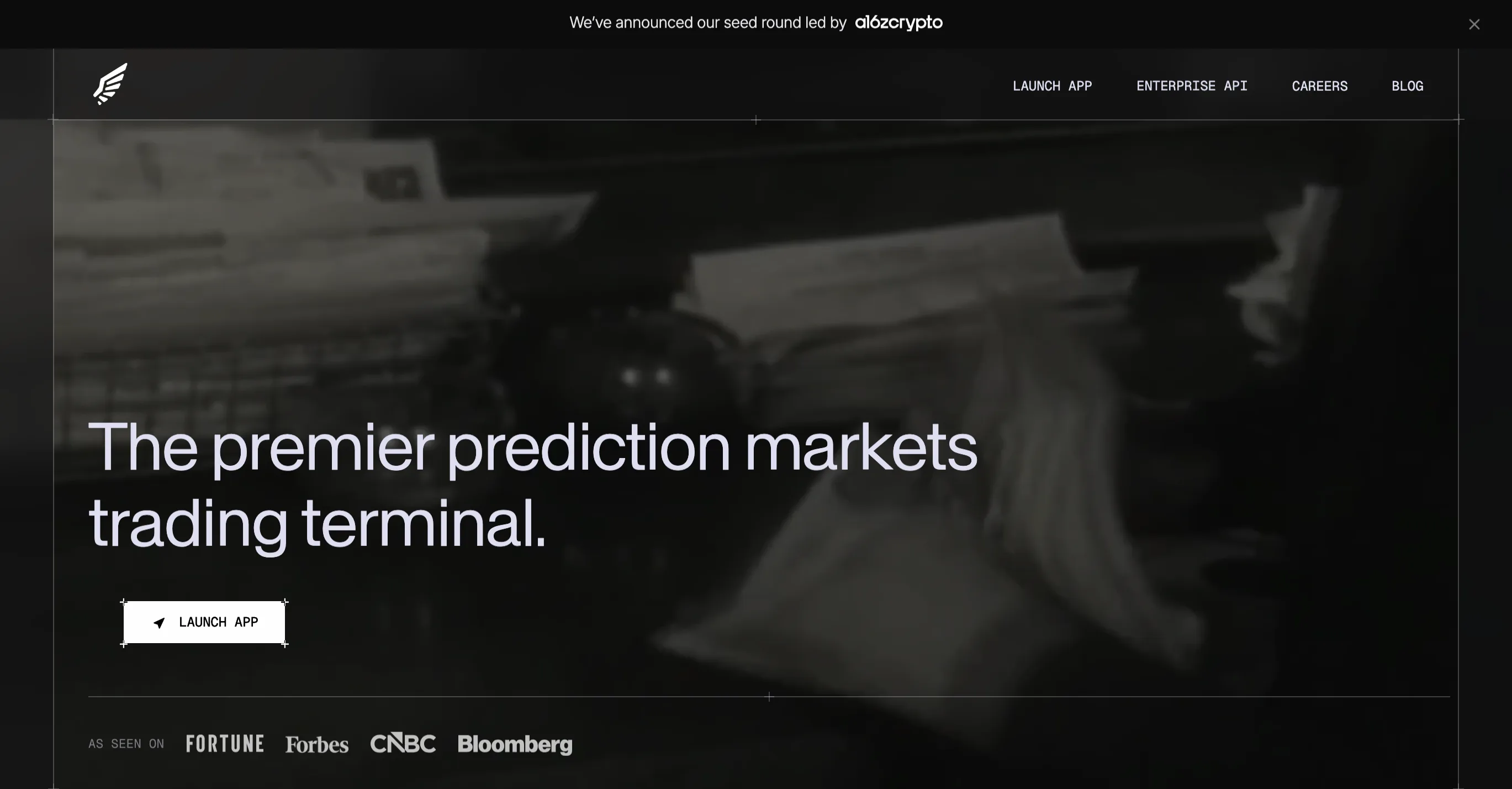
Kairos
Cross-venue trading terminal that merges Kalshi, Polymarket and Predict.fun into one order book. Matching contracts on different exchanges are shown as a single instrument with a composite ladder and a global best bid and offer, so you can see which venue is actually cheapest before you send, and an order to the NBBO endpoint routes to whichever book shows that price. Feeds are ingested next to the venues and merged in the browser with no polling interval; the ticket carries GTC, GTD, FOK, FAK and IOC time-in-force, post-only and slippage caps, with batch cancel and a per-venue kill switch. A bots panel runs parameterised templates — market making, cross-venue arbitrage, dip buying — against recorded books first and promotes the same config to live. The same engine is exposed as a REST and WebSocket API with scoped keys, IP whitelisting and a free read-only market-data tier. Built by a team from high-frequency trading firms and exchanges and backed by a $2.5M seed led by a16z.
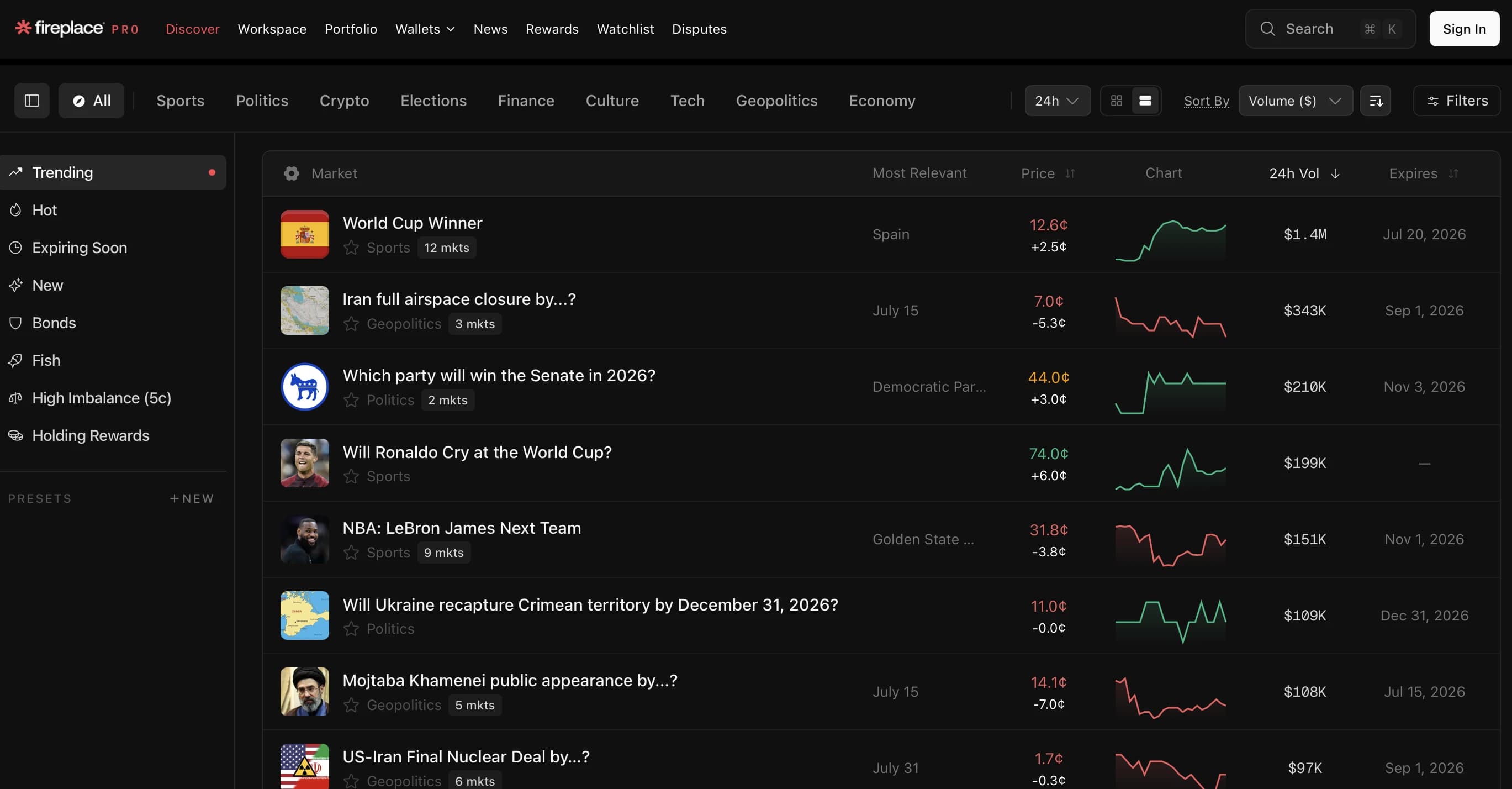
Fireplace
Social news app and pro trading terminal that aggregates prediction markets across Polymarket and Kalshi. Scroll a social news feed, bet in a single click, deposit cross-chain in USDC, and compete on a leaderboard ranked by real PnL — friends can comment, reply and copy each other's trades.

OKbet
Prediction-market aggregator across Polymarket, Kalshi, Limitless and Opinion. Browse thousands of markets in one feed, get whale alerts and AI trading signals, copy top traders, and use an AI agent that finds the best price, executes and manages positions autonomously. Web, Telegram and $OK token.
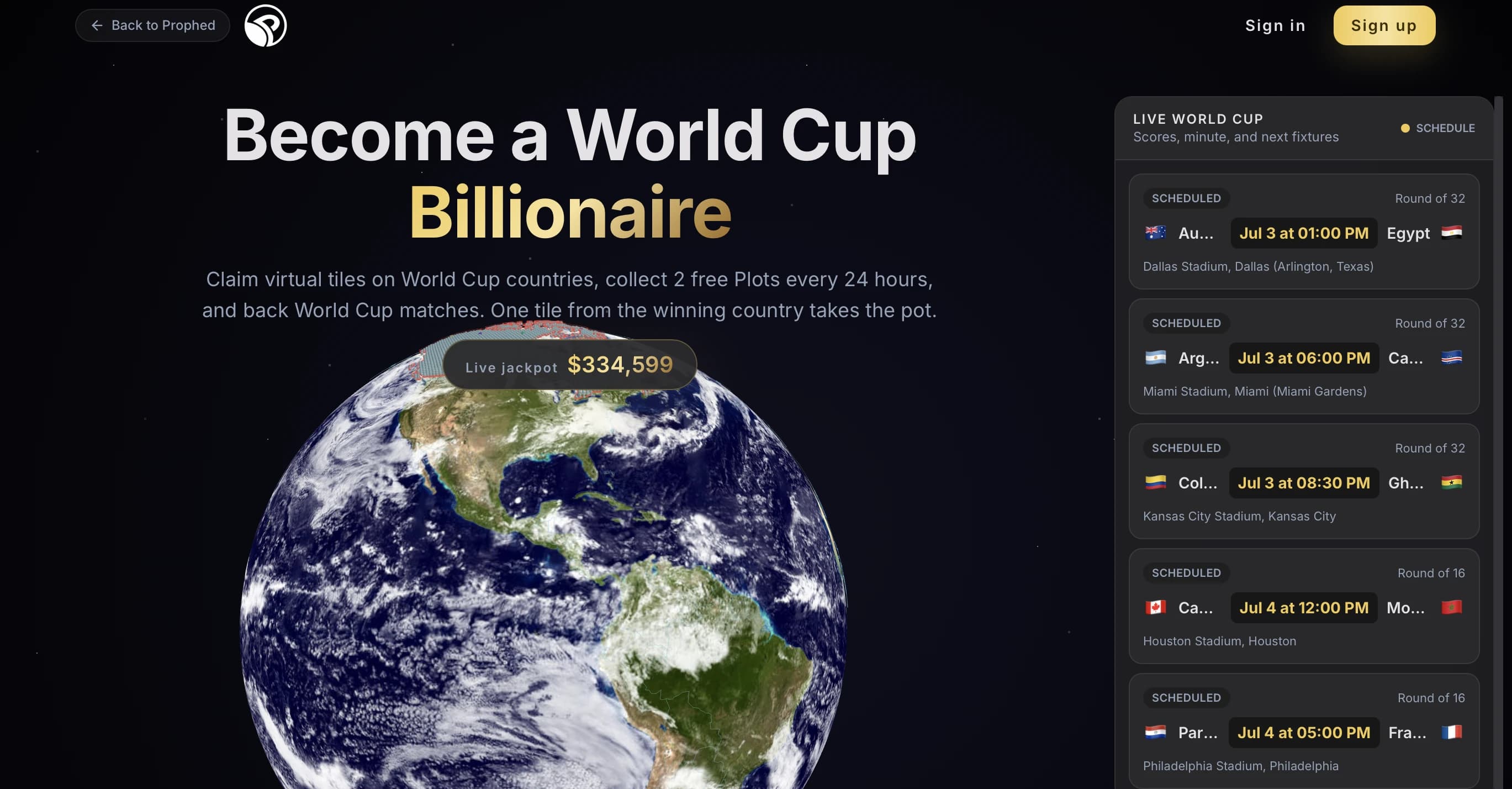
Prophed
Prediction-market aggregator that lets you trade Polymarket, Kalshi and predict.fun from a single interface. Its World Cup Billionaire campaign turns the 2026 World Cup into a claim-your-country game layered on top of live prediction-market odds.
Stand
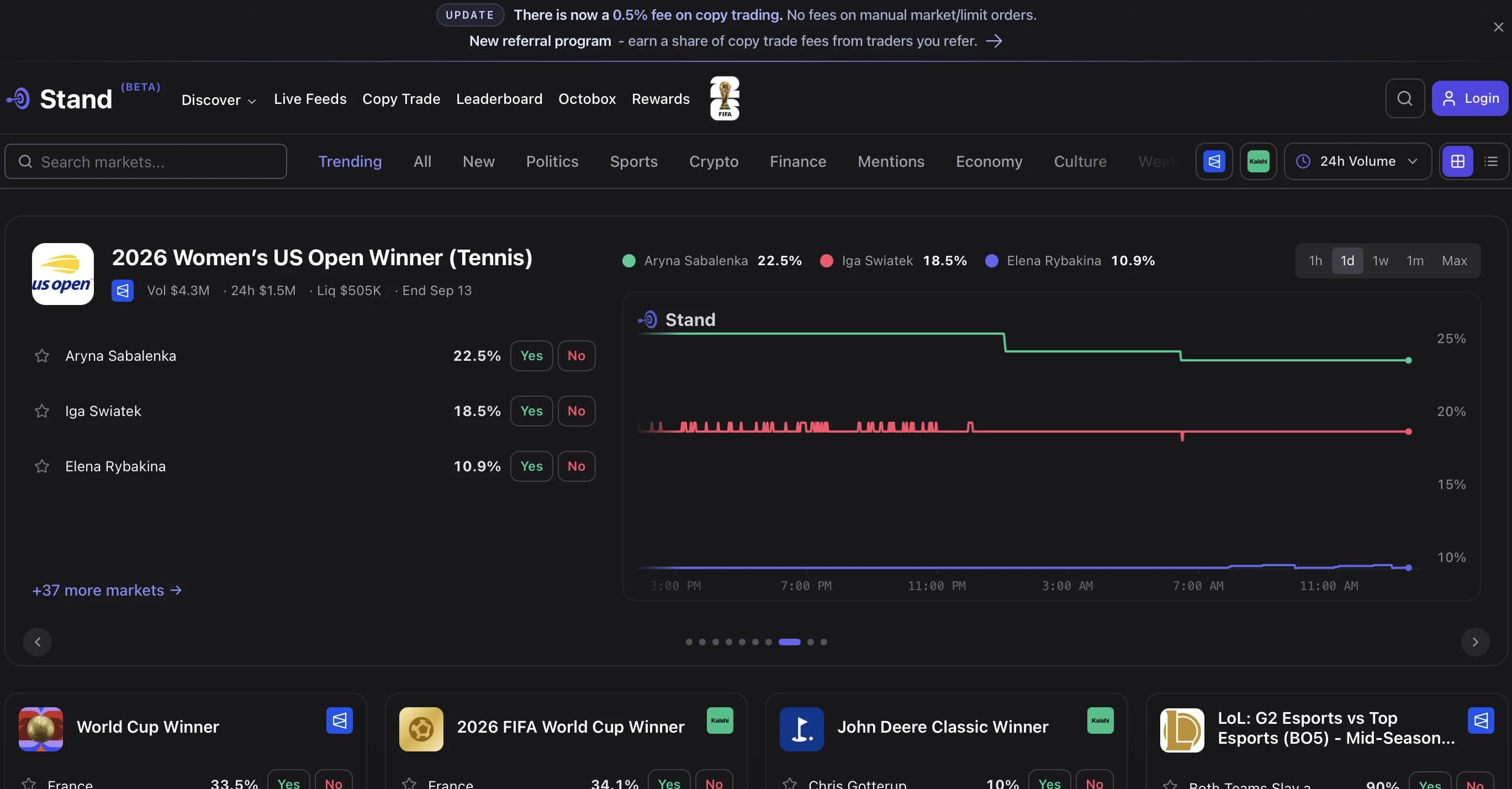
Advanced trading terminal and aggregator for prediction markets. Pulls Polymarket and Kalshi into one trade-first interface with live volume, liquidity and open interest, whale copy-trading, TP/SL and stop orders, and an Octobox that watches up to eight markets at once. Non-custodial via Privy, no fees on manual orders.
Research, data and arbitrage tools
10Analyzers, scanners, data APIs and calculators that read Kalshi without trading on it — model-versus-market research, side-by-side prices against Polymarket, weather and data feeds.
EventArb
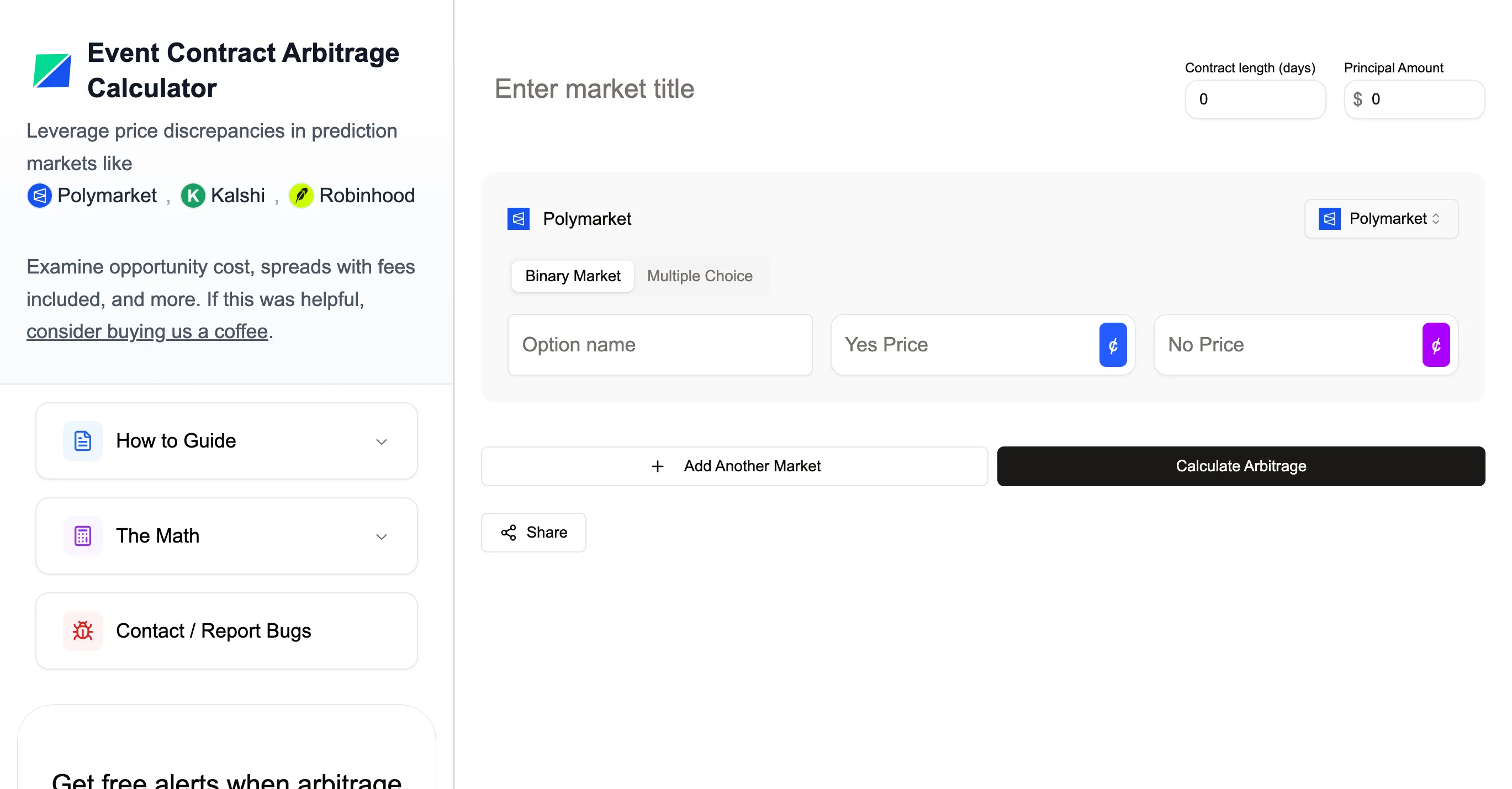
Free cross-platform arbitrage calculator for event contracts. Punch in YES/NO prices for the same event on Polymarket, Kalshi or Robinhood and it does the math each venue's fee schedule implies — whether buying opposite sides locks in a profit, what the spread nets after fees, and the opportunity cost of parking capital until resolution. Supports binary and multiple-choice markets, side-by-side venue comparison, shareable links and free email notifications when opportunities open.
PillarLab
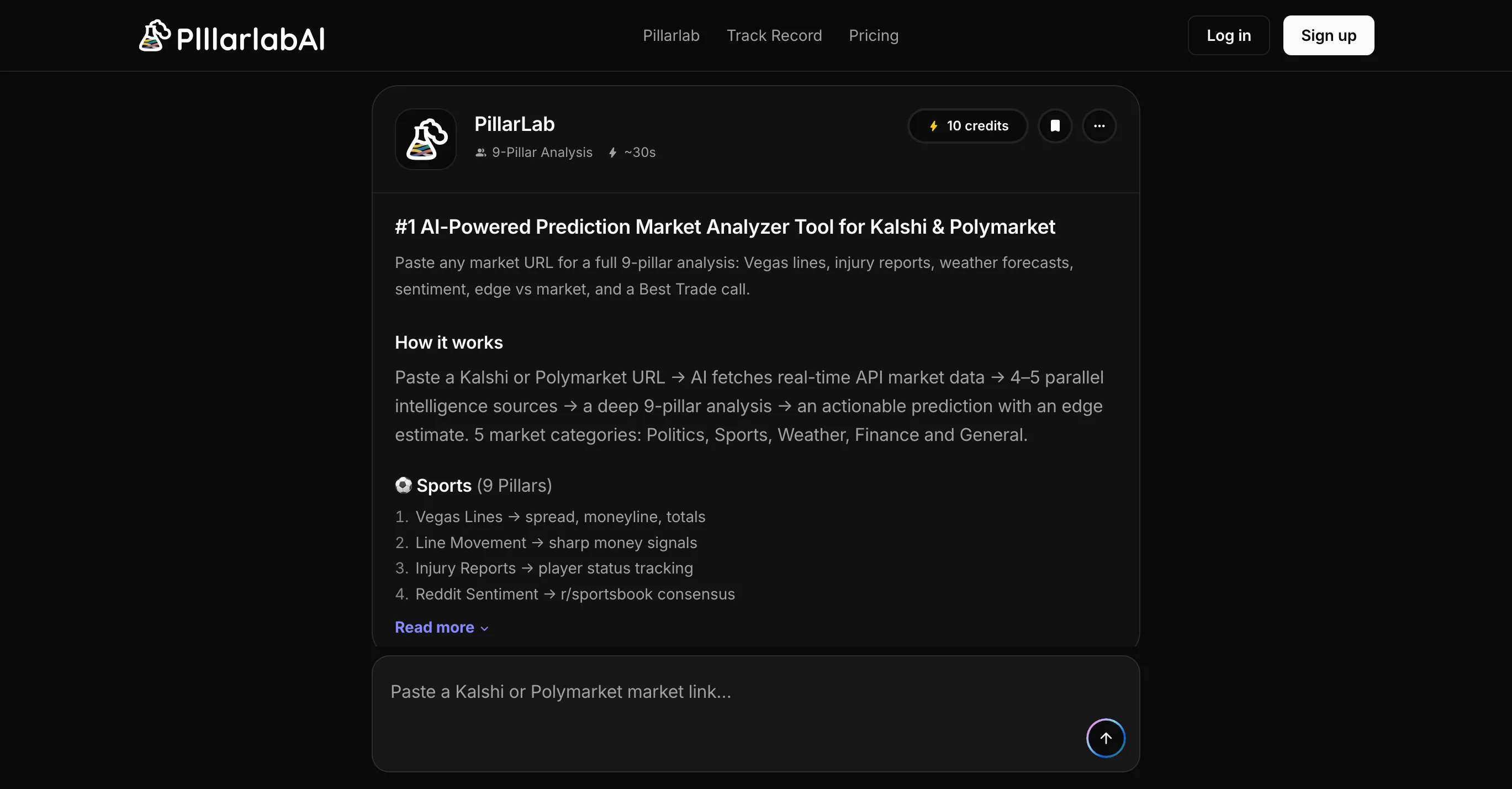
AI market analyzer for Kalshi and Polymarket. Paste a market URL and it pulls live market data plus four or five parallel intelligence sources, then returns a nine-pillar breakdown and a Best Trade call with an edge estimate in about 30 seconds. The nine pillars are tailored per category: Vegas lines, line movement and injury reports for sports; GFS/ECMWF/NWS forecast consensus and ensemble spread for weather; polls-versus-odds divergence for politics; technicals, institutional flows and macro for finance. Every category ends on a contrarian check.
Polypick
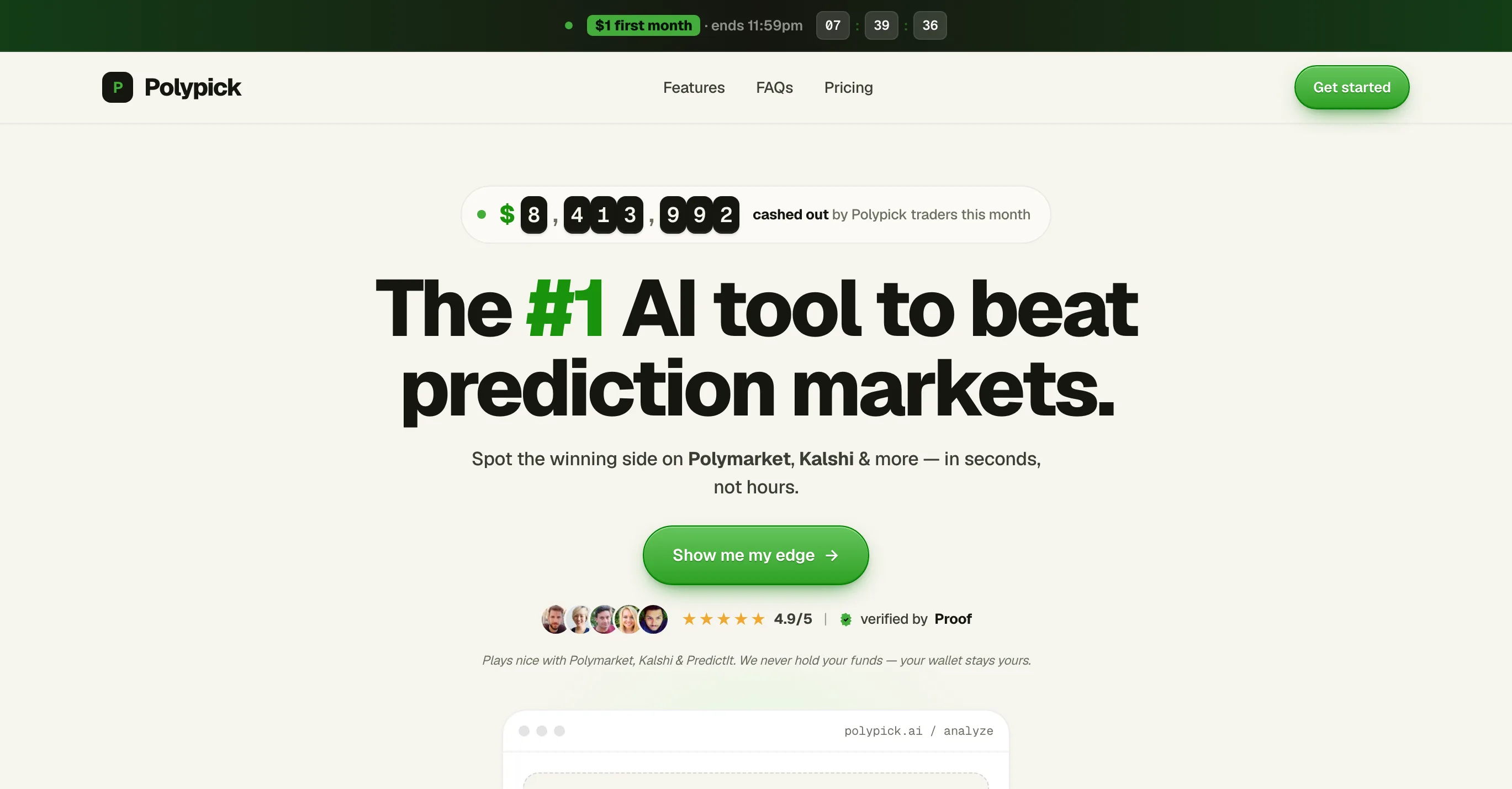
AI edge-finder for prediction markets. Drop in any market — or a screenshot of one — and Polypick reads the latest news and data to call the side with an edge in under 10 seconds, with a plain-English rationale and a risk score. Adds curated daily picks, copy signals from winning wallets and real-time alerts when odds shift. Analysis only — non-custodial, it never touches your funds.
Predictefy
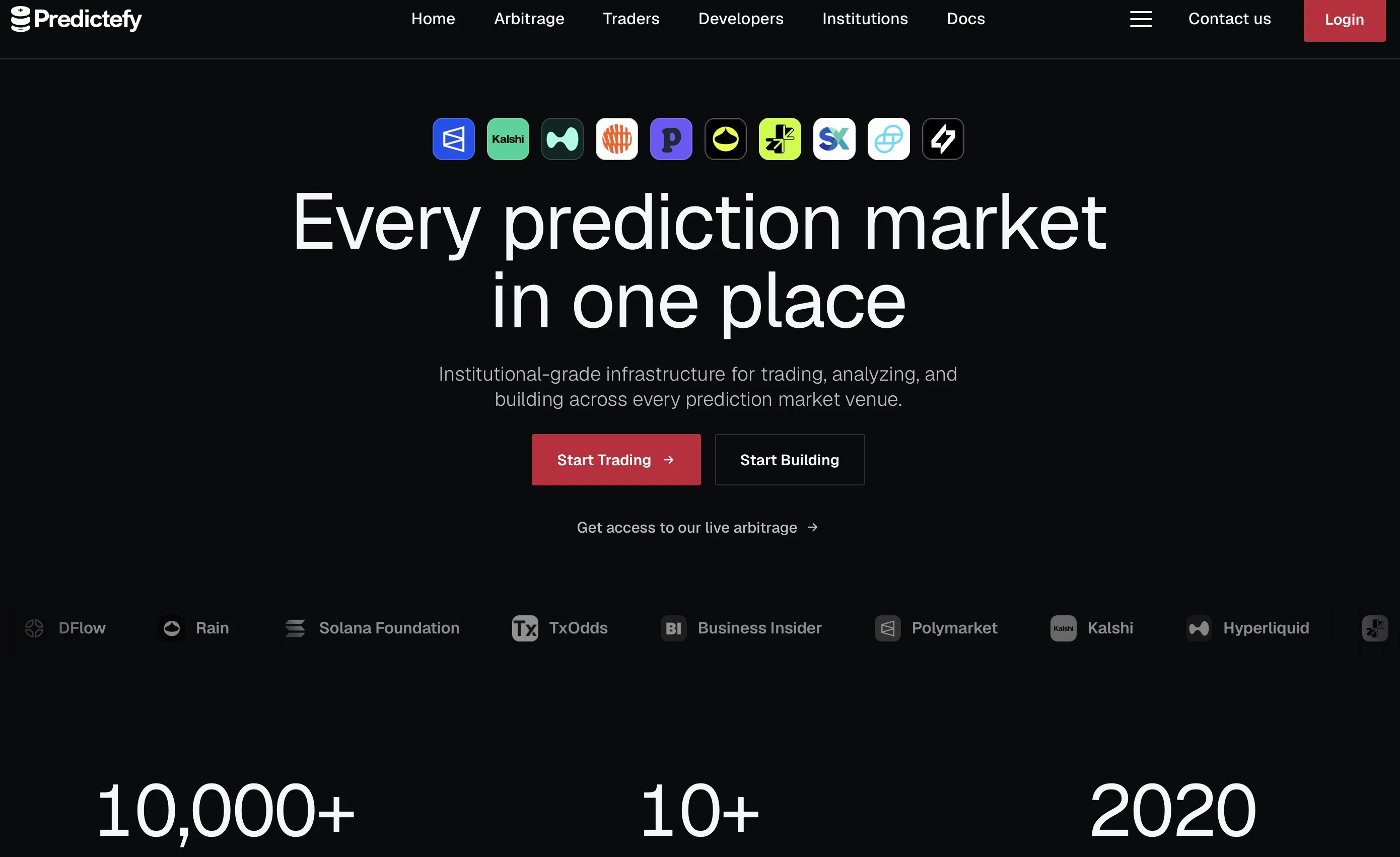
Institutional-grade infrastructure across every prediction market venue. Matches identical markets on Polymarket, Kalshi, Hyperliquid, Limitless and more, then streams cross-venue arbitrage — spread, size, liquidity and route — in real time. Ships a market-data API, SDK, smart order router, MCP server and agent CLI, plus historical data back to 2020.
Climate Sight
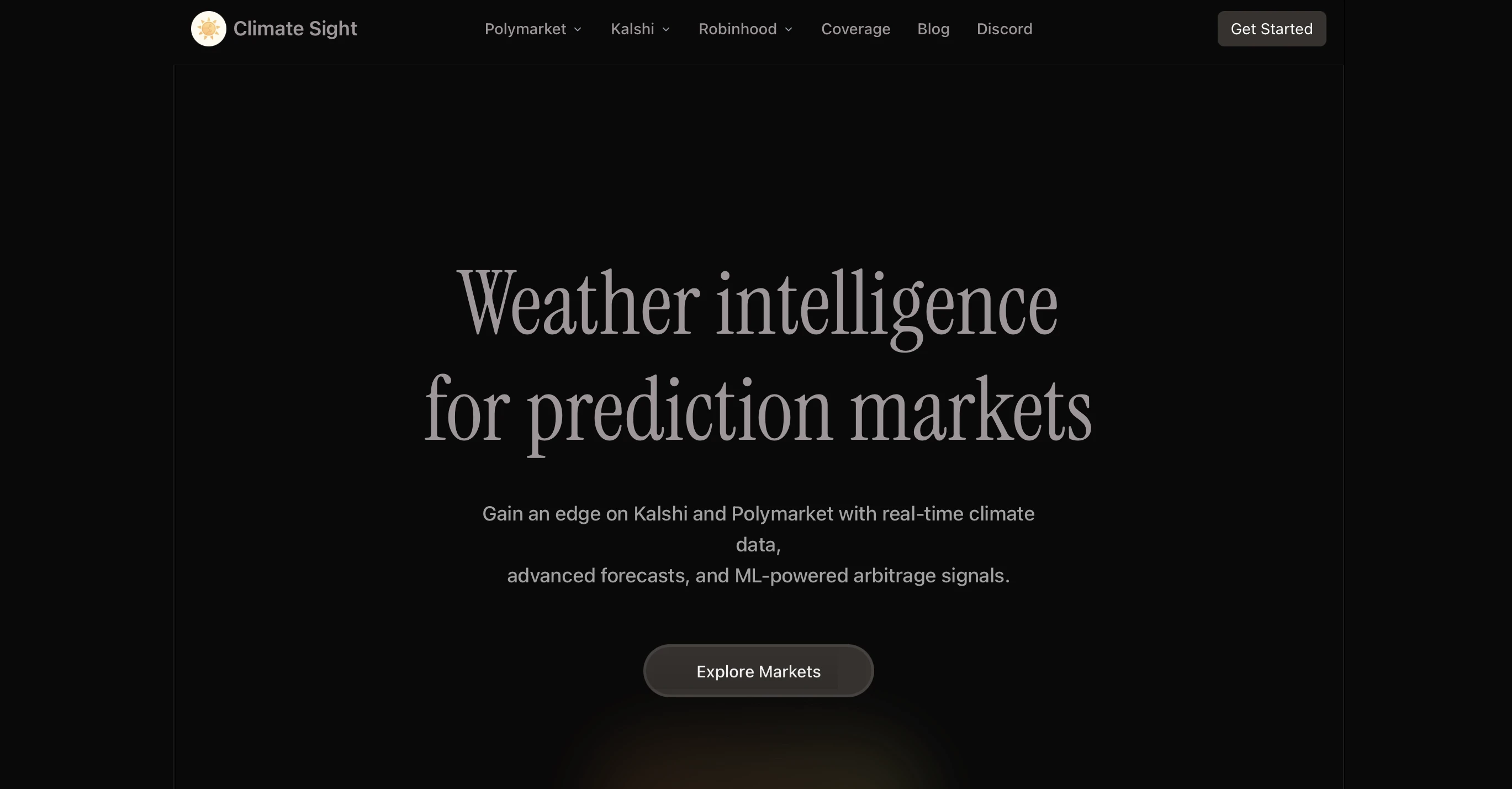
Weather analytics for climate prediction markets. Aggregates institutional feeds (NOAA, NWS, Synoptic) into professional forecasts across 40+ global cities, with ML-powered buy signals to flag high-probability trades on Kalshi, Polymarket and Robinhood.
Dome
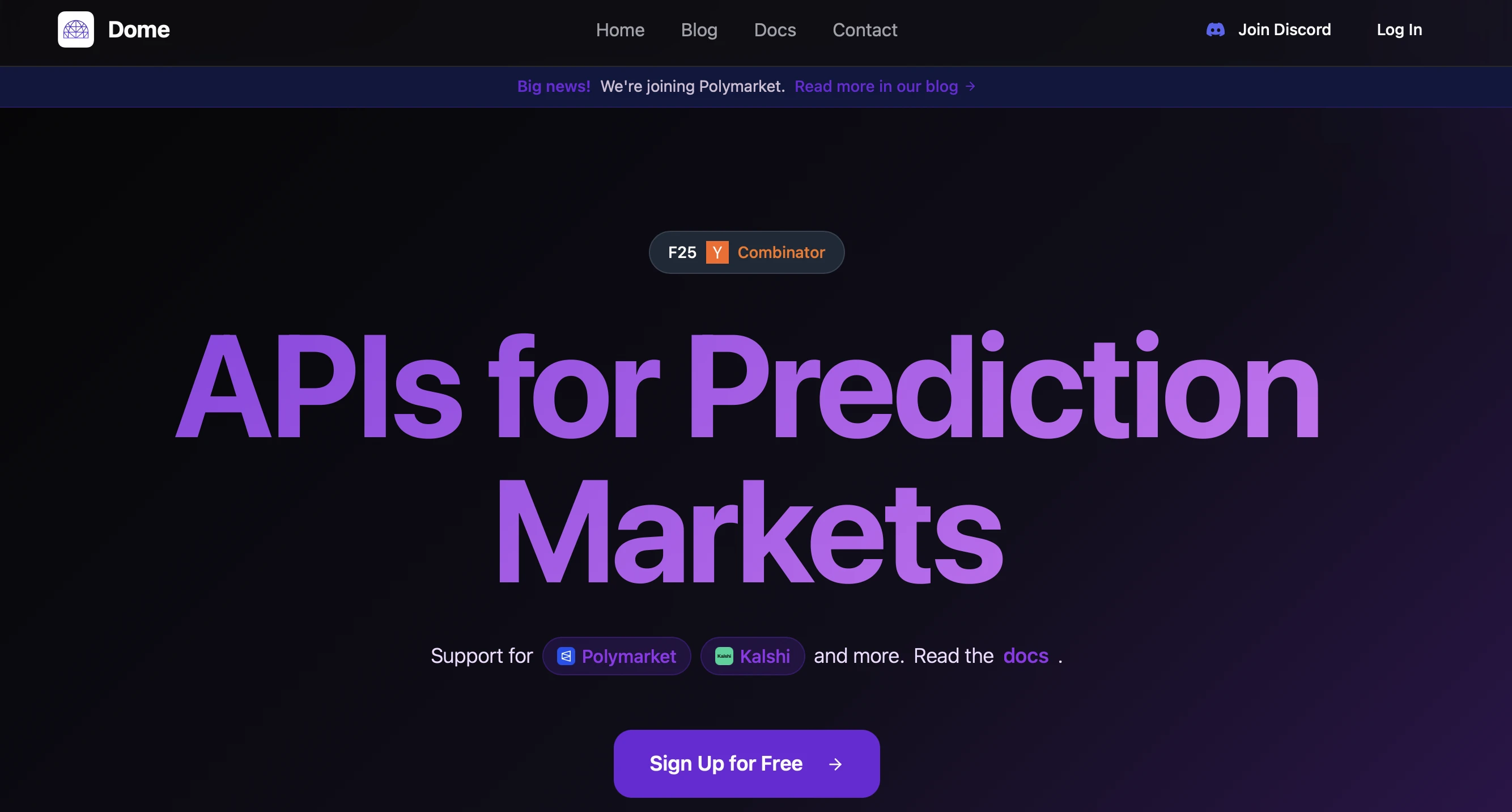
Prediction-market APIs and SDK for developers. One integration for Polymarket and Kalshi data — historical order books, real-time trade webhooks and WebSockets, and backtesting — via REST plus TypeScript and Python SDKs.
HashDive
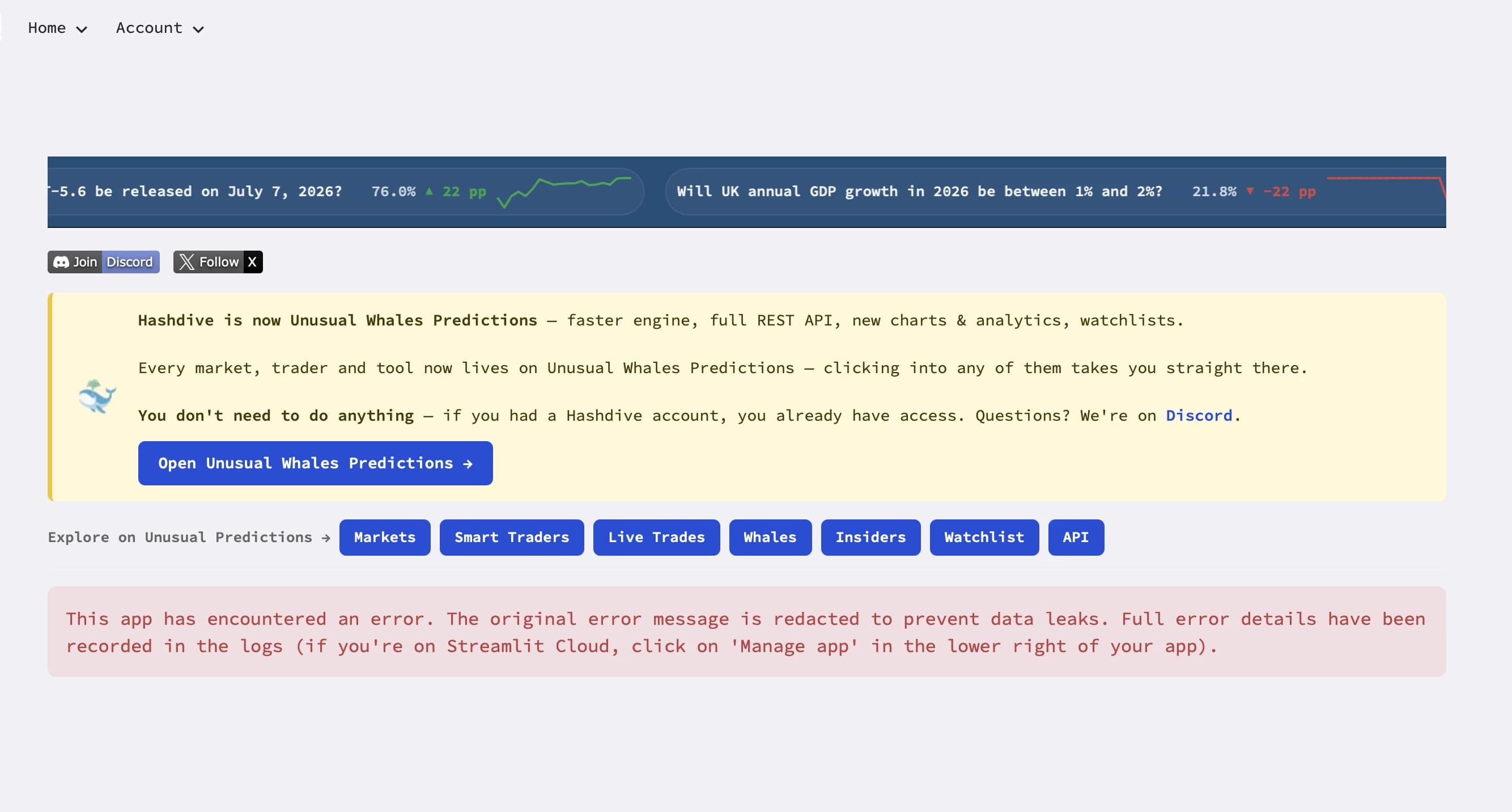
Advanced analytics for Polymarket and Kalshi. HashDive's proprietary Smart Scores rank how consistent and profitable a trader is, alongside a market screener, wallet tracking and candlestick charts with RSI, MACD and whale-volume breakdowns.
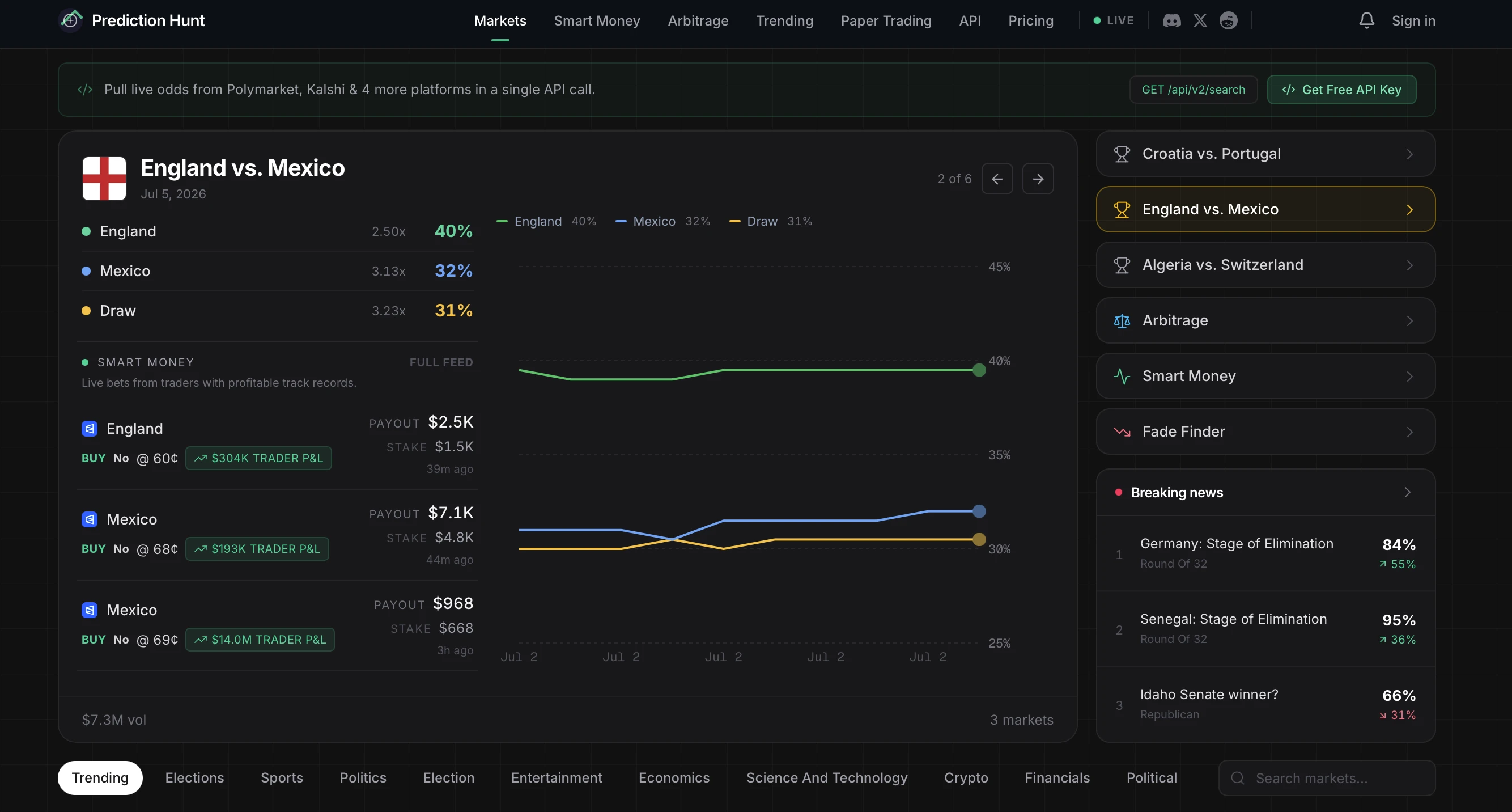
Prediction Hunt
Odds aggregator and tools directory for prediction markets. Compares side-by-side pricing for the same market across Polymarket, Kalshi and PredictIt to surface arbitrage, and hosts a community-curated directory of prediction-market tools.
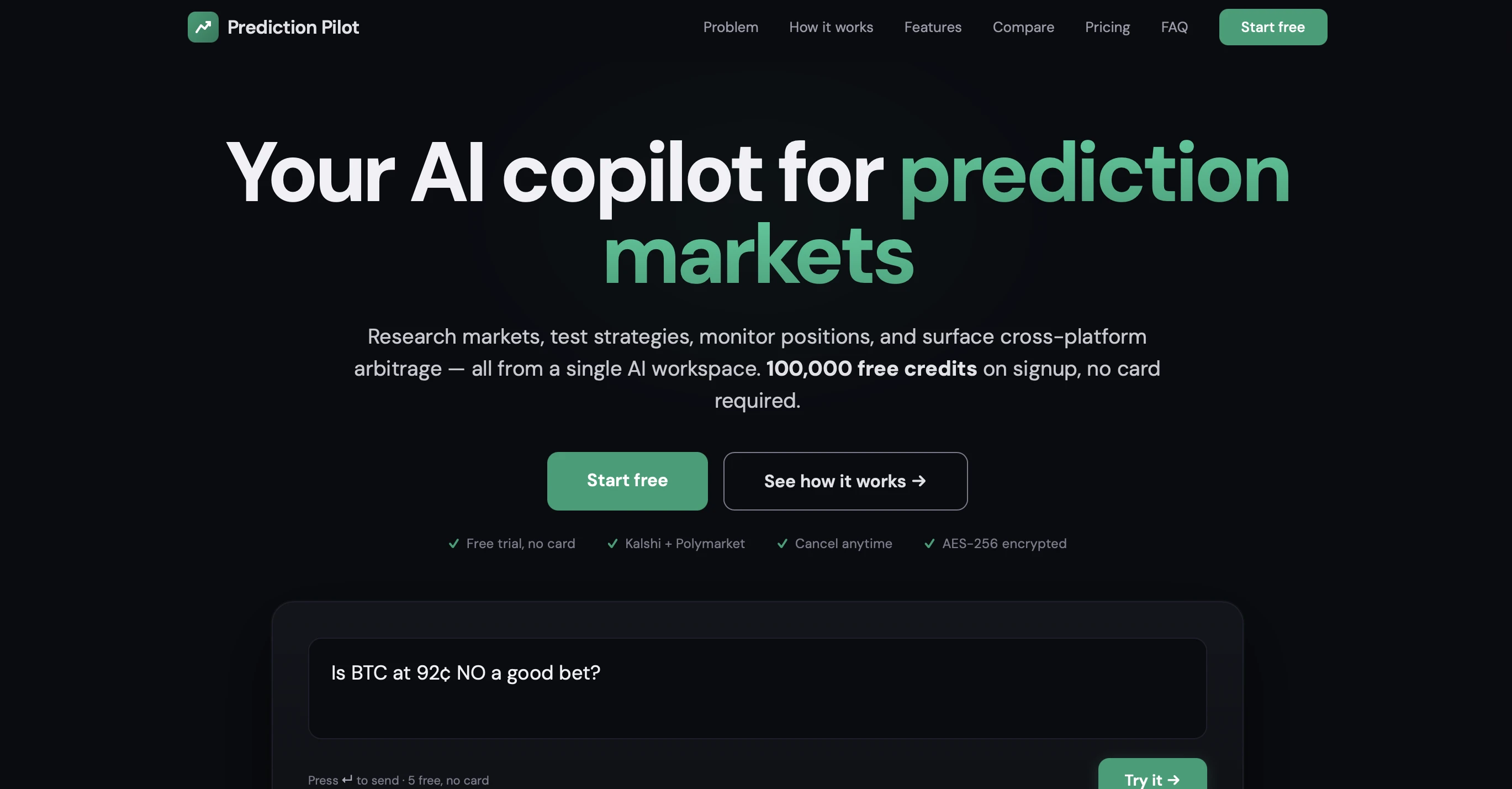
Prediction Pilot
AI assistant for prediction-market research and monitoring. Ask questions in plain English, scan Kalshi's order books live, backtest ideas on 90 days of settled data, monitor open positions with real-time P&L, and get scheduled alerts — plus cross-platform arbitrage detection between Kalshi and Polymarket.
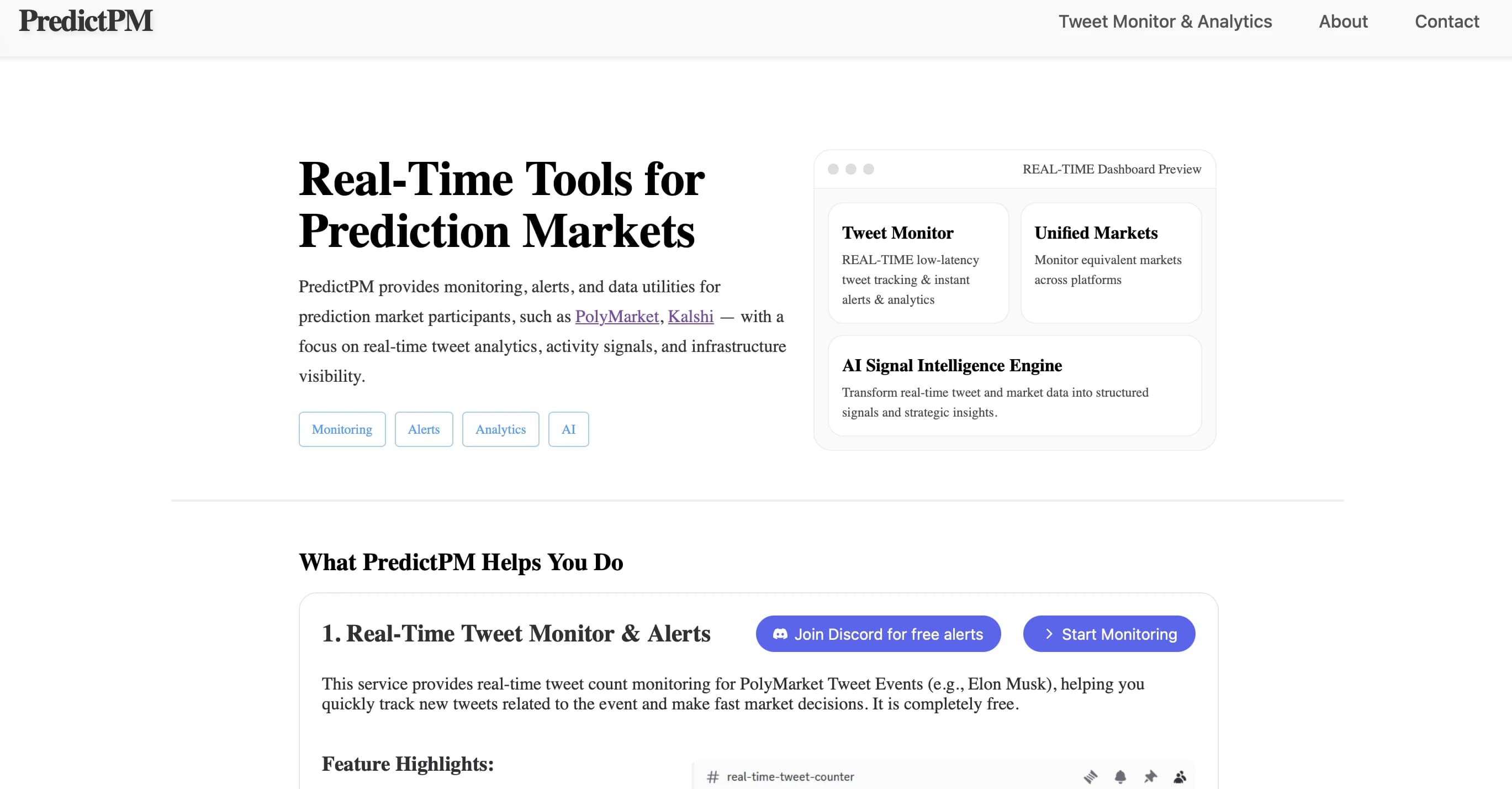
PredictPM
Real-time social and market monitoring for prediction markets. Tracks tweets with ~2-second alert latency, monitors equivalent markets across Polymarket and Kalshi at once, and runs AI signal intelligence over tweet and market data to surface structured, strategic insights.
How a bot trades on Kalshi
Kalshi is a US exchange for event contracts regulated by the CFTC: you open an account with identity checks and fund it in dollars, and every contract settles at $1 or $0. A bot never holds that money. It connects through Kalshi's trading API with an API key ID and an RSA private key that you create on your own account page — every request is signed with that key — and you can revoke the pair there at any time. Kalshi also runs a separate demo exchange with play money, which is where a new bot belongs first.
That model shapes the whole category. There is no wallet private key to hand over, so the custody question becomes where the RSA key lives: in a .env on your own machine for the self-hosted repos, or encrypted on the vendor's server for hosted bots. There is also no public ledger: Kalshi trades are anonymous, so a tool can only follow or rank traders who have opted into a public Kalshi profile, and anything that promises to mirror Kalshi whales is following trade sizes, not people.
Fees are the other constant. Kalshi's standard taker fee is 7% of the contract's price times its complement, rounded up — about 1.75¢ per contract at 50¢, less toward the extremes — so a bot that crosses the spread needs that much edge on every fill before it earns anything. Most tools here also cover Polymarket, and several exist precisely because the same question trades at different prices on the two venues.
How to pick a Kalshi bot
Decide where the RSA key should live. A self-hosted repo keeps it in a file on your machine and sends it nowhere; a hosted bot needs it on their server to trade while you sleep. Both are revocable on Kalshi, which is the advantage over a wallet key — but only a key you created for that bot alone can be revoked without breaking everything else.
Run it on Kalshi's demo exchange or in paper mode before money. The open-source toolkits here ship paper and dry-run modes, and the better ones refuse to call a strategy profitable until enough trades have settled. A bot that cannot be tested without funding is asking for trust it has not earned.
Ask for the record, and price in the fee. A published track record with losses in it, scored against Kalshi's own settlements, beats any backtest chart; a model edge smaller than the taker fee at the prices you trade is not an edge at all.
Read before you fund one
All guidesPolymarket arbitrage: the four kinds, why the edge vanishes, and what it costs to chase
What arbitrage means on a prediction market — outcome sets priced under a dollar, multi-outcome books that don't sum, the same event priced differently on Kalshi — why those gaps appear, the fee and capital maths that decide whether a bot can take them, and the execution risks (legging, resolution mismatch) that turn a sure thing into a loss.
5 minAug 21, 2026Trading Polymarket weather markets with forecast models: where the edge is, and how the rule eats it
Daily temperature and weather markets are priced by people with a weather app and resolved by a specific station's reading — which is why model-driven bots like them. How ensemble forecasts turn into a probability, when to trade the gap, the 1.25% fee, and the resolution details (station, rounding, time zone, source) that turn a correct forecast into a losing trade.
4 minAug 21, 2026How to spot a scam Polymarket bot: nine red flags to check before you pay
Guaranteed returns, ROI with no trade record, a form asking for your seed phrase, countdown timers, referral tiers, impossible latency claims — the nine signs a Polymarket bot is a scam, what a legitimate one looks like, and what to do if you already paid.
5 minAug 21, 2026Frequently asked questions
- Is there a free or open-source Kalshi trading bot?
- Yes. Kalshi AI Trading Bot is an MIT-licensed Python toolkit with a paper mode, a risk governor and a harness that scores your settled trades against Kalshi's prices; Octagon's Kalshi Trading Bot CLI is MIT-licensed too, though its research needs a paid Octagon plan; and CloddsBot is an open-source AI agent that reaches Kalshi among ten venues. Predict & Profit sells its Kalshi weather and inflation bots with the full source included.
- Are bots allowed on Kalshi?
- Kalshi publishes a trading API for exactly this purpose and runs a demo exchange to test against. You create the API key on your own account, the bot signs each order with it, and you remain responsible for what it trades — the exchange's rules apply to automated orders the same as to manual ones.
- Can you copy-trade on Kalshi?
- Only partly. Kalshi trades are anonymous, so a copier cannot follow an account the way Polymarket tools follow a public wallet. Copy features that cover Kalshi, such as Kreo and Shadow Markets, can follow traders who use a public Kalshi profile; anything that mirrors anonymous large trades is following size, not a person.
- Which Kalshi bots trade weather or inflation markets?
- Predict & Profit is built for them: self-hosted bots for Kalshi's daily high-temperature contracts across 20 US cities and for the CPI and PCE releases. Climate Sight is the research side, with weather-model forecasts and buy signals for temperature markets on Kalshi, Polymarket and Robinhood.
- What do Kalshi bots cost?
- The open-source toolkits are free but need your own model API key, metered per token; hosted bots and research tools run from about $17 a month, and some take a cut per trade instead. Kalshi's own fee applies on every fill whichever you choose, and at mid prices it is the larger cost for an active bot.