Open-source Polymarket bots
Bots whose code you can read before you trust it with your keys. Two groups: free repositories under open-source licences, and bots sold once with the full source included — no licence server, no subscription, nothing that stops working if the author does.
Open-source, free to use
7Published under a free licence (MIT). Clone it, read it, run it on your own machine — and maintain it yourself.
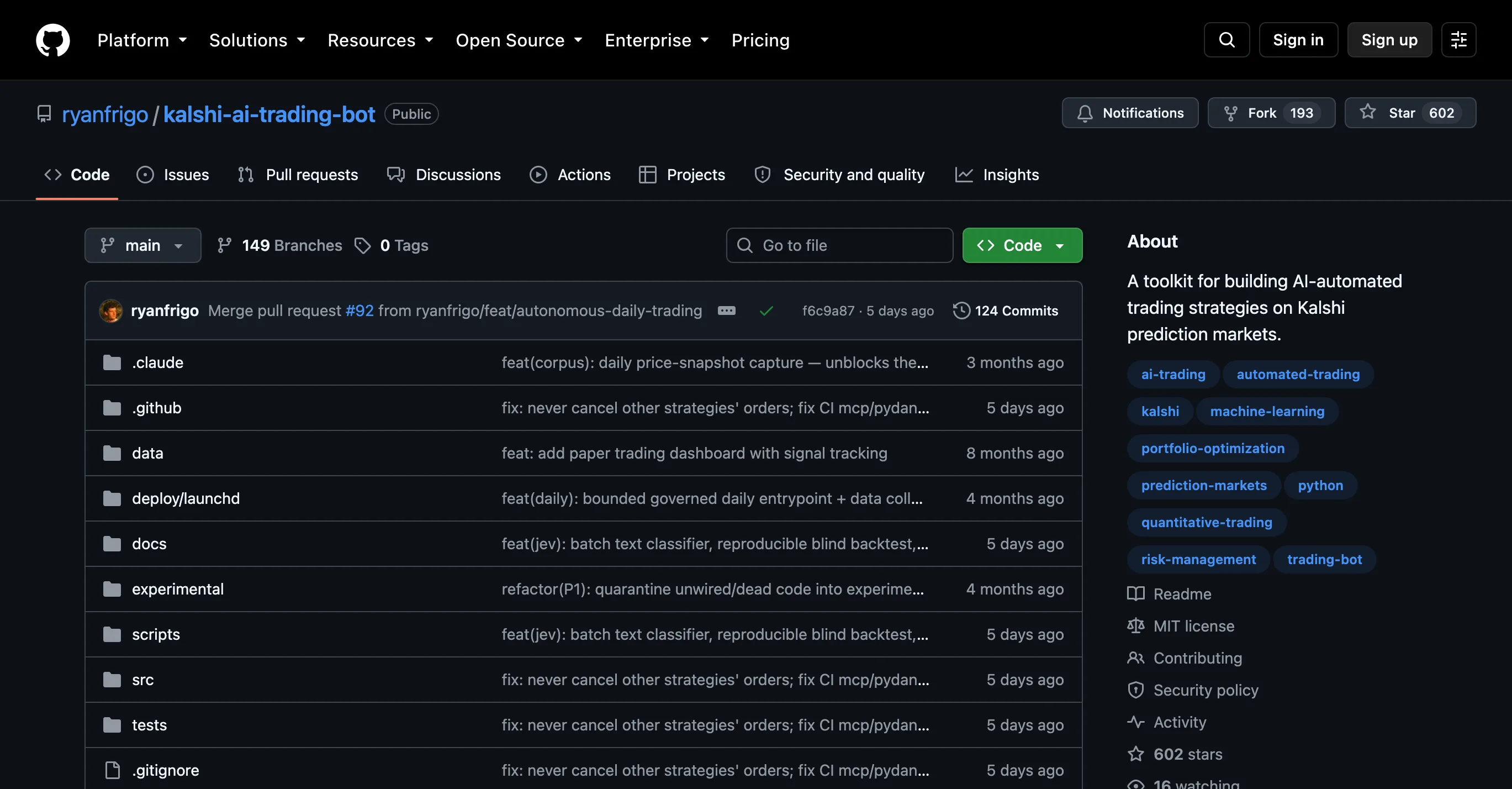
Kalshi AI Trading Bot
Open-source Python toolkit for automated trading on Kalshi, built around the question most bot repos skip: do you actually beat the book? An LLM reads each candidate market with a news summary, scores a probability through any model on OpenRouter, and the trade is sized at quarter-Kelly under a risk governor with a daily-loss limit and a drawdown kill switch. Every decision goes into a local journal; the edge harness then pulls Kalshi's own settlements, scores your settled trades by Brier score, log-loss and realised win rate against the price you paid, and refuses to call it an edge on fewer than ten trades that resolved after you bought. A policy step turns that record into a pre-trade gate that blocks categories you have lost money in. Ships a paper mode, a Streamlit dashboard, a Claude skill and an MCP server; MIT-licensed at github.com/ryanfrigo/kalshi-ai-trading-bot.
CloddsBot
Open-source AI trading agent that runs on your own machine and takes orders in natural language over Telegram, Discord, WebChat and eighteen other channels. Powered by Claude, it covers ten prediction markets — Polymarket, Kalshi, Betfair, Smarkets, Drift, Manifold, Metaculus, PredictIt, Opinion.xyz and Predict.fun — plus perpetual-futures exchanges and Solana and EVM DeFi. The Polymarket layer is real code rather than a wrapper: an EIP-712 order signer with unit tests, a CLOB client exposing 60-plus methods, real-time data and user WebSocket feeds, a large-trade tracker, and round-based discovery of the 5-minute BTC and the 15-minute, hourly, 4-hour and daily crypto windows with four automated strategies, alongside cross-venue arbitrage detection, copy trading and DCA bots. MIT-licensed at github.com/alsk1992/CloddsBot: 2,700 stars, 460-plus commits from one primary author, v1.9.1 released Sep 12, 2026, installed with one npm command on Node 22.
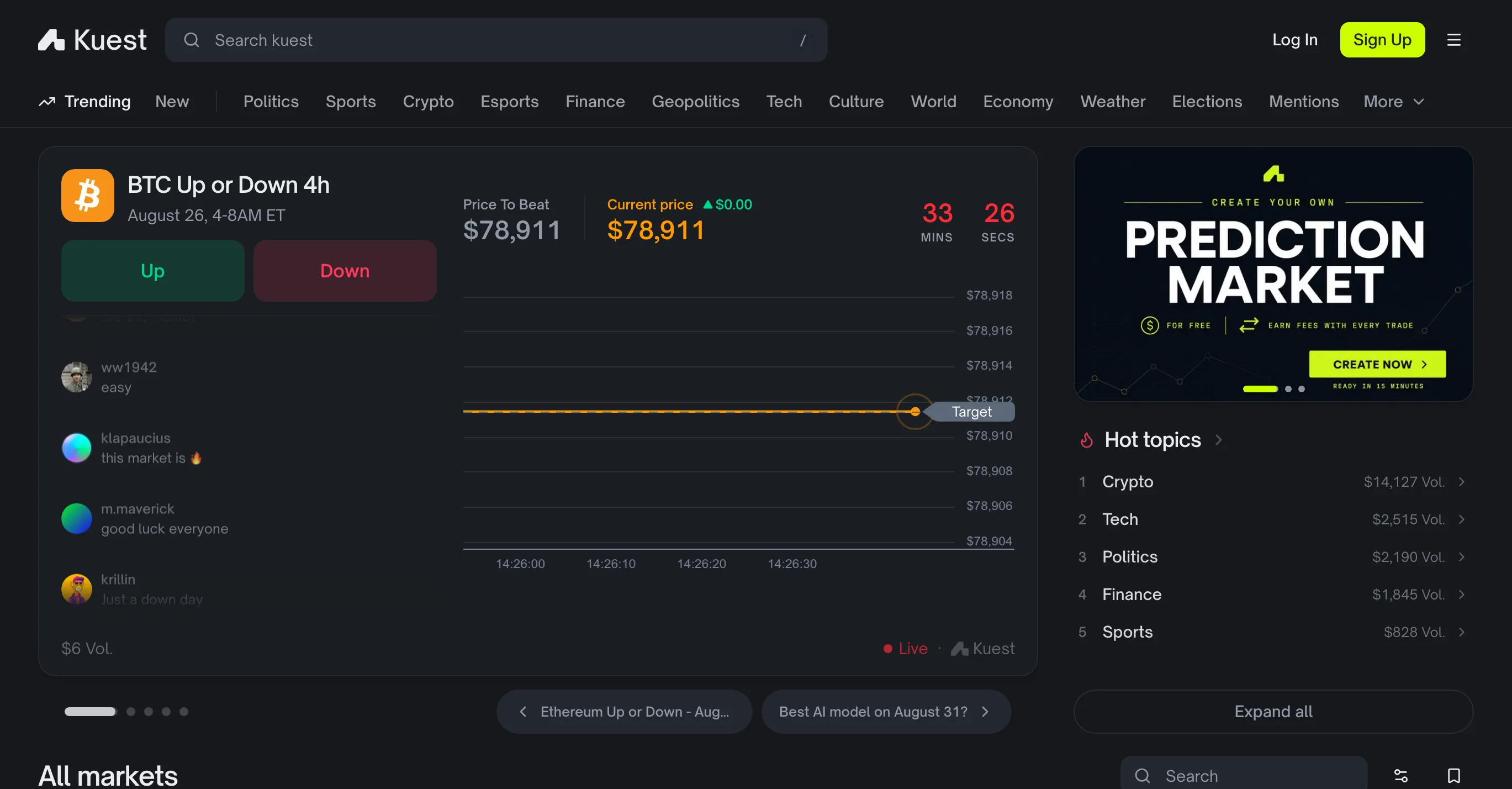
Kuest
Open-source white-label infrastructure for launching your own Polymarket-style exchange — the team calls it the Shopify for prediction markets. A guided no-code flow takes a branded site live in about 15 minutes on your own domain, with shared liquidity synced from live Polymarket order flow so the books aren't empty on day one, and a 0.5–3% per-trade fee you set yourself, paid straight to your wallet. Runs on Polygon with USDC settlement, ships Python and Rust SDKs compatible with existing Polymarket tooling, and the entire TypeScript stack is public on GitHub with 1,000+ stars.
Polymarket Agents
Official open-source framework from Polymarket for building AI agents that trade autonomously. Combines Polymarket & Gamma market data, news and web-search sourcing, and RAG-powered LLM tooling so an agent can research a market and place trades from the command line.
BTC 15-Min Bot
Open-source Python bot for Polymarket's 15-minute Bitcoin up/down markets. A 7-phase engine fuses spike detection, Fear & Greed sentiment and cross-exchange divergence via weighted voting. Runs live or in paper mode with Grafana dashboards.
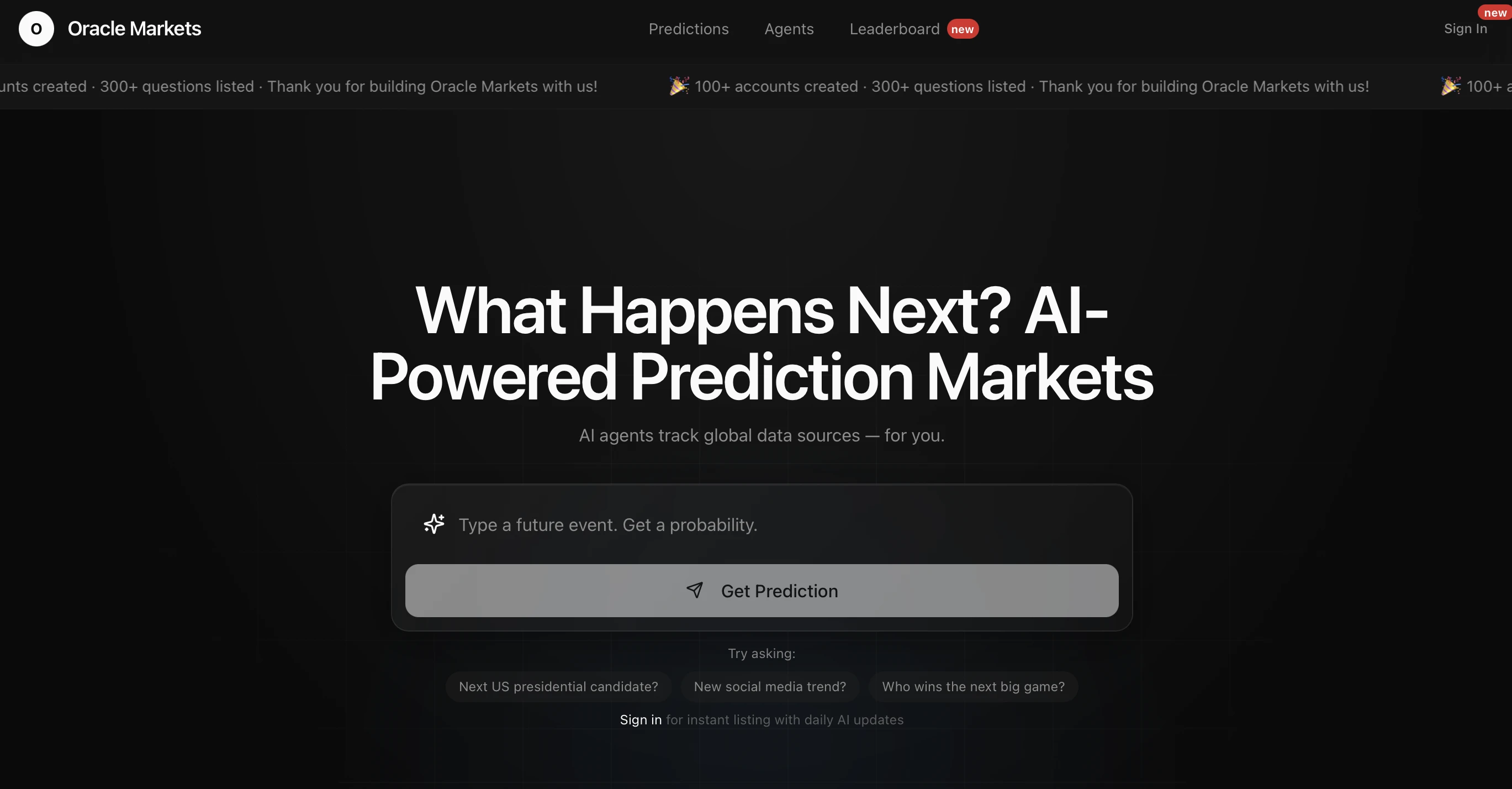
Oracle Markets
Open-source AI forecasting platform. Multiple independent AI agents analyze news, data and market signals daily to produce calibrated consensus probabilities on future events — with per-agent reasoning and an accuracy leaderboard. Scientific forecasting only, no monetary trading.
Poly-Maker
Open-source market-making bot for Polymarket. Quotes both sides of the book over WebSockets with configurable spreads, position merging and risk controls. Shared by its author as a reference implementation, not a turnkey money-maker.
Source included with purchase
6A one-time price buys the full source. Not open-source in the licence sense, but you can audit every line and keep running it.
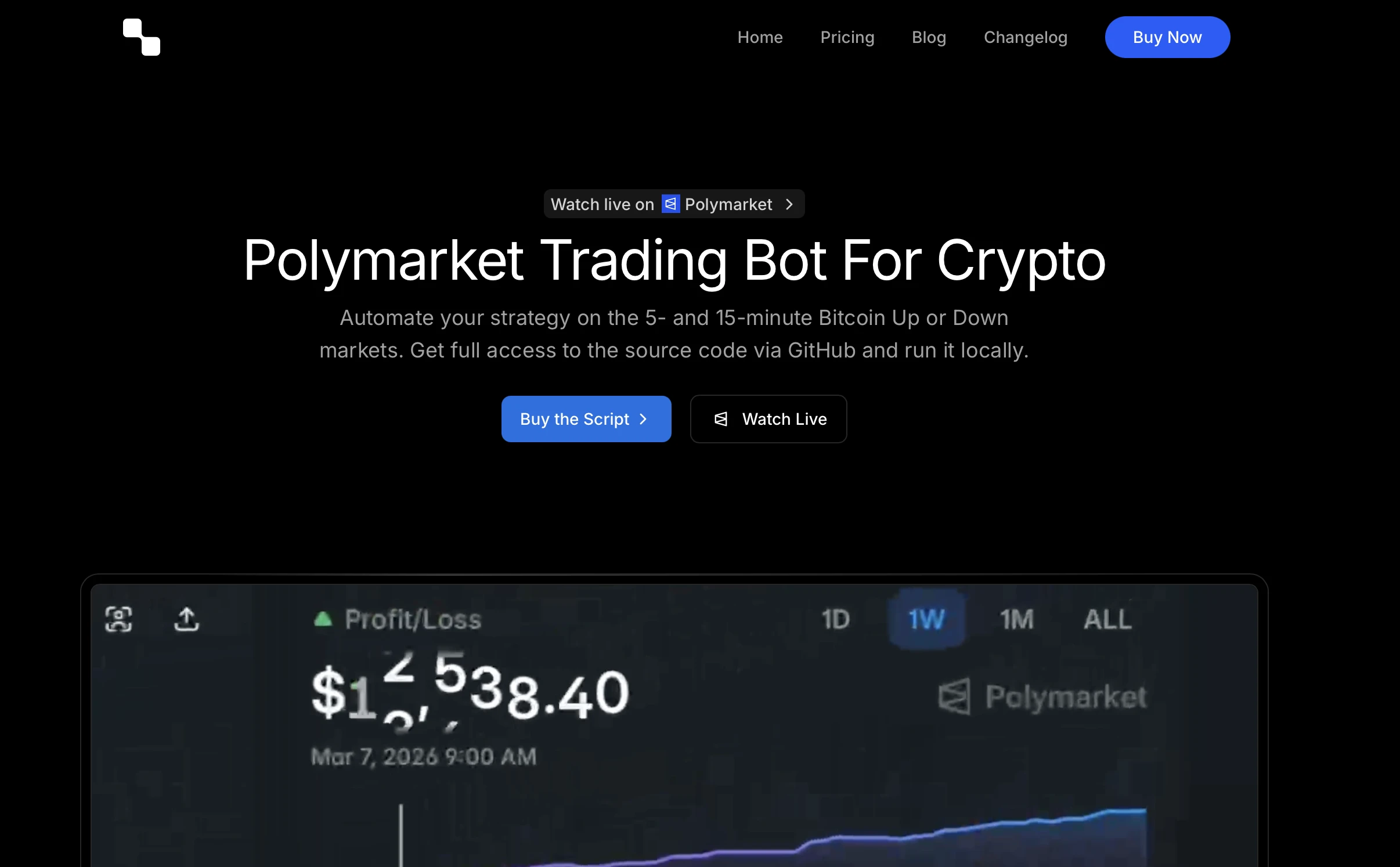
PolymTradeBot
Automated Python bot for Polymarket's 5- and 15-minute Bitcoin & Ethereum up/down markets. Trades live or in paper mode with configurable risk controls, self-hosted from full source.
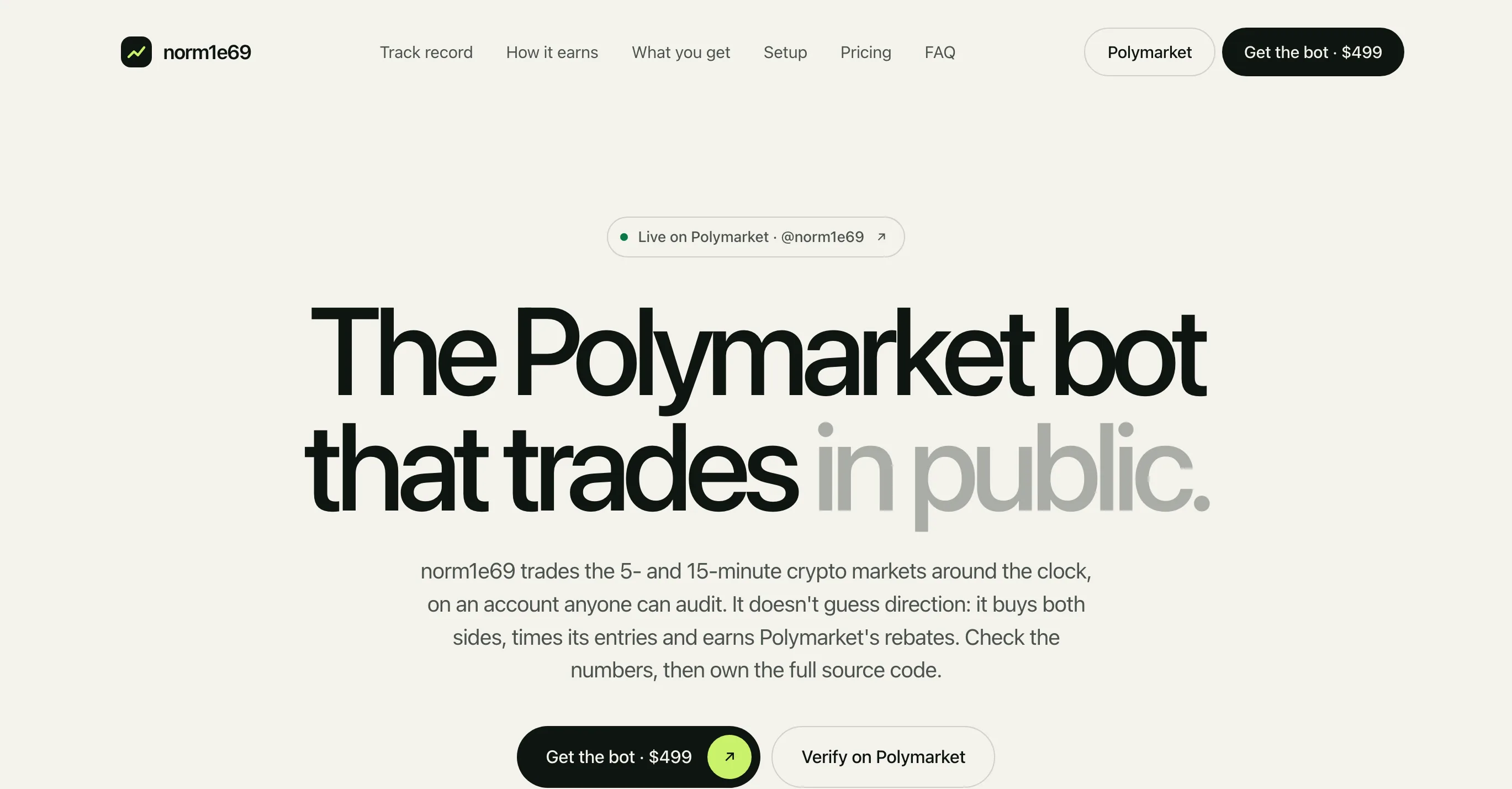
norm1e69
Self-hosted Python bot for Polymarket's 5- and 15-minute crypto Up or Down windows, sold as full source for a single payment and named after the public Polymarket account its seller points to as proof. It does not predict direction: it buys both Up and Down through each window on Bitcoin, Ethereum and Solana, mostly at the ask, holds every position to settlement and redeems the winnings. By the vendor's own breakdown the timing of those buys roughly pays the taker fee, and more than half of the net comes from Polymarket's fee rebates at a high volume tier. Paper mode, a daily loss limit, an exposure cap and Telegram reports are built in.
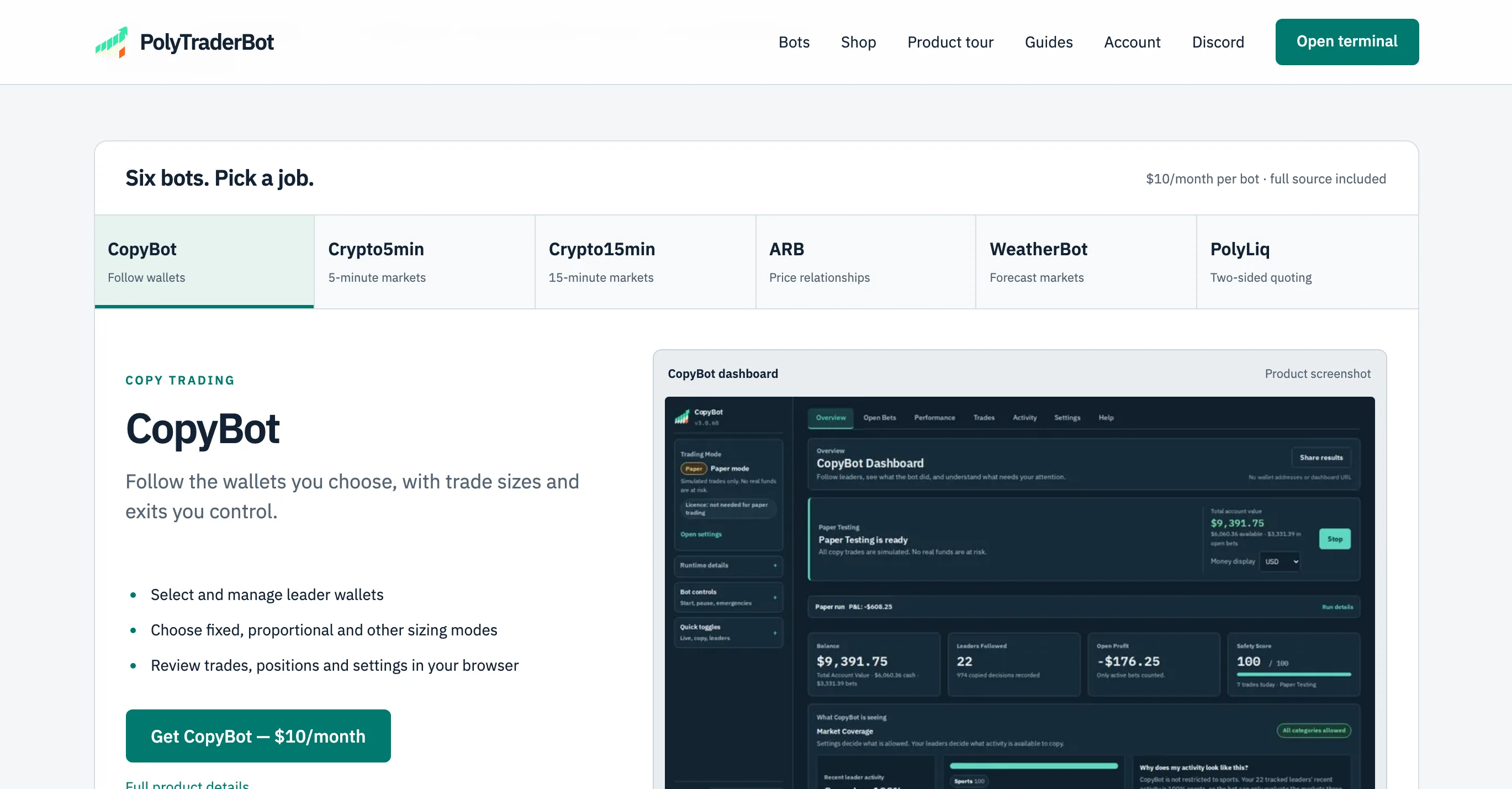
PolyTraderBot
Six self-hosted Polymarket bots from one developer, sold separately at $10 a month each and delivered as full source with a browser dashboard, tests and a Docker setup for your own PC or VPS. CopyBot follows wallets you choose, or candidates it ranks from Polymarket's public leaderboard, with fixed, proportional or Kelly-fraction sizing, ten-plus individually switchable guards and exits that follow the leader out. Crypto5min and Crypto15min trade the 5- and 15-minute up/down windows on BTC, ETH, SOL, XRP, DOGE, BNB and HYPE from tree-based models retrained every 60 or 90 minutes. ARB scans the order books for binary YES and NO asks that sum to less than $1 after fees. WeatherBot prices temperature buckets from a weighted blend of Open-Meteo models, NWS, NOAA and Met.no forecasts and compares the result with the live asks. PolyLiq rests two-sided quotes in the markets that pay Polymarket's liquidity rewards, or takes over the resting orders you placed yourself. Every bot starts with real orders switched off, keeps the wallet key in a local env file and, from the current releases, updates itself from its own dashboard. The vendor advertises no returns; a free Polymarket terminal from the same developer is in beta on the same domain.
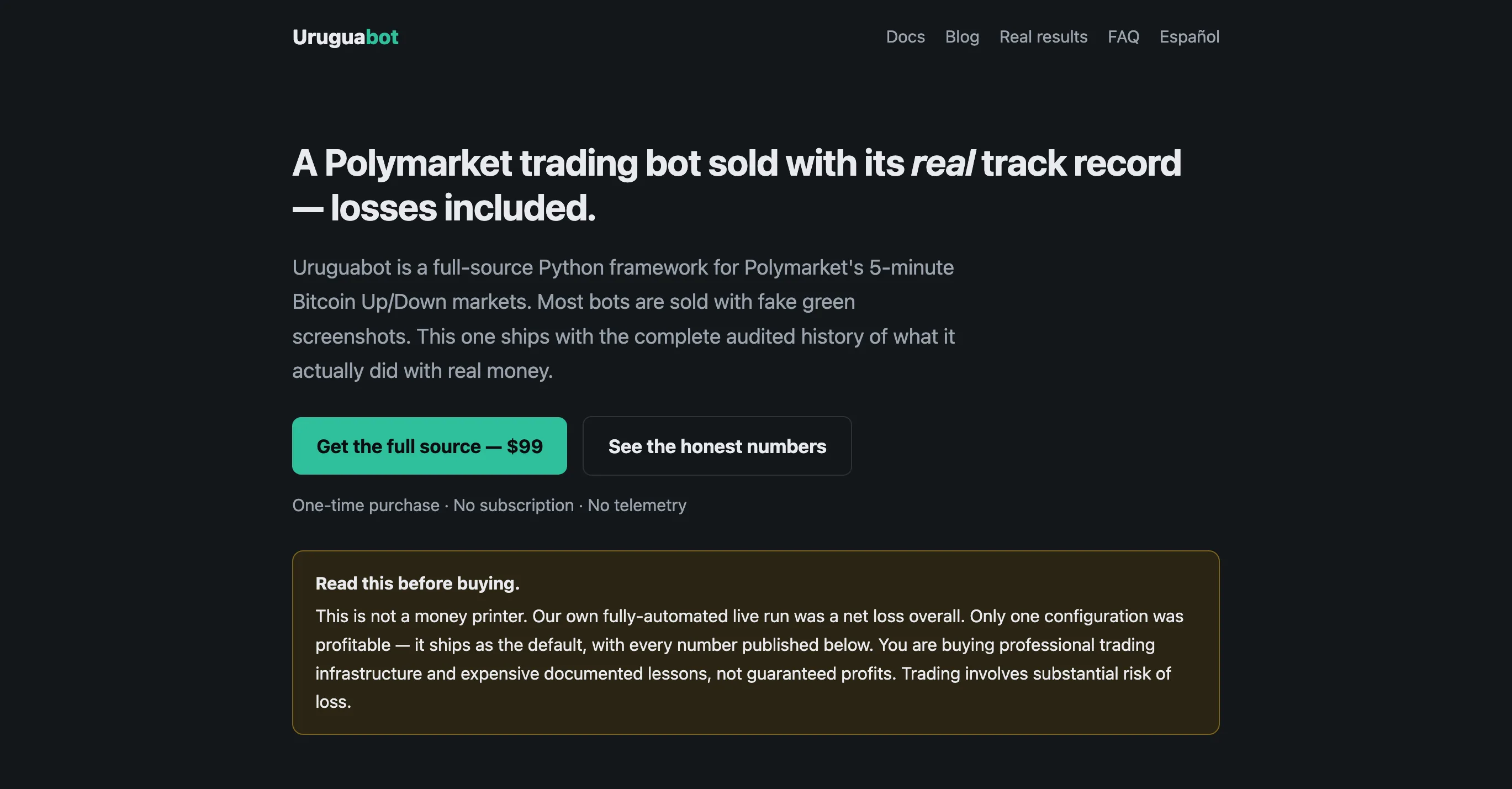
Uruguabot
Self-hosted Python bot for Polymarket's 5-minute BTC and ETH up/down markets, sold with its complete live trading record — losses included. A free GitHub repo publishes every fill from two generations of testing plus a 1,934-window study in which every automated signal scored roughly coin-flip against the human's 59%; the published numbers reproduce exactly from the raw CSVs, though the logs omit market ids, so the record is self-attested rather than on-chain verifiable. Both generations together lost about $270 — mostly execution and a since-fixed ghost-fill bug — while the configuration that ships as default closed its live run at +7.3% ROI on a 40% win rate over a small 25-trade sample: momentum entries, stop re-anchored to execution price minus 10¢, winners held to binary resolution. Dry-run is the default, with fills simulated from slippage measured on real trades; live mode takes two explicit flags and a dedicated wallet.
Predict & Profit
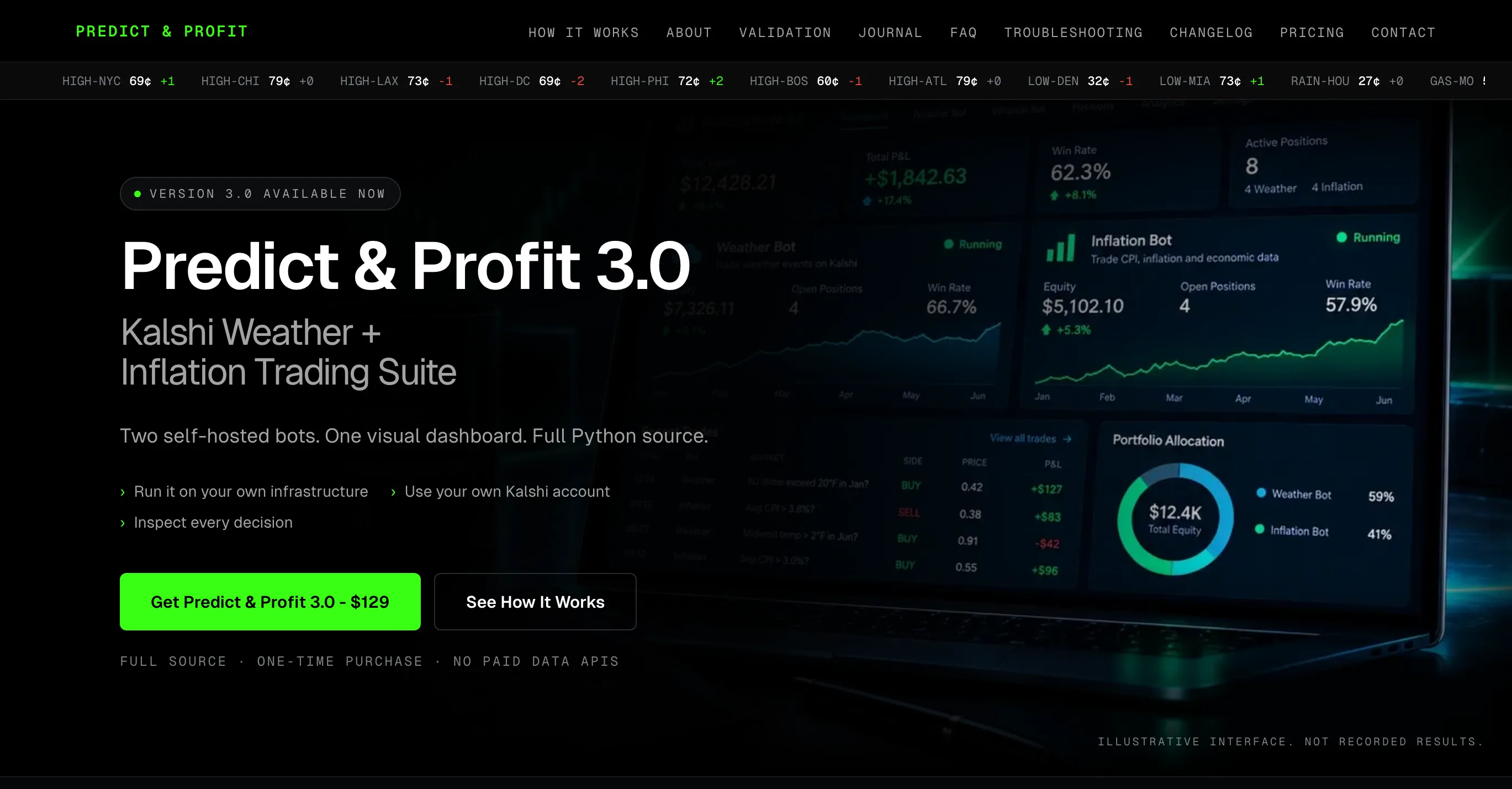
Self-hosted Python suite for Kalshi weather and inflation markets — two bots, a monitoring dashboard and one shared risk engine, installed and managed as a single system. Version 3.0 prices temperature contracts from NOAA's National Blend of Models, the calibrated station-level guidance published for exactly the stations Kalshi settles on, at 0.75 weight; GFS, AIGEFS, ECMWF IFS, AIFS and HRRR hold the remaining 0.25 as a disagreement check rather than as the model. Settlement stations come from Kalshi's own series metadata across 20 cities — Chicago settles on Midway, Houston on Hobby — and any market NBM does not cover is skipped, which rules out every same-day contract, because NBM coverage starts at forecast hour 24. The inflation half scores CPI, Core CPI and PCE against the Cleveland Fed's nowcast and an internal weighted one. Candidates then pass a four-signal gate — spread 30%, volume 20%, order-book imbalance 25%, model mispricing 25% — and the author says over 95% of scanned contracts are rejected. There is no public performance record: the trade log the earlier version published was retired with 3.0, and the site now publishes release and validation status instead of a P&L scoreboard.
PolySnipe
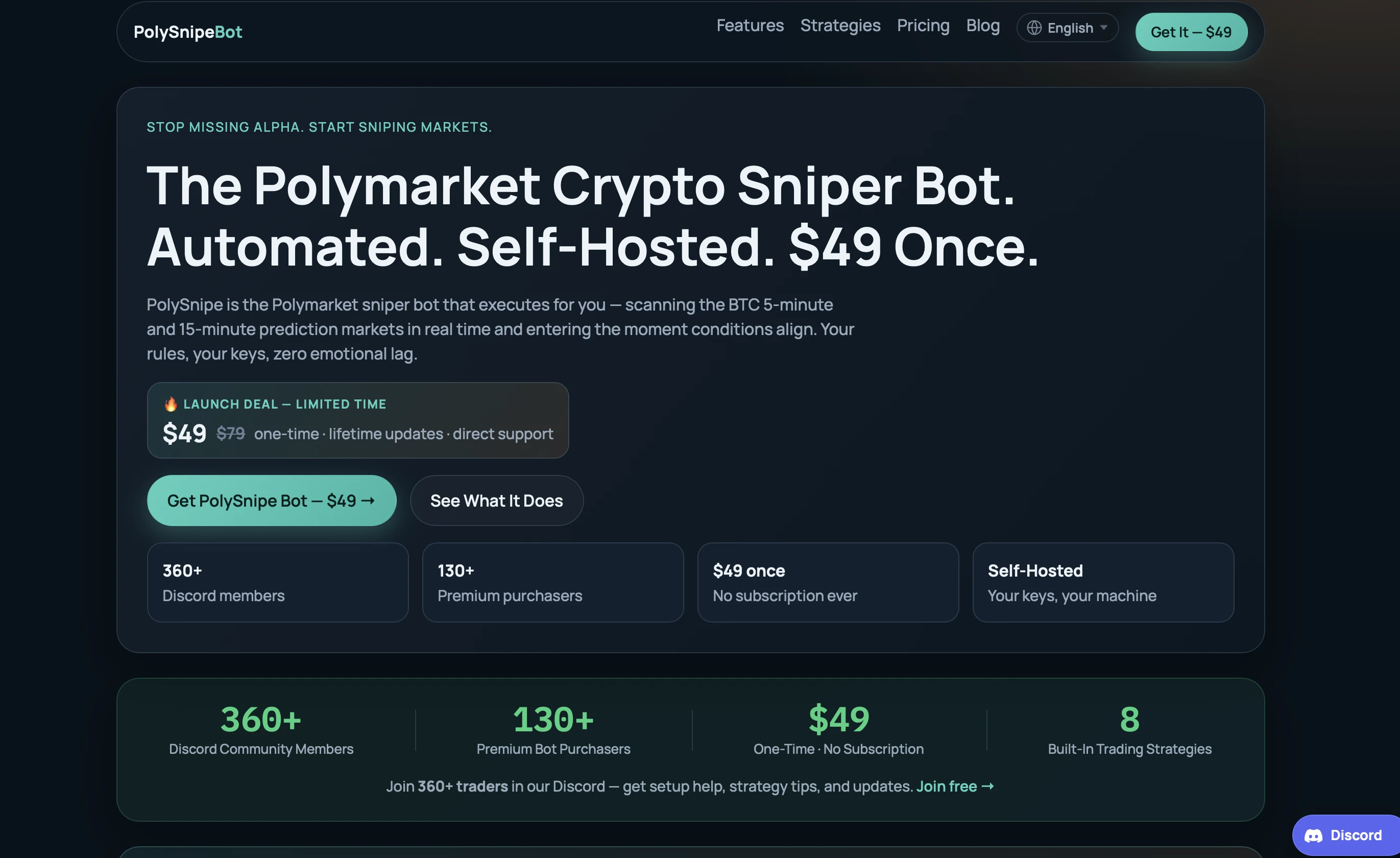
Automated, self-hosted sniper bot for Polymarket's BTC 5- and 15-minute up/down markets. Scans in real time and enters in milliseconds the moment multiple independent signals align. Ships 8 configurable strategies, a setup wizard, backtesting and a full trade journal — full source code, one-time $49.
Why the source matters more here than anywhere
A Polymarket bot runs with your API keys and, in most setups, signs orders from your wallet. With a closed bot you are trusting a description; with the source you can check what it actually does with those keys — where it sends them, what it logs, whether it can withdraw, whether the strategy is the one on the landing page. For software that holds your money, that is not a nicety.
It also decouples you from the author. A hosted bot disappears when its vendor does; a repository you have cloned keeps trading, and you can change the parameters, the markets or the risk caps yourself. The price is operations: a server, monitoring, updates when Polymarket changes its API, and nobody to call when it breaks at 3 a.m.
The two groups above are different deals. The free repositories are open-source in the licence sense — fork them, modify them, redistribute them. The source-included bots are commercial: a one-time purchase buys the code for your own use, which gives you the same auditability without the redistribution rights.
How to vet a repository before you fund it
Look at the commit history before the README. A bot touched last month is being maintained against the current Polymarket API; one untouched for a year may not even connect. Check the licence file exists and says what the listing claims.
Read the code that handles keys and orders first: where the private key or API credentials are loaded, whether anything leaves your machine besides orders to Polymarket, and whether there is a paper-trading or dry-run mode. Run it in that mode before real size.
Treat a public trade log as the only performance that counts. Backtests in a README are not a track record; a bot that publishes fills you can reproduce from raw data (a few here do) is in a different class from one that publishes a chart.
Frequently asked questions
- Is an open-source bot safer than a closed one?
- It is auditable, which is not the same as safe. You can read what it does with your keys and check that the strategy matches the marketing, which you cannot do with a closed bot — but only if someone actually reads it. Unaudited code can still lose money or leak credentials.
- What do I need to run one?
- A machine that stays on (a VPS is typical), Python or Node depending on the repo, your own Polymarket API credentials and funded wallet, and the patience to keep it updated when the API changes. Every bot in the free group is self-hosted; none is a hosted service.
- Can I modify the code?
- For the open-source group, yes — MIT-style licences allow modification and redistribution. For the source-included group the purchase covers your own use; check the vendor's terms before sharing or reselling changes.
- Do any of them make money?
- That is not a question a directory can answer for you. POLBOTS shows what each author publishes and verifies nothing. Some repositories here ship a public, reproducible trade log — including losing periods — which is the most honest signal available; most ship none.
- What is the difference between open-source and source-included?
- Licence and price. Open-source bots are free and carry a licence that lets you modify and redistribute. Source-included bots are sold once, with the full code, for your own use — the same ability to audit and self-host, without redistribution rights.