PolySigma vs Uruguabot
PolySigma and Uruguabot are both filed under Crypto Markets and Momentum. PolySigma is a trading platform that is paid; Uruguabot is an automated bot that is paid. Below: the facts side by side, where the two actually differ, and when each one is the better pick.
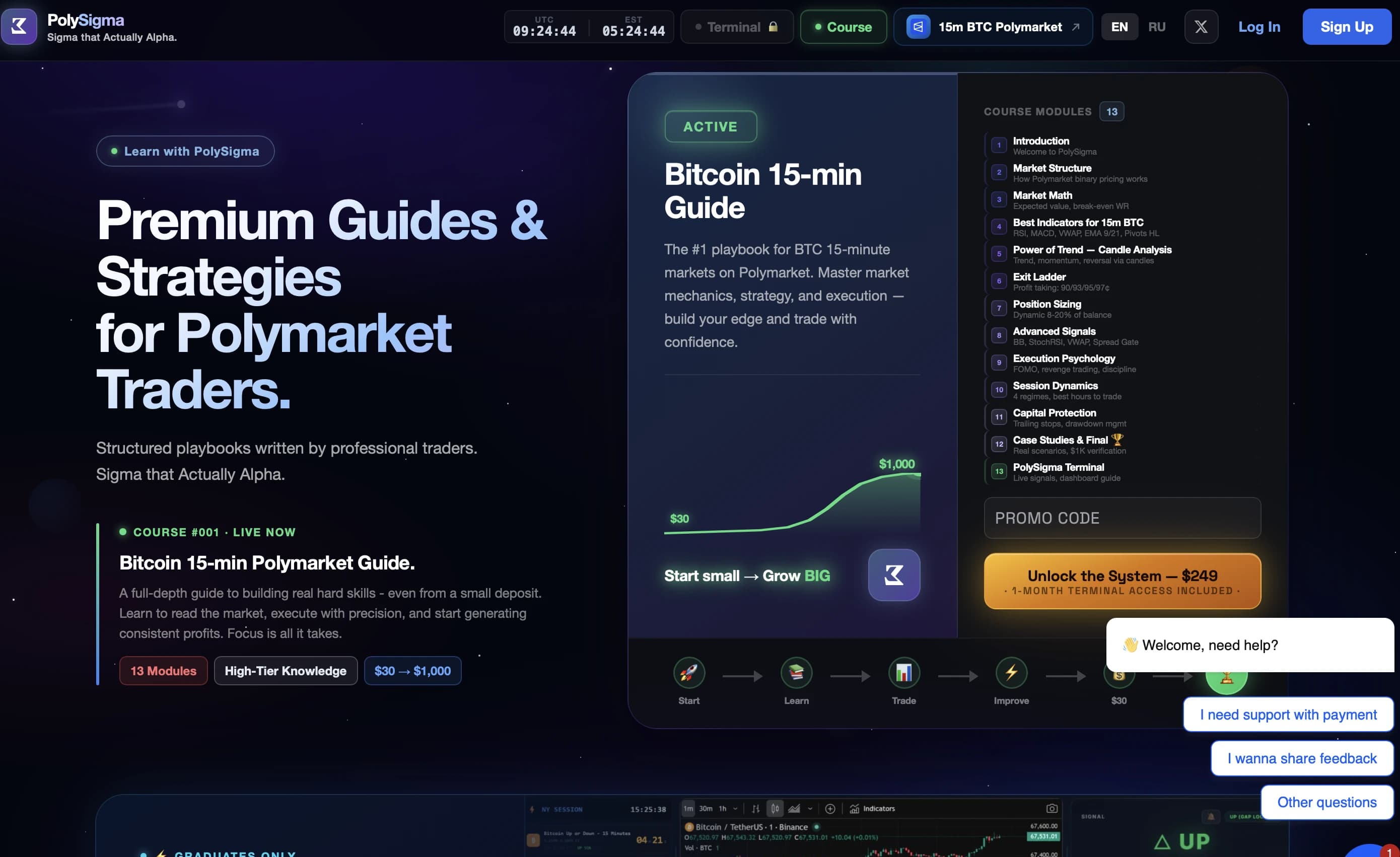
Premium strategy course and live signals terminal for Polymarket's BTC 15-minute markets.
Compared with Uruguabot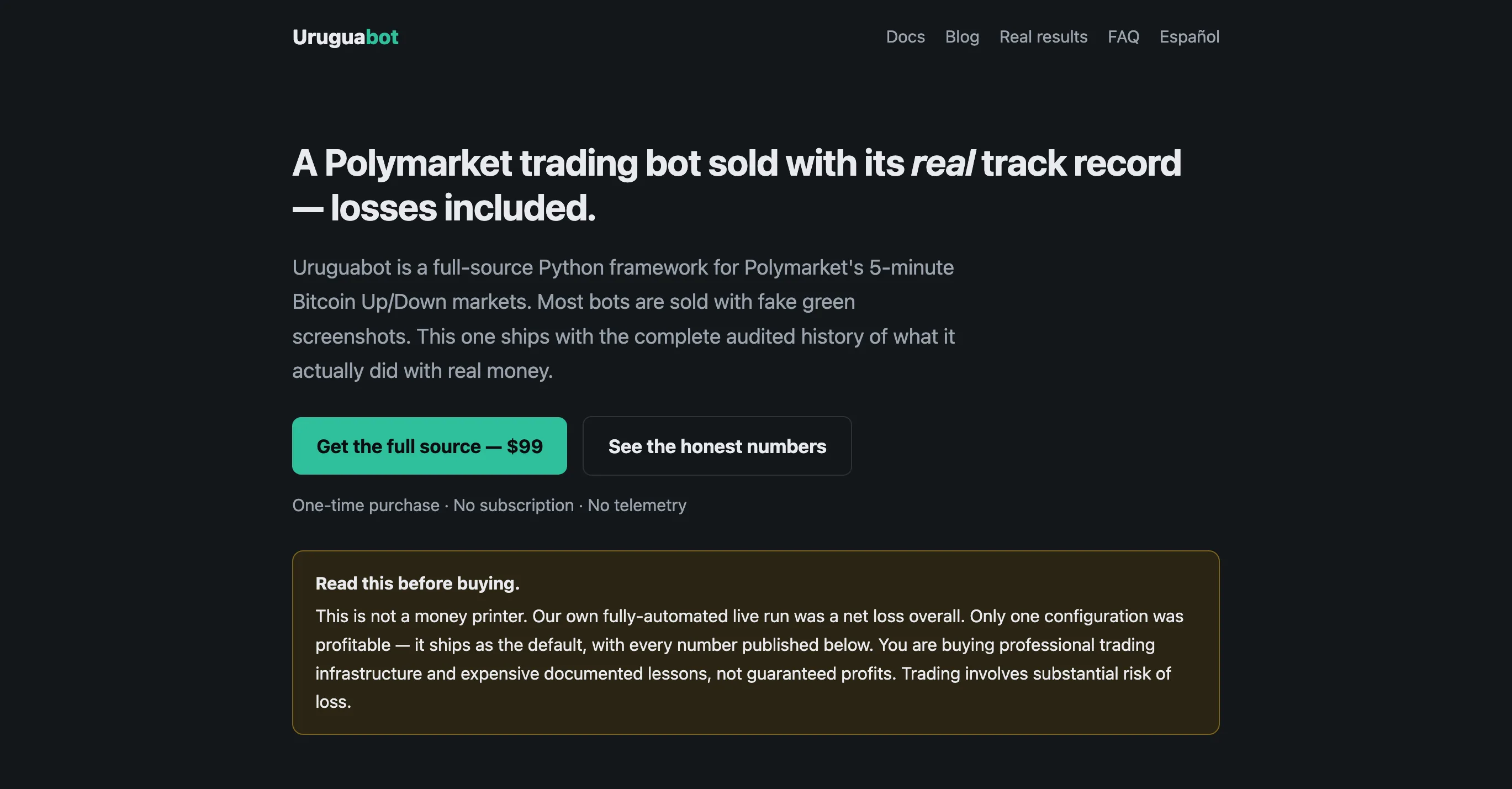
Uruguabot
Verified PartnerSelf-hosted Python bot for Polymarket's 5-minute BTC and ETH up/down markets, sold with its complete live trading record — losses included.
Compared with PolySigmaAt a glance
| Fact | PolySigma | Uruguabot |
|---|---|---|
| Type | Trading platform | Automated bot |
| Category | Crypto Markets | Crypto Markets |
| Also listed in | Scalping, Momentum | Momentum |
| Pricing | Paid | Paid |
| Price | one-time | one-time |
| Risk rating | Medium risk | High risk |
| Markets | BTC up/down · 15m | BTC up/down · 5m, ETH up/down · 5m, BTC/ETH up/down · 15m (tested in gen 1) |
| Source | Source not published | Source included with purchase |
| Runs in Telegram | No | No |
| Listed since | Jul 14, 2026 | Aug 20, 2026 |
Highlighted rows differ
Key differences
- Uruguabot is an automated bot that places orders for you; PolySigma is a manual platform — you decide every trade.
- They cover different markets: PolySigma lists BTC up/down · 15m, Uruguabot lists BTC up/down · 5m and ETH up/down · 5m and 1 more.
- PolySigma does not publish its source; Uruguabot ships the full source with the purchase.
- PolySigma is rated medium risk, Uruguabot high risk.
- Only PolySigma is filed under Scalping.
Choose PolySigma if…
- you want to stay in control of every order
- you trade BTC up/down · 15m
- you prefer the lower-risk profile (medium vs high)
- your focus is Scalping
Choose Uruguabot if…
- you want to read — and keep running — the code yourself
- you want the trading automated rather than done by hand
- you trade BTC up/down · 5m and ETH up/down · 5m and 1 more
What PolySigma does
Premium strategy course and live signals terminal for Polymarket's BTC 15-minute markets. A 13-module playbook covers market structure, indicators (RSI, MACD, VWAP, EMA), position sizing, exit ladders and trading psychology; graduates unlock the Prediction Terminal — a live quantitative system that surfaces edge in real time.
Features- 13-module BTC 15-min trading course by pro traders
- Indicator toolkit: RSI, MACD, VWAP, EMA 9/21, Bollinger, StochRSI
- Exit-ladder and dynamic position-sizing frameworks
- Execution psychology and capital-protection modules
- Prediction Terminal — live signals dashboard (1 month included)
- Teaches how Polymarket binary pricing, expected value and break-even work.
- Reads trend, momentum and reversals through candle and indicator analysis.
- Sizes positions dynamically and scales out on a fixed profit ladder.
What Uruguabot does
Self-hosted Python bot for Polymarket's 5-minute BTC and ETH up/down markets, sold with its complete live trading record — losses included. A free GitHub repo publishes every fill from two generations of testing plus a 1,934-window study in which every automated signal scored roughly coin-flip against the human's 59%; the published numbers reproduce exactly from the raw CSVs, though the logs omit market ids, so the record is self-attested rather than on-chain verifiable. Both generations together lost about $270 — mostly execution and a since-fixed ghost-fill bug — while the configuration that ships as default closed its live run at +7.3% ROI on a 40% win rate over a small 25-trade sample: momentum entries, stop re-anchored to execution price minus 10¢, winners held to binary resolution. Dry-run is the default, with fills simulated from slippage measured on real trades; live mode takes two explicit flags and a dedicated wallet.
Features- Full Python source, one-time purchase, bilingual EN/ES docs
- Published trade-by-trade record on GitHub: 4,086 gen-1 trades, 97 live gen-2 fills, raw CSVs under CC BY 4.0
- Dry-run simulator calibrated with slippage distributions measured from real fills, not zero-friction backtests
- Ghost-fill detection via USDC balance delta with on-chain fallback — the bug it fixes cost more than the strategy earned
- Asymmetric exits: stop at execution minus 10¢, winners held to $1 resolution
- Enters on multi-timeframe momentum consensus (30s/1m/5m) with entry gates — but the published audit shows the edge came from exit asymmetry, not prediction accuracy.
- Cuts losers at execution price minus 10¢ and holds winners to binary resolution, so average wins run about 3× average losses at a 40% win rate.
- Simulates first by default using friction measured from its own real fills, then requires deliberate opt-in for live trading.
More head-to-heads
Every fact on this page is taken from the two listings as their authors publish them; POLBOTS verifies neither performance nor claims and has no stake in either tool. Nothing here is financial advice.