Kairos vs Kuest
Kairos and Kuest are both filed under Platforms & Tools and Market Making. Both are trading platforms, and both are free. Below: the facts side by side, where the two actually differ, and when each one is the better pick.
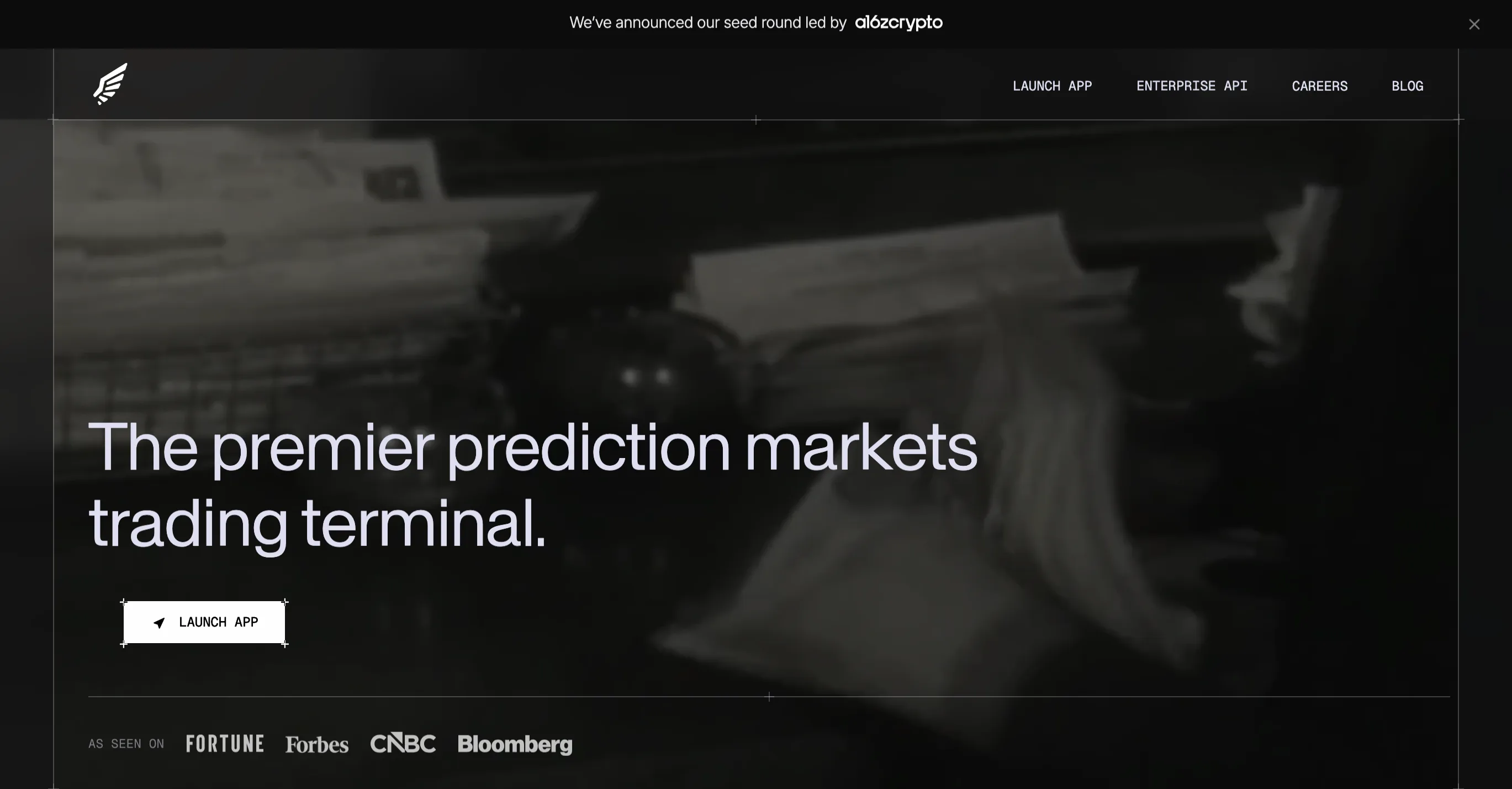
Cross-venue trading terminal that merges Kalshi, Polymarket and Predict.fun into one order book.
Compared with Kuest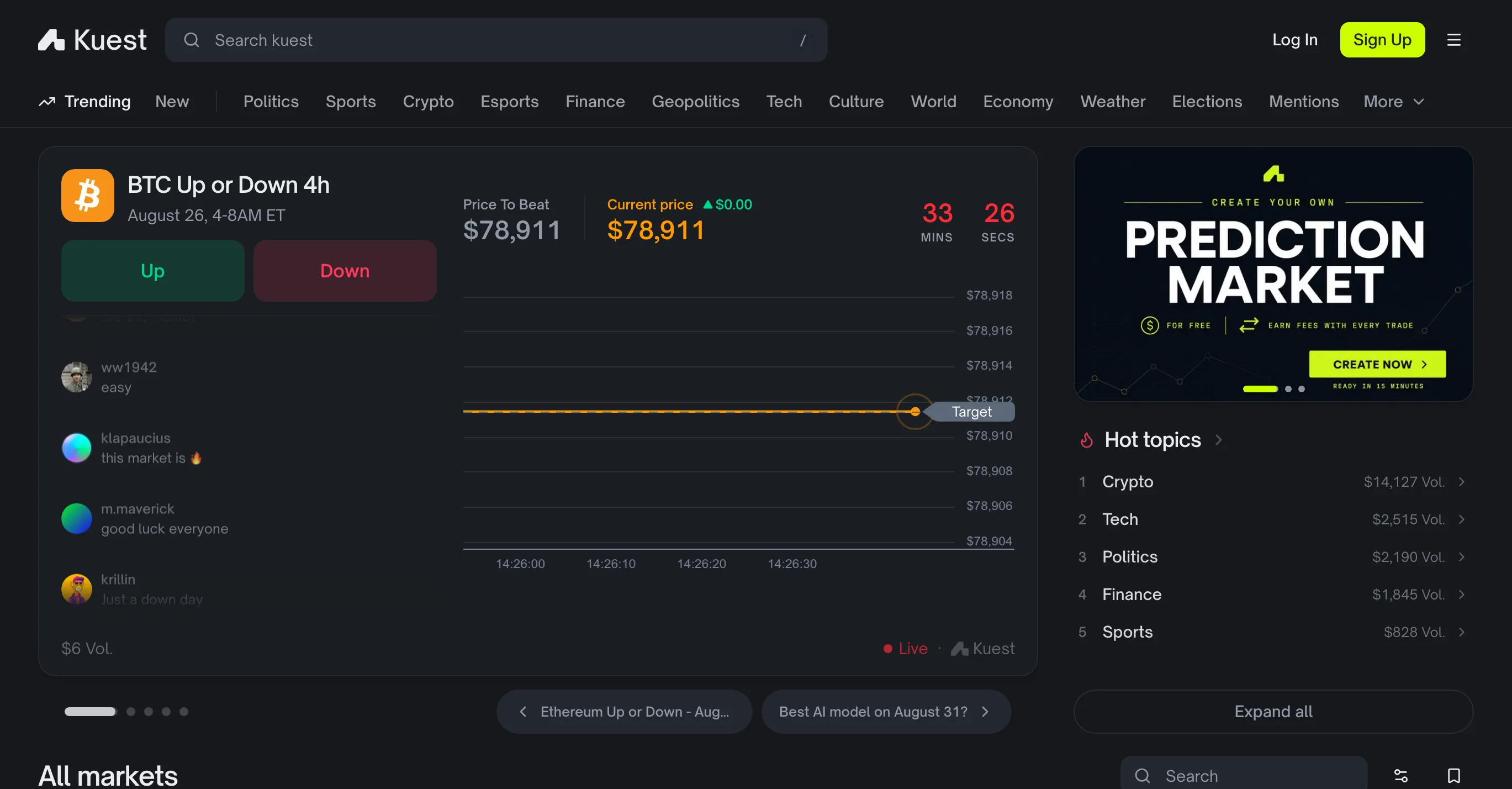
Open-source white-label infrastructure for launching your own Polymarket-style exchange — the team calls it the Shopify for prediction markets.
Compared with KairosAt a glance
| Fact | Kairos | Kuest |
|---|---|---|
| Type | Trading platform | Trading platform |
| Category | Platforms & Tools | Platforms & Tools |
| Also listed in | Arbitrage, Market Making | Market Making |
| Pricing | Free | Free |
| Price | free terminal · API by contract | free to launch |
| Risk rating | Medium risk | Medium risk |
| Markets | Kalshi, Polymarket and Predict.fun — trading and data, Hyperliquid HIP-4 outcome markets — data only, Every listed category, aggregated per event | Operator-defined event markets, Polymarket shared liquidity, Polygon / USDC |
| Source | Source not published | Open-source |
| Runs in Telegram | No | No |
| Listed since | Sep 15, 2026 | Aug 26, 2026 |
Highlighted rows differ
Key differences
- They cover different markets: Kairos lists Kalshi, Polymarket and Predict.fun — trading and data and Hyperliquid HIP-4 outcome markets — data only and 1 more, Kuest lists Operator-defined event markets and Polymarket shared liquidity and 1 more.
- Kairos does not publish its source; Kuest publishes its code under an open-source licence.
- Only Kairos is filed under Arbitrage.
Choose Kairos if…
- you trade Kalshi, Polymarket and Predict.fun — trading and data and Hyperliquid HIP-4 outcome markets — data only and 1 more
- your focus is Arbitrage
Choose Kuest if…
- you want to read — and keep running — the code yourself
- you trade Operator-defined event markets and Polymarket shared liquidity and 1 more
What Kairos does
Cross-venue trading terminal that merges Kalshi, Polymarket and Predict.fun into one order book. Matching contracts on different exchanges are shown as a single instrument with a composite ladder and a global best bid and offer, so you can see which venue is actually cheapest before you send, and an order to the NBBO endpoint routes to whichever book shows that price. Feeds are ingested next to the venues and merged in the browser with no polling interval; the ticket carries GTC, GTD, FOK, FAK and IOC time-in-force, post-only and slippage caps, with batch cancel and a per-venue kill switch. A bots panel runs parameterised templates — market making, cross-venue arbitrage, dip buying — against recorded books first and promotes the same config to live. The same engine is exposed as a REST and WebSocket API with scoped keys, IP whitelisting and a free read-only market-data tier. Built by a team from high-frequency trading firms and exchanges and backed by a $2.5M seed led by a16z.
Features- Composite order book and NBBO across three venues, with prices, probabilities and share counts normalised to one convention
- Sub-second colocated feeds merged client-side over WebSocket — quotes and fills land without polling
- Pro order ticket: GTC / GTD / FOK / FAK / IOC, post-only, slippage caps, batch cancel of up to 100 orders and a per-venue cancel-all kill switch
- Bot templates for market making, cross-venue arbitrage and dip buying, backtested on recorded books and promoted to live unchanged
- Draggable workspace with saved layouts, positions, orders, time and sales, holders and market rules on one screen
- Aggregation is the product: the same event often trades at different prices on Kalshi, Polymarket and Predict.fun, and a single-venue app cannot see the gap. Kairos builds one book across all of them so the cheapest side is visible and routable from one ticket.
- Execution is self-custodial through Turnkey enclaves — Kairos signs within a policy you set, or hands you an EIP-712 payload to sign yourself on allow-listed accounts — and keys are exportable. That is still signing authority held by a third party, which is why the custody line above does not say non-custodial.
- The bots are templates, not a track record: nothing on the site publishes live P&L for any strategy, and the terminal itself sits behind an account we did not create. What we exercised is the public surface — docs dated Aug 21, 2026, the data dashboard reading both venues' APIs, and the API endpoints answering as documented.
What Kuest does
Open-source white-label infrastructure for launching your own Polymarket-style exchange — the team calls it the Shopify for prediction markets. A guided no-code flow takes a branded site live in about 15 minutes on your own domain, with shared liquidity synced from live Polymarket order flow so the books aren't empty on day one, and a 0.5–3% per-trade fee you set yourself, paid straight to your wallet. Runs on Polygon with USDC settlement, ships Python and Rust SDKs compatible with existing Polymarket tooling, and the entire TypeScript stack is public on GitHub with 1,000+ stars.
Features- No-code launch in ~15 minutes on your own domain and brand
- Shared liquidity synced from live Polymarket markets
- Set your own 0.5–3% trade fee, paid directly to your wallet
- Open-source TypeScript stack — self-host or deploy on Vercel
- Python / Rust bot SDKs compatible with Polymarket tooling
- Guided setup deploys the full exchange stack — CLOB, wallets, settlement — with no backend work.
- Imports live Polymarket markets so your site opens with real order flow instead of empty books.
- Routes every trade's operator fee straight to your wallet on-chain, with no revenue share.
More head-to-heads
Every fact on this page is taken from the two listings as their authors publish them; POLBOTS verifies neither performance nor claims and has no stake in either tool. Nothing here is financial advice.