Kuest vs PolyData
Kuest and PolyData are both filed under Platforms & Tools and Market Making. Both are trading platforms, and both are free. Below: the facts side by side, where the two actually differ, and when each one is the better pick.
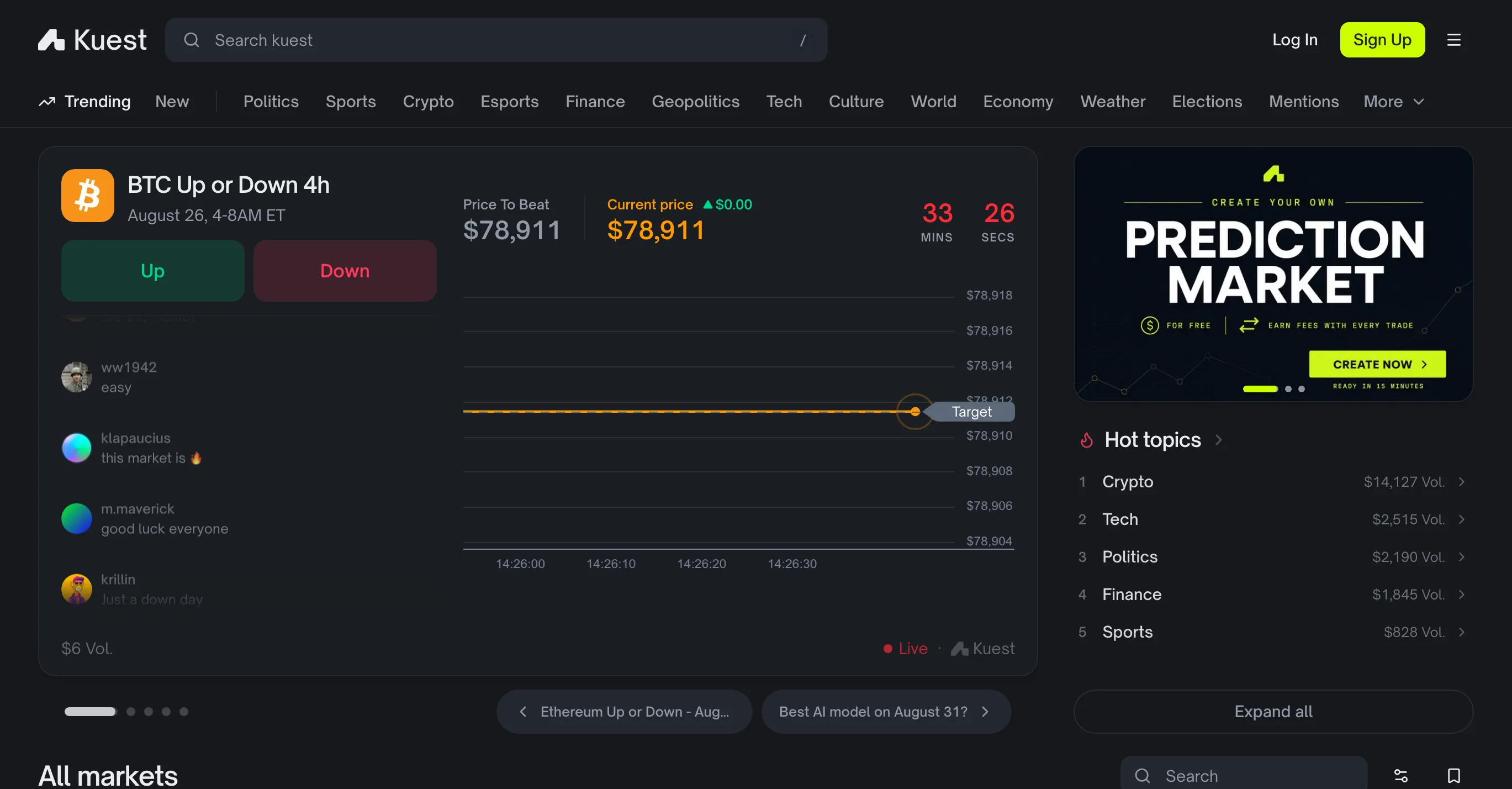
Open-source white-label infrastructure for launching your own Polymarket-style exchange — the team calls it the Shopify for prediction markets.
Compared with PolyData
Analytics workspace and trading terminal for Polymarket.
Compared with KuestAt a glance
| Fact | Kuest | PolyData |
|---|---|---|
| Type | Trading platform | Trading platform |
| Category | Platforms & Tools | Platforms & Tools |
| Also listed in | Market Making | Copy Trading, Market Making, Momentum |
| Pricing | Free | Free |
| Price | free to launch | free |
| Risk rating | Medium risk | Medium risk |
| Markets | Operator-defined event markets, Polymarket shared liquidity, Polygon / USDC | All Polymarket markets and On-chain wallet data |
| Source | Open-source | Source not published |
| Runs in Telegram | No | No |
| Listed since | Aug 26, 2026 | Jul 14, 2026 |
Highlighted rows differ
Key differences
- They cover different markets: Kuest lists Operator-defined event markets and Polymarket shared liquidity and 1 more, PolyData lists All Polymarket markets and On-chain wallet data.
- Kuest publishes its code under an open-source licence; PolyData does not publish its source.
- Only PolyData is filed under Copy Trading and Momentum.
Choose Kuest if…
- you want to read — and keep running — the code yourself
- you trade Operator-defined event markets and Polymarket shared liquidity and 1 more
Choose PolyData if…
- you trade All Polymarket markets and On-chain wallet data
- your focus is Copy Trading and Momentum
What Kuest does
Open-source white-label infrastructure for launching your own Polymarket-style exchange — the team calls it the Shopify for prediction markets. A guided no-code flow takes a branded site live in about 15 minutes on your own domain, with shared liquidity synced from live Polymarket order flow so the books aren't empty on day one, and a 0.5–3% per-trade fee you set yourself, paid straight to your wallet. Runs on Polygon with USDC settlement, ships Python and Rust SDKs compatible with existing Polymarket tooling, and the entire TypeScript stack is public on GitHub with 1,000+ stars.
Features- No-code launch in ~15 minutes on your own domain and brand
- Shared liquidity synced from live Polymarket markets
- Set your own 0.5–3% trade fee, paid directly to your wallet
- Open-source TypeScript stack — self-host or deploy on Vercel
- Python / Rust bot SDKs compatible with Polymarket tooling
- Guided setup deploys the full exchange stack — CLOB, wallets, settlement — with no backend work.
- Imports live Polymarket markets so your site opens with real order flow instead of empty books.
- Routes every trade's operator fee straight to your wallet on-chain, with no revenue share.
What PolyData does
Analytics workspace and trading terminal for Polymarket. Track positions, liquidity and market flow in real time, analyze any wallet's PnL, exposure and win rate from live on-chain data, rank top traders on a leaderboard, and execute in a focused terminal — from market signal to order entry in one place.
Features- Discover markets by liquidity, velocity, category and price movement
- Wallet analysis — positions, PnL, exposure, win rate
- Leaderboard ranking top traders by PnL, volume and win rate
- Live ecosystem dashboard: volume, active traders, open interest
- Focused trading terminal for fast order entry and clean exits
- Surfaces active Polymarket opportunities ranked by liquidity and momentum.
- Inspects wallet behavior, position exposure and market depth before you commit.
- Ranks top traders so you can follow the wallets shaping a market.
More head-to-heads
Every fact on this page is taken from the two listings as their authors publish them; POLBOTS verifies neither performance nor claims and has no stake in either tool. Nothing here is financial advice.