PolyTraderBot vs Predict & Profit
PolyTraderBot and Predict & Profit are both filed under Arbitrage and Weather Markets. Both are automated bots, and both are paid. Below: the facts side by side, where the two actually differ, and when each one is the better pick.
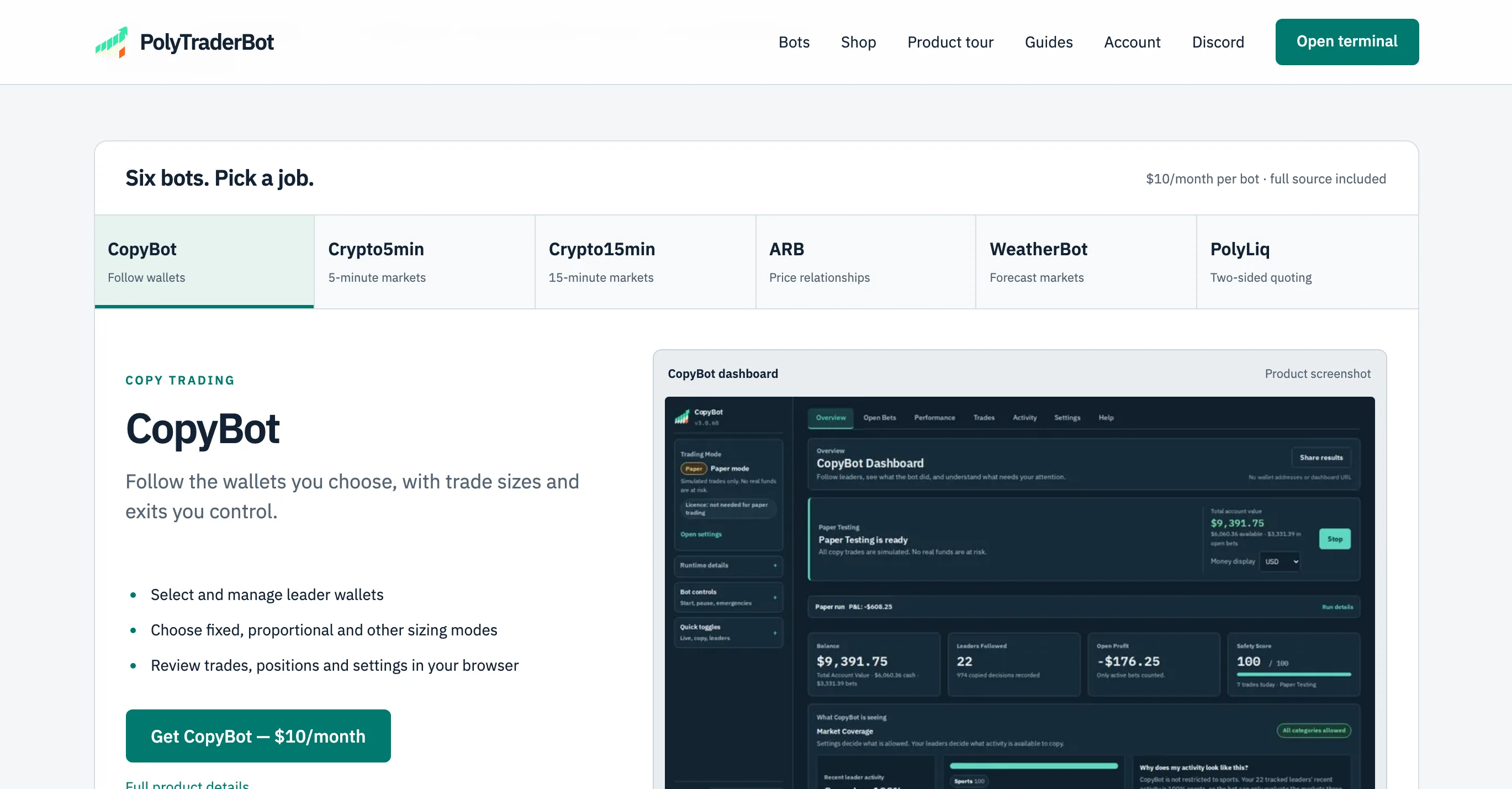
Six self-hosted Polymarket bots from one developer, sold separately at $10 a month each and delivered as full source with a browser dashboard, tests and a Docker setup for your own PC or VPS.
Compared with Predict & Profit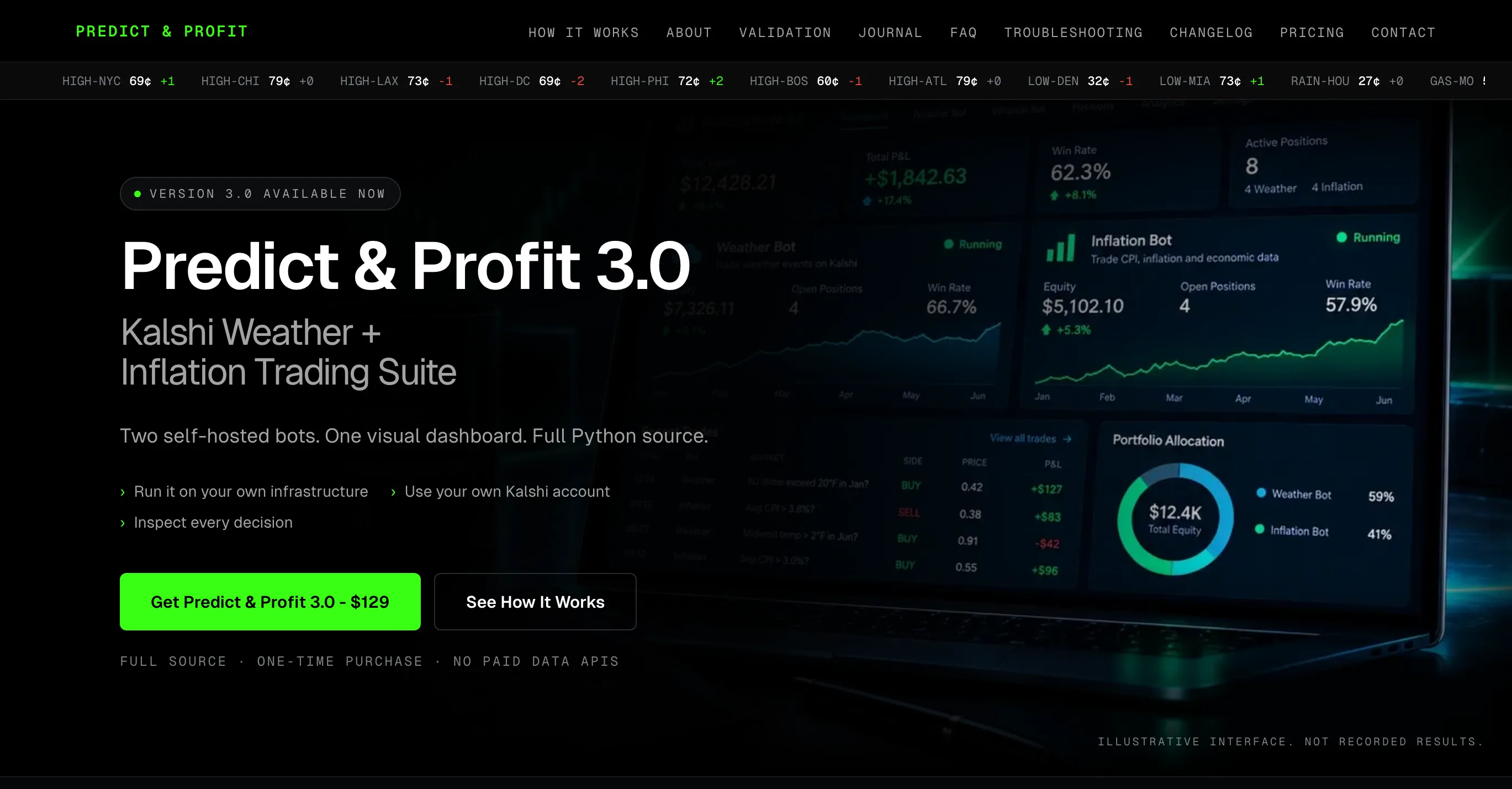
Self-hosted Python suite for Kalshi weather and inflation markets — two bots, a monitoring dashboard and one shared risk engine, installed and managed as a single system.
Compared with PolyTraderBotAt a glance
| Fact | PolyTraderBot | Predict & Profit |
|---|---|---|
| Type | Automated bot | Automated bot |
| Category | Copy Trading | Weather Markets |
| Also listed in | Crypto Markets, Arbitrage, Weather Markets, Market Making | Arbitrage |
| Pricing | Paid | Paid |
| Price | $10/mo per bot | one-time |
| Risk rating | High risk | Medium risk |
| Markets | Any Polymarket market a followed wallet trades — short crypto windows skipped by default (CopyBot), Crypto up/down · 5m and 15m — BTC, ETH, SOL, XRP, DOGE, BNB, HYPE, Binary YES/NO pairs across the order book; multi-outcome baskets only behind an experimental switch (ARB) and 2 more | Kalshi weather · 20 US cities and CPI / Core CPI / PCE |
| Source | Source included with purchase | Source included with purchase |
| Runs in Telegram | No | No |
| Listed since | Sep 30, 2026 | Jul 16, 2026 |
Highlighted rows differ
Key differences
- Both are paid, but on different terms: PolyTraderBot is $10/mo per bot, Predict & Profit is one-time.
- They cover different markets: PolyTraderBot lists Any Polymarket market a followed wallet trades — short crypto windows skipped by default (CopyBot) and Crypto up/down · 5m and 15m — BTC, ETH, SOL, XRP, DOGE, BNB, HYPE and 3 more, Predict & Profit lists Kalshi weather · 20 US cities and CPI / Core CPI / PCE.
- PolyTraderBot is rated high risk, Predict & Profit medium risk.
- Only PolyTraderBot is filed under Copy Trading and Crypto Markets and 1 more.
- Predict & Profit has been listed since Jul 16, 2026; PolyTraderBot joined on Sep 30, 2026.
Choose PolyTraderBot if…
- you trade Any Polymarket market a followed wallet trades — short crypto windows skipped by default (CopyBot) and Crypto up/down · 5m and 15m — BTC, ETH, SOL, XRP, DOGE, BNB, HYPE and 3 more
- your focus is Copy Trading and Crypto Markets and 1 more
Choose Predict & Profit if…
- you trade Kalshi weather · 20 US cities and CPI / Core CPI / PCE
- you prefer the lower-risk profile (medium vs high)
What PolyTraderBot does
Six self-hosted Polymarket bots from one developer, sold separately at $10 a month each and delivered as full source with a browser dashboard, tests and a Docker setup for your own PC or VPS. CopyBot follows wallets you choose, or candidates it ranks from Polymarket's public leaderboard, with fixed, proportional or Kelly-fraction sizing, ten-plus individually switchable guards and exits that follow the leader out. Crypto5min and Crypto15min trade the 5- and 15-minute up/down windows on BTC, ETH, SOL, XRP, DOGE, BNB and HYPE from tree-based models retrained every 60 or 90 minutes. ARB scans the order books for binary YES and NO asks that sum to less than $1 after fees. WeatherBot prices temperature buckets from a weighted blend of Open-Meteo models, NWS, NOAA and Met.no forecasts and compares the result with the live asks. PolyLiq rests two-sided quotes in the markets that pay Polymarket's liquidity rewards, or takes over the resting orders you placed yourself. Every bot starts with real orders switched off, keeps the wallet key in a local env file and, from the current releases, updates itself from its own dashboard. The vendor advertises no returns; a free Polymarket terminal from the same developer is in beta on the same domain.
Features- CopyBot — follow wallets you add or candidates ranked from Polymarket's public leaderboard by past results, settled history, activity and copyability; fixed, proportional or Kelly-fraction sizing; separate toggles for price-drift, spread, volume, extreme-price, duplicate-market and wash-trade guards; leader-exit detection with a 5-minute minimum hold
- Crypto5min and Crypto15min — seven assets each; tree-based models retrained every 60 and 90 minutes; maker-first, taker-only or maker-only orders; fixed, percent or fractional-Kelly sizing; confidence threshold, daily-loss limit and losing-streak pause; paper, dry-run and live modes switched from the dashboard
- ARB — WebSocket scan of up to 4,000 token books for YES + NO asks under $1; a minimum net profit after taker fees; fill-or-kill entries with retry-and-shrink and a fill-and-kill fallback; millisecond limits on book age and leg skew; daily loss limit and position caps
- WeatherBot — Open-Meteo global and regional models, NWS and NBM, NOAA TAF and METAR, HRRRCast and Met.no, each with its own weight; settlement station read from the market's rules; source disagreement lowers confidence; bias calibration applied only when it beats the raw blend on a recent holdout; best-bucket, adjacent-bucket ladder and low-probability NO approaches
- PolyLiq — Automatic Mode ranks reward markets by the share of the daily pool its own score would win and quotes both sides of YES inside the incentive band; Manual Mode takes over GTC orders you placed, rechecks prices every 30 seconds and restores unfilled size; inventory cap; Polymarket's published scoring formula
- Six products, not one suite: each bot is its own subscription, its own download and its own dashboard. What $10 buys is a Source Access licence — read the code and modify it privately, run it on two machines, no redistribution — tied to a licence key in a local file. The bot checks that key against PolyTraderBot's entitlement service, sending the product, the key, its version and a one-way hash of a machine fingerprint, and runs on signed leases with a limited offline window. When a subscription lapses the bot stops opening new or larger positions but, by the licence's own wording, can still cancel orders, close or reduce positions, redeem settled markets and withdraw, and the vendor undertakes not to delete your files remotely.
- “Paper mode by default” holds for five of the six. Crypto5min, Crypto15min, WeatherBot and PolyLiq start in paper mode and ARB in the dry-run it uses for paper trading; CopyBot starts with live buying switched off and paper trading as a separate toggle, and in that state it may still cash out winners and redeem resolved positions already in the wallet. The wallet key sits in an env file on your machine, and the privacy policy says the bots send no keys, trades or telemetry to the vendor — a statement we could not test without the source. Two cautions come from the vendor's own guides. The dashboard updater needs the Docker socket mounted, so anyone who reaches a dashboard can control Docker on that machine: WeatherBot and PolyLiq bind to localhost by default, while CopyBot and ARB listen on every interface unless told otherwise. And the AI Setup Assistant guide suggests pointing a coding assistant at the bot folder to read the env file — with a cloud assistant that passes the wallet key to the assistant's provider, whatever the prompt says about redacting it; the same guide's local-model route avoids that.
- Where the landing pages and the guides disagree, the guides are the more careful document. The ARB page sells complement and negative-risk baskets, while its guide says customer releases ship with negative-risk execution locked off behind an explicit experimental acknowledgement, leaving binary complement arb as the live default. The Crypto5min page leads with a CNN-LSTM network; the guide says the default is a lighter LightGBM and CatBoost stack and calls the CNN-LSTM an older backend kept for testing. The Crypto15min page's comparison table marks its delta-first mode as the default, while that page's own FAQ and the guide both have it off. The late-window entry mode the same page labels “Higher hit-rate” is, in the guides, off by default and assumes no fixed win rate, and the delta-first variant built on it “is not treated as validated until your own settled results show positive net performance”.
What Predict & Profit does
Self-hosted Python suite for Kalshi weather and inflation markets — two bots, a monitoring dashboard and one shared risk engine, installed and managed as a single system. Version 3.0 prices temperature contracts from NOAA's National Blend of Models, the calibrated station-level guidance published for exactly the stations Kalshi settles on, at 0.75 weight; GFS, AIGEFS, ECMWF IFS, AIFS and HRRR hold the remaining 0.25 as a disagreement check rather than as the model. Settlement stations come from Kalshi's own series metadata across 20 cities — Chicago settles on Midway, Houston on Hobby — and any market NBM does not cover is skipped, which rules out every same-day contract, because NBM coverage starts at forecast hour 24. The inflation half scores CPI, Core CPI and PCE against the Cleveland Fed's nowcast and an internal weighted one. Candidates then pass a four-signal gate — spread 30%, volume 20%, order-book imbalance 25%, model mispricing 25% — and the author says over 95% of scanned contracts are rejected. There is no public performance record: the trade log the earlier version published was retired with 3.0, and the site now publishes release and validation status instead of a P&L scoreboard.
Features- NOAA National Blend of Models at 0.75 weight — mean, sigma and percentiles for the settlement station, interpolated with normal tails beyond P10/P90 and sigma × 1.15 for fat tails
- GFS, AIGEFS, ECMWF IFS, AIFS and HRRR at 0.25 combined, kept as a disagreement check; AIGEFS and HRRR are pulled as byte ranges out of GRIB2 files on S3
- 20 Kalshi cities, with the settlement station read from Kalshi's series metadata instead of guessed from the city name
- Inflation bot on CPI, Core CPI and PCE against the Cleveland Fed's nowcast and an internal weighted one, with FRED and BLS inputs when their free keys are configured
- One account-risk engine across both bots: cost cap per trade, per-city and per-series exposure limits, and a daily-loss kill switch
- Prices every temperature contract from NOAA's published percentiles for the station that contract settles on.
- Declines any market NBM cannot price, including every same-day contract.
- Scores spread, volume, order-book imbalance and model mispricing into one composite before an order goes out.
More head-to-heads
Every fact on this page is taken from the two listings as their authors publish them; POLBOTS verifies neither performance nor claims and has no stake in either tool. Nothing here is financial advice.