ArbEdge vs Arbitrage Agent
ArbEdge and Arbitrage Agent are both filed under Arbitrage and Platforms & Tools. Both are trading platforms, and both are paid. Below: the facts side by side, where the two actually differ, and when each one is the better pick.
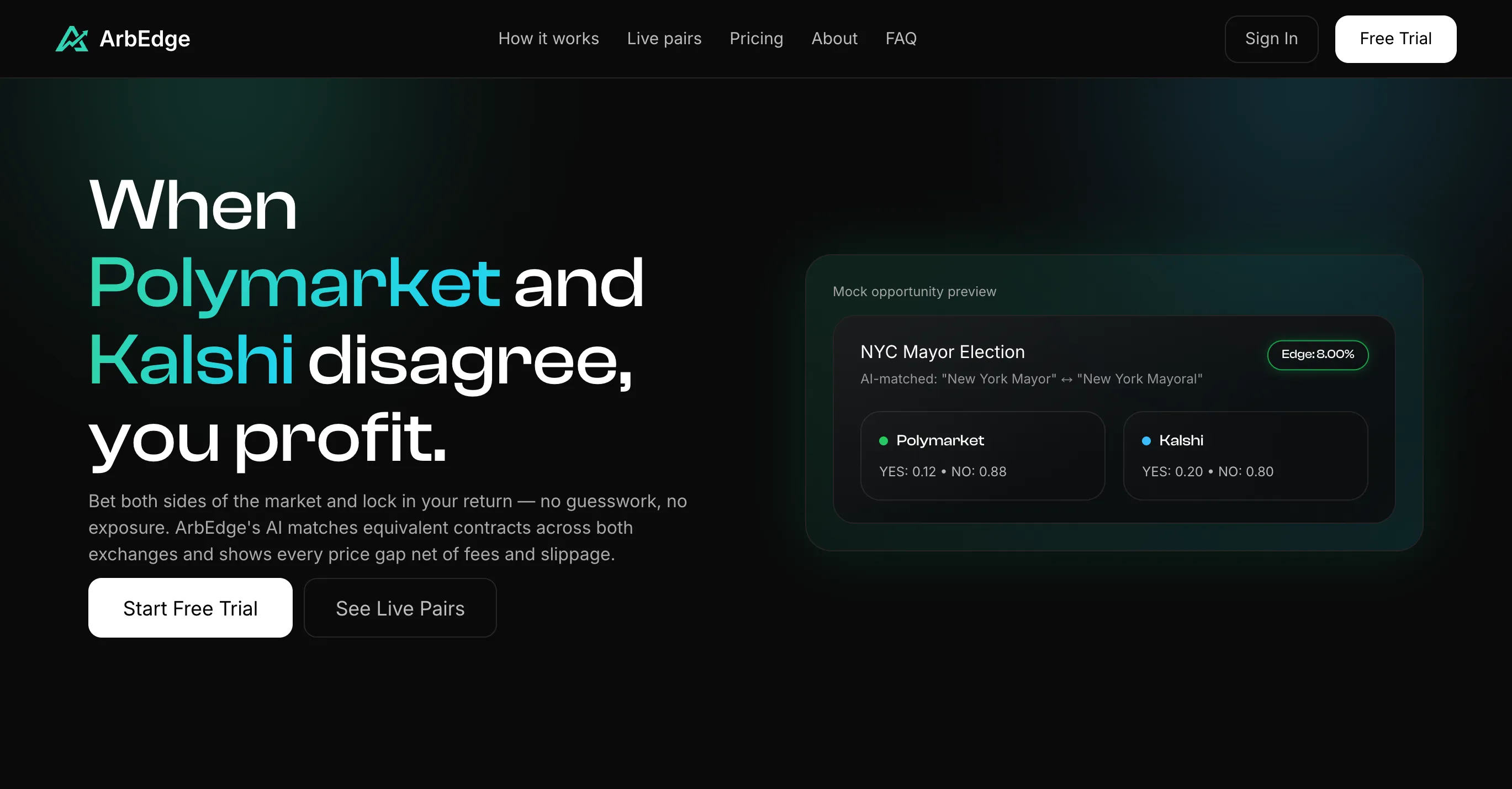
Polymarket × Kalshi arbitrage scanner. Every 5 minutes it re-prices each pair of markets that ask the same question on both venues — matched by an AI pipeline that reads the full resolution rules — at the average cost of filling 100 contracts from each order…
Compared with Arbitrage Agent
Arbitrage scanner for the same event on Kalshi and Polymarket.
Compared with ArbEdgeAt a glance
| Fact | ArbEdge | Arbitrage Agent |
|---|---|---|
| Type | Trading platform | Trading platform |
| Category | Arbitrage | Arbitrage |
| Also listed in | Platforms & Tools, Sports Trading | Platforms & Tools, Market Making, Sentiment / News |
| Pricing | Paid | Paid |
| Price | $12.99/mo | from $29/mo |
| Risk rating | Low risk | Low risk |
| Markets | Polymarket and Kalshi binary markets that list the same event | Kalshi and Polymarket binary markets that list the same event, filtered by volume, liquidity and time to close |
| Source | Source not published | Source not published |
| Runs in Telegram | No | No |
| Listed since | Nov 2, 2026 | Oct 31, 2026 |
Highlighted rows differ
Key differences
- Both are paid, but on different terms: ArbEdge is $12.99/mo, Arbitrage Agent is from $29/mo.
- They cover different markets: ArbEdge lists Polymarket and Kalshi binary markets that list the same event, Arbitrage Agent lists Kalshi and Polymarket binary markets that list the same event, filtered by volume, liquidity and time to close.
- Only ArbEdge is filed under Sports Trading, and only Arbitrage Agent is filed under Market Making and Sentiment / News.
Choose ArbEdge if…
- you trade Polymarket and Kalshi binary markets that list the same event
- your focus is Sports Trading
Choose Arbitrage Agent if…
- you trade Kalshi and Polymarket binary markets that list the same event, filtered by volume, liquidity and time to close
- your focus is Market Making and Sentiment / News
What ArbEdge does
Polymarket × Kalshi arbitrage scanner. Every 5 minutes it re-prices each pair of markets that ask the same question on both venues — matched by an AI pipeline that reads the full resolution rules — at the average cost of filling 100 contracts from each order book, subtracts both venues' taker fees, and lists only the pairs that still pay, with the stake for each leg and a link to place it. You trade by hand on your own accounts. One plan, $12.99 a month after a 14-day trial that needs a card; an automated bot and an API at $19.99 are marked “coming soon”.
Features- Scan of every matched Polymarket–Kalshi pair every 5 minutes, around the clock
- Pairs matched by an AI pipeline on the full resolution rules, re-validated on each scan
- Each leg priced at the volume-weighted cost of filling 100 contracts, with both taker fees subtracted
- Pairs too thin to fill 100 contracts are left out
- Enter a stake and get the dollar amount for each leg, with links to both markets
- A cheap, narrow tool that does one thing and says how it does it: two venues, a 5-minute scan, profit shown after fees and after slippage at a 100-contract fill. Its FAQ is honest about what remains — prices that move before you fill both legs, sizes beyond the depth it measured, and voided events the two venues may settle differently.
- The live sample on the home page checks out. On Nov 2, 2026 it showed Karl-Anthony Towns to lead the NBA in rebounds per game, Yes on Kalshi at 11¢ and No on Polymarket at 83¢, and Jayson Tatum for MVP, No on Kalshi at 91¢ and Yes on Polymarket at 4¢; both venues' public order books matched those prices that morning. Both markets resolve at the end of the 2026–27 season, so the 4–5% they show ties the money up for about eight months, and Kalshi's side had only 550 contracts on offer at 11¢. The NYC mayor card at the top of the page is labelled a mock.
- The about page's “risk-free” and “free money” overstate it, as its own FAQ admits. ArbEdge says it never holds or touches your funds, and the scanner needs no keys. The site names no company or founder — the footer links an X account, @usemako — and the terms fall under United States law. We found no Polymarket builder record under its name. We read the home, pricing, about, terms and risk pages and checked the two live pairs against Polymarket's and Kalshi's public APIs; we did not start the trial, so the dashboard is untested by us.
What Arbitrage Agent does
Arbitrage scanner for the same event on Kalshi and Polymarket. It pairs markets that ask the same question in different words — with OpenAI embeddings and a reranker that compares resolution rules — recomputes the spread on every Polymarket price change and a continuous Kalshi poll, and lists the pairs that still pay after both venues' fees, each with a step-by-step guide to placing the two legs yourself. Nothing trades for you yet: automated execution of both legs with a circuit breaker is “in final testing” and promised to the higher plan first. Its public proof page is unusually frank about the size of the edge — a median of 0.79% per opportunity, worth a median $0.25 at the depth the order books allow, with capital locked for a median 88 days. Plans are $29 a month for the feed and $99 for alerts and future automation.
Features- Cross-venue matching of differently worded markets, by embeddings plus a reranker and a diff of resolution criteria
- Spreads re-evaluated on each Polymarket price change; Kalshi polled continuously
- Every edge shown after both venues' fees, with a guide giving both legs and their prices
- Dry-run P&L and mark-to-market on open positions
- Public proof page with live medians of edge, realisable profit, days to resolution and pair turnover
- Cross-venue arbitrage locks in a small, known return and ties the capital up until the market resolves, and the vendor's own numbers say how small. On the proof page on Oct 31, 2026, 409 opportunities over 24 hours across 15 market pairs had a median net edge of 0.79% and a best of 1.85%; at the depth the thinner order book could absorb, the median opportunity was worth $0.25 and the best $16.04, and the median pair resolves in 88 days. The page works that out to about 3.3% a year for a customer who takes everything, and shows 30 days of dry-run profit of $0.43. The landing page's terminal, with a $48k bankroll and a 100% win rate, is labelled simulated.
- The weak point of any such tool is the match: two markets that look alike can resolve on different rules. The site says every pair is validated before it goes live, but the same proof page reports matcher precision from human review as 0 approved and 0 blocklisted, so treat each pair's resolution wording as yours to check before placing both legs.
- Today it is a paid signal feed: you place both legs by hand, on accounts you hold on both venues, and your money stays there. When automated execution ships it will need API keys with trading rights on both — an RSA key on Kalshi and a signing key on Polymarket — which changes the custody picture; the site says neither can withdraw. A blackjack pop-up offers 20% off for a winning hand and asks for an email to play again.
More head-to-heads
Every fact on this page is taken from the two listings as their authors publish them; POLBOTS verifies neither performance nor claims and has no stake in either tool. Nothing here is financial advice.