CopyOdds vs PolyVexa
CopyOdds and PolyVexa are both filed under Copy Trading. Both are automated bots, and both are paid. Below: the facts side by side, where the two actually differ, and when each one is the better pick.
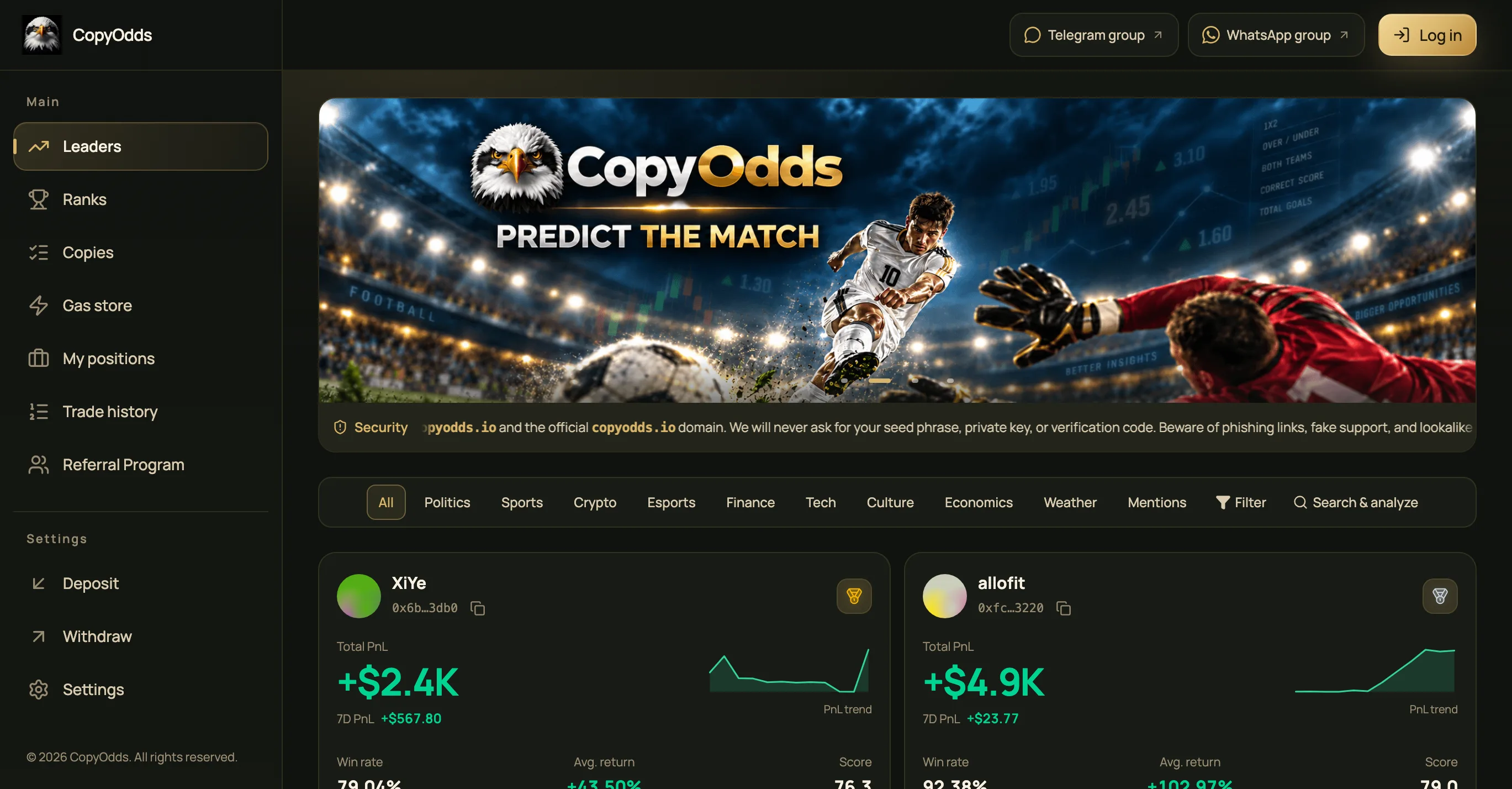
Copy trading for Polymarket in the browser and as a Telegram Mini App.
Compared with PolyVexa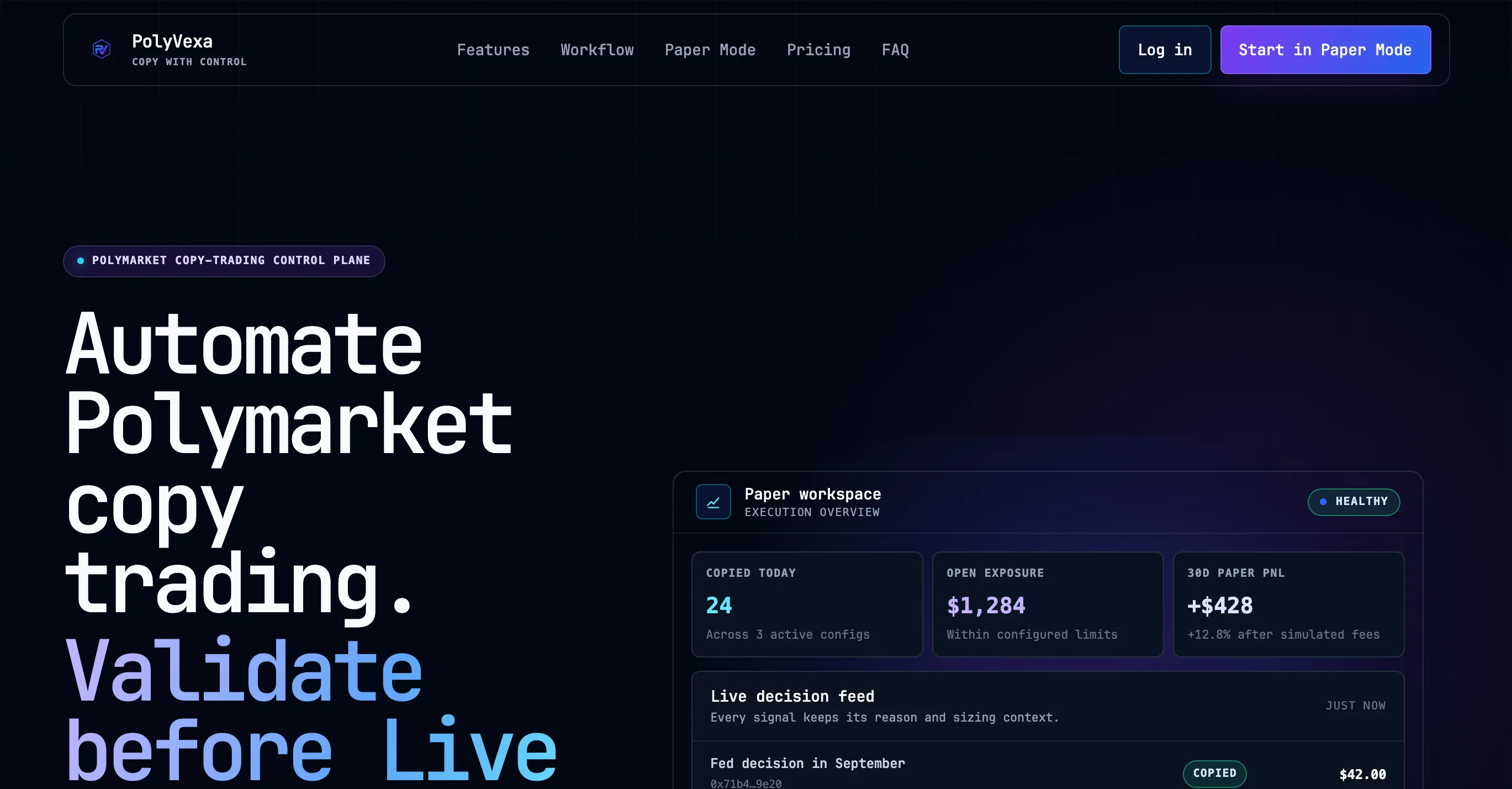
Polymarket copy-trading service built around a paper stage.
Compared with CopyOddsAt a glance
| Fact | CopyOdds | PolyVexa |
|---|---|---|
| Type | Automated bot | Automated bot |
| Category | Copy Trading | Copy Trading |
| Also listed in | Telegram | Politics & Elections |
| Pricing | Paid | Paid |
| Price | 0.5% per fill · Gas from $30 | from $49/mo |
| Risk rating | High risk | Medium risk |
| Markets | All Polymarket markets the followed wallets trade and The board can be filtered by Polymarket's market categories | Polymarket markets traded by the wallets you follow, narrowed by your market filters |
| Source | Source not published | Source not published |
| Runs in Telegram | Yes | No |
| Listed since | Oct 16, 2026 | Nov 2, 2026 |
Highlighted rows differ
Key differences
- Both are paid, but on different terms: CopyOdds is 0.5% per fill · Gas from $30, PolyVexa is from $49/mo.
- They cover different markets: CopyOdds lists All Polymarket markets the followed wallets trade and The board can be filtered by Polymarket's market categories, PolyVexa lists Polymarket markets traded by the wallets you follow, narrowed by your market filters.
- CopyOdds runs inside Telegram; PolyVexa does not.
- CopyOdds is rated high risk, PolyVexa medium risk.
- Only CopyOdds is filed under Telegram, and only PolyVexa is filed under Politics & Elections.
Choose CopyOdds if…
- you want it inside Telegram
- you trade All Polymarket markets the followed wallets trade and The board can be filtered by Polymarket's market categories
- your focus is Telegram
Choose PolyVexa if…
- you trade Polymarket markets traded by the wallets you follow, narrowed by your market filters
- you prefer the lower-risk profile (medium vs high)
- your focus is Politics & Elections
What CopyOdds does
Copy trading for Polymarket in the browser and as a Telegram Mini App. You pick a wallet from its smart-money board or paste any address, look at the wallet's profit curve, drawdown and a copy backtest that adds delay and slippage, then choose how big each copy is — a fixed amount, a share of your balance, or a size scaled to the wallet's largest past fill — and a slippage limit. CopyOdds then mirrors the wallet's buys and sells from a trading wallet it creates and holds for you. The board and backtests are free; every copied fill, opening or closing, costs 0.5% of its size, paid from prepaid Gas sold from $30. The same account runs an eight-level referral program that pays up to 80% of what the people below you spend.
Features- Smart-money board: wallets scored on Polymarket's own profit data, win rate and profit factor on settled markets and recent trade count, with risk flags that keep a wallet off the board
- Wallet lookup for any address: profit curve, drawdown and a copy backtest over roughly the last 30 days or 4,000 trades, with a copy delay and your slippage, comparing fixed-amount and balance-share copying
- Three sizing modes — a fixed amount per buy, a percentage of your available balance, or a ratio scaled to the wallet's largest past fill with a suggested ratio from its daily trade count — plus a minimum order and a slippage tolerance
- The followed wallet's buys and sells are both copied; positions can also be closed by hand, one at a time or in a batch, and settled winnings redeemed
- Deposits in USDC on Polygon or BSC to a personal custodial address; each withdrawal is confirmed again with an authenticator app, a passkey or an email code
- This is a referral pyramid as much as a copy-trading tool, and its own code says so. The open backend sets eight partner levels, L1 to L8, that take 10% to 80% of what the people below them spend on Gas, with the difference passed up as many as eight levels. Your first Gas purchase makes you L1; three direct referrals at L1 lift you to L2, and larger networks unlock the levels above automatically up to L7, while L8 can only be bought. Rank is for sale in the store as well: the $4,250 Elite package holds half the Gas of the $850 package and adds level L4, so about $3,400 of its price buys a place in the referral tree. The landing page leads with “Share. Earn.” and “up to 70% commission” rather than with copy trading. The Terms say rewards come only from fees already earned and that the program does not depend on recruiting; that is true of where the money comes from, but it is still paid for by the Gas that the people you bring in buy.
- Copying is custodial. When you sign up, CopyOdds creates a trading wallet for you; its Terms say you do not hold the private key, and the app says the key cannot be exported because the wallet signs remotely through CopyOdds's own custody service. You deposit USDC on Polygon or BSC, and CopyOdds signs the copied trades, the Gas purchases and your withdrawals, which the Terms say can be held for security reviews or legal holds. The Terms name no company, address or country — disputes fall under “the laws applicable to CopyOdds' operation of the Services” — and their support email is on copyodds.com, a domain with no website and no mail record. Users in the United States and mainland China are barred.
- The code is open apart from the part that holds the money. Two public repositories under Apache-2.0 carry a large, tested TypeScript backend and the web app, including the Gas store and the referral levels, but the service that keeps the keys and signs is not among them. Activity is hard to measure: we did not find CopyOdds among the 589 builders in Polymarket's builders Data API, and its code switches between several builder credentials. The public signals are modest — a Telegram group of 840 members and a channel of 50, an X account with 7,744 followers that itself follows 7,022 — and the domain dates from Mar 20, 2026. The developer works in Chinese, and the site's media sits on Tencent Cloud in Singapore.
What PolyVexa does
Polymarket copy-trading service built around a paper stage. You pick a Polymarket wallet to follow and write a copy config for it — markets, sizing, a budget, a maximum order size, cooldowns and filters — and PolyVexa first runs it on paper, logging every trade it would have copied, every one it skipped and why, the simulated positions and P&L. Only on a paid plan can a config be promoted to live trading, which the docs call a managed beta behind invite, tier, balance and credential checks. The free trial runs up to three paper configs with no card; Pro costs $49 a month, with the first month at half price, for 15 paper and 5 live configs.
Features- Copy configs per followed wallet with market filters, sizing rules, budget, maximum order size and cooldowns
- Paper Mode: simulated copied trades, positions, balances and P&L, kept apart from live orders
- A log of every copied, skipped, blocked and failed decision with the rule that caused it
- Several configs for the same wallet, to compare stricter and looser rules side by side
- Live trading on paid plans only, off by default, with single-trade and daily limits
- The idea is sound and simple: run a copy config on paper long enough to see what it would have done before you put money behind it. Paper fills are not real fills, and the terms say so — slippage, fees, latency and thin books can make the live result worse than the paper one, especially when you copy a wallet that trades large into shallow markets.
- Most of what the site shows is illustration. The workspace on the home page — 24 trades copied today, $1,284 of exposure, +$428 or 12.8% of paper profit over 30 days, and copied trades on a Fed decision and ETH above $4k — is labelled an example, and the site publishes no customer or paper results of its own. Much of the rest is guide pages written around search terms. We found no Polymarket builder record under its name.
- Read the custody answer carefully. Asked whether it holds your funds, the FAQ replies that PolyVexa is “built around controlled wallet and managed-account workflows”; the docs call live trading “managed” and say paper mode involves no private keys, which implies that live mode does. The site does not say who holds the key that signs your live orders or where it is stored, so treat live trading as handing the service control of a trading account until it does.
More head-to-heads
Every fact on this page is taken from the two listings as their authors publish them; POLBOTS verifies neither performance nor claims and has no stake in either tool. Nothing here is financial advice.