On this page6 sections
What a market maker does
A market maker keeps a bid and an ask resting in a book and earns the difference when both get hit. On Polymarket that means quoting an outcome token — or both outcomes of a binary market, which is the same thing seen from two sides — at prices just inside the spread, continuously, while managing the inventory that accumulates when one side trades more than the other. It is the oldest strategy on any exchange and the most misunderstood by people who think "earning the spread" is free.
The three ways a maker gets paid
- The spread. Buy at 0.48, sell at 0.52, keep four cents — if both sides trade and the price does not move between them.
- Maker rebates. Takers pay a fee on every fill (peaking at 1.75% of notional on crypto markets, 1.25% on sports, 1% on politics, nothing on geopolitics). Makers pay nothing and receive a share of those fees back as daily rebates. On a busy market this is real money for standing still.
- Liquidity rewards. Separately from rebates, Polymarket runs a rewards program that pays for resting liquidity near the midpoint on eligible markets. The mechanics matter for how you quote: the book is sampled every minute; each qualifying order — above the market's minimum size and inside its maximum qualifying spread — is scored with a quadratic rule on how close to the mid it sits, so an order at half the maximum spread earns a quarter of the score of one at the touch, not half; when the midpoint is between 0.10 and 0.90 a single-sided quote scores at a reduced rate, and outside that range liquidity must be two-sided to score at all; the day's allocation for the market is split by score and paid to maker addresses at midnight UTC, with a one-dollar minimum payout. In August 2026 the program put a seven-figure allocation behind the crypto TWAP markets — the 5-minute, 15-minute and 4-hour books on BTC, ETH, SOL and others — which is why so many of the new bots in the catalog quote exactly those.
Read the rewards and rebates pages in Polymarket's docs before you design around them: allocations, eligible markets and parameters change, and each market's reward settings are readable from its market details.
The risk that eats all three: inventory
Every fill you get is a trade someone else wanted. Most of the time they are a noise trader and you keep the spread. Some of the time they know something — a news bot that read the headline, a minute-market sniper that saw spot move, a whale with an opinion — and your bid just bought the thing that is about to be worth less. That is adverse selection, and a naive maker's inventory is built entirely out of it: you end up long what is falling and short what is rising.
On a prediction market it has a second, harsher form: resolution. Inventory you hold into the close pays a dollar or nothing. A maker who was happy to be slightly long YES at 0.50 is, at the moment of resolution, simply long YES. The spread you earned over a month can be one resolution's loss.
How makers survive it
- Skew. When inventory grows on one side, shift both quotes against it — bid lower, ask lower — so you are paid more to hold and more likely to unload. Quote asymmetric sizes the same way.
- Inventory caps. A hard maximum per market and overall; at the cap, pull the side that would add.
- Widen on information. Spot moved, a headline hit, the book thinned: widen or pull. A maker that quotes the same spread into news is a donation.
- Flatten before resolution. Reduce to zero, or to what you actually want to hold, well before the close; on the minute markets that means in the last seconds, every few minutes, all day.
- Merge full sets. When you hold both YES and NO of a binary market, merge them back into collateral — the conditional-token contracts support it, and the better bots (Poly-Maker ships position merging) do it automatically to free capital and cut resolution exposure.
- Quote wide markets two-sided. The rewards rule near 0 and 1 requires it, and it is also where single-sided quoting is most dangerous.
The plumbing a maker needs
Market making is the most infrastructure-heavy strategy in the catalog. It lives on the WebSocket market channel — polling cannot keep quotes honest — and on the user channel for its own fills; it posts post-only orders so it never accidentally takes and pays; it cancels and replaces constantly, which is exactly what the per-signer rate-limit buckets introduced in 2026 meter, so it must budget cancels and respect Retry-After; it reconciles inventory continuously; and it must behave correctly across disconnects — pull everything on a gap, requote only after a fresh snapshot. A maker that is down is merely earning nothing; a maker with stale quotes in a moving market is paying everyone.
Tools in the catalog
Poly-Maker
Open-source market-making bot for Polymarket. Quotes both sides of the book over WebSockets with configurable spreads, position merging and risk controls. Shared by its author as a reference implementation, not a turnkey money-maker.
Polybot (No-Code)
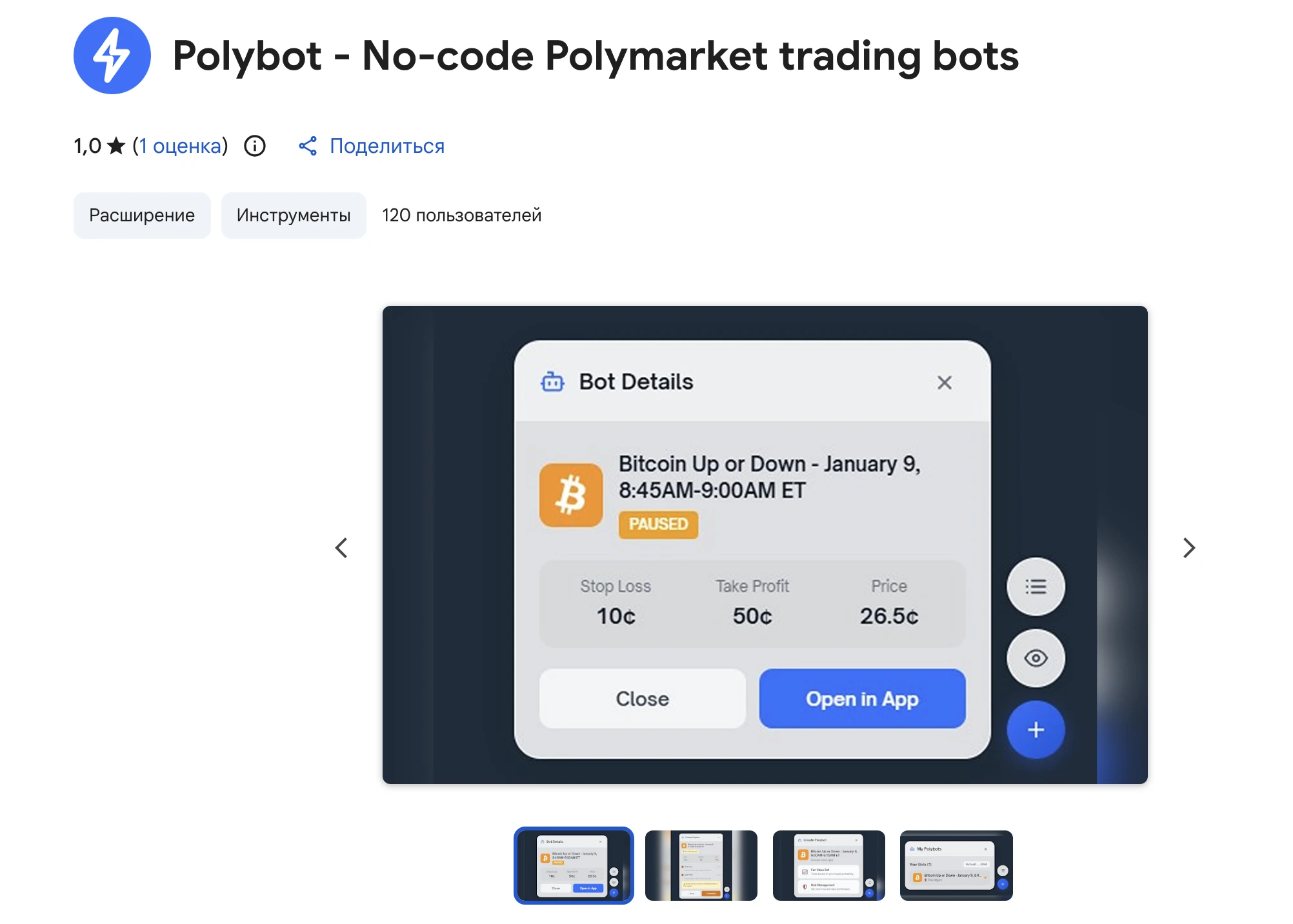
No-code Chrome extension for building automated Polymarket trading bots right in your browser. Spin up a bot from any event page with one click, add stop-loss and take-profit orders, or run the Fair Value market-making bot with a configurable target probability — no coding required.
PolyScalping
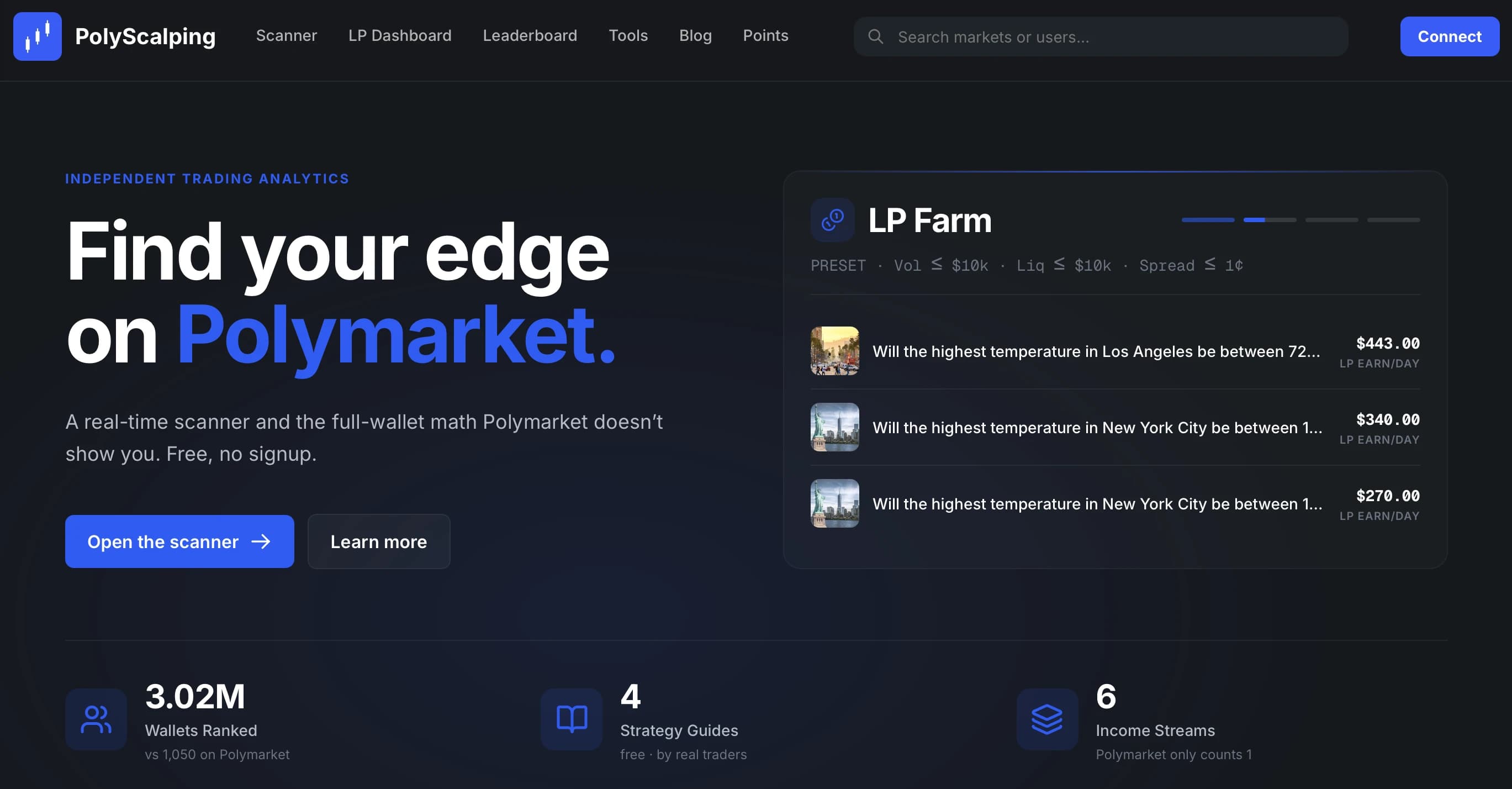
Real-time scanner and reward analytics for Polymarket. Surfaces scalping opportunities as they appear and shows the full-wallet math Polymarket hides — tracking LP rewards, maker rebates, referral rewards and yield payouts, with leaderboards and an LP dashboard.
HashDive
Advanced analytics for Polymarket and Kalshi. HashDive's proprietary Smart Scores rank how consistent and profitable a trader is, alongside a market screener, wallet tracking and candlestick charts with RSI, MACD and whale-volume breakdowns.
Poly-Maker is the open reference implementation — read it before you write one. Polybot (No-Code) puts simple quoting rules behind a browser extension for people who will not write code. PolyScalping is a scanner that shows the reward maths Polymarket's interface hides — useful for choosing where to quote. HashDive is analytics for the same decision. The market making category lists the rest, and the arbitrage guide covers the identity-constrained cousin of this strategy. POLBOTS does not verify any of their performance, and this is not financial advice.
Frequently asked questions
- Do market makers pay fees on Polymarket?
- No — only takers pay. A resting order that gets hit pays nothing, and makers receive a rebate of a share of the taker fees on top. Post-only orders guarantee you never accidentally take. That asymmetry is the whole reason market making is viable on the platform.
- What are Polymarket liquidity rewards?
- A program that pays resting orders for sitting near the midpoint on eligible markets. Every minute it samples the book, scores each order by how tight it is relative to the market's maximum qualifying spread (a quadratic rule — tighter is worth much more than slightly tighter), requires two-sided quotes when the price is near 0 or 1, and pays the day's allocation to maker addresses at midnight UTC, with a one-dollar minimum.
- Can I market-make with a few hundred dollars?
- You can quote; you cannot absorb much. Inventory risk scales with size, and the rewards and rebates are proportional to what you quote. Small makers do best on quiet markets with wide qualifying spreads, two-sided, and with hard inventory limits — and should expect the first months to teach more than they pay.
- Is Poly-Maker a turnkey money-maker?
- Its own author says it isn't: it is an open-source reference implementation — two-sided quoting over WebSockets, configurable spreads, position merging and risk controls — meant to be read and adapted. That is exactly what makes it valuable and exactly why you should not run it unchanged with real size.