On this page6 sections
What "arbitrage" means on a prediction market
A prediction market has a built-in identity: the outcomes of a market are worth exactly one dollar in total at resolution. One of them pays a dollar; the rest pay nothing. Arbitrage is any trade that exploits a price set that breaks that identity — or the same event priced two ways in two places. Four kinds show up on Polymarket, in rough order of how often a bot can actually take them.
1. A binary market priced under (or over) a dollar
If YES trades at 0.46 and NO at 0.51, the pair costs 0.97 and pays 1.00 at resolution: three cents, locked in, for as long as the market takes to resolve. The reverse — the pair trading above a dollar — is taken by minting a full set of outcome shares for exactly one dollar of collateral (the conditional-token contracts let you split collateral into a complete set, and merge a set back) and selling both sides into the book.
2. Multi-outcome books that don't sum
An election or a tournament is one event with many outcomes; Polymarket lists these as negative-risk markets, where the outcomes are mutually exclusive and should sum to a dollar. When the sum of all the best asks is below one, buying the whole set locks in the gap; when the bids sum above one, the mint-and-sell trade does. These books have more legs, more chances for one to move while you take the others, and a separate exchange contract your orders must be signed against.
3. The same event on two venues
Polymarket and Kalshi — and bookmakers, and other prediction venues — list overlapping events. A spread between them looks like the cleanest arbitrage of all and is the most dangerous: the venues' rules for what counts, which source decides and when, are not the same, and a "hedged" position across them is a bet that both resolve identically. Tools like Stand put both venues in one interface precisely because people trade this; the ones who do it for a living read both rulebooks first.
4. Latency "arbitrage" on the minute markets
The 5- and 15-minute crypto markets reprice against live spot, and a bot that sees the exchange move before the book does is often called an arbitrageur. It is really trading momentum with a deadline; the book is not mispriced against a fixed payout, it is slow. The minute-markets guide treats it on its own terms.
Why the gaps exist at all
Three honest reasons, and they tell you who can take the trade. Capital lockup — the set pays a dollar at resolution, which may be a day or six months away, so the "3%" is really 3% annualised over whatever that horizon is, and capital sitting in a resolved-but-unredeemed position earns nothing. Thin, fragmented liquidity — the cheap side of the set may be cheap for ten shares. Fees and rules — a gap that is smaller than the cost of taking it is not a gap, and a gap that depends on two rulebooks agreeing is a bet.
The fee maths, which decides most of this
Only takers pay. On a fill of C shares at price p the fee is C × rate × p × (1 − p), with rate 0.07 on crypto markets, 0.05 on sports, economics, culture and weather, 0.04 on finance, politics, mentions and tech, and zero on geopolitics. It peaks at p = 0.5: 1.75% of notional on crypto, 1.25% sports, 1% politics, nothing geopolitics.
| Market category | Taker fee per leg near 50¢ | Both legs taken | A 97¢ set is… |
|---|---|---|---|
| Crypto | ~1.75% | ~3.5% | a loss |
| Sports, weather | ~1.25% | ~2.5% | roughly break-even |
| Politics, finance | ~1.0% | ~2.0% | 1% before spread |
| Geopolitics | 0 | 0 | 3% minus spread |
Now add the spread you cross on each leg, and the capital cost of waiting. The takeaway is structural: the arbitrages worth having are taken by makers — resting orders that pay no fee, earn a rebate of the taker fees, and sometimes earn liquidity rewards — and by bots with enough capital to leave many small resting orders across many markets. A bot that must cross the spread on both legs is last in line and pays the most to be there.
Execution risk: how a sure thing loses
- Legging. You take YES at 0.46; by the time your NO order arrives the ask is 0.55. You now hold a directional position you did not want. Fill-or-kill orders on each leg help; they do not make the second leg exist.
- Partial fills. Ten shares of the cheap side, two hundred of the expensive side.
- Resolution mismatch. The cross-venue case; also the case where a multi-outcome market adds an outcome, or resolves to "other", or is voided.
- Signing against the wrong contract. Negative-risk markets settle through a different exchange contract; a V1-era bot that assumes every market is binary gets its orders rejected as invalid signatures at the worst moment.
- Capital. The position is correct and pays in four months. Your annualised return is a rounding error and your collateral was needed elsewhere.
What a real arbitrage bot looks like
It watches many markets through WebSockets rather than polling a few; it keeps resting post-only orders on the cheap side of sets rather than chasing with takers; it knows each market's tick, minimum size, fee category and resolution date before it quotes; it sizes to the thinner leg; it holds enough collateral to sit through resolution; and it reconciles positions continuously because legging *will* happen. That is a market maker with an identity constraint, which is why the market-making guide is the natural next read.
Tools in the catalog
The arbitrage category lists everything we have reviewed, from dedicated scanners to terminals with an arbitrage view:
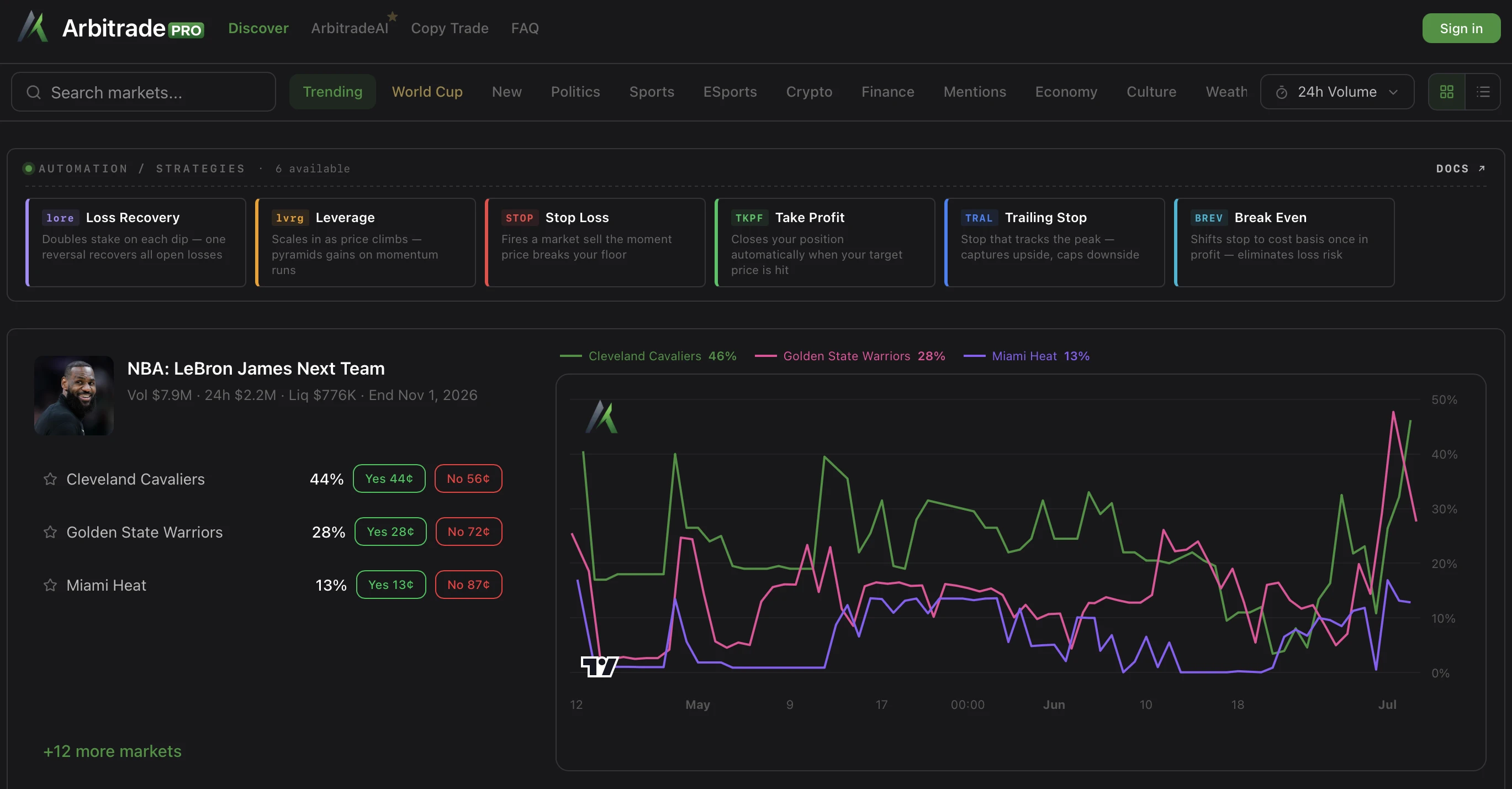
ArbiTrade Pro
Web-based automated arbitrage platform for prediction markets. Scans for price inefficiencies across correlated and cross-platform markets and manages the trades to capture the spread.
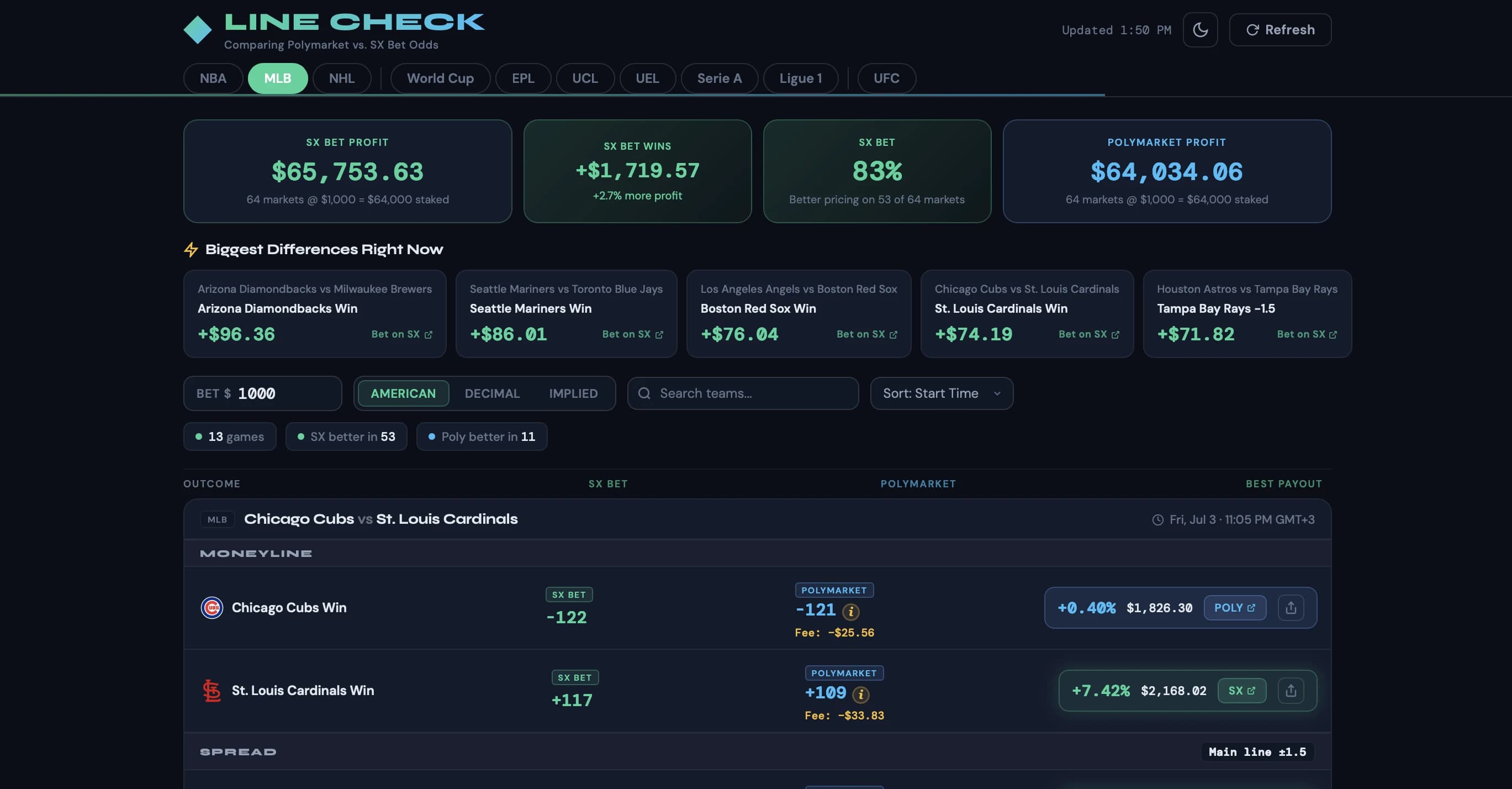
Line Check
Odds-comparison tool that pits Polymarket against SX Bet side by side. Shows American, decimal and implied-probability formats, highlights the best-edge opportunity and optimal payout, and lets you size a custom bet across NBA, MLB, NHL, UFC and major soccer leagues.
Stand
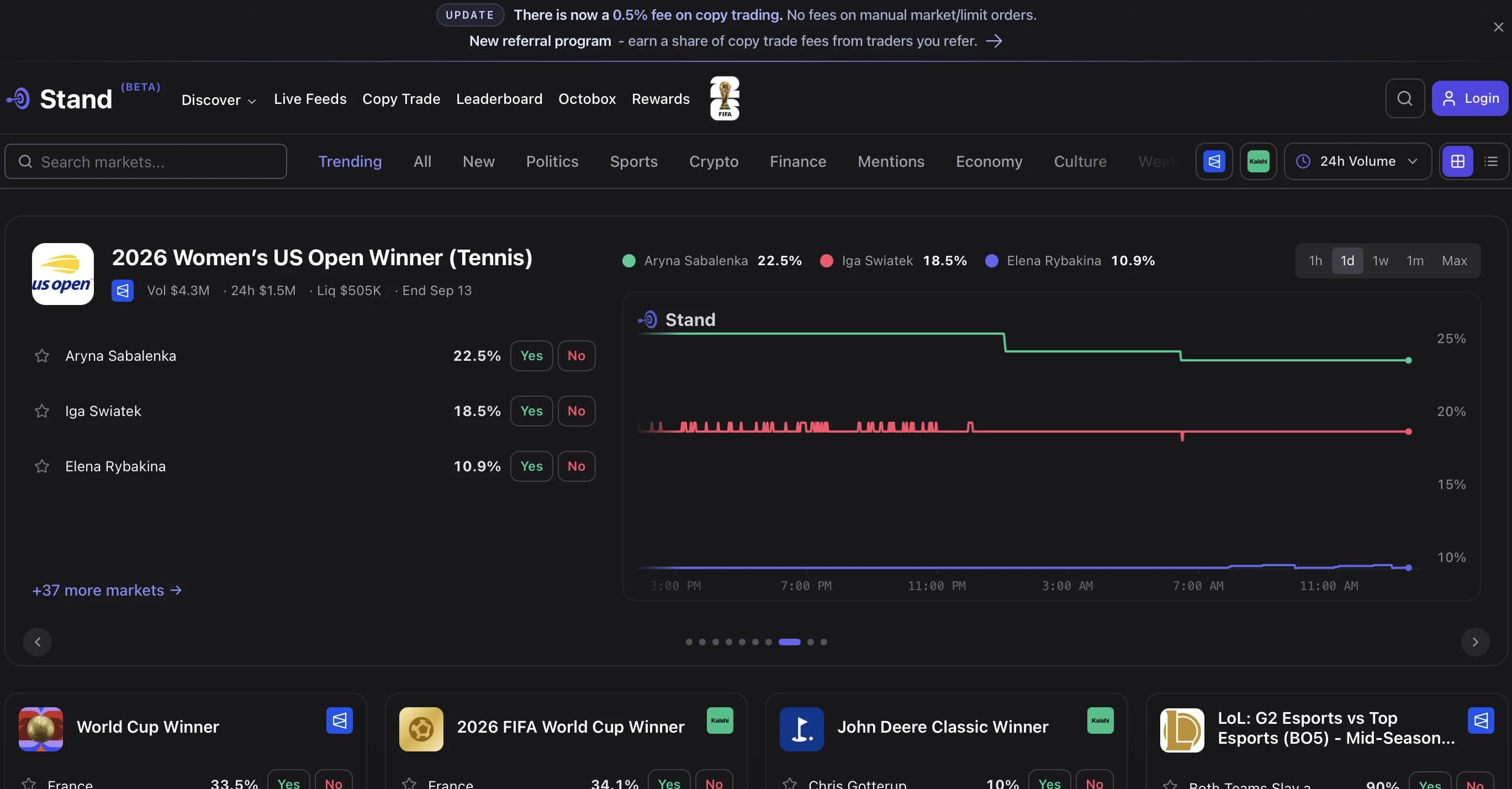
Advanced trading terminal and aggregator for prediction markets. Pulls Polymarket and Kalshi into one trade-first interface with live volume, liquidity and open interest, whale copy-trading, TP/SL and stop orders, and an Octobox that watches up to eight markets at once. Non-custodial via Privy, no fees on manual orders.
PolymTradeBot
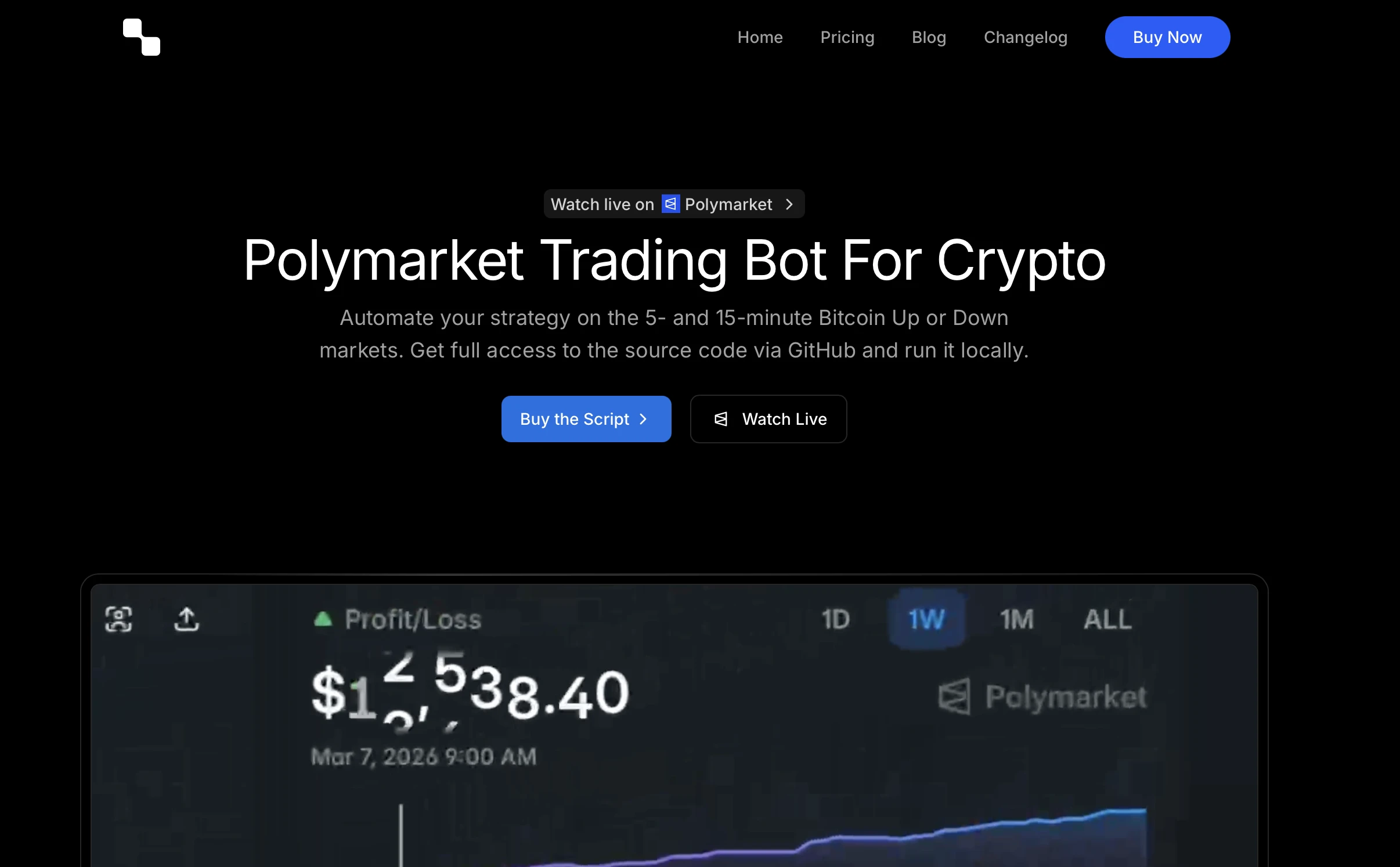
Automated Python bot for Polymarket's 5- and 15-minute Bitcoin & Ethereum up/down markets. Trades live or in paper mode with configurable risk controls, self-hosted from full source.
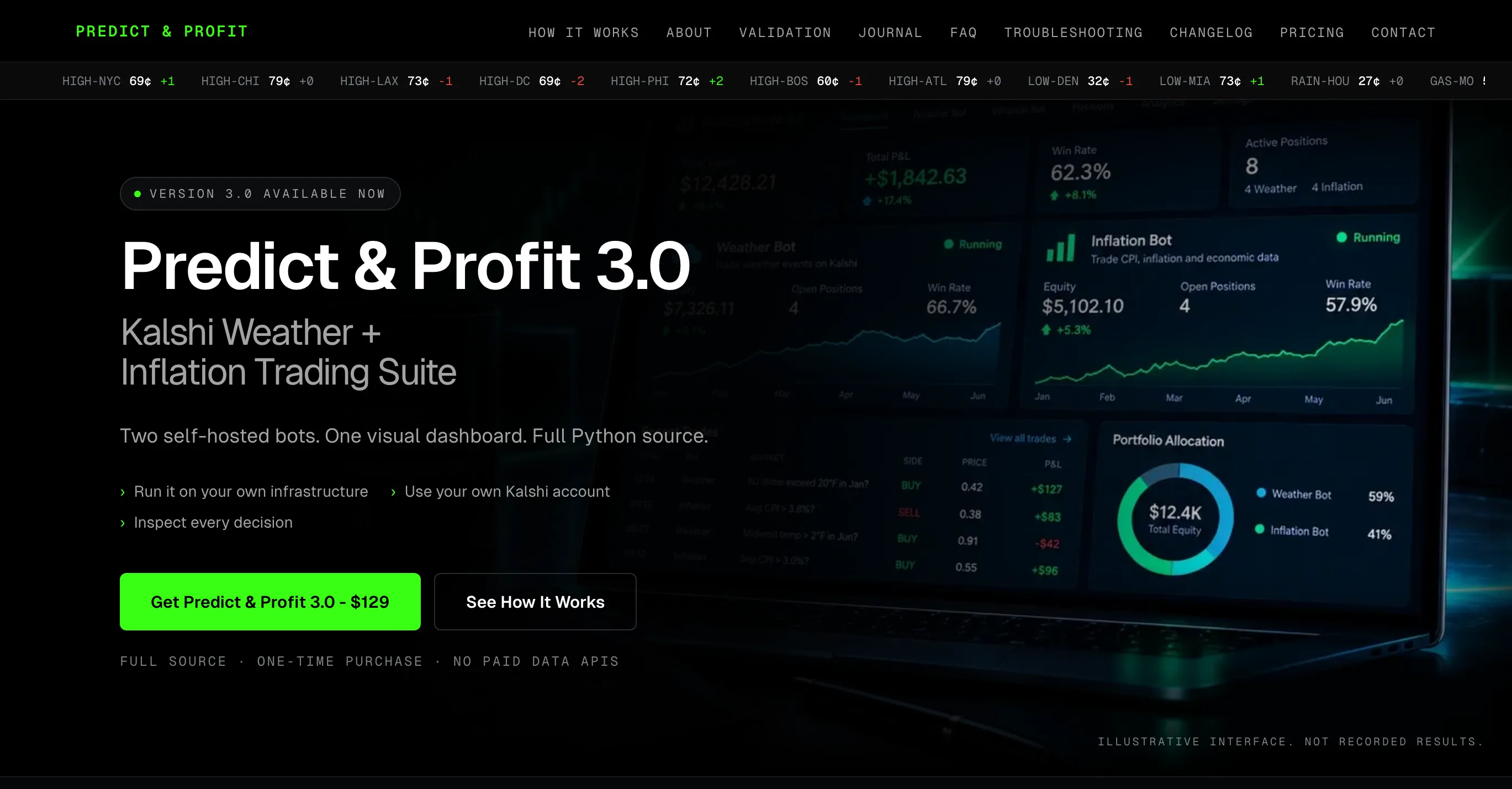
ArbiTrade Pro is the dedicated cross-market scanner in the list; Line Check compares Polymarket against bookmaker lines; Stand puts Polymarket and Kalshi side by side; and PolymTradeBot, though sold as a minute-market bot, is filed here for its spot-versus-book logic. For the weather and inflation markets, Predict & Profit trades model-versus-price gaps on Kalshi with full source. As everywhere on this site: none of them is verified by us, and none of this is financial advice.
Frequently asked questions
- Is Polymarket arbitrage risk-free?
- No. The canonical trade — buying every outcome of a market for less than a dollar in total — is guaranteed only if every leg fills at the price you saw, the market resolves as written, and you can wait for that resolution. Each of those fails often enough that the word 'risk-free' belongs to the landing pages, not to the trade.
- How much edge do I need to cover fees?
- Only takers pay, and the fee peaks at a 50-cent price: 1.75% of notional on crypto markets, 1.25% on sports, 1% on politics, nothing on geopolitics. Taking both legs of a YES+NO arbitrage near 50 cents on a crypto market therefore costs about 3.5% before the spread — so a set priced at 97 cents is not a trade there, and would be on a geopolitics market.
- Can I arbitrage Polymarket against Kalshi?
- People do, and the biggest risk is not price but rules. The two venues word and resolve similar-looking markets differently — different sources, cutoffs, thresholds — and a 'locked-in' spread between them is a bet that both resolve the same way. Read both rule sets before you treat a gap as free money.
- Why do the obvious arbitrages disappear so fast?
- Because bots with resting orders, more capital and lower latency are already waiting for them, and because makers pay no fee and earn rebates while takers pay the full fee. A retail bot that has to cross the spread on both legs is last in line and pays the most to get there.