On this page5 sections
What these markets are
Every few minutes Polymarket opens a binary market on whether Bitcoin — or ETH, SOL, XRP and others — will close the next 5-, 15-minute or longer window above where it opened. YES pays a dollar if it does. Resolution is against a reference price at the window's close, not the screen you happen to be watching, and the rule says which reference; read it, because "Bitcoin went up on my exchange" and "the market resolved YES" are not the same sentence.
They are the most bot-traded books on the platform for one structural reason: repetition. A political market resolves once; a minute market resolves a few hundred times a day. That makes strategies testable at a scale nothing else on Polymarket offers — and it makes the fee bite on every single one of those repetitions.
The fee is the story
Crypto markets carry the highest taker rate Polymarket charges: 0.07 against a curve that peaks at a 50-cent price, where most of these markets spend most of their life.
| Price | Taker fee per fill (crypto) | Round trip, taker both ways |
|---|---|---|
| 0.50 | 1.75% | ~3.5% |
| 0.70 | 1.47% | ~2.9% |
| 0.90 | 0.63% | ~1.3% |
Makers pay nothing, receive a rebate of a share of the takers' fees, and on these exact books can earn liquidity rewards — in August 2026 the program put a seven-figure allocation behind the crypto TWAP markets across the 5-minute, 15-minute and 4-hour timeframes. So the two sides of every minute-market trade are not symmetric: a bot that crosses the spread needs an edge larger than 3.5% a round trip to break even; a bot that quotes gets paid to be there. Almost everything else about the category follows from that table.
How the bots trade them
Spot lead. Bitcoin moves on the big exchanges and the Polymarket book takes a moment to catch up; a bot watching the exchange feed buys the side that should reprice. It is a latency race with other bots, and as the books have grown faster the window has shrunk. Works as a taker; pays the fee; needs the edge to be large and frequent.
Momentum and order flow. Within a window the book itself shows imbalance; a bot reads the tape and joins. PolymTradeBot and Uruguabot are configurable engines of this kind, with stop re-anchoring, hold-to-resolution modes and loss caps; PolySnipe ships eight strategies from reversal to late flip.
Signal fusion. The open-source BTC 15-minute bot fuses spike detection, a sentiment index and cross-exchange divergence by weighted vote — and ships a paper mode and dashboards so you can watch it not work before it costs you.
Making the market. Quote both sides inside the spread, skew against inventory, flatten in the last seconds of each window, collect spread, rebates and rewards. The structurally favoured side of the book, and the one the market-making guide covers.
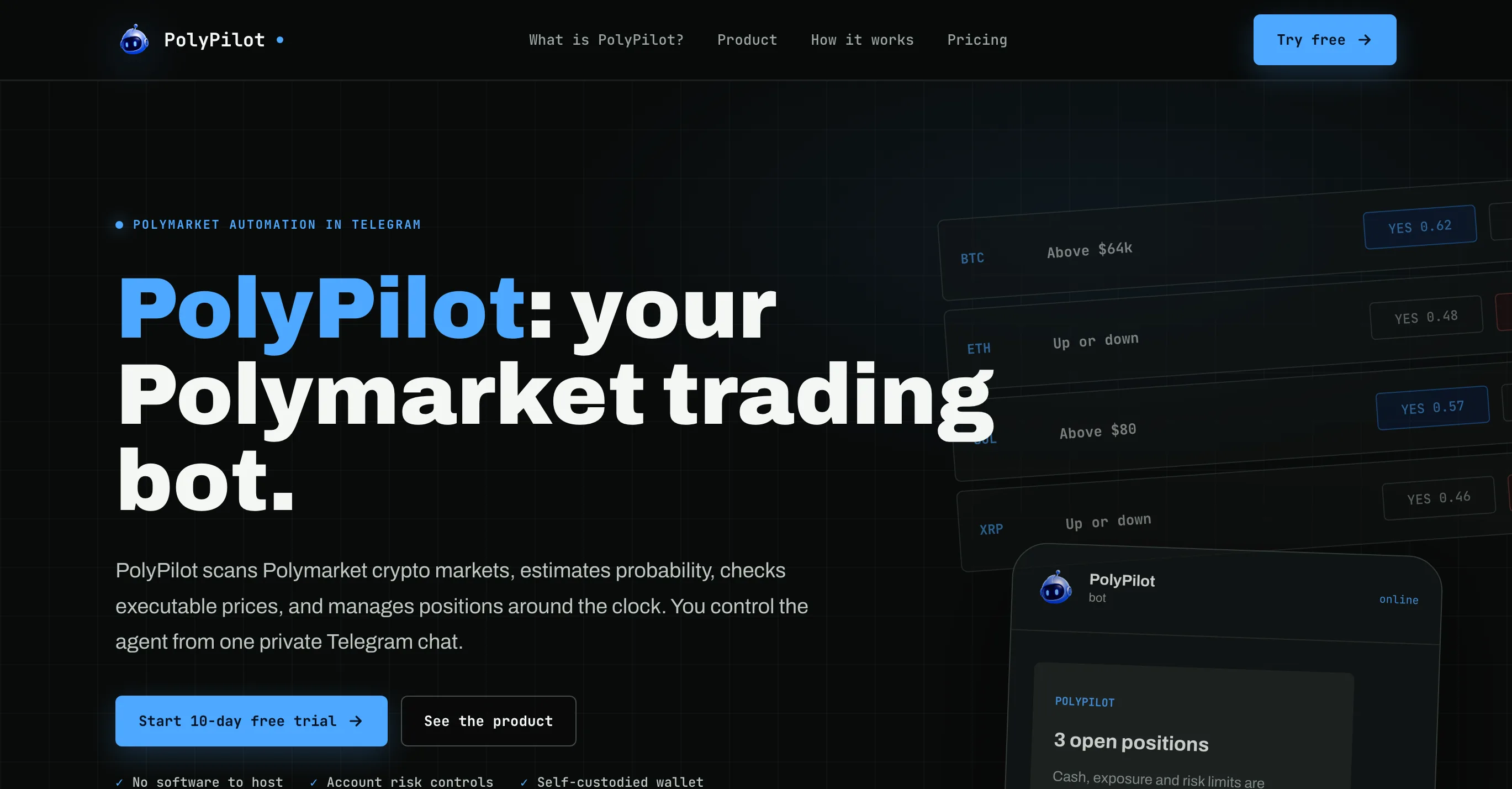
Probability terminals. PolyPilot and similar tools estimate a probability from spot, check executable prices and liquidity and manage positions — a middle path between a signal and a manual trade.
What the published records actually show
The catalog shows the performance authors publish and marks the rest N/A, and this category has the most honest data on the site. Uruguabot publishes every fill from two generations as raw CSVs: roughly four thousand first-generation trades, the live second-generation fills, and a 1,934-window study in which every automated signal scored about coin-flip against the human's 59%. The vendor's overall record is a net loss, with one default configuration that closed its live run at +7.3% on a 40% win rate over a small 25-trade sample — and the listing says so. That is what a real record looks like in this category; read anything rosier as a claim until you can reproduce it from fills.
Two practical lessons from the same data. Ghost fills — orders that appear filled and are not — happen, and a bot needs to detect them. And a dry-run simulator is only as good as its slippage model; Uruguabot's is calibrated from slippage measured on real fills, which is the standard the backtesting guide argues for.
What to check in a minute-market bot
- Paper mode, with a fill model that charges the spread and the 0.07 fee curve. Without it you are testing with money.
- Fee awareness in the strategy — a bot that does not know it pays 1.75% at the mid is a bot that will happily trade for a 1% edge.
- Kill switches by default: daily loss, losing streak, unfilled ratio, volatility guard. Circuit breakers that ship *on* are a sign the author has lost money with it.
- Latency measured, not assumed: from exchange tick to order acknowledgement, logged.
- Resolution-aware exits: what happens to inventory in the final seconds, every window.
- Geo: these are the international venue's markets; the usual restrictions apply.
- A record you can check, or at least a paper mode that lets you make one.
Uruguabot
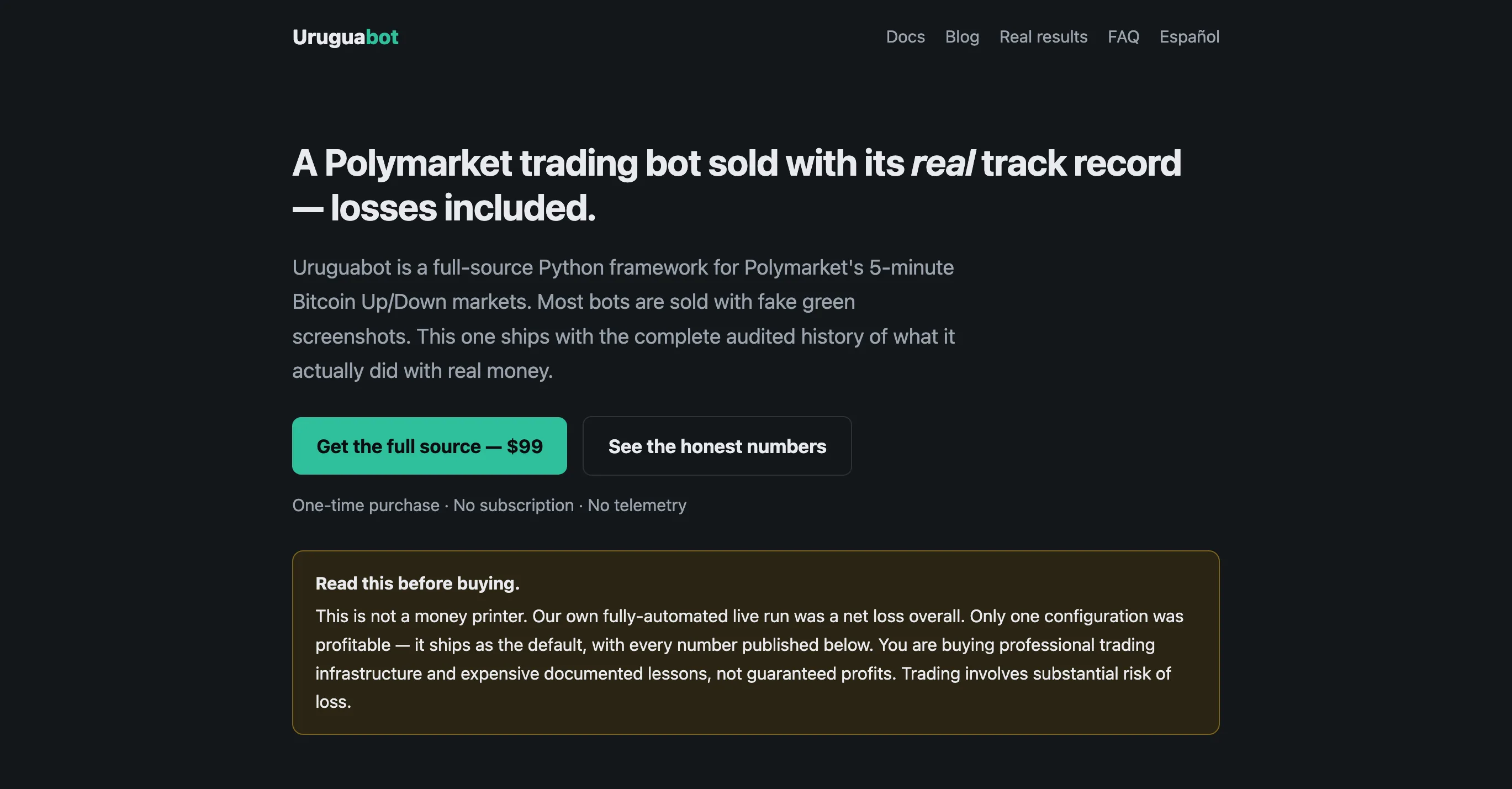
Self-hosted Python bot for Polymarket's 5-minute BTC and ETH up/down markets, sold with its complete live trading record — losses included. A free GitHub repo publishes every fill from two generations of testing plus a 1,934-window study in which every automated signal scored roughly coin-flip against the human's 59%; the published numbers reproduce exactly from the raw CSVs, though the logs omit market ids, so the record is self-attested rather than on-chain verifiable. Both generations together lost about $270 — mostly execution and a since-fixed ghost-fill bug — while the configuration that ships as default closed its live run at +7.3% ROI on a 40% win rate over a small 25-trade sample: momentum entries, stop re-anchored to execution price minus 10¢, winners held to binary resolution. Dry-run is the default, with fills simulated from slippage measured on real trades; live mode takes two explicit flags and a dedicated wallet.
PolymTradeBot
Automated Python bot for Polymarket's 5- and 15-minute Bitcoin & Ethereum up/down markets. Trades live or in paper mode with configurable risk controls, self-hosted from full source.
PolySnipe
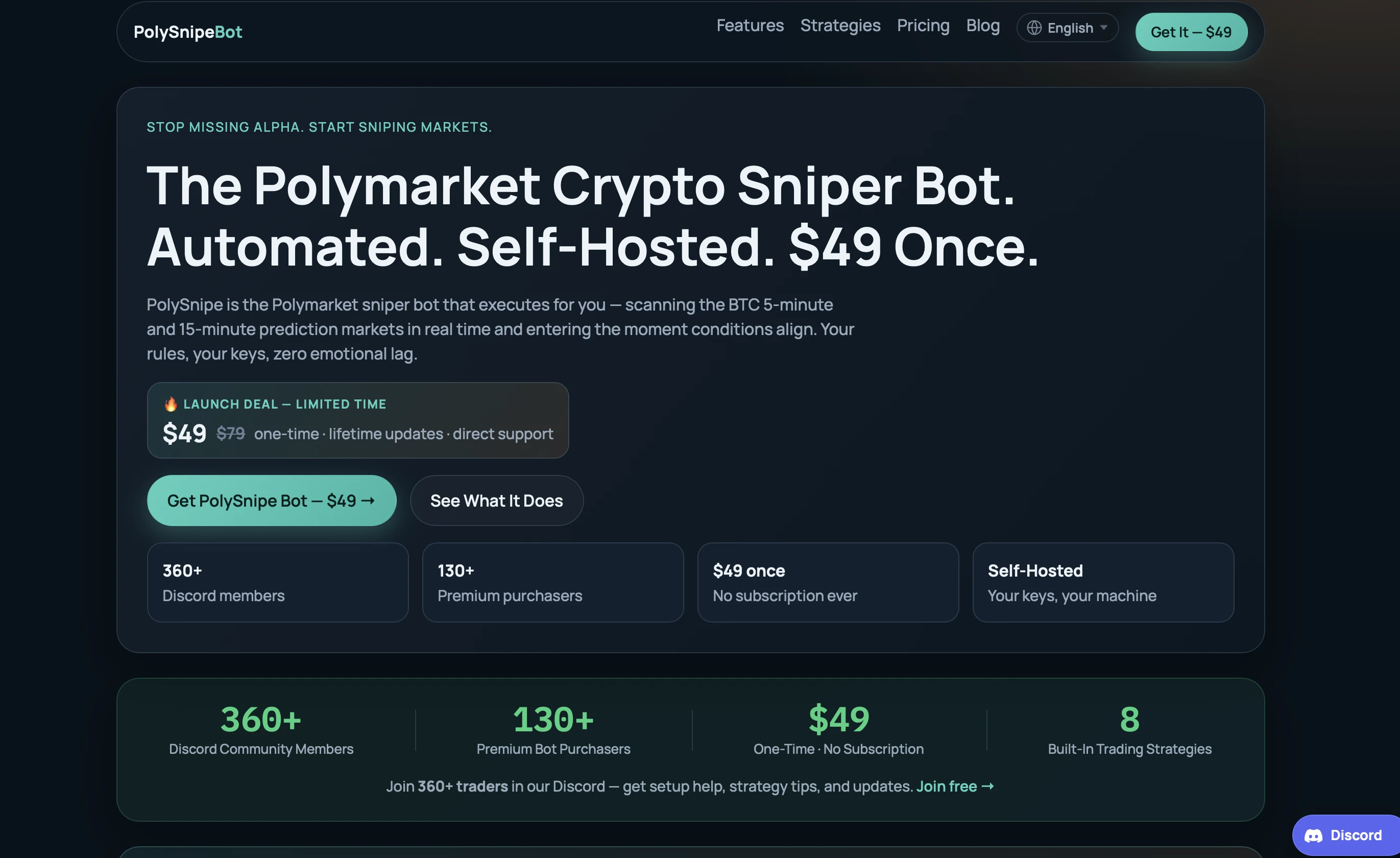
Automated, self-hosted sniper bot for Polymarket's BTC 5- and 15-minute up/down markets. Scans in real time and enters in milliseconds the moment multiple independent signals align. Ships 8 configurable strategies, a setup wizard, backtesting and a full trade journal — full source code, one-time $49.
BTC 15-Min Bot
Open-source Python bot for Polymarket's 15-minute Bitcoin up/down markets. A 7-phase engine fuses spike detection, Fear & Greed sentiment and cross-exchange divergence via weighted voting. Runs live or in paper mode with Grafana dashboards.
The 5- and 15-minute bot list has every bot built for these windows, the Crypto Markets category has every listing that touches crypto, and Momentum, Sniping and Scalping overlap it heavily. None of it is verified by POLBOTS and none of this is financial advice — on these books in particular, the house edge is a published number, and it is 1.75%.
Frequently asked questions
- Are the 5-minute Bitcoin markets just coin flips?
- The base rate is close to 50/50 and the honest published data says most automated signals do not beat it: one vendor's 1,934-window study scored every one of its signals at roughly coin-flip against a human's 59%. Edges exist — in spot leading the book, in order-flow, in being the maker rather than the taker — but they are small, and the fee is not.
- What is the fee on these markets?
- Crypto markets carry the highest taker rate on the platform: 0.07, which at a 50-cent price is 1.75% of notional per fill. A taker strategy that enters and exits at the mid pays about 3.5% a round trip before the spread, so it needs a large edge per trade just to break even. Makers pay nothing and earn rebates — which is why the serious bots on these books quote rather than take.
- Which bots publish real results?
- Few, and the most honest one is a net loss: Uruguabot publishes every fill from two generations of testing as raw CSVs, losses included, and reports one profitable default configuration at +7.3% over a small 25-trade sample. PolymTradeBot and the open-source 15-minute bot ship paper modes so you can generate your own record. Treat everything else as a claim.
- Do I need to be fast?
- For the spot-lead trade, yes — you are racing other bots to the book, and latency from a home connection loses. For maker strategies, no — you need to be right about skew and quick to pull quotes, which is a software problem, not a geography problem.