On this page7 sections
Four different trades called "sniping"
The Sniping category collects bots whose edge is being first. First at what differs, and each variant has its own economics.
- New-market sniping. Polymarket lists new markets all day; the first prices in a fresh book are often lazy. A bot that hears about creation instantly — PolySpy fires Telegram alerts the moment a market appears, filtered by category — and posts a sharp price before anyone else is there, gets filled by the first naive order. Window: minutes. Risk: being the naive one.
- Dislocation sniping. A price jumps away from fair — Bitcoin moved on the exchanges and the 5-minute book has not caught up, a whale swept a side, a copy-bot cascade overshot — and the first order back toward fair wins. Window: seconds or less. This is the latency game proper; PolySnipe is built for exactly the minute-market version of it.
- Resolution sniping. The outcome is effectively known — the result is in, the vote is counted — and the market still trades at 0.95 because the rule has not resolved yet. Buying the winner at 0.97 is a near-certain 3% in days; the catch is the word "near". Window: hours. Risk: the rule, and disputes.
- Whale-follow sniping. A large wallet fills and a bot jumps in behind it before the rest of the copy-traders do. WhaleSight and PolyAlertHub alert on fills over a threshold; the edge is being earlier than the crowd that reads the same alert. Window: seconds to minutes. Risk: the whale is wrong, or the whale is bait.
The latency stack
Every snipe is a chain, and it is as slow as its slowest link:
- Signal. An exchange price feed, the Polymarket market WebSocket, a creation alert, a headline. Polling is disqualifying here; subscribe.
- Decision. Pure computation; microseconds if you wrote it that way, milliseconds if you call a model.
- Signing. EIP-712 signing of the order is cheap; building it requires the token id, tick size and neg-risk flag already in memory, not fetched on the fly.
- Transport. From your server to the CLOB and back with an acknowledgement. Proximity matters; so does not being rate-limited.
- Matching. Immediate — unless the market imposes a matching delay, in which case your order waits with everyone else's and speed buys nothing.
Order type is part of the stack. A sniper takes: fill-and-kill or fill-or-kill with a worst price, never a resting order it will forget. And it has its risk checks *before* the decision, because there is no time after it.
The fee curve is on your side at the extremes and against you at the mid
Only takers pay, and a sniper is always a taker. The fee on C shares at price p is C × rate × p × (1 − p), with the rate by category: 0.07 crypto, 0.05 sports and weather, 0.04 politics and finance, zero geopolitics.
| Snipe | Typical price | Category | Fee per fill |
|---|---|---|---|
| Resolution, politics | 0.97 | 0.04 | ~0.12% |
| New-market, politics | 0.50 | 0.04 | ~1.0% |
| Dislocation, BTC 5-minute | 0.50 | 0.07 | ~1.75% |
| Whale-follow, sports | 0.60 | 0.05 | ~1.2% |
So resolution sniping is nearly free to execute and dislocation sniping on the minute markets needs a 1.75%-plus move to break even on a single crossing — which is why the honest records in the minute-markets guide look the way they do.
Where the exchange has closed the door
Three things on Polymarket exist specifically to blunt sniping, and a bot should know them:
- Matching delays on selected markets — live sports above all — hold every order for a moment before matching. On those books "first" is meaningless; "right about the price after the delay" is the only game.
- Per-signer rate limits since July 2026: token buckets for placing and cancelling that refill with your 30-day volume, with Retry-After on 429. A sniper that sprays orders and cancels burns its bucket at the exact moment it needs it.
- Resolution rules and disputes. The outcome you "know" is known under a rule that names a source and a time; the optimistic oracle can dispute and delay; "effectively resolved" markets have reversed. Resolution sniping's 3% is rent on that risk.
Adverse selection, from the other side
Market makers fear snipers because a sniper's fill is, by construction, informed. The mirror holds: when your snipe fills instantly against a resting order, ask why it was resting. On thin books the order you lifted may be a maker who knows more than your feed, or a spoof that will vanish behind you, or simply the last liquidity before a gap. The cheapest protection is a maximum price on every taker order and a size that the book can absorb without you becoming the price.
What a sniper needs that other bots don't
- WebSocket subscriptions to everything it trades, with reconnect and resnapshot logic, because a sniper on stale data is a donor.
- Market metadata — token ids, tick sizes, neg-risk, minimum sizes — preloaded and refreshed, never fetched in the hot path.
- Hard per-order and per-minute limits, a kill switch, and a log of measured latency from signal to acknowledgement.
- A server where the round trip is short, for dislocation work; a reliable one anywhere, for the rest. Running a bot 24/7 covers the operations.
Tools in the catalog
PolySnipe
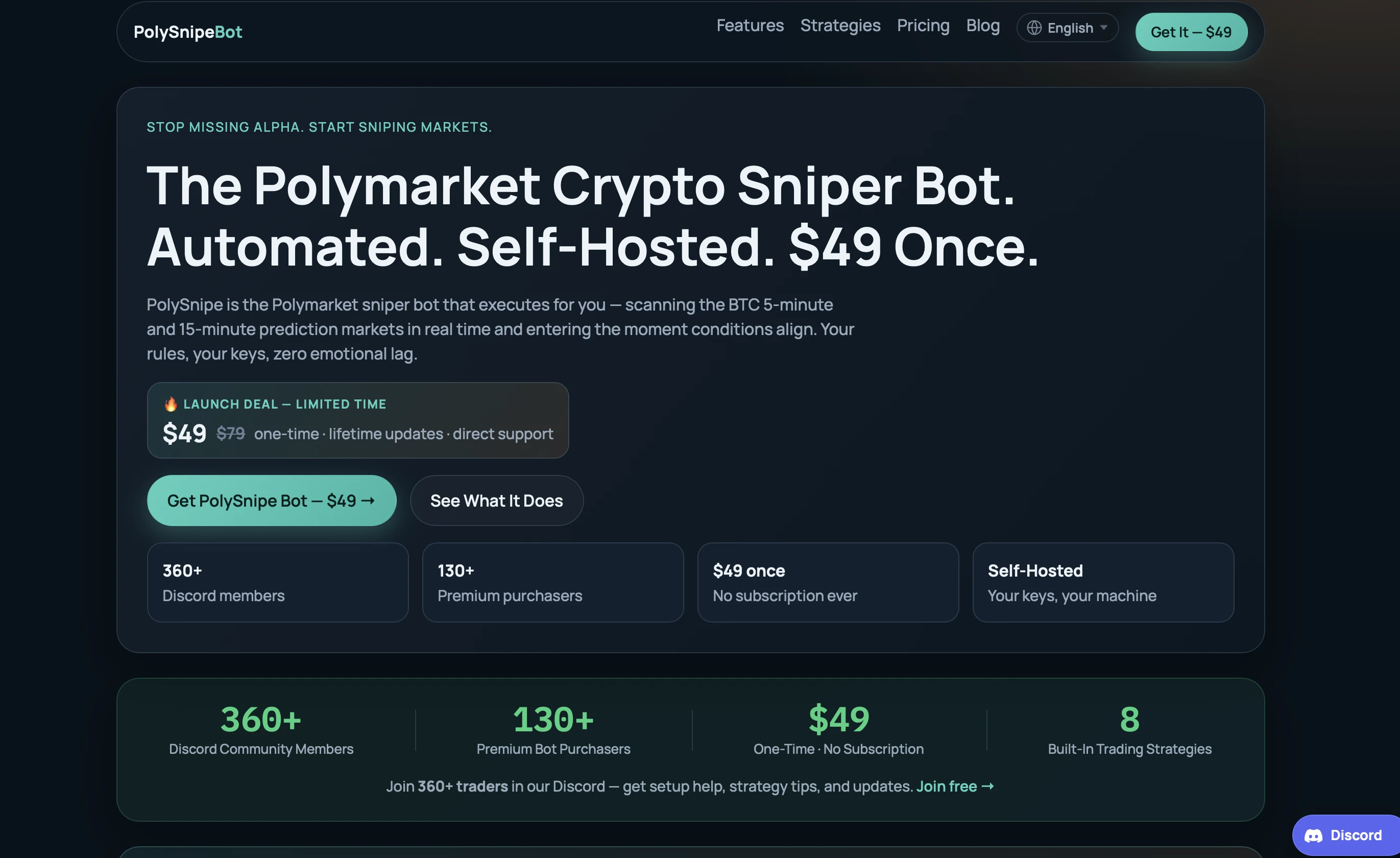
Automated, self-hosted sniper bot for Polymarket's BTC 5- and 15-minute up/down markets. Scans in real time and enters in milliseconds the moment multiple independent signals align. Ships 8 configurable strategies, a setup wizard, backtesting and a full trade journal — full source code, one-time $49.
PolySpy
Telegram bot for instant alerts on brand-new Polymarket markets. Fires notifications the moment markets are created — filtered by category (politics, sports, crypto, finance, tech, culture, geopolitics) with subcategory and ignore-tag controls — so you can take a first-mover position before the crowd.
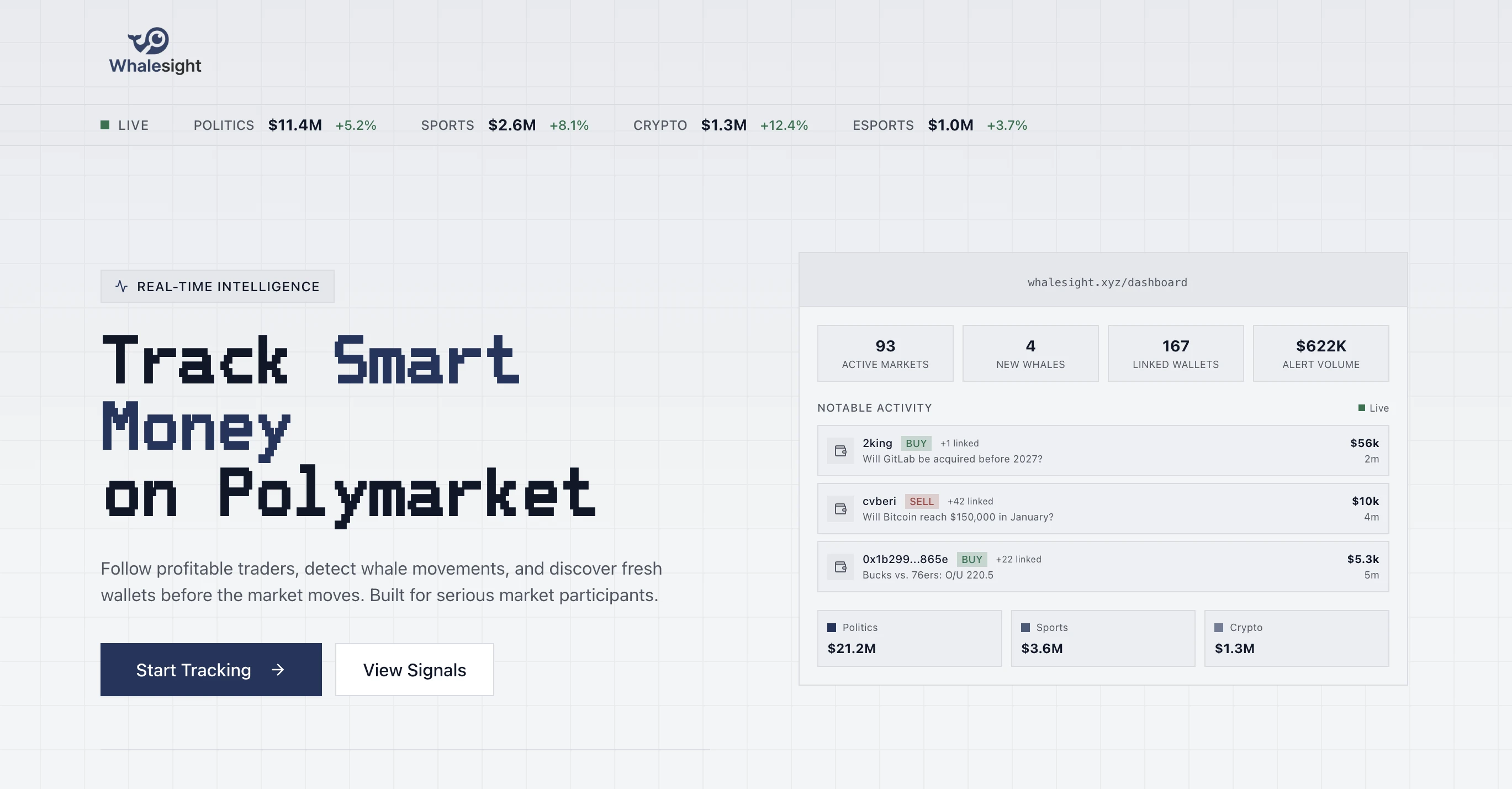
Whalesight
Real-time whale-tracking intelligence for Polymarket. Alerts you the moment large bets ($5k+) hit, ranks top traders on a profit/volume/win-rate leaderboard and breaks down each wallet's historical P&L, category performance and open positions across 2,000+ markets.
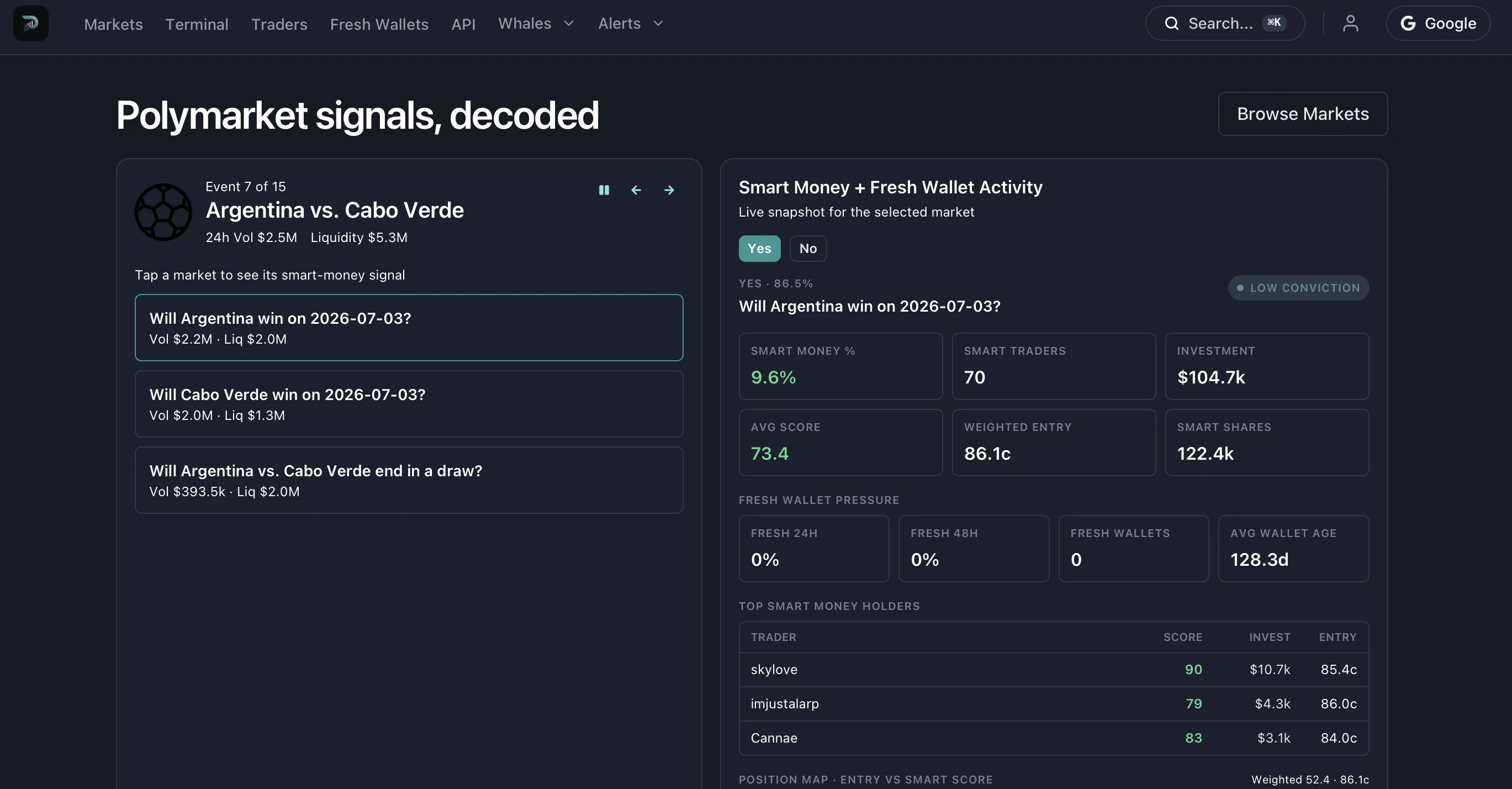
PolyAlertHub
Real-time intelligence and alerting for Polymarket — no wallet connection needed. Tracks where profitable smart-money traders position, fires whale alerts on trades over $10K, flags fresh-wallet risk, and includes a trading terminal and $10K paper-trading mode across 15,000+ markets.
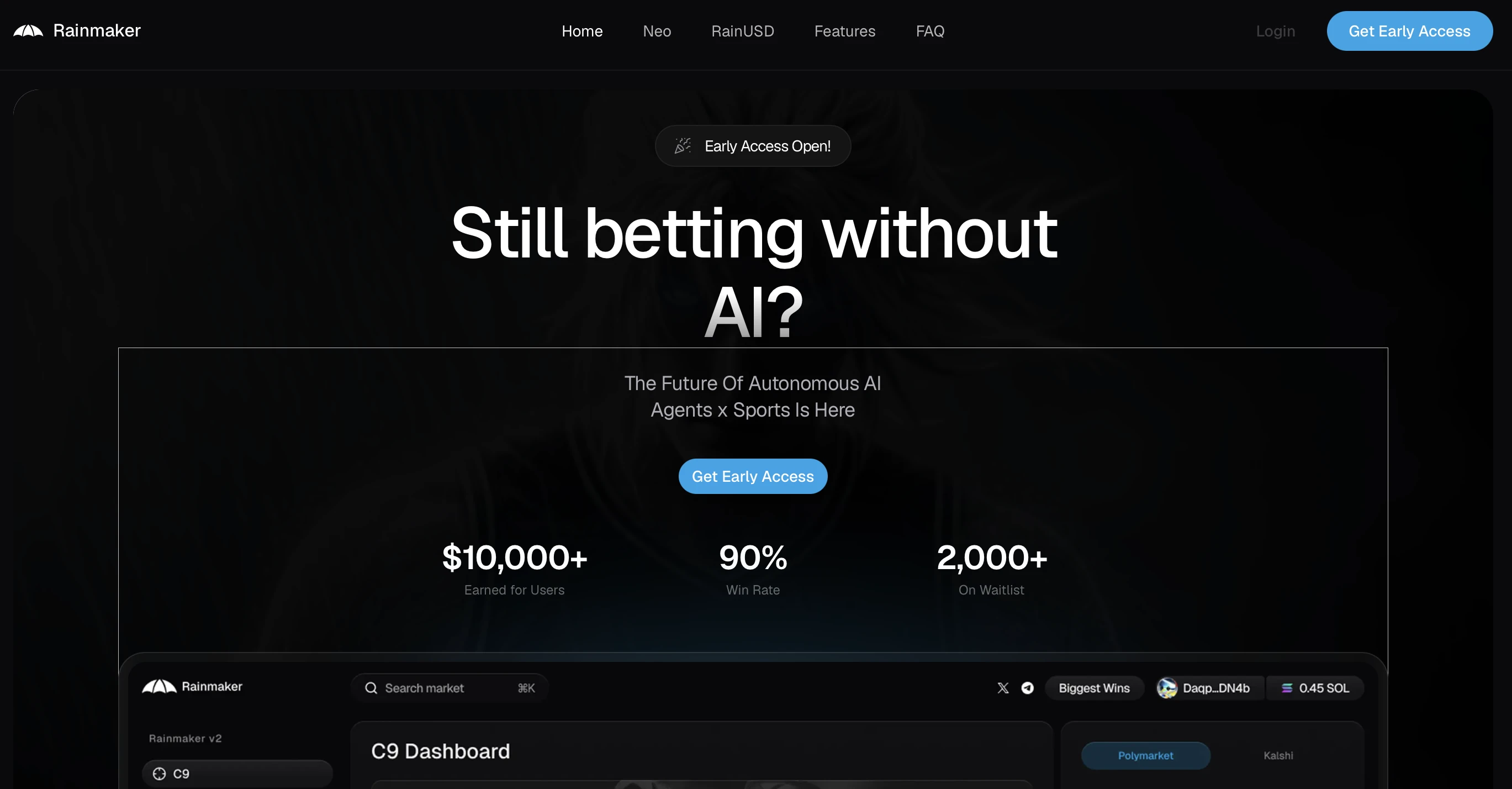
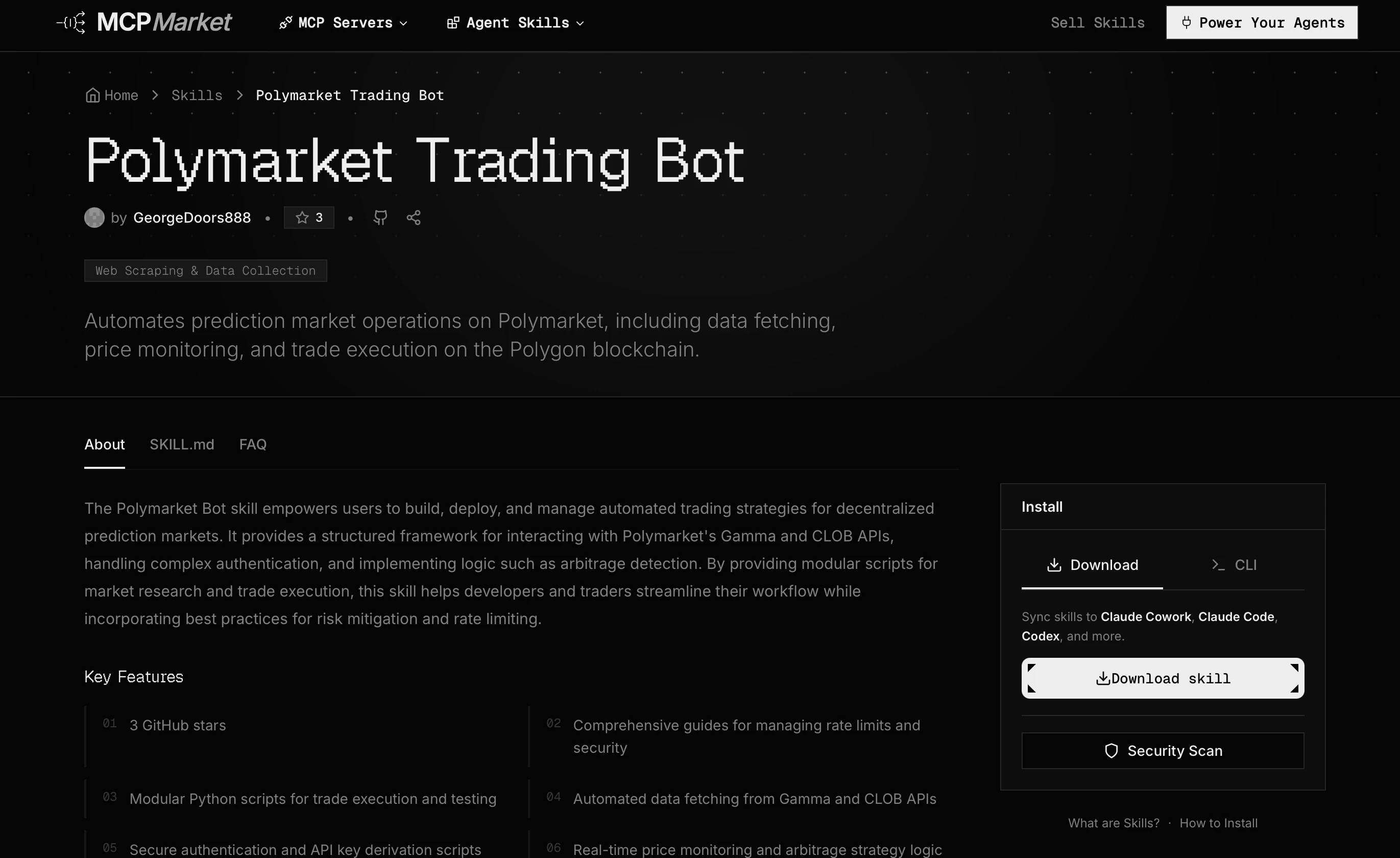
Rainmaker's agents snipe arbitrage between venues, and the Polymarket Bot Skill gives an AI coding agent modular scripts for the Gamma and CLOB APIs — price monitoring included — if you would rather generate a sniper than buy one. None of it is verified by POLBOTS, and none of this is financial advice.
Frequently asked questions
- Is sniping allowed on Polymarket?
- Reacting faster than others to public information is trading, and it is allowed. Spoofing to create the dislocation you then snipe, trading on information you should not have, or hammering the API past its limits are not. The line is the same as for any bot: speed is fine, manipulation and theft are not.
- Can a bot front-run orders on Polymarket?
- No. The CLOB matches orders off-chain and settles on-chain afterwards; there is no public mempool of pending matches to jump ahead of. What a bot can do is see public inputs — a price move on an exchange, a whale's fill, a headline, a new market — before other people act on them. That is sniping; front-running is a claim that describes a mechanism the venue does not have.
- Why is resolution sniping so cheap in fees?
- Because the fee is C × rate × p × (1 − p) and collapses at the extremes: buying the winning side at 0.97 on a politics market costs about 0.12% of notional, against 1% at the mid. The risk is not the fee but the rule — the market may not resolve the way the headline says, and an optimistic-oracle dispute can hold your capital for days.
- Do I need a server next to Polymarket?
- For dislocation sniping on busy books, proximity and a clean WebSocket path are the whole game and people pay for both. For new-market and whale-follow sniping, a reliable VPS and good alerts are enough — the window is seconds to minutes, not milliseconds.