On this page7 sections
What you are actually trading
Polymarket's sports markets are mostly the simple kind: who wins the game, who wins the series, who wins the tournament — plus spreads and totals on bigger events. Each one is a binary or multi-outcome book like any other, priced in cents that are probabilities, tradeable before the game and, for many events, during it. They resolve on the official result under a rule that says what happens on a postponement, an abandonment or a void, which is the sentence a sports bot author should read before anything else.
Two things set them apart from the rest of the catalog. There is a deep, liquid reference market for the same event everywhere else — bookmakers and betting exchanges — so "fair" is less mysterious than on an election. And during the game the price moves on public information that arrives at different speeds to different people, which makes live trading a latency contest that Polymarket deliberately slows down.
Where a sports bot gets its number
From the bookmakers. Take a bookmaker's odds, remove the margin (the "vig") so the implied probabilities sum to one, and you have a market-derived probability for each outcome. Do it across many books and you have a sharp consensus. Compare it to the Polymarket price and trade the gap. This is what an odds-comparison tool does by hand — Line Check pits Polymarket against a betting exchange in American, decimal and implied-probability form; Polyhelper shows bookmaker odds across nineteen books beside the Polymarket book; PolyEdge scans for the gaps — and what a bot does continuously.
From a model. Ratings, lineups, injuries, rest, weather, pace; or for in-play, a live win-probability model fed by score, time and possession. Harder, slower to build, and the only source of edge that is not already priced by the books.
From the tape. Polymarket-specific signals — a whale sweeping a side, a thin book gapping, a new market listed naively — which is sniping with a sports flavour.
Whichever source, the output is the same: a probability, a comparison to the price, a size, an order.
Latency, and the matching delay
Pre-game, edges last minutes to days and speed barely matters. In-play is different: a goal, a turnover, an injury moves the fair price in seconds, and the first order to the book wins. Bookmakers and their data providers are very fast at this; a bot on a home connection reading a free score feed is not, and a bot reading the Polymarket price itself is last by definition.
Polymarket knows this and counters it: some markets impose a matching delay — an order is accepted and comes back with status "delayed", and matching begins only when the delay elapses. It exists to stop a fast feed picking off slower traders, and it turns "be first" into "be right about where the price will be in a few seconds", which is a much harder and fairer game. A sports bot should read the flag and plan for it rather than discover it in production. Polymarket also publishes a dedicated sports WebSocket feed for live match results, which is the closest thing to an official clock a bot can subscribe to.
The fee, and what it does to thin edges
Only takers pay. On sports markets the rate is 0.05, so the fee on a fill of C shares at price p is C × 0.05 × p × (1 − p): 1.25% of notional at the mid, falling toward zero at the extremes.
| Price | Taker fee per fill | What a gap must exceed to be a trade |
|---|---|---|
| 0.50 | 1.25% | 1.25% + the spread |
| 0.70 | 1.05% | 1.05% + the spread |
| 0.90 | 0.45% | 0.45% + the spread |
A bookmaker gap of two cents at the mid is therefore not an edge once you take. The structural answer is the same as everywhere on the platform: rest orders where you have a view and let others cross the spread into you — makers pay nothing and earn rebates — and take only when the gap is large and the book is deep.
Liquidity, limits and resolution
Outside marquee games and finals the books are thin: a few hundred dollars a side is common, and a bot that sizes for the Premier League will move a minor-league market by itself. Set size to depth, not to conviction.
Resolution is where sports bots lose money while being right. A postponed game may resolve "no", be voided, or roll to the rescheduled date depending on the rule; a game called early, a disqualification, a change of venue — each market's rules say what counts, and cross-venue hedges against bookmakers or Kalshi are bets that both rulebooks agree. The arbitrage guide covers that risk in detail.
What tends to work, and what tends not to
- Works: resting orders on pre-game and futures markets at model or de-vigged prices; scanning many small markets for stale prices; trading the Polymarket book's own dislocations when a whale or a copy-bot cascade moves it away from the books.
- Tends not to: taking in-play against a matching delay; copying bookmaker moves you see late; any strategy whose edge is smaller than 1.25% plus the spread; sizing beyond the book's depth.
Tools in the catalog
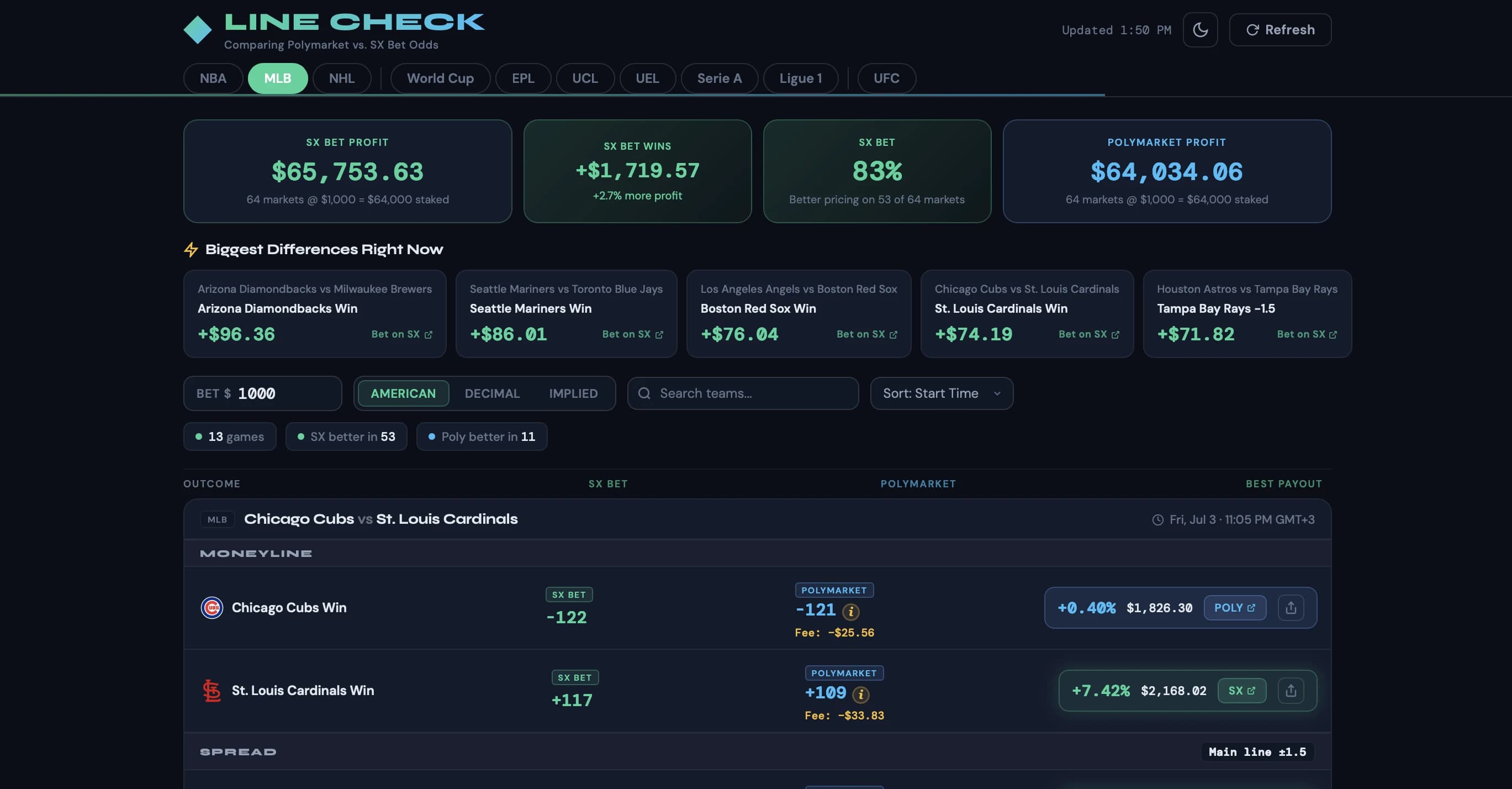
Line Check
Odds-comparison tool that pits Polymarket against SX Bet side by side. Shows American, decimal and implied-probability formats, highlights the best-edge opportunity and optimal payout, and lets you size a custom bet across NBA, MLB, NHL, UFC and major soccer leagues.
Poly Helper
Browser extension that upgrades Polymarket without leaving its interface — 25+ context panels: live crypto and stock stats, sports intel with live scores, bookmaker odds comparison across 19 sportsbooks with automatic edge detection, polls vs market price on election events, top-holders PnL, a tracker to follow top traders, breaking-news X feed, LP-rewards calculator and TradingView-style charts. Polymarket Builders Badge — supported and approved by Polymarket.
Polymtrade
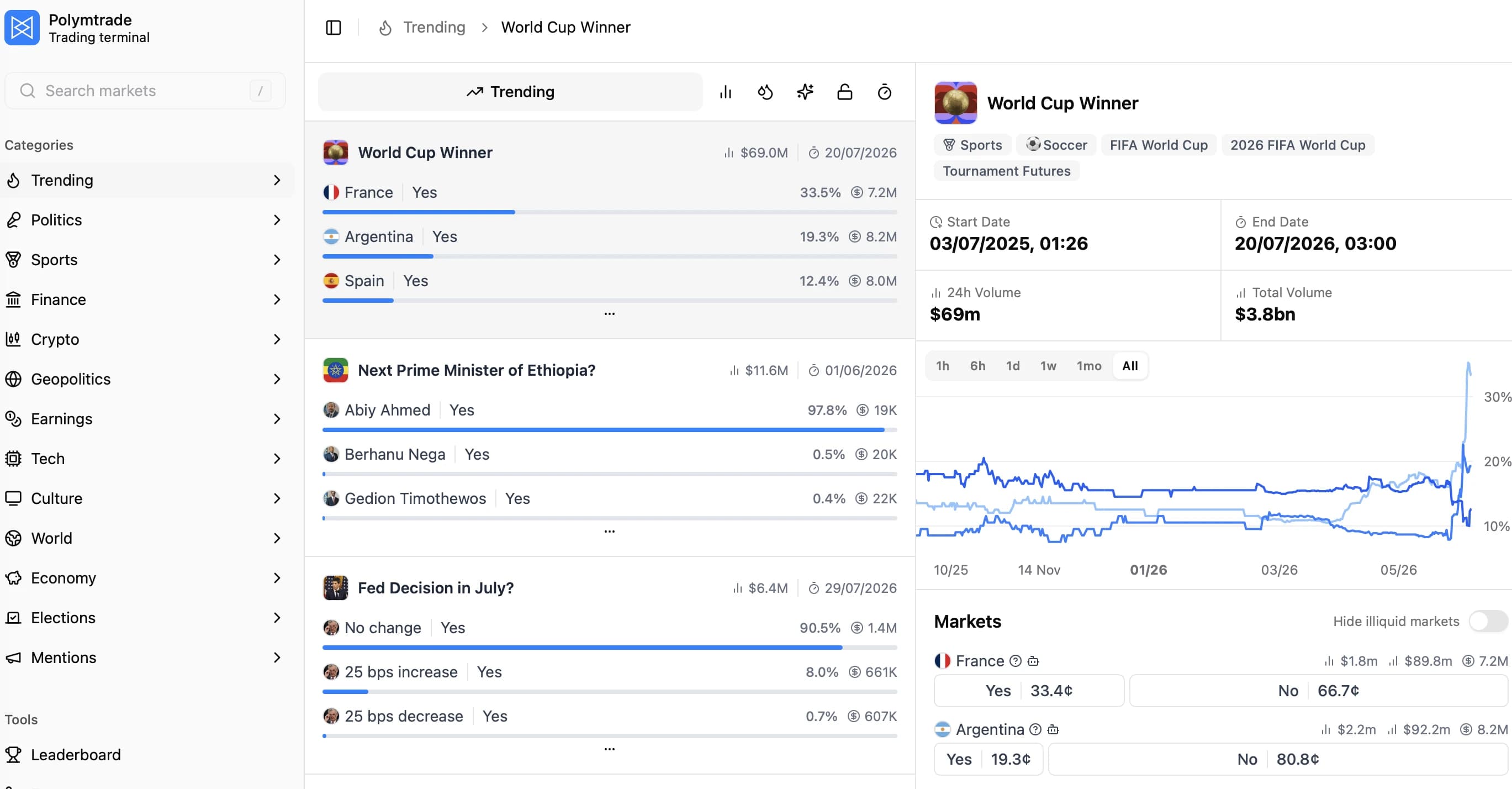
Dedicated trading terminal for Polymarket. Browses every market by category — politics, sports, crypto, finance, geopolitics, earnings — with bookmaker-style decimal odds next to cent prices, live scores for sports and esports, an AI-predictions feed, trader leaderboard and a real-time trade feed, all from one screen.
Traderline
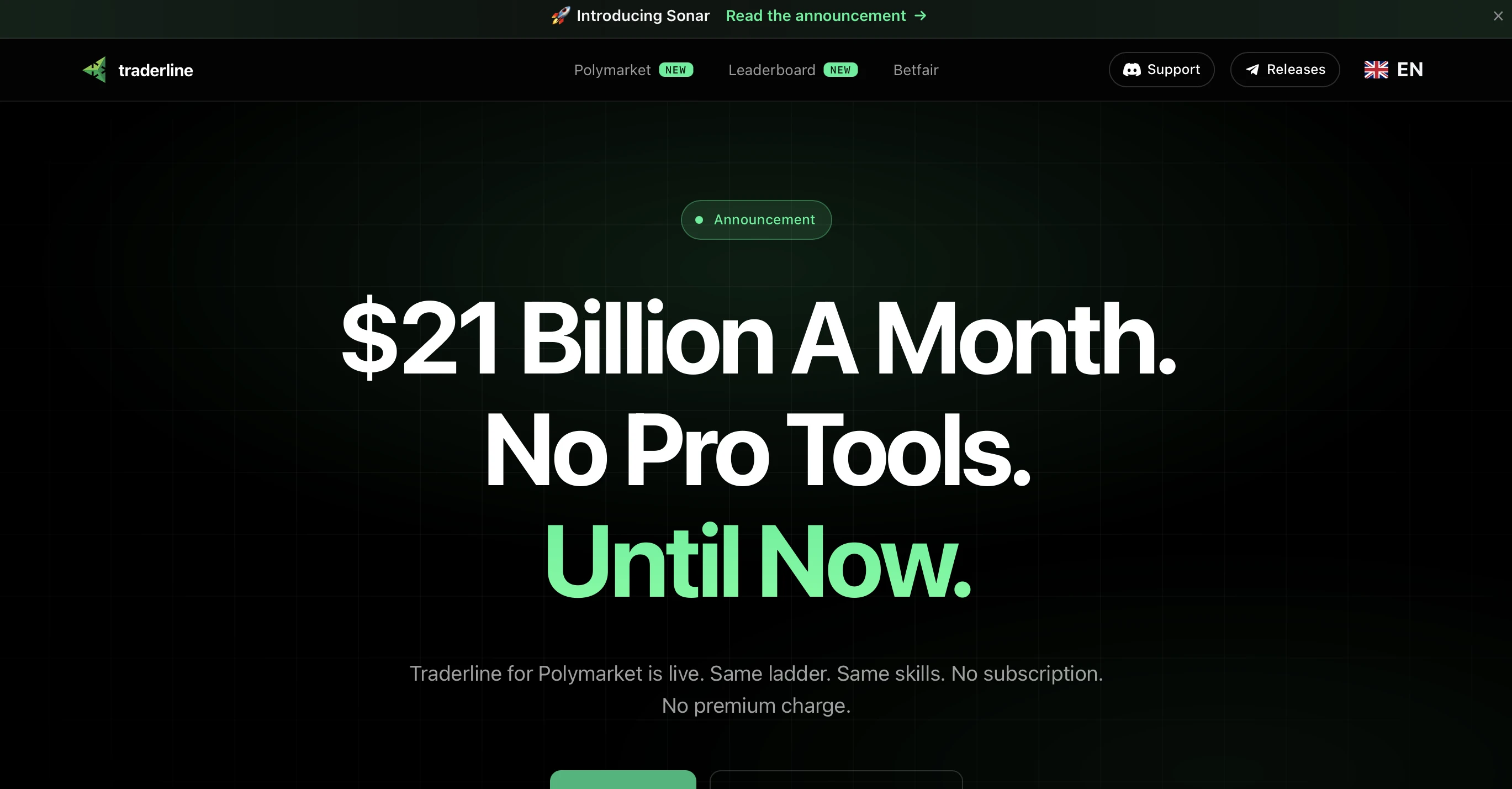
Professional trading software for prediction markets and betting exchanges. A pro-grade ladder interface with fast execution, a NET button for scalping and on-chain 'Sonar' — covering Polymarket and Betfair, free with no subscription. Used by 150,000+ traders across 20+ countries.
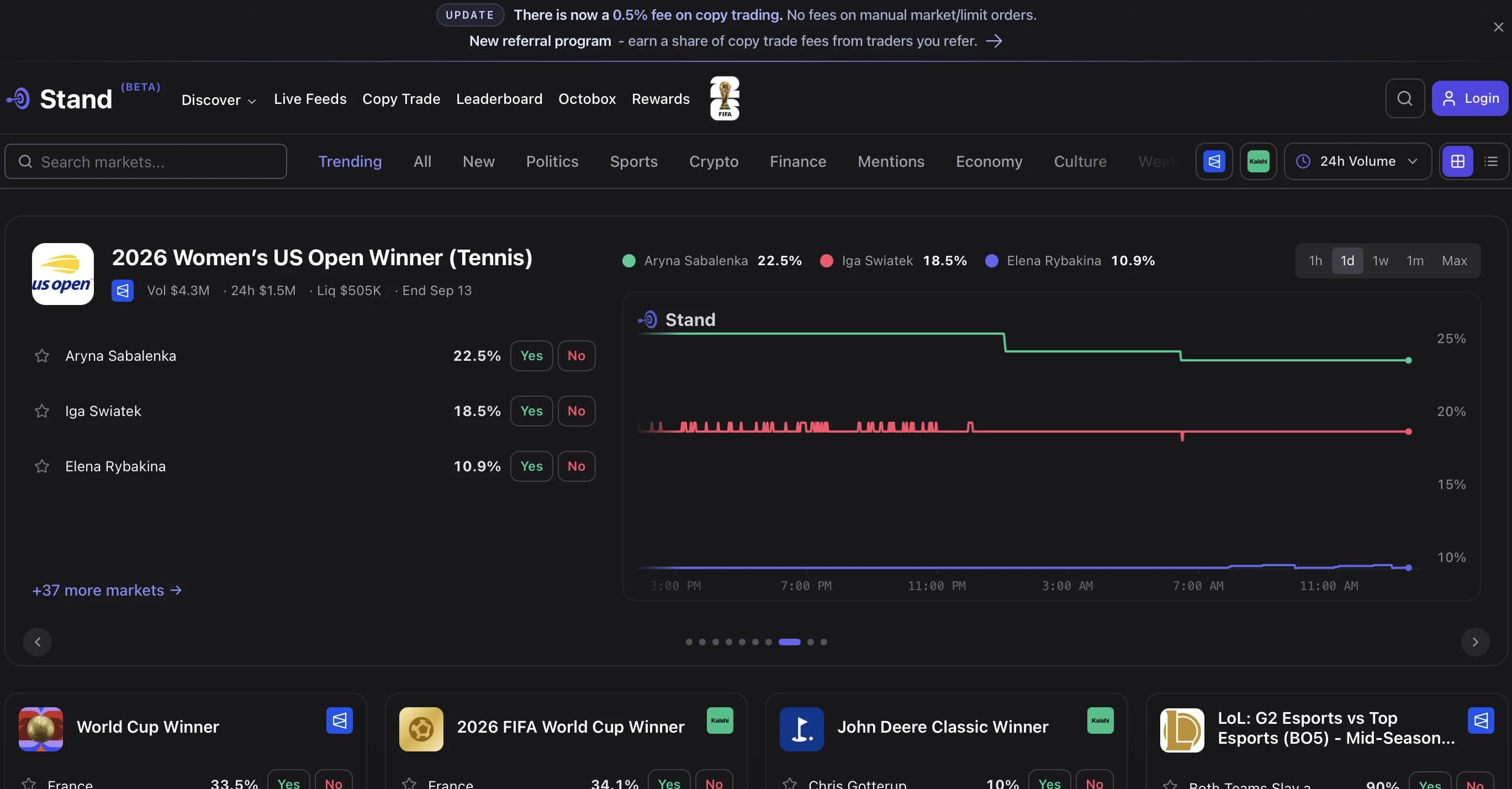
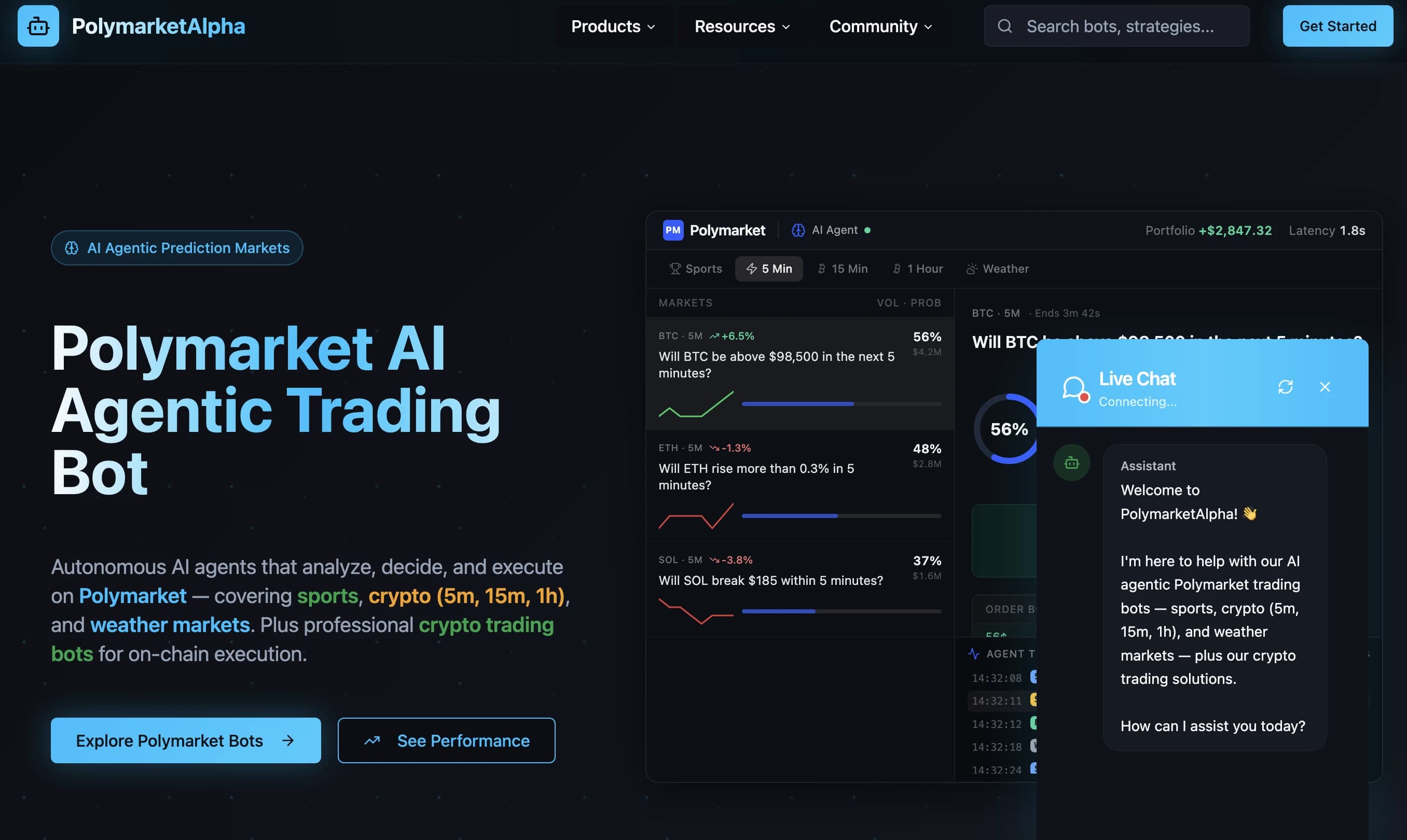
Polymtrade and Traderline are terminals built for this — bookmaker-style decimal odds beside cent prices, ladders, fast execution; Stand puts Polymarket and Kalshi in one interface; PolymarketAlpha sells autonomous agents that cover sports among other markets. The Sports Trading category lists everything we have reviewed. As with all of it: POLBOTS does not verify any tool's performance, and nothing here is financial advice.
Frequently asked questions
- Can a bot beat bookmakers' odds on Polymarket?
- Sometimes, on the gap between a bookmaker line and a Polymarket price — but the gap has to exceed the taker fee (1.25% at a 50-cent price on sports markets), the spread you cross, and the chance the two resolve differently. Bookmakers also move faster than most bots on live events. The edge is real and thin, and it belongs to whoever gets there first with a resting order.
- Why did my live order come back as 'delayed'?
- Because the market imposes a matching delay: orders are accepted and matched only after a short pause. Polymarket applies it to protect books where a fast feed could pick off slower traders — live sports are the obvious case. A sniping strategy that relies on beating the book by a second is built for a door that is closed.
- Is sports trading on Polymarket legal where I am?
- That is a jurisdiction question, not a bot question. The international order book will not take new orders from the US, UK, France, Germany and thirty-odd other jurisdictions; Polymarket US lists sports contracts under CFTC rules with identity checks and its own state restrictions. The bot does not change where you are.
- What do sports bots do between games?
- Mostly research: reconciling bookmaker lines, building or updating models, tracking lineups and injuries, and placing resting orders on futures and pre-game markets where edges last longer than in-play. A bot that only trades live is a sniper, and in-play on Polymarket is a sniper's hardest room.