DeskBot for Kalshi
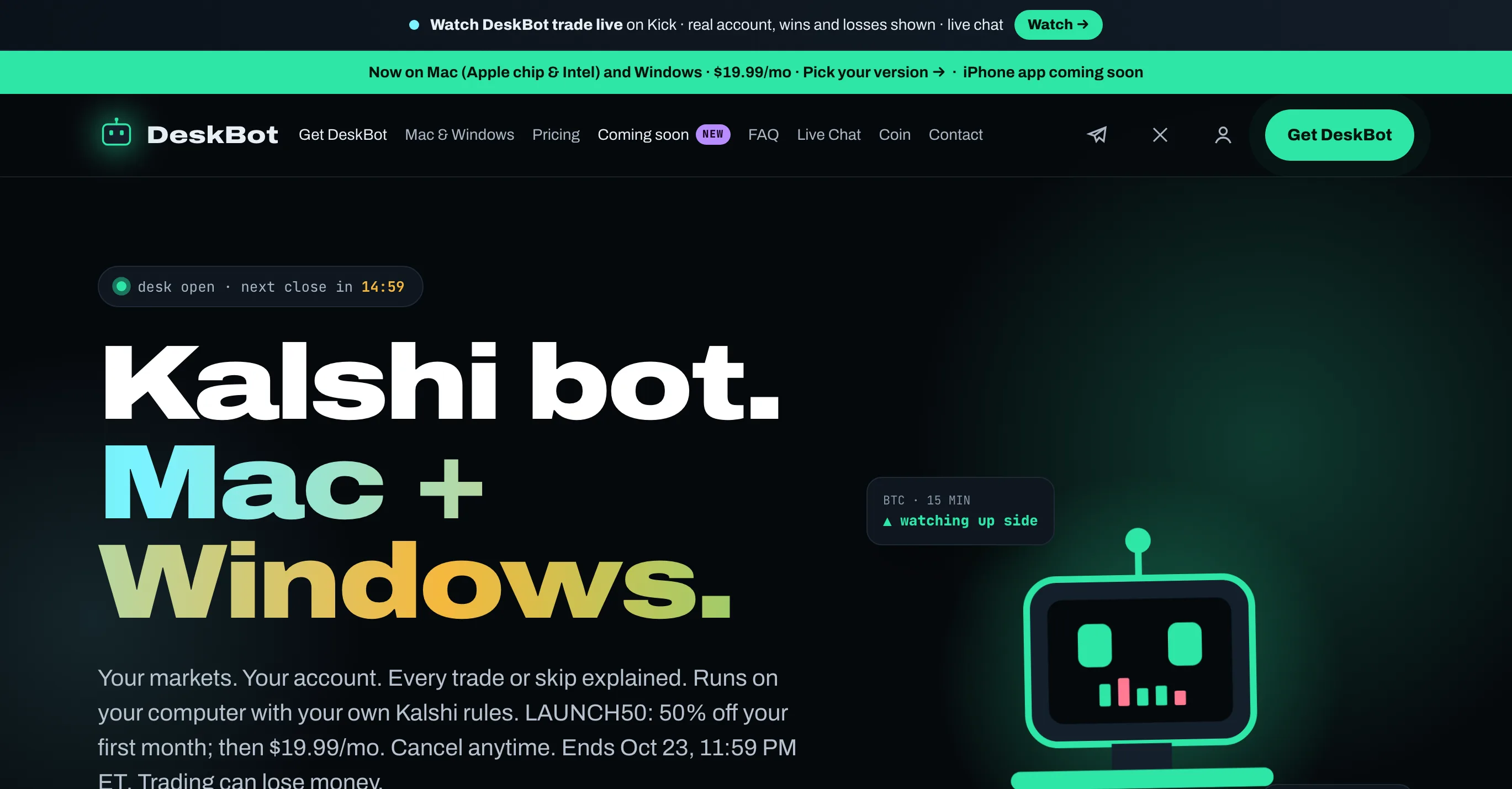
Desktop bot for Kalshi's 15-minute up-or-down markets, all 19 of them at once: nine coins — BTC, ETH, XRP, SOL, DOGE, HYPE, ZEC, NEAR and BNB — plus gold, silver, copper, platinum, palladium, oil, natural gas and three currency pairs. It runs on your own Mac or Windows PC, trades your own Kalshi account through your API key and writes a reason for every trade and every skip on a local dashboard. You choose the markets, the contract size, which side it may take and a cap on what it can risk; it weighs each price against the time left and against the win rate that price needs after Kalshi's fee. In the developer's own live account it buys the side already priced around 92¢, so a win pays about $1 and a loss costs about $14. $19.99 a month, with a free 24-hour trial in paper mode. Kalshi only — it does not trade Polymarket.
Overview
Desktop bot for Kalshi's 15-minute up-or-down markets, all 19 of them at once: nine coins — BTC, ETH, XRP, SOL, DOGE, HYPE, ZEC, NEAR and BNB — plus gold, silver, copper, platinum, palladium, oil, natural gas and three currency pairs. It runs on your own Mac or Windows PC, trades your own Kalshi account through your API key and writes a reason for every trade and every skip on a local dashboard. You choose the markets, the contract size, which side it may take and a cap on what it can risk; it weighs each price against the time left and against the win rate that price needs after Kalshi's fee. In the developer's own live account it buys the side already priced around 92¢, so a win pays about $1 and a loss costs about $14. $19.99 a month, with a free 24-hour trial in paper mode. Kalshi only — it does not trade Polymarket.
How it works
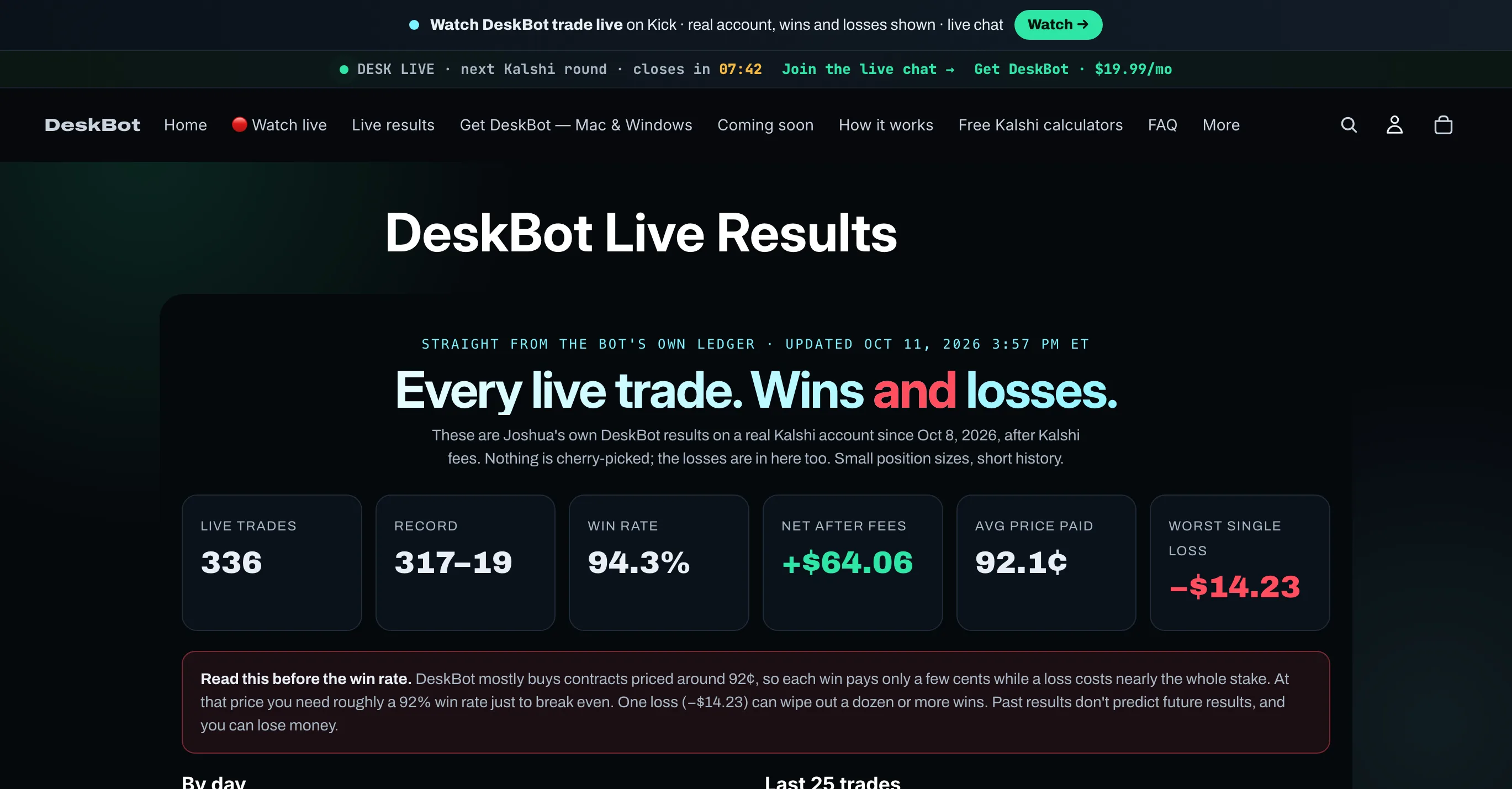
- The developer's own live account shows what the bot does by default. From Oct 8 to Oct 11, 2026 it made 336 trades, won 317 and lost 19, and netted +$64.06 after Kalshi's fees, buying the side already priced at 85–95¢ — 92.1¢ on average — with 4 to 11 minutes left in the window. At that price a win on a 15-contract order pays about $1 and a loss costs about $14, so the bot has to win roughly 92 times in 100 just to break even, and one loss erases a dozen wins or more. The first day shows the risk: 108 wins, 12 losses and −$51.64. The site says all of this itself, plainly, and calls it one account over a short stretch. Its results page has not been updated since Oct 11; a frame of the vendor's demo from Oct 14 reads +$140.05 over 712 settled trades, and −$41.39 for that day.
- We checked that ledger against Kalshi rather than taking it on trust. For 35 trades — the 25 on the results page and 10 more shown on the developer's Kick stream on Oct 12, EUR/USD and oil among them — the side Kalshi settled each window on matched the win or loss recorded, and Kalshi's public trade tape shows fills on the recorded side at the recorded price in that minute; in the EUR/USD window the only such fill is a single 15-contract order at 93¢, the size the ledger implies. Every profit and loss we tried recomputes to the cent from Kalshi's fee formula. The demo video on the home page is the working app, not a mock-up: the strikes it shows for the 3:15 PM ET window on Oct 14 — BTC 81,629.01, ETH 2,429.42, XRP 1.3279 — are the ones Kalshi set. None of this proves whose account it is, or that your copy will behave the same: the video shows the developer's own build, and the vendor says your results will differ with your settings, size and timing.
- Your money stays in your Kalshi account, and by the vendor's description your API key stays on your computer: the app asks for it when it first starts and serves its dashboard locally. A Kalshi API key can be revoked on your own account page, so create one for DeskBot alone. The trust question moves to the program itself. The builds are not signed — on a Mac you open the app with right-click → Open, on Windows past SmartScreen with More info → Run anyway — and what you run is closed code from a vendor whose domain was registered on Sep 20, 2026.
- The vendor is new and small. DeskBot names no company, only a Gmail address and a unit address in Cumberland, Rhode Island; the developer streams as Joshua. In September the same store sold 91 “DeskBot for …” products covering brokers and exchanges of every kind, while its own home page said the Kalshi modules were still being prepared and could not be bought; the catalog is now the Kalshi bot and its trial, with Robinhood, Kraken and a Solana coin checker marked as in development and not for sale. The refund and cancellation pages still describe a One-Day Pass and weekly and annual plans that are not sold. On Oct 15 the X account @DeskbotKalshi, opened Oct 10, had 12 followers, the Discord 9 members and the Telegram group 11. The site also keeps a page for an “official” DeskBot coin, not launched, which warns that any coin before it is fake, naming a copycat token, and says holders would get nothing from the bot's trades or sales; a banner on the Oct 12 stream announced that “something” would launch live on Friday, Oct 16.
- We read the site, the product and trial pages, the FAQ, the results page, the Terms and the store policies; rebuilt 35 of the ledger's trades from Kalshi's settlements and trade tape; checked the demo's strikes against Kalshi; and looked at the Kick stream. We did not run DeskBot: the download arrives by email after checkout, and we do not run unsigned code from a new vendor. The free paper trial is the way to see it before paying.
Supported markets
- Kalshi only — the quarter-hour up-or-down series on BTC, ETH, XRP, SOL, DOGE, HYPE, ZEC, NEAR and BNB
- Kalshi quarter-hour series on gold, silver, copper, platinum, palladium, WTI oil and natural gas
- Kalshi quarter-hour series on EUR/USD, GBP/USD and USD/JPY
One plan, $19.99 a month through the store's Shopify checkout; the code LAUNCH50 halves the first month until Oct 23, 2026. Cancelling stops the next charge and keeps access to the end of the month paid for, and there are no refunds once the download has been delivered. The free trial is a $0 checkout that asks for an email and a billing address and unlocks 24 hours of paper trading only — it never places a real order. Live trading needs a funded Kalshi account and your own API key, and Kalshi's taker fee, 7% of the price times its complement and rounded up to the cent on each order, applies on every fill: 8¢ on a 15-contract order at 92¢.
Get DeskBot for Kalshi- All 19 of Kalshi's 15-minute series on one screen, each switched on or off by itself, with its price, the time left and the bot's call
- A written reason for every trade and every skip — “too close”, “near certain · fee too big”, “watching up side” — on a dashboard served by the app on your own computer
- Your rules: contract size, the yes side, the no side or both, and a cap on what it can risk
- A break-even check before each entry: the win rate the price needs after Kalshi's fee, against the bar you set
- Stays out of the last stretch of a window rather than open a trade with no time left to be right
- Starts in paper mode and trades live only once you arm it
- Builds for Mac (Apple silicon or Intel) and Windows 10/11; no Python install needed on Windows
- Author
- DeskBot
- Category
- Crypto Markets
- Website
- deskbot.store
- Risk level
- High risk
- Added
- Oct 15, 2026
Link to this page from your site and the listing gets the Verified Partner mark and a followed link back to you.
Get the badgeDeskBot for Kalshi reviews
No one has reviewed DeskBot for Kalshi here yet. If you have run it, your write-up is the one the next reader will see.
Be the first to review DeskBot for Kalshi. Tell the next reader what it traded for you, what it cost and whether you would run it again.
Reviews are written by readers, not by us or by the bot's author. Each one is read by a human before it is published, and we never accept payment for a review or for a rating.
DeskBot for Kalshi alternatives
Pbot.pro
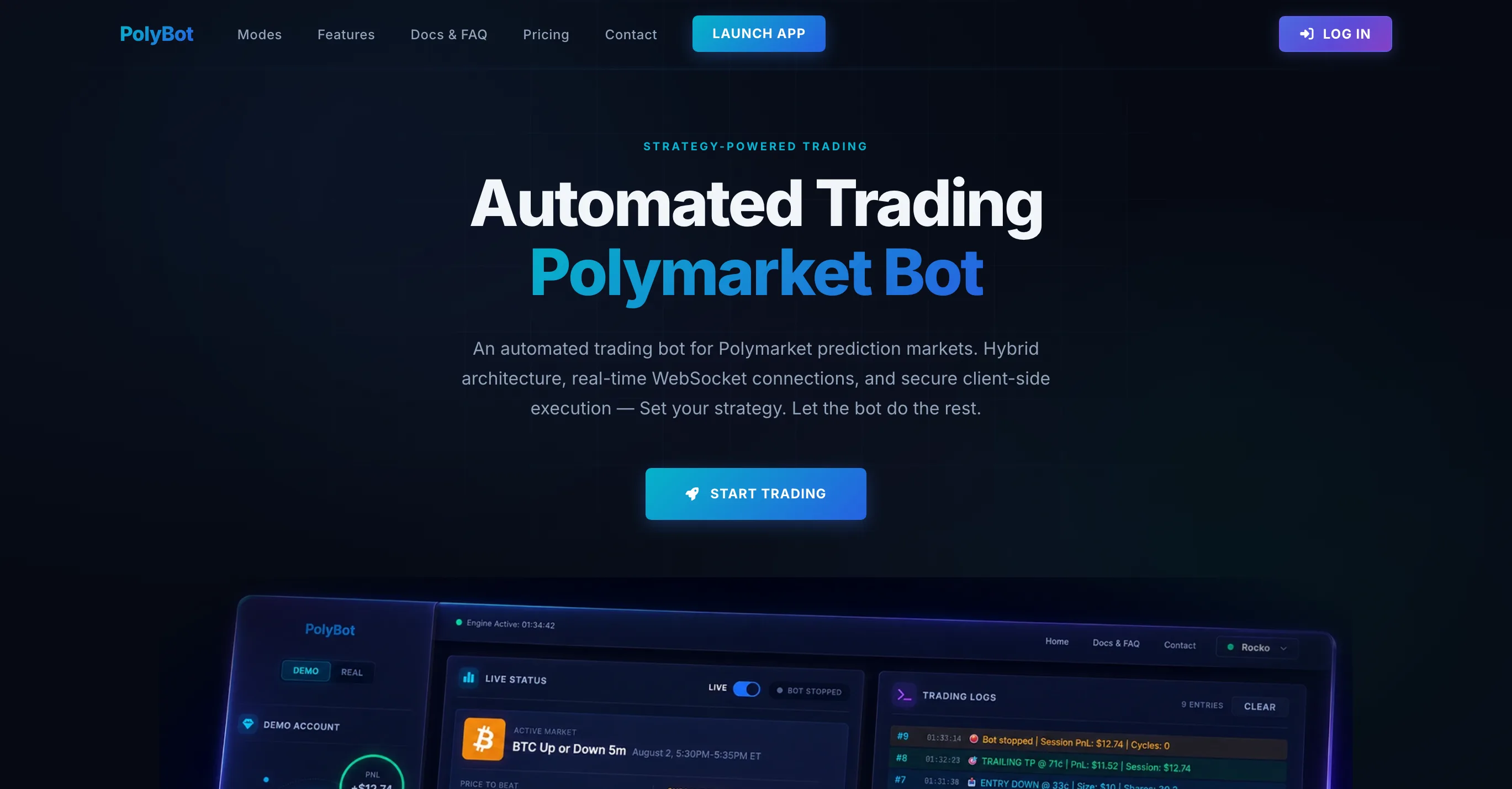
Browser-based bot for Polymarket's short crypto Up or Down windows — 5 minutes, 15 minutes or an hour, on BTC, ETH, SOL, XRP, DOGE or BNB. You set a stake, an entry price and the part of each window in which it may buy; the bot steps from one window to the next by itself, buys the Up or Down side once its ask falls to your price, and sells on a take-profit, stop-loss or trailing stop, in percent or in cents, or automatically at 99¢. Demo mode trades a $10,000 virtual balance against Polymarket's live order books. Real mode runs entirely in your browser tab: you paste your Polymarket wallet's private key into the page, orders go from there straight to Polymarket, and the bot stops when the tab closes. A week of demo is free; real mode costs $9 a week or $29 a month in USDC, and every fill also pays Pbot.pro a 1% builder fee that the site does not mention. Polymarket records no live volume under its builder code so far.
norm1e69
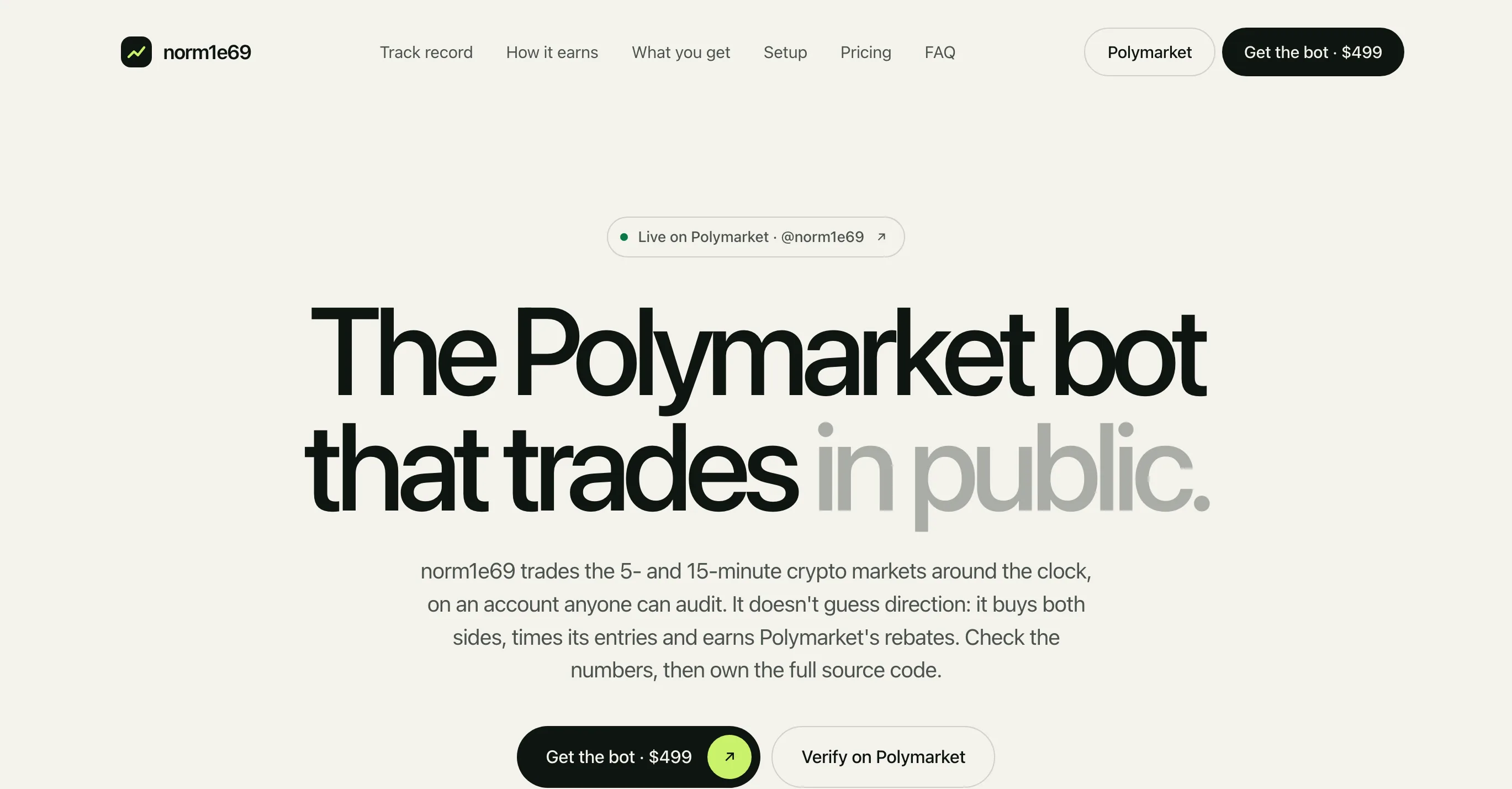
Editor's ChoiceSelf-hosted Python bot for Polymarket's 5- and 15-minute crypto Up or Down windows, sold as full source for a single payment and named after the public Polymarket account its seller points to as proof. It does not predict direction: it buys both Up and Down through each window on Bitcoin, Ethereum and Solana, mostly at the ask, holds every position to settlement and redeems the winnings. By the vendor's own breakdown the timing of those buys roughly pays the taker fee, and more than half of the net comes from Polymarket's fee rebates at a high volume tier. Paper mode, a daily loss limit, an exposure cap and Telegram reports are built in.
Poly Sniper
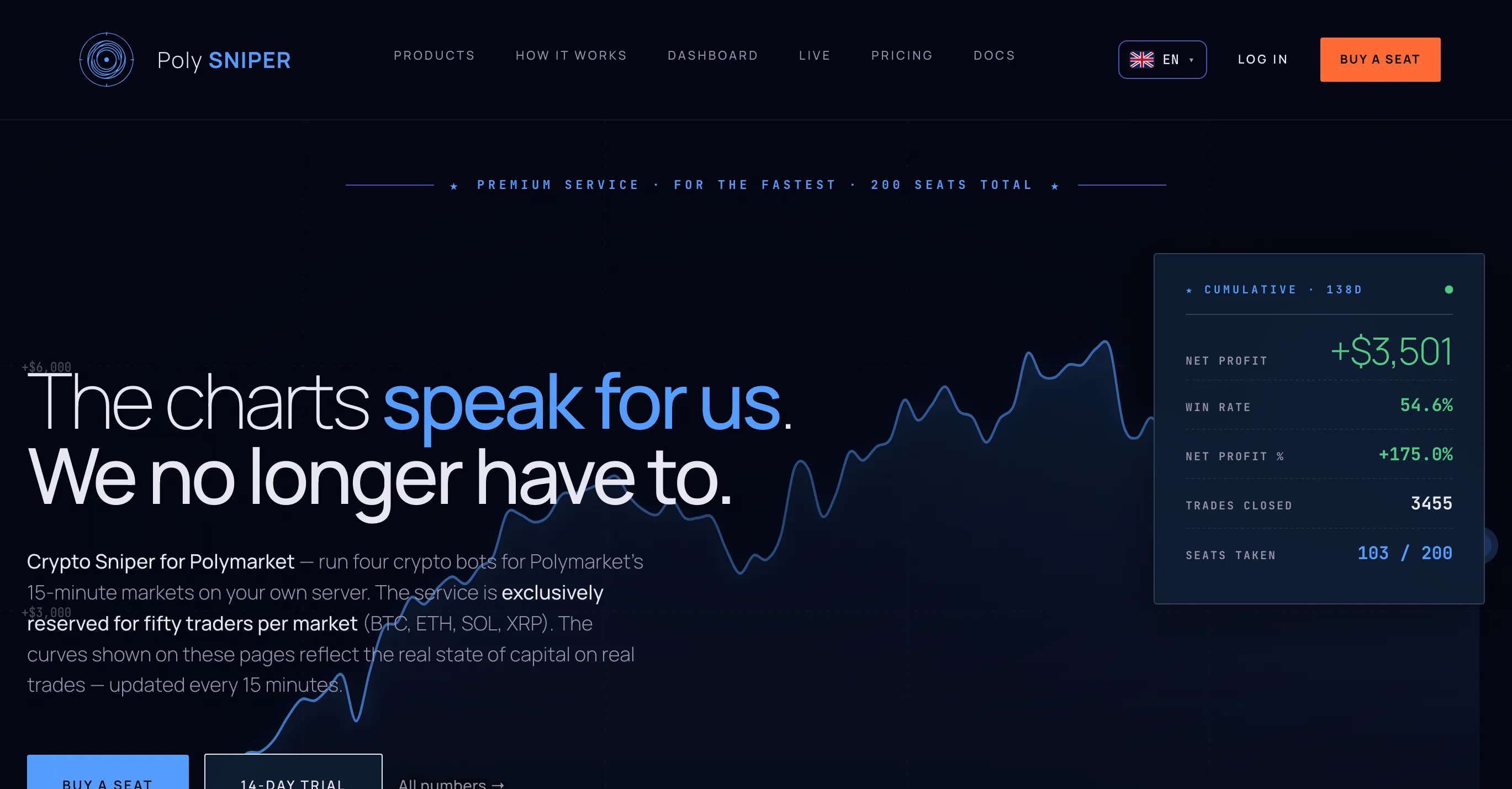
Four self-hosted bots for Polymarket's 15-minute crypto windows — BTC, ETH, SOL and XRP — sold per coin and capped at fifty seats each. You rent a small Linux VPS outside the US, unpack a package of compiled Python 3.14 modules built for your CPU, and enter per-coin licence keys plus your Polymarket wallet credentials in a dashboard that runs on localhost; the credentials stay in a local .env and the bot connects outbound to Polymarket, a Polygon RPC, the vendor's signal server and its licence server. Every coin starts in demo mode with real data and virtual positions, and you flip it to live yourself. Basic runs the strategy; Premium adds one-second order-book updates, 2x and 3x signal multipliers, entry-price filters and a daily digest. The results page shows 138 days, 3,455 closed trades, a 54.6% win rate and +$3,501 on $2,000 — self-reported, with the caveats below.