99market vs Pulse Market
99market and Pulse Market are both filed under Platforms & Tools and Sports Trading and 1 more. Both are trading platforms; 99market is free, Pulse Market is free to use with a per-trade fee. Below: the facts side by side, where the two actually differ, and when each one is the better pick.
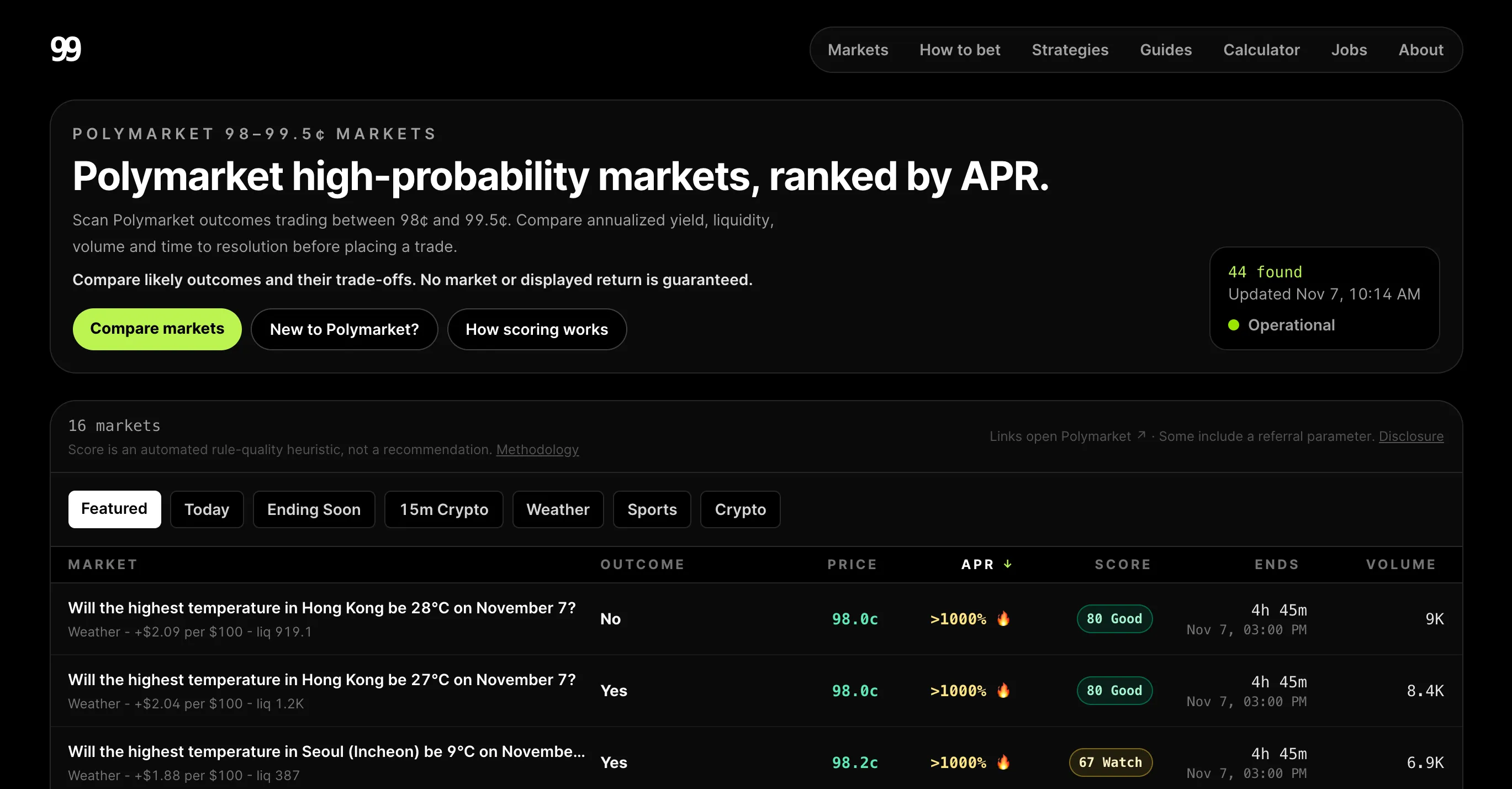
Free scanner for Polymarket outcomes priced between 98¢ and 99.5¢, ranked by annualized return.
Compared with Pulse Market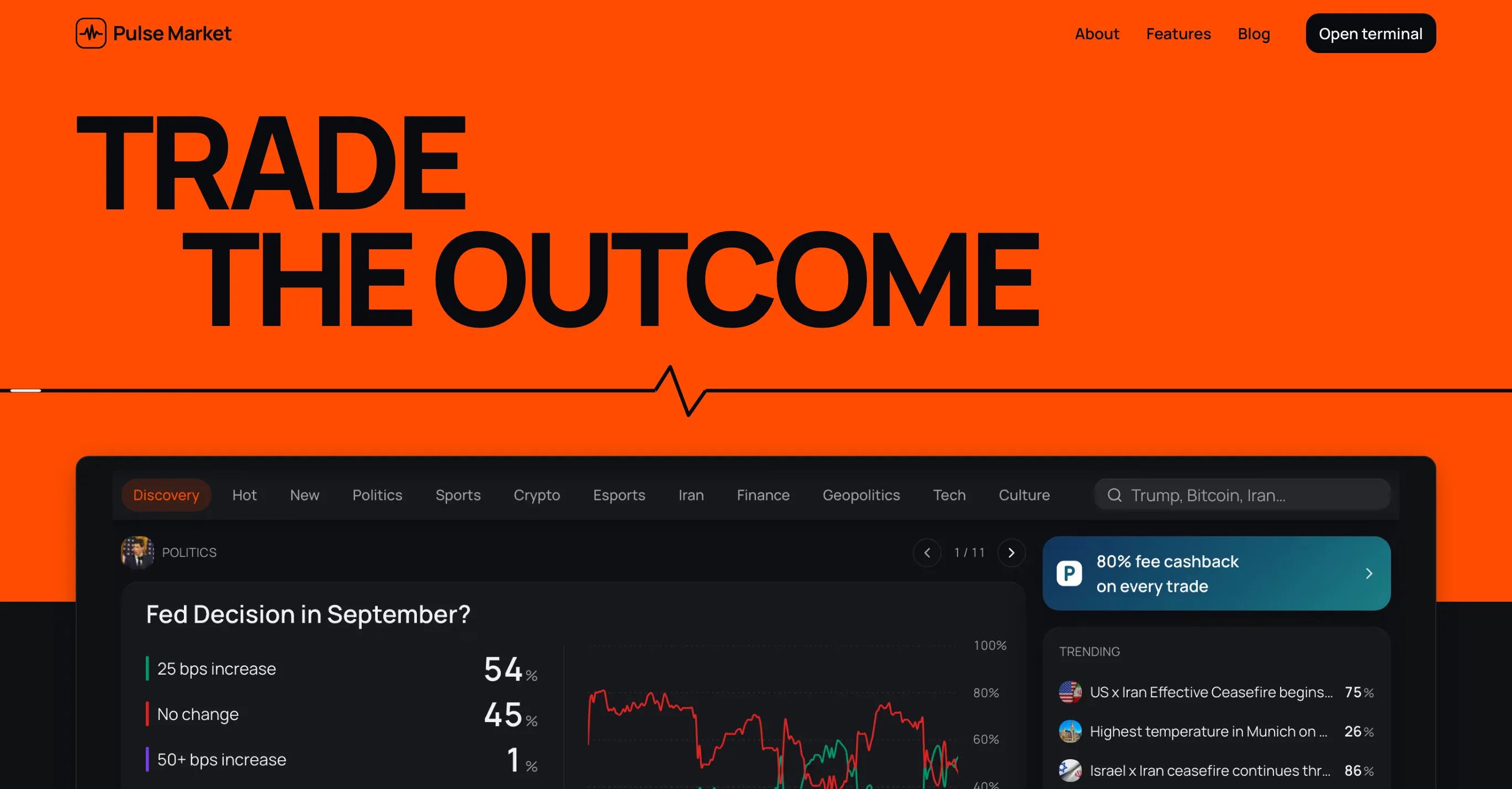
Web terminal for Polymarket's own markets and order books, built around the way in and the record after rather than any strategy: sign in with an email code or Google, fund a Polygon trading account with USDC or USDT from six networks from $10, and trade with…
Compared with 99marketAt a glance
| Fact | 99market | Pulse Market |
|---|---|---|
| Type | Trading platform | Trading platform |
| Category | Platforms & Tools | Platforms & Tools |
| Also listed in | Market Making, Sports Trading, Politics & Elections, Crypto Markets, Weather Markets | Crypto Markets, Sports Trading |
| Pricing | Free | Free to use, fee per trade |
| Price | free | free · 0.5% per fill |
| Risk rating | Medium risk | Medium risk |
| Markets | Polymarket outcomes priced at 98–99.5¢: weather, sports, crypto, politics, economy and more | All Polymarket markets — sports with live scores and a LIVE mark, crypto 5-minute up-or-down windows, esports, finance, tech, culture, the economy and current affairs and Screener presets: Undecided (both sides at 40–60¢), Top movers (more than a tenth in an hour), Live now (matches started within eight hours), Closing soon (resolving within 24 hours) |
| Source | Source not published | Source not published |
| Runs in Telegram | No | No |
| Listed since | Nov 7, 2026 | Sep 28, 2026 |
Highlighted rows differ
Key differences
- 99market is free (free); Pulse Market is free to use with a per-trade fee (free · 0.5% per fill).
- They cover different markets: 99market lists Polymarket outcomes priced at 98–99.5¢: weather, sports, crypto, politics, economy and more, Pulse Market lists All Polymarket markets — sports with live scores and a LIVE mark, crypto 5-minute up-or-down windows, esports, finance, tech, culture, the economy and current affairs and Screener presets: Undecided (both sides at 40–60¢), Top movers (more than a tenth in an hour), Live now (matches started within eight hours), Closing soon (resolving within 24 hours).
- Only 99market is filed under Market Making and Politics & Elections and 1 more.
Choose 99market if…
- you want to start without paying
- you trade Polymarket outcomes priced at 98–99.5¢: weather, sports, crypto, politics, economy and more
- your focus is Market Making and Politics & Elections and 1 more
Choose Pulse Market if…
- you trade All Polymarket markets — sports with live scores and a LIVE mark, crypto 5-minute up-or-down windows, esports, finance, tech, culture, the economy and current affairs and Screener presets: Undecided (both sides at 40–60¢), Top movers (more than a tenth in an hour), Live now (matches started within eight hours), Closing soon (resolving within 24 hours)
What 99market does
Free scanner for Polymarket outcomes priced between 98¢ and 99.5¢, ranked by annualized return. It reads Polymarket's public market data, keeps markets with at least $1,000 of volume, and shows the price, simple APR, time left, volume, liquidity and gross profit per $100. An automated score rates how clear each market's rules are. Around it sit an APR calculator, strategy guides, a directory of 231 Polymarket products and a jobs board. You trade by hand on Polymarket, and there are no accounts.
Features- Feed of outcomes at 98–99.5¢ with at least $1,000 of volume, ranked by APR and then end time
- Views for Today, Ending Soon, 15-minute crypto, Weather, Sports and Crypto
- Rule-quality score from 1 to 100: resolution clarity 45%, market realism 55%
- Gross profit per $100 and reported liquidity on each row
- APR calculator
- Buying at 98¢ makes about 2¢ if you are right and loses 98¢ if you are wrong, so one loss takes back some 49 wins and the strategy needs better than 98% just to break even. The scanner does not tell you whether a market clears that bar. It has no win-rate history for these prices; the methodology says the score does not use a complete database of past results and does not predict the winner. That number is the one a user of this strategy most needs, and they will have to work it out themselves.
- The APR column looks better than it is. It divides a small gain by a short time, so on Nov 7, 2026 the top of the feed was same-day weather markets at >1000%, each worth about $2 per $100. Those rows showed liquidity of about $400 to $1,600, so the figure cannot be scaled up or repeated at will, and it leaves out fees, slippage and any delay in settlement. The site says all of this itself in its methodology, and that APR can pass 1,000% for exactly this reason, but it still sorts by that column and marks it with a flame.
- The score is the more original part. It is a fixed text heuristic that looks for official sources and measurable thresholds and marks down subjective wording, and price or volume cannot raise it. That suits this strategy, where losses tend to come from disputed or badly worded rules. It is still a reading of text: a “Good” label is not evidence that the market will resolve as priced, and the site tells you to read the original rules.
What Pulse Market does
Web terminal for Polymarket's own markets and order books, built around the way in and the record after rather than any strategy: sign in with an email code or Google, fund a Polygon trading account with USDC or USDT from six networks from $10, and trade with no gas to pay. The Screener puts every tradable market into one table — price, 1h and 24h change, spread, 24h and all-time volume, depth, close time and match start — with range filters on each column, a topic filter and five presets: All markets, Undecided at 40–60¢, Top movers, Live now and Closing soon. The trade panel takes market orders and a beta limit mode with an expiry, shows the book and spread underneath and folds the fees into the total before you confirm. Analytics covers your own trades: realized and unrealized P&L by day, win rate, average stake, time in trade for wins and for losses, best and worst trade, and a Price vs. win block that sets your entry prices against how often you actually won. Pulse Points accrue per trade; rule-based automation, an AI assistant and API trading are marked coming soon. A verified Polymarket builder, paid through Polymarket's builder-fee registry at 0.5% per fill.
Features- Screener over every tradable market with range filters on each column, time-to-close from 30 minutes to a year, topic and name search, and sorting by price, 1h and 24h change, spread, volume, depth and close time
- Market orders (fill-or-kill or fill-and-kill) and a beta limit mode with an open-ended or dated expiry; open orders cancel one at a time or all at once
- Order book and spread under the trade panel; average price, share count and total with fees included before you confirm; $1 minimum buy
- Analytics on your own record: portfolio, realized and unrealized P&L by day over a week, a month or all time, win rate, average stake, trade and market counts, win streaks, time in trade for wins vs losses, the side that made you money, best and worst trade, Price vs. win
- Wallet with Positions, Orders, Results (stake, P&L, ROI, won / lost / sold), Activity and Points tabs, and a Claim button for settled markets
- A front-end, not an edge. Everything you trade here is Polymarket's book at Polymarket's prices: the event page we checked showed the book's asks to the cent and the same $14.4M of volume as Polymarket's own API, and the terminal runs no markets of its own. What it adds is the way in — email sign-in, six deposit networks, no gas — and the record after: a screener that sorts on spread and depth rather than volume alone, and analytics that will tell you whether your entry prices were honest.
- Custody sits with Magic, the key-management service behind Polymarket's own email login. Signing in creates a Magic wallet whose key material stays encrypted on Magic's side; a separate Polymarket proxy wallet on Polygon holds the money and positions and answers to that signer. Email accounts can export the private key from the Private Key page and turn on authenticator 2FA; Pulse says it never sees the key, and the two activation signatures grant Polymarket's contracts and order-book credentials rather than hand anything over. Its own API does list and cancel your open orders, so Pulse's server holds the order-book credentials — placing an order still needs the Magic signature. Your inbox is the real perimeter.
- Checkable from outside. Polymarket's builders Data API credits the Pulse Market builder code with $7.88M across 738 traders since Jan 27, 2026, rank 63 all-time, and the CLOB's fee registry lists that code at 50 bps. The curve points up: $1.05M in May (rank 40), $1.91M in July, $1.31M in August and $2.51M from Sep 1 to 28 (rank 33, about 70 traders a day) — $2.71M over the trailing 30 days, rank 32 of 303 builders. The submission's “$5.5M+ in two quarters” is behind the live figure; its “1,100+ traders” and “2,000+ registrations” are the vendor's own counts and not visible from outside. The pinned X post's “top 25” matches early-September daily ranks of 24 to 30, not the month. The step up has a date: the code saw 9 traders on Jun 24 and 39 on Jun 26, the day Pulse's Telegram channel announced the full release, then 61 two days later — and a post on Jun 28 told readers the terminal could not be funded from their Pulse Platform account.
More head-to-heads
Every fact on this page is taken from the two listings as their authors publish them; POLBOTS verifies neither performance nor claims and has no stake in either tool. Nothing here is financial advice.