BlockRotate vs Potabo
BlockRotate and Potabo are both filed under Copy Trading and Crypto Markets and 1 more. Both are automated bots, and both are paid. Below: the facts side by side, where the two actually differ, and when each one is the better pick.
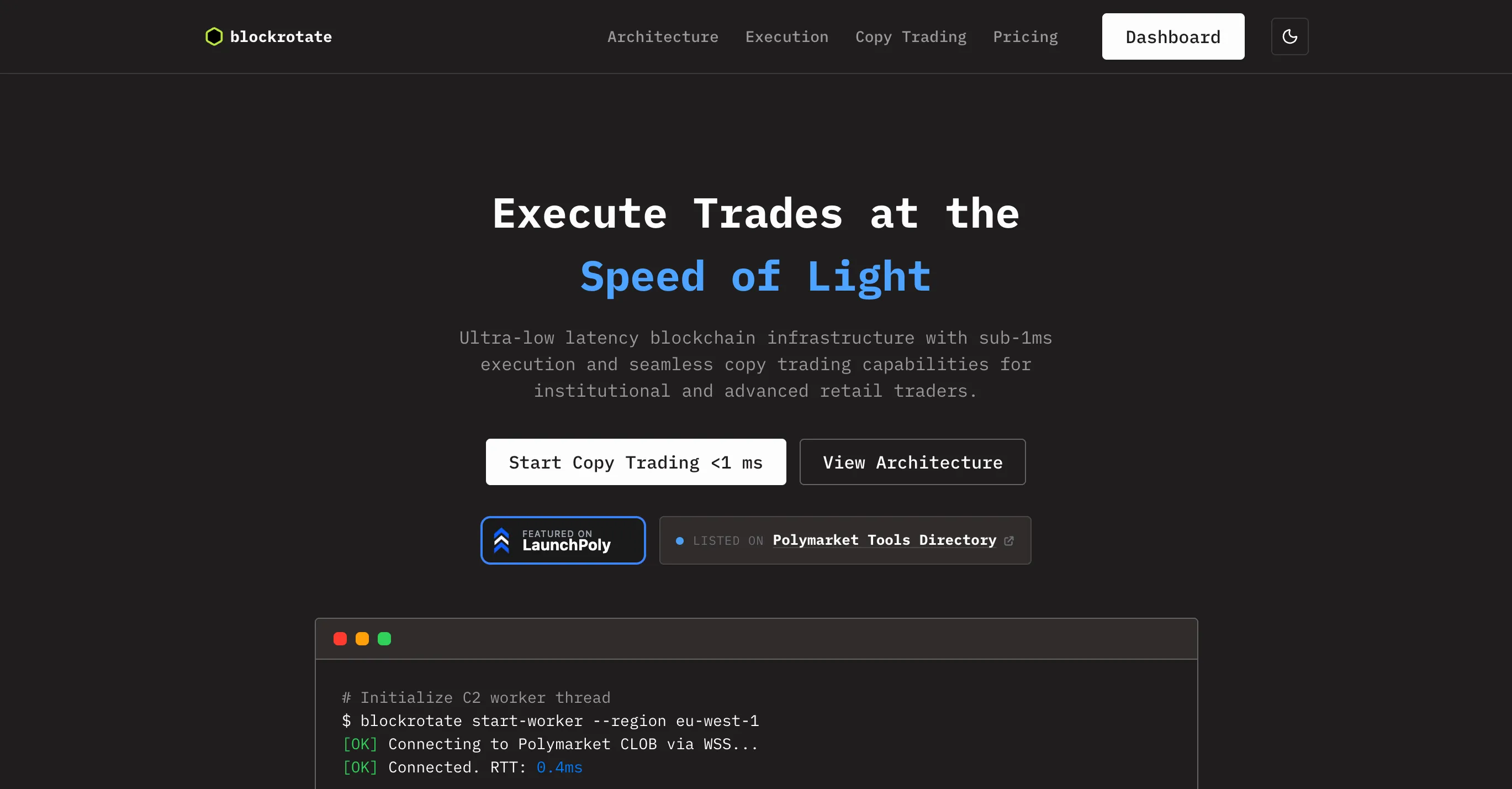
Hosted copy-trading bot for Polymarket sold on speed.
Compared with Potabo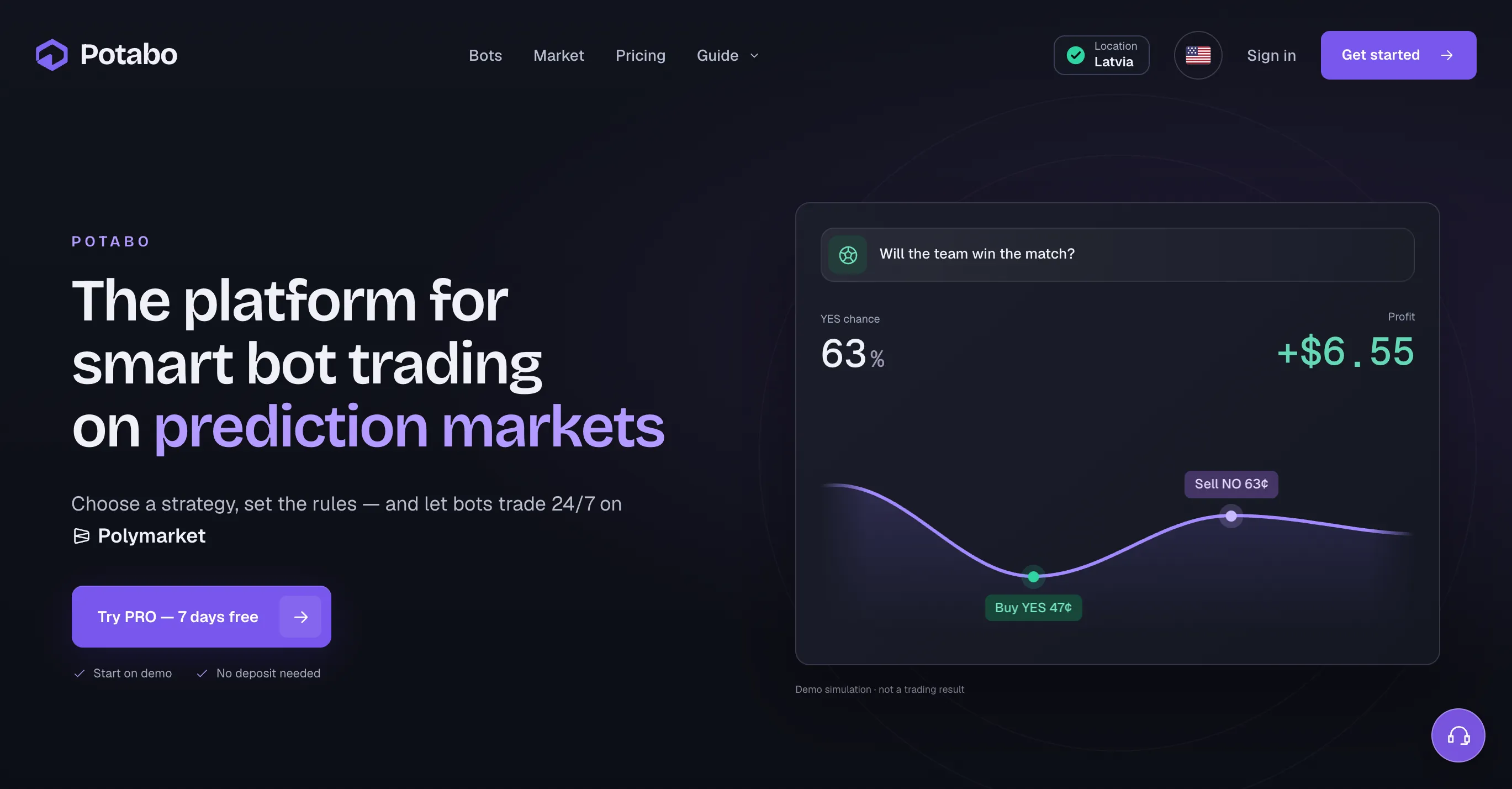
Hosted Polymarket bots with three ready-made strategies.
Compared with BlockRotateAt a glance
| Fact | BlockRotate | Potabo |
|---|---|---|
| Type | Automated bot | Automated bot |
| Category | Copy Trading | Scalping |
| Also listed in | Crypto Markets, Sentiment / News, Momentum, Hedging, Scalping | Crypto Markets, Copy Trading, Politics & Elections |
| Pricing | Paid | Paid |
| Price | from $29/mo | from $23/mo + 0.1% per trade |
| Risk rating | Medium risk | High risk |
| Markets | Any Polymarket market the followed wallet trades, narrowed to the market slugs you set | Polymarket 5- and 15-minute crypto Up or Down markets (BTC, ETH, SOL, BNB), Polymarket politics, world, economy and technology events, Polymarket markets traded by the wallets you copy |
| Source | Source not published | Source not published |
| Runs in Telegram | No | No |
| Listed since | Oct 31, 2026 | Nov 5, 2026 |
Highlighted rows differ
Key differences
- Both are paid, but on different terms: BlockRotate is from $29/mo, Potabo is from $23/mo + 0.1% per trade.
- They cover different markets: BlockRotate lists Any Polymarket market the followed wallet trades, narrowed to the market slugs you set, Potabo lists Polymarket 5- and 15-minute crypto Up or Down markets (BTC, ETH, SOL, BNB) and Polymarket politics, world, economy and technology events and 1 more.
- BlockRotate is rated medium risk, Potabo high risk.
- Only BlockRotate is filed under Sentiment / News and Momentum and 1 more, and only Potabo is filed under Politics & Elections.
Choose BlockRotate if…
- you trade Any Polymarket market the followed wallet trades, narrowed to the market slugs you set
- you prefer the lower-risk profile (medium vs high)
- your focus is Sentiment / News and Momentum and 1 more
Choose Potabo if…
- you trade Polymarket 5- and 15-minute crypto Up or Down markets (BTC, ETH, SOL, BNB) and Polymarket politics, world, economy and technology events and 1 more
- your focus is Politics & Elections
What BlockRotate does
Hosted copy-trading bot for Polymarket sold on speed. You sign in with Google, paste the wallet of a trader to follow, choose the markets and a copy ratio, set a slippage cap, a momentum filter and a daily loss limit, then hand over your Polymarket API credentials, and BlockRotate's servers mirror that wallet's trades into your account. Every plan starts with a 14-day trial of one paper bot with no card. Paid plans run several bots at once for a flat monthly fee, $29 for two, $79 for eight and $249 for twenty-five, with no cut of each trade, paid by card or crypto. The site's headline number, under 1 ms, is the vendor's own figure for network latency between its servers and Polymarket, not a measured delay between the leader's trade and your copy, and the site publishes no follower results.
Features- Copy any Polymarket wallet by address, one leader per bot
- Copy ratio, max slippage, momentum threshold and per-market scope set per bot
- Daily loss limit that stops a bot, plus basic price protection
- Unlimited paper trading on every paid plan; the free trial is paper only
- Web dashboard with a live trade feed
- Copy trading lives or dies on whom you follow, and BlockRotate leaves that to you. Its most useful page is a guide to Polymarket's leaderboard: on Sep 13, 2026 it took the top 100 wallets by monthly profit and found 50 of them claiming more for the month than their all-time realised profit, with rebates, refunds and rewards making up 36.7% of the combined income. Read it before you pick a leader.
- Speed is the pitch, and the site does not back it up. The home page promises sub-1 ms fills from bare-metal servers in New York, London, Tokyo and Singapore; the privacy policy puts its workers on AWS in Frankfurt and Ireland, and the top plan names AWS Frankfurt. Polymarket matches orders on its own order book, so no copy can start before the leader's trade has filled and been seen, and the site gives no measured leader-to-follower delay. The home page's whale card, “+420.69% APY”, and its live feed of ETH/USDC and BTC/USDT longs and shorts are illustrations — the second are not Polymarket markets at all. “Trusted by hedge funds, family offices” names none, and the third-party audits it mentions are not published.
- Custody is where to ask questions. The site calls itself non-custodial and asks for your Polymarket “L2 credentials”, which it describes as a key that can trade but cannot withdraw. By Polymarket's documentation those API credentials only authenticate requests, and every order must also be signed by the wallet's own key; the site does not say what it signs your copies with or where that is stored, and its terms describe yet another set-up, smart-contract deposit proxies. Until that is answered, treat it as a service holding the keys to trade your account.
What Potabo does
Hosted Polymarket bots with three ready-made strategies. The scalper trades the 5- and 15-minute crypto Up or Down markets, buying the side already priced high near the end of the round and holding it to settlement; the high-probability bot buys near-certain outcomes, say at 95¢, and waits for them to resolve; the copy bot repeats the trades of wallets you choose, within your limits. Every strategy can run on a demo account first, and a free Telegram bot reports results. PRO costs $23 a month for three bots at once, after a 7-day trial with no card, and every trade carries a 0.1% Potabo fee on top of Polymarket's own.
Features- Scalper: set the coins, trade size and a price threshold such as 80¢; it enters late in the round and holds to settlement
- High-probability bot: choose topics, an amount per event from $5 and an entry price range
- Copy bot with a limit per copy and in total
- Demo account on live market data with virtual money
- A separate budget per bot, and a dashboard of every closed trade
- The two main strategies are the same bet at different speeds: buy what is already expensive and collect the last few cents. That wins often and loses large, since one loss at 90¢ takes back nine wins. The site quotes a 92–95% win rate and +3 to +5% per trade for the scalper, which together imply entries near 90¢, and 94–99% for the near-certain bot. No live record stands behind those figures. The profit counters, the “Investor” cards and the analytics panel are all labelled demo data, and the site publishes no real trades.
- The record we could check is very small. Potabo's verified builder code sits at 588 of 617 on Polymarket's all-time leaderboard on Nov 5, 2026, with 73 shares of volume and 2 active users, so very little live trading has gone through it so far. The domain was registered on Sep 15, 2026, and the terms took effect on Oct 26, 2026.
- The site also disagrees with itself in places. The About page lists the fee on trades as “None”, while the pricing page and terms charge 0.1%. The scalper card says it exits by the strategy rules, while its own page says it never exits early. Kalshi, Manifold and PredictIt appear on the home page as “Connecting”; only Polymarket works today. A Learn article says many traders use a VPN and lists the risks, while the terms forbid using one to get around restrictions.
More head-to-heads
Every fact on this page is taken from the two listings as their authors publish them; POLBOTS verifies neither performance nor claims and has no stake in either tool. Nothing here is financial advice.