Chironus vs Kairos
Chironus and Kairos are both filed under Platforms & Tools. Both are trading platforms, and both are free. Below: the facts side by side, where the two actually differ, and when each one is the better pick.
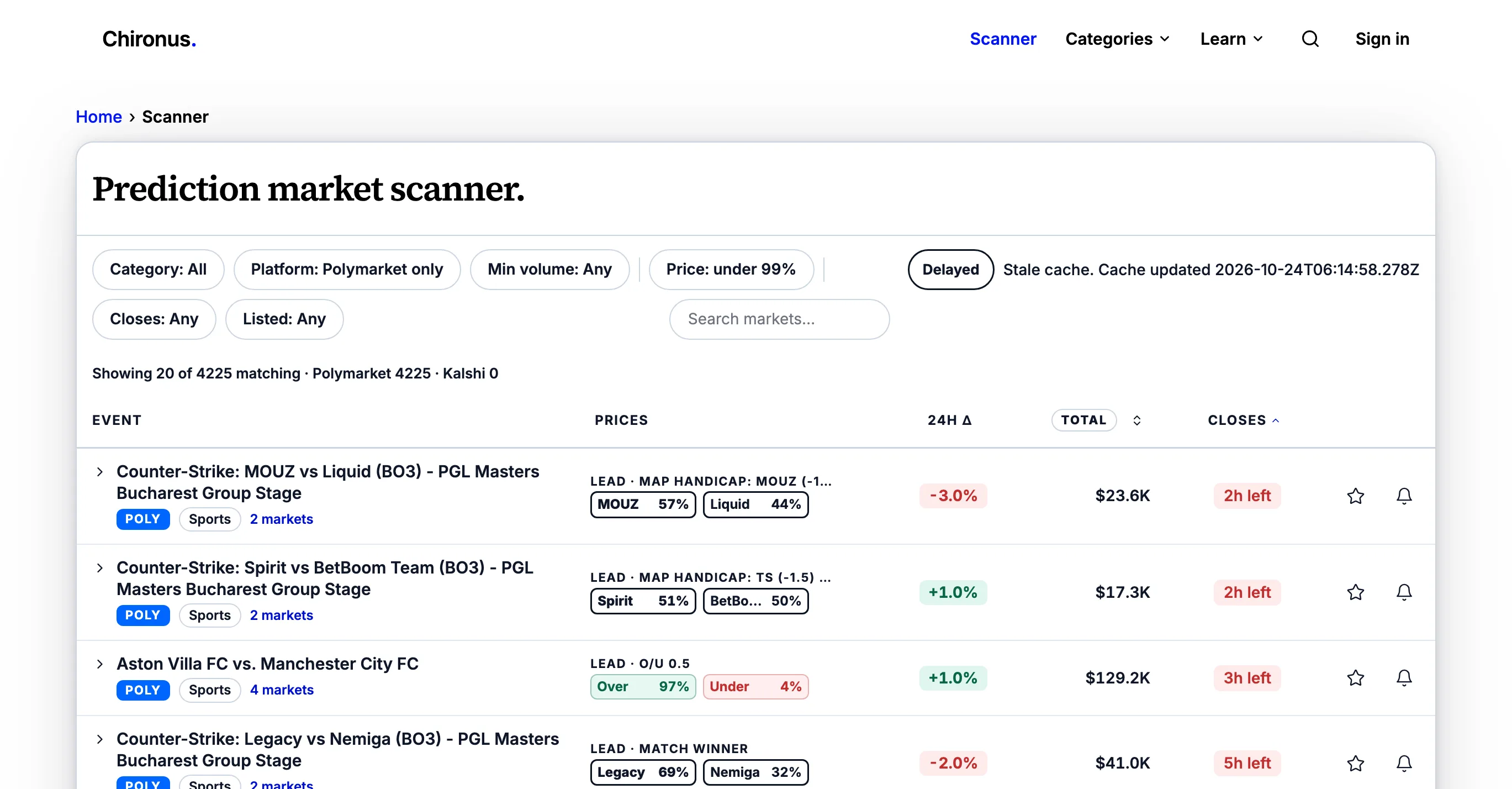
Free research and practice site for prediction markets.
Compared with Kairos
Cross-venue trading terminal that merges Kalshi, Polymarket and Predict.fun into one order book.
Compared with ChironusAt a glance
| Fact | Chironus | Kairos |
|---|---|---|
| Type | Trading platform | Trading platform |
| Category | Platforms & Tools | Platforms & Tools |
| Also listed in | — | Arbitrage, Market Making |
| Pricing | Free | Free |
| Price | free | free terminal · API by contract |
| Risk rating | Medium risk | Medium risk |
| Markets | Polymarket (all categories) and Kalshi (listed on the site, paused when we checked) | Kalshi, Polymarket and Predict.fun — trading and data, Hyperliquid HIP-4 outcome markets — data only, Every listed category, aggregated per event |
| Source | Source not published | Source not published |
| Runs in Telegram | No | No |
| Listed since | Oct 24, 2026 | Sep 15, 2026 |
Highlighted rows differ
Key differences
- They cover different markets: Chironus lists Polymarket (all categories) and Kalshi (listed on the site, paused when we checked), Kairos lists Kalshi, Polymarket and Predict.fun — trading and data and Hyperliquid HIP-4 outcome markets — data only and 1 more.
- Only Kairos is filed under Arbitrage and Market Making.
Choose Chironus if…
- you trade Polymarket (all categories) and Kalshi (listed on the site, paused when we checked)
Choose Kairos if…
- you trade Kalshi, Polymarket and Predict.fun — trading and data and Hyperliquid HIP-4 outcome markets — data only and 1 more
- your focus is Arbitrage and Market Making
What Chironus does
Free research and practice site for prediction markets. A public scanner lists about 4,200 open Polymarket markets with price, 24-hour change, total volume and closing date, filterable by category, price, volume and close; with a free account you can follow markets, paper trade them at live prices with no money at stake, group trades into strategies, note the reasoning behind each position and review the record in a journal. Around it sit plain-English guides and a topic page for each major market category. It places no real orders and never asks for a wallet. The site is running in what it calls recovery: Kalshi coverage, email notifications and paid plans are paused, and the scanner shows a delayed cache.
Features- Public scanner over about 4,200 Polymarket markets, with filters for category, price, minimum volume, closing date and listing date
- Search, sort by volume or close, 24-hour change and multi-market events grouped under one row
- Follow markets and track their prices from a dashboard
- Paper trading at live prices, grouped into named strategies with a written reason for each position
- Journal of every closed paper trade with entry, exit, outcome and notes, and results per strategy
- A tool for doing the homework, not a bot: it finds markets, lets you rehearse a trade with no money down and keeps an honest record of how your calls turned out. Market links send you to Polymarket to trade for real.
- The scanner's prices match the exchange. On Oct 24, 2026 its Yes 5% / No 96% for J.D. Vance leaving the vice presidency by Dec 31, and Yes 7% / No 95% for Vance ruling out a 2028 run, were Polymarket's own asks on both sides, rounded — so Yes and No add up to a little over 100%. The data is delayed, though: that morning the cache was about an hour and a half old against the site's own 10-minute target, and its health check reported it as stale.
- The expert network is a plan, not a feature yet. The site's tagline speaks of knowledge from verified experts; its own About page says it is still building that network and will start publishing expert work later, and Pro's credits are for expert content “as it launches.”
What Kairos does
Cross-venue trading terminal that merges Kalshi, Polymarket and Predict.fun into one order book. Matching contracts on different exchanges are shown as a single instrument with a composite ladder and a global best bid and offer, so you can see which venue is actually cheapest before you send, and an order to the NBBO endpoint routes to whichever book shows that price. Feeds are ingested next to the venues and merged in the browser with no polling interval; the ticket carries GTC, GTD, FOK, FAK and IOC time-in-force, post-only and slippage caps, with batch cancel and a per-venue kill switch. A bots panel runs parameterised templates — market making, cross-venue arbitrage, dip buying — against recorded books first and promotes the same config to live. The same engine is exposed as a REST and WebSocket API with scoped keys, IP whitelisting and a free read-only market-data tier. Built by a team from high-frequency trading firms and exchanges and backed by a $2.5M seed led by a16z.
Features- Composite order book and NBBO across three venues, with prices, probabilities and share counts normalised to one convention
- Sub-second colocated feeds merged client-side over WebSocket — quotes and fills land without polling
- Pro order ticket: GTC / GTD / FOK / FAK / IOC, post-only, slippage caps, batch cancel of up to 100 orders and a per-venue cancel-all kill switch
- Bot templates for market making, cross-venue arbitrage and dip buying, backtested on recorded books and promoted to live unchanged
- Draggable workspace with saved layouts, positions, orders, time and sales, holders and market rules on one screen
- Aggregation is the product: the same event often trades at different prices on Kalshi, Polymarket and Predict.fun, and a single-venue app cannot see the gap. Kairos builds one book across all of them so the cheapest side is visible and routable from one ticket.
- Execution is self-custodial through Turnkey enclaves — Kairos signs within a policy you set, or hands you an EIP-712 payload to sign yourself on allow-listed accounts — and keys are exportable. That is still signing authority held by a third party, which is why the custody line above does not say non-custodial.
- The bots are templates, not a track record: nothing on the site publishes live P&L for any strategy, and the terminal itself sits behind an account we did not create. What we exercised is the public surface — docs dated Aug 21, 2026, the data dashboard reading both venues' APIs, and the API endpoints answering as documented.
More head-to-heads
Every fact on this page is taken from the two listings as their authors publish them; POLBOTS verifies neither performance nor claims and has no stake in either tool. Nothing here is financial advice.