GoodFallen vs StepAhead
GoodFallen and StepAhead are both filed under Crypto Markets and Scalping. Both are automated bots, and both are paid. Below: the facts side by side, where the two actually differ, and when each one is the better pick.
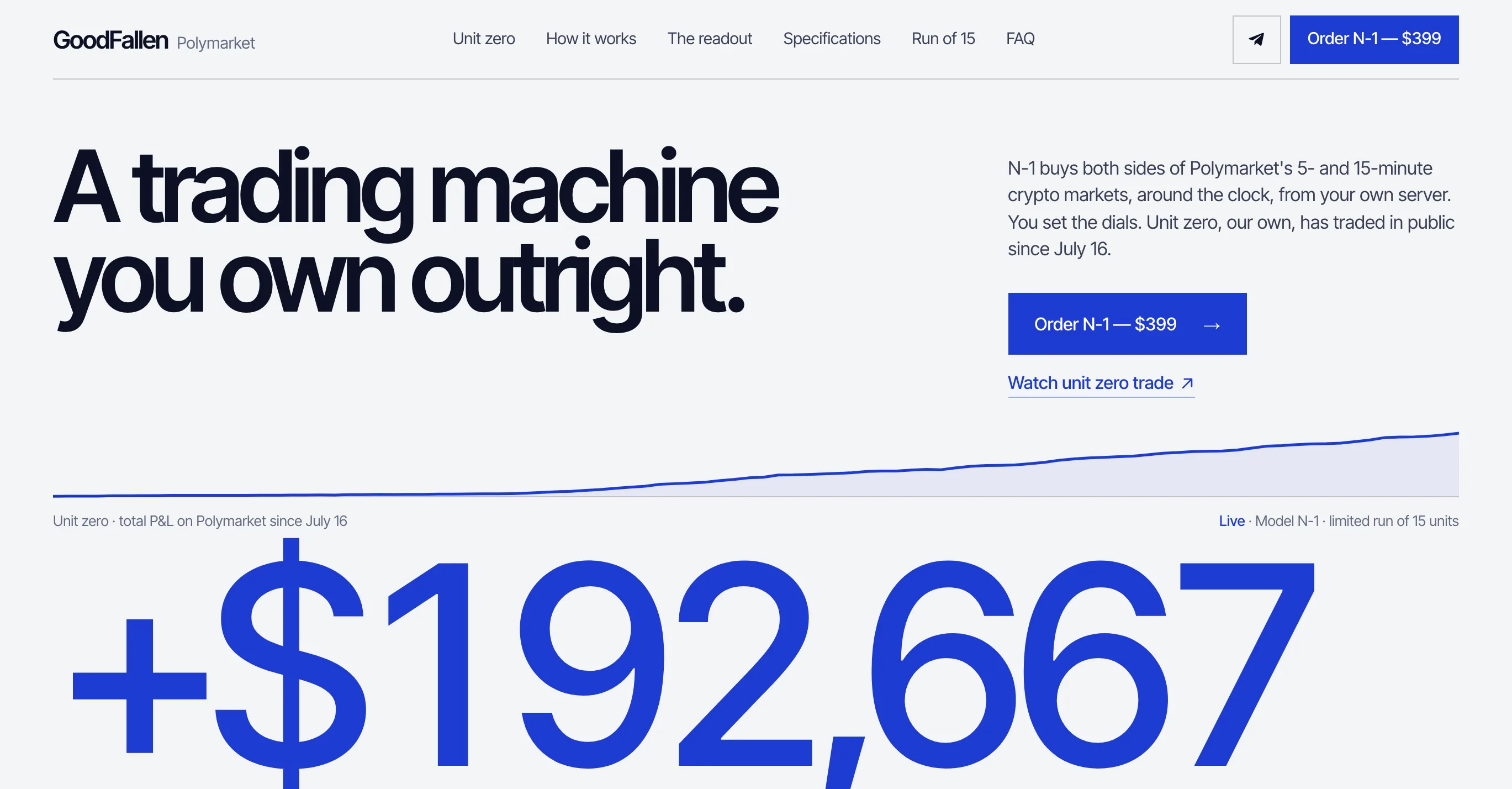
GoodFallen
Editor's ChoiceSelf-hosted Python bot for Polymarket's 5- and 15-minute crypto Up or Down windows, sold as full source for $399 once and backed by the public Polymarket account its seller runs it on, @GoodFallen.
Compared with StepAhead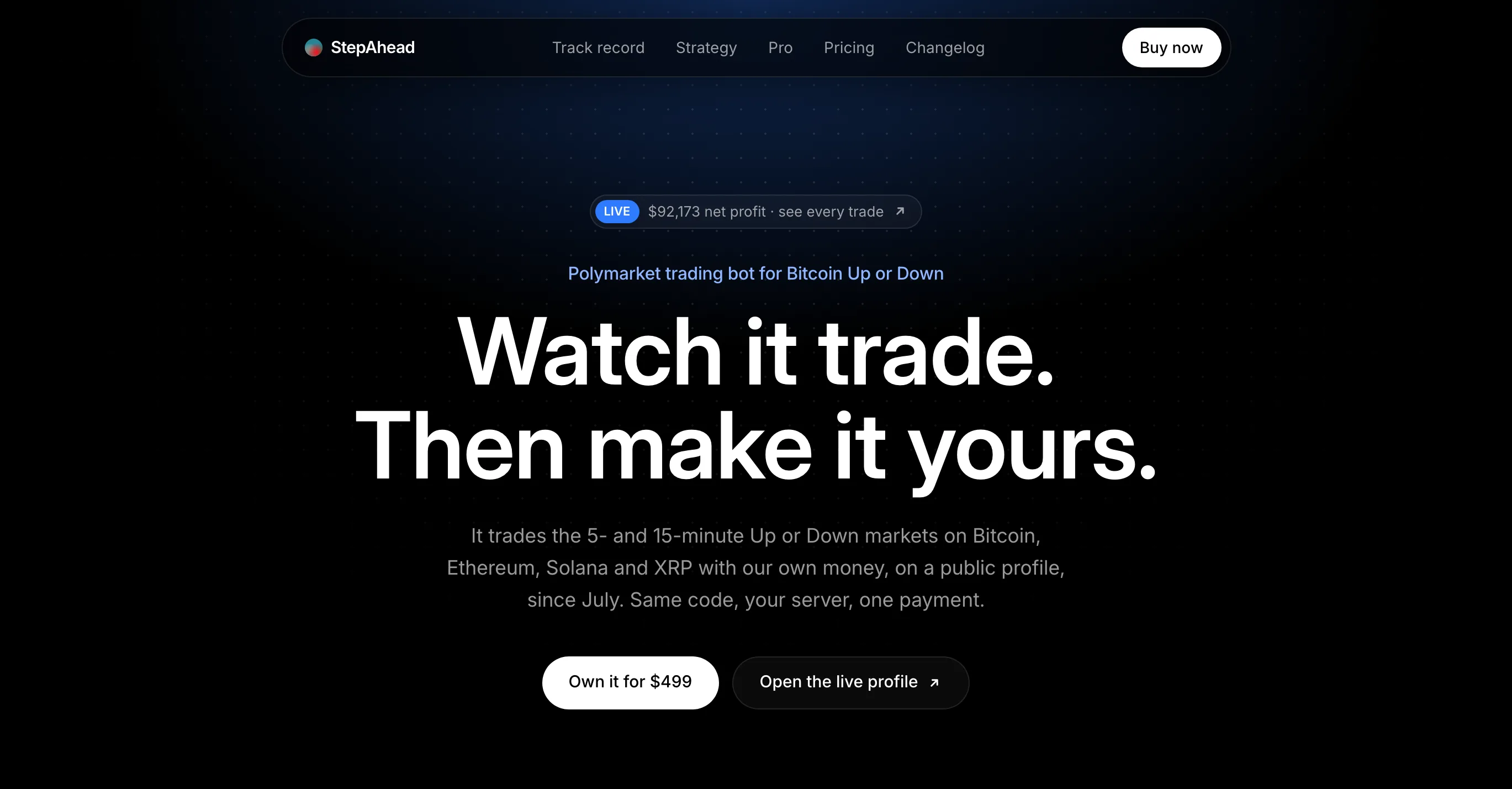
StepAhead
Editor's ChoiceSelf-hosted Python bot for Polymarket's 5- and 15-minute crypto Up or Down windows, sold as full source for $399 once, or for $899 with installation on your server and a private monitoring dashboard.
Compared with GoodFallenAt a glance
| Fact | GoodFallen | StepAhead |
|---|---|---|
| Type | Automated bot | Automated bot |
| Category | Crypto Markets | Crypto Markets |
| Also listed in | Scalping | Scalping |
| Pricing | Paid | Paid |
| Price | one-time | one-time |
| Risk rating | Low risk | Low risk |
| Markets | BTC up/down · 5m, ETH up/down · 5m, SOL up/down · 5m and 1 more | BTC up/down · 5m, BTC up/down · 15m, ETH, SOL and XRP up/down · 5m and 15m (supported, not in the public record) |
| Source | Source included with purchase | Source included with purchase |
| Runs in Telegram | No | No |
| Listed since | Oct 20, 2026 | Oct 24, 2026 |
Highlighted rows differ
Key differences
- Both list BTC up/down · 5m and BTC up/down · 15m; GoodFallen adds ETH up/down · 5m and SOL up/down · 5m; StepAhead adds ETH, SOL and XRP up/down · 5m and 15m (supported, not in the public record).
- GoodFallen carries the editor's choice mark in the catalog.
Choose GoodFallen if…
- you trade ETH up/down · 5m and SOL up/down · 5m
Choose StepAhead if…
- you trade ETH, SOL and XRP up/down · 5m and 15m (supported, not in the public record)
What GoodFallen does
Self-hosted Python bot for Polymarket's 5- and 15-minute crypto Up or Down windows, sold as full source for $399 once and backed by the public Polymarket account its seller runs it on, @GoodFallen. It does not call direction: through each window it buys both Up and Down in small pieces, some at the ask and some as resting bids, never sells, and redeems the winning side after settlement. Taker fees eat most of the trading result, and Polymarket's daily rebates, which grow with volume, make up half of what the account keeps. Paper mode, a daily loss limit, an exposure cap, a stop file and Telegram reports are built in.
Features- Full Python source, run on your own computer or VPS; orders go straight from your machine to Polymarket and the wallet key stays there
- Buys both Up and Down through the window, at the ask and as resting bids; never sells, holds to settlement
- Paper mode on live order books and real settlements, charging every taker fee and adding only the rebate rate you set, zero by default
- Daily loss limit that cancels open orders and halts trading, an exposure cap and a STOP file
- Winning shares redeemed automatically about a minute after each close
- The account checks out. On Oct 20, 2026 Polymarket's APIs showed @GoodFallen opened on Jul 16, 2026, $10.8 million traded across 23,276 markets, a profile profit of $192,667 before fees and 13th place on the month's Crypto leaderboard by profit. Its last 500 actions were 486 buys and 14 redemptions, with no sells.
- The site does the fee arithmetic itself, and the numbers hold. Polymarket's P&L feed puts the trading result at +$192,667 and taker fees at $126,223; the account's activity feed lists $60,015 in taker rebates over 93 daily payouts and $6,950 more for its resting orders. That leaves about $133,400 net, the figure the site prints, and half of it is rebates. Polymarket's all-time leaderboard, which counts fees but not rebates, credits the account with $66,252. Rebuilt from the same data, the daily log matches the site's: 80 of 95 days in profit, the worst −$1,658 on Sep 15.
- Two things the page does not stress. The account trades almost only Bitcoin's 5-minute windows: in samples spread over three months we found Ethereum once and no Solana or 15-minute fills, so the other markets the bot supports have no public record here. And both sides does not mean balanced: in a typical window the smaller side was about two-thirds of the larger, and the window the site charted when we read it held 155 Up shares against 378 Down, so each window still leans one way.
What StepAhead does
Self-hosted Python bot for Polymarket's 5- and 15-minute crypto Up or Down windows, sold as full source for $399 once, or for $899 with installation on your server and a private monitoring dashboard. It runs the same rules on every window: when Up and Down together cost less than $1 it buys both and keeps the difference at settlement, and when the order book leans one way it backs that side and holds a small position on the other. It never sells; positions are held to settlement and redeemed. The seller runs it on a public Polymarket account, @stepahead, which today trades almost only Bitcoin's 5-minute windows. Practice mode on live markets, a daily loss cap, an exposure cap and Telegram reports are built in.
Features- Full Python source, run on your own VPS; orders are signed on that machine and the wallet key stays there
- Buys Up and Down together when the pair costs under $1, and otherwise backs the side the book leans to with a small position on the other
- Never sells: positions are held to settlement and redeemed automatically, up to 100 per run
- Practice mode with play money on live order books, with fills that wait in a realistic queue; going live is one setting
- Daily loss cap that cancels every order, stops trading and survives a restart, plus an exposure cap that pauses new buys
- The account is real, and the site's window holds. @stepahead is Polymarket wallet 0xe290…a33f. Polymarket's own P&L feed, which counts fees and the daily rebates, has it gaining $88,800 from Jul 1 to Oct 22, 2026, against $92,173 on the site; roughly $32,000 of that came from rebates rather than from trading. The month bars match too: +$43.2K in July, a pause from late July to Sep 20, +$8.7K in September.
- The window is chosen. The wallet's first fill was on Mar 28, 2026, not in July, and on Jul 1 it stood at about −$25,100 after a losing spring. Counted from the first trade it is up about $71,500, and Polymarket's all-time leaderboard, which counts fees but not rebates, credits it with $12,348 — so rebates are more than four-fifths of what the account has kept overall. The site's changelog lists versions back to Jan 22, 2026, two months before that first fill.
- The record covers less than the bot is sold for. The site names Bitcoin, Ethereum, Solana and XRP on both window lengths; in samples we took on seven days between July and October the account traded only Bitcoin, the 15-minute windows made up about a fifth of its fills in July and none since September, and every fill was a buy. The other markets have no public record here.
More head-to-heads
Every fact on this page is taken from the two listings as their authors publish them; POLBOTS verifies neither performance nor claims and has no stake in either tool. Nothing here is financial advice.