norm1e69 vs Pbot.pro
norm1e69 and Pbot.pro are both filed under Crypto Markets. Both are automated bots, and both are paid. Below: the facts side by side, where the two actually differ, and when each one is the better pick.
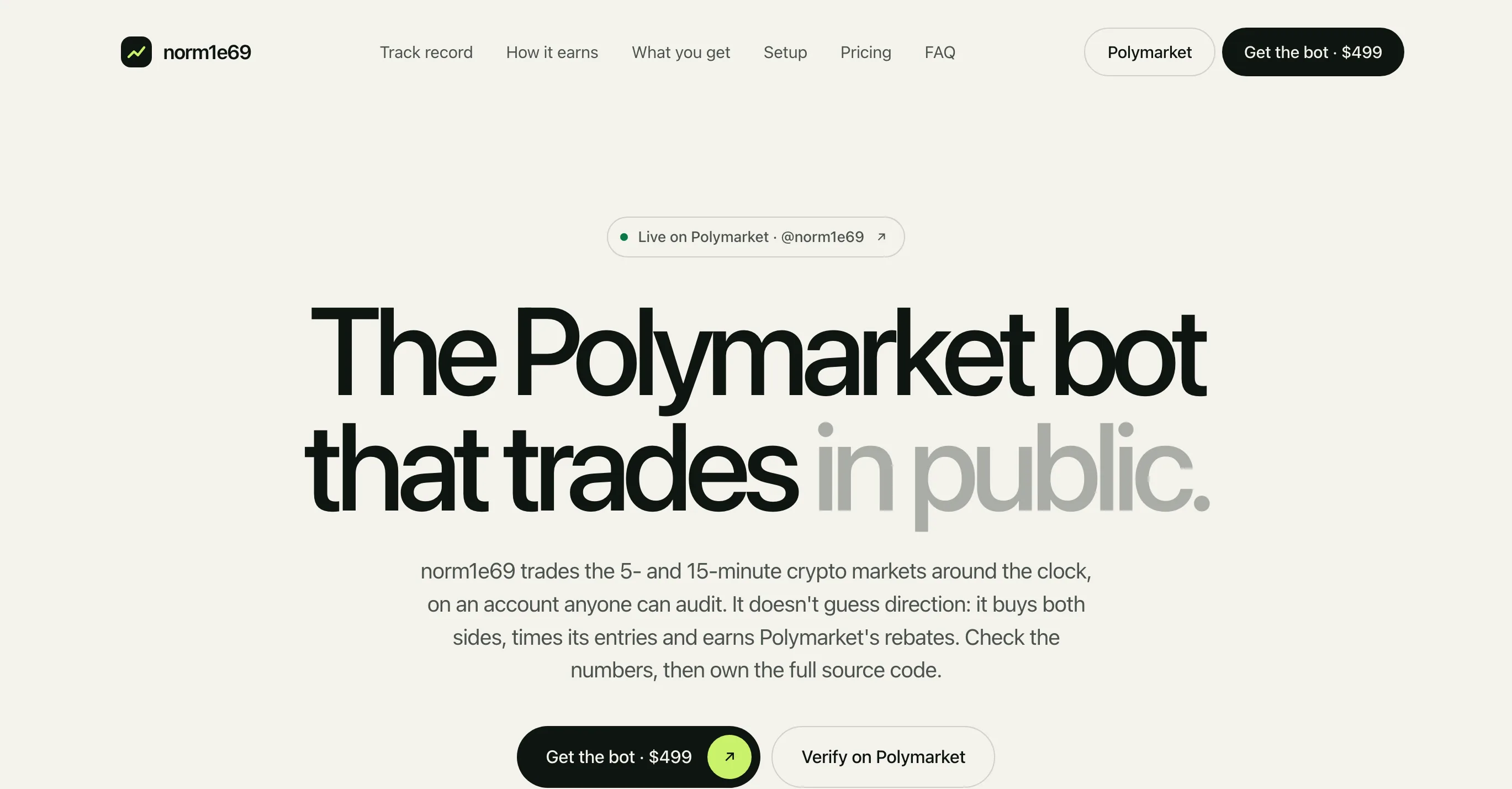
norm1e69
Editor's ChoiceSelf-hosted Python bot for Polymarket's 5- and 15-minute crypto Up or Down windows, sold as full source for a single payment and named after the public Polymarket account its seller points to as proof.
Compared with Pbot.pro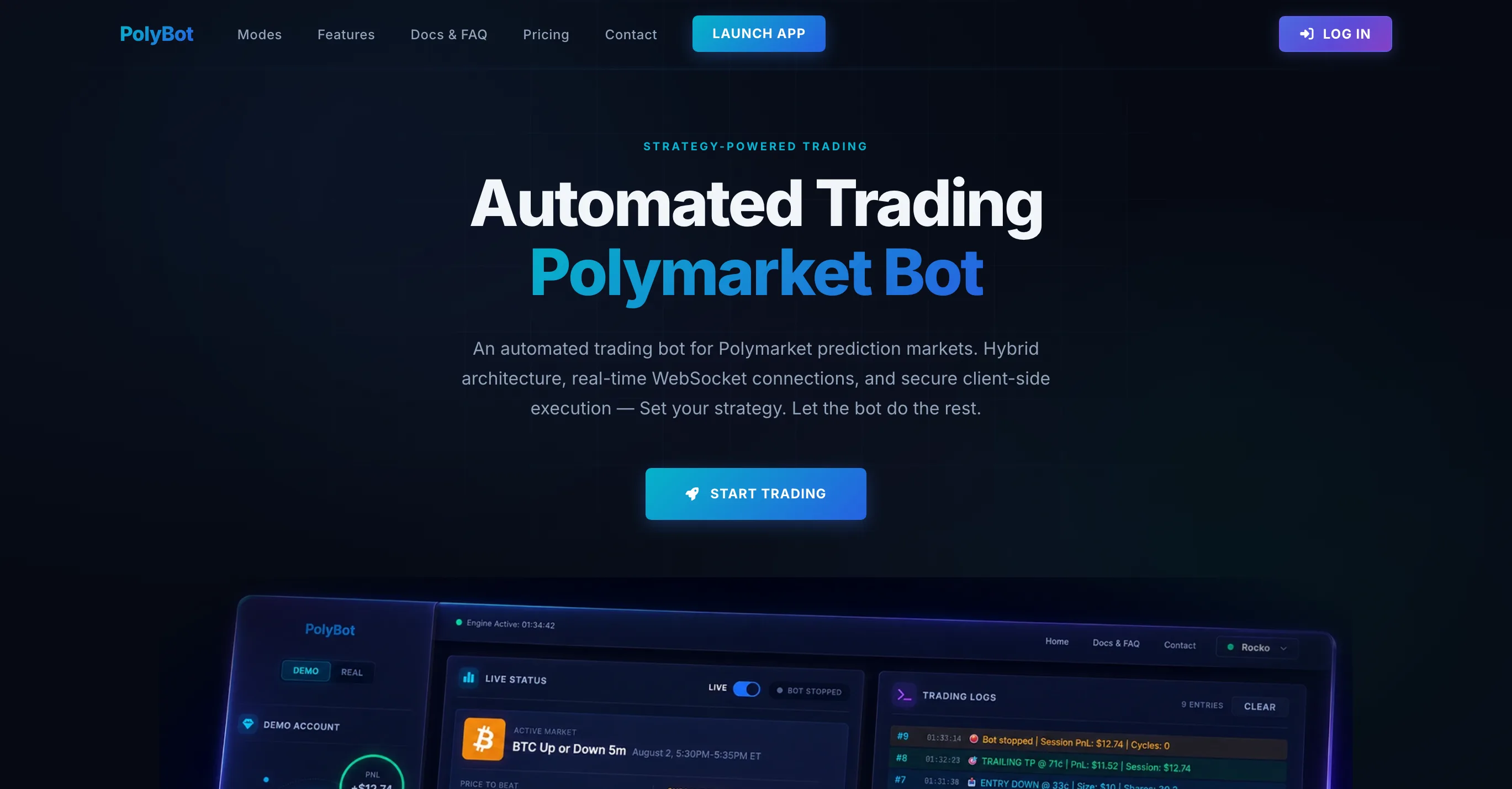
Browser-based bot for Polymarket's short crypto Up or Down windows — 5 minutes, 15 minutes or an hour, on BTC, ETH, SOL, XRP, DOGE or BNB.
Compared with norm1e69At a glance
| Fact | norm1e69 | Pbot.pro |
|---|---|---|
| Type | Automated bot | Automated bot |
| Category | Crypto Markets | Crypto Markets |
| Also listed in | Scalping | — |
| Pricing | Paid | Paid |
| Price | one-time | $9/week · $29/mo · 1% fee per fill |
| Risk rating | Low risk | High risk |
| Markets | BTC up/down · 5m, ETH up/down · 5m, SOL up/down · 5m and 1 more | Polymarket crypto Up/Down windows of 5m, 15m and 1h and BTC, ETH, SOL, XRP, DOGE and BNB — one coin and one window length per run |
| Source | Source included with purchase | Source not published |
| Runs in Telegram | No | No |
| Listed since | Oct 2, 2026 | Oct 15, 2026 |
Highlighted rows differ
Key differences
- Both are paid, but on different terms: norm1e69 is one-time, Pbot.pro is $9/week · $29/mo · 1% fee per fill.
- They cover different markets: norm1e69 lists BTC up/down · 5m and ETH up/down · 5m and 2 more, Pbot.pro lists Polymarket crypto Up/Down windows of 5m, 15m and 1h and BTC, ETH, SOL, XRP, DOGE and BNB — one coin and one window length per run.
- norm1e69 ships the full source with the purchase; Pbot.pro does not publish its source.
- norm1e69 is rated low risk, Pbot.pro high risk.
- Only norm1e69 is filed under Scalping.
- norm1e69 carries the editor's choice mark in the catalog.
Choose norm1e69 if…
- you want to read — and keep running — the code yourself
- you trade BTC up/down · 5m and ETH up/down · 5m and 2 more
- you prefer the lower-risk profile (low vs high)
- your focus is Scalping
Choose Pbot.pro if…
- you trade Polymarket crypto Up/Down windows of 5m, 15m and 1h and BTC, ETH, SOL, XRP, DOGE and BNB — one coin and one window length per run
What norm1e69 does
Self-hosted Python bot for Polymarket's 5- and 15-minute crypto Up or Down windows, sold as full source for a single payment and named after the public Polymarket account its seller points to as proof. It does not predict direction: it buys both Up and Down through each window on Bitcoin, Ethereum and Solana, mostly at the ask, holds every position to settlement and redeems the winnings. By the vendor's own breakdown the timing of those buys roughly pays the taker fee, and more than half of the net comes from Polymarket's fee rebates at a high volume tier. Paper mode, a daily loss limit, an exposure cap and Telegram reports are built in.
Features- Full Python source, run on your own computer or VPS; the wallet key stays in a local .env file
- Buys both Up and Down across the whole window, mostly as taker orders with resting limit bids alongside; never sells, holds to settlement
- Paper mode: simulated orders against the live order book, settled with Polymarket's real results, with every fee charged and your own rebate tier applied
- Daily loss limit that cancels open orders, halts trading and messages you; exposure cap that pauses new buys
- Automatic redemption of winning shares after each window settles (needs a little POL for gas)
- The pitch is a public account instead of a screenshot, and the account checks out. On Oct 2, 2026 Polymarket's own APIs showed @norm1e69 opened on Aug 7, 2026, a profile profit curve at $206,805, about $14.6 million traded, sixth place on the month's Crypto leaderboard by profit and a deepest fall of $489 on the hourly curve — the figures the site prints. The last 500 activity rows were 486 buys and 14 redemptions with no sells, spread over BTC, SOL and ETH 5-minute windows and BTC 15-minute ones.
- Read the top number the way the vendor itself tells you to. The profile chart is before taker fees and without rebates. Over a four-day sample the site reports +$26,040 before fees, $20,262 paid in taker fees and $7,937 received in rebates: about $13,700 net, or 1.10% of volume. Polymarket's all-time leaderboard credits the same account with roughly $50,000, not $206,805. The site counts 56 of 56 days closed up; our cut of the same hourly series found one small down day, −$147 in mid-August.
- That result leans on size. The account trades more than $10 million a month and gets a large share of its taker fees back; a small account pays the same fee and gets 3% back at the lowest tier. The vendor says so plainly: you will probably not make the same profit, and at small size the fees can outweigh the edge. Run paper mode with your own tier before funding a wallet.
What Pbot.pro does
Browser-based bot for Polymarket's short crypto Up or Down windows — 5 minutes, 15 minutes or an hour, on BTC, ETH, SOL, XRP, DOGE or BNB. You set a stake, an entry price and the part of each window in which it may buy; the bot steps from one window to the next by itself, buys the Up or Down side once its ask falls to your price, and sells on a take-profit, stop-loss or trailing stop, in percent or in cents, or automatically at 99¢. Demo mode trades a $10,000 virtual balance against Polymarket's live order books. Real mode runs entirely in your browser tab: you paste your Polymarket wallet's private key into the page, orders go from there straight to Polymarket, and the bot stops when the tab closes. A week of demo is free; real mode costs $9 a week or $29 a month in USDC, and every fill also pays Pbot.pro a 1% builder fee that the site does not mention. Polymarket records no live volume under its builder code so far.
Features- Entry rules: a stake from $1, an entry price in cents, a price band, a time window counted in seconds before the close, and the side — Up, Down or whichever is cheaper; no entries in the last 15 seconds
- Re-entry controls: a second buy in the same window only with Re-Buy switched on, a minimum distance in cents from the last entry price, and a pause after each exit, 5 seconds by default
- Exits: take-profit, stop-loss and trailing stop in percent or in cents, plus an automatic sell at 99¢
- Stops by itself after a maximum loss or a set number of windows; moves on to the next window of the same coin when one resolves
- One position at a time, with manual Buy and Close buttons that override the bot
- There is no forecast inside. The engine buys a side when its ask drops to your entry price inside your time and price windows, and sells on your exit rules. It shows the coin's live price and the price the window has to beat, read from Polymarket's own feeds — including the 60-second average Polymarket has settled these windows on since August — but neither enters the buy or sell decision. Whether a cheap side is cheap for a reason is left to you, and the demo is where to find out, with one gap: demo profit is the stake times the price change, with no fees and every order filled, so it flatters what the same settings would earn for real.
- Fees set a high bar. Polymarket charges takers 3.5% of the trade at 50¢ on these markets, Pbot.pro's builder code adds 1% of every fill, and the bot takes on both the way in and the way out — about 9% of the stake for a round trip at 50¢ before the price moves at all. As a share of the stake Polymarket's fee grows as the price falls — 6.3% at 10¢, 0.7% at 90¢ — while Pbot.pro's 1% stays the same at every price. None of this appears on the pricing page, which presents the $9 or $29 pass as the whole cost.
- Non-custodial in the literal sense, and the code bears it out: we read every request the app sends to its own server — your wallet address and sign-in signature, demo stats, saved settings and the payment's transaction hash — and the private key is in none of them; it stays in the page's memory and signs orders sent straight to Polymarket. The catch is the method. The key itself is pasted into a web page whose code comes fresh from the vendor's server on every visit, so the guarantee holds only as long as that code does; use a separate Polymarket account holding only what you mean to trade, as the vendor's own docs advise. And because the engine lives in the tab, it trades only while the tab stays open and online, whatever the landing's “uninterrupted 24/7 trading” suggests.
More head-to-heads
Every fact on this page is taken from the two listings as their authors publish them; POLBOTS verifies neither performance nor claims and has no stake in either tool. Nothing here is financial advice.