norm1e69 vs ZCL Bot
norm1e69 and ZCL Bot are both filed under Crypto Markets. Both are automated bots, and both are paid. Below: the facts side by side, where the two actually differ, and when each one is the better pick.
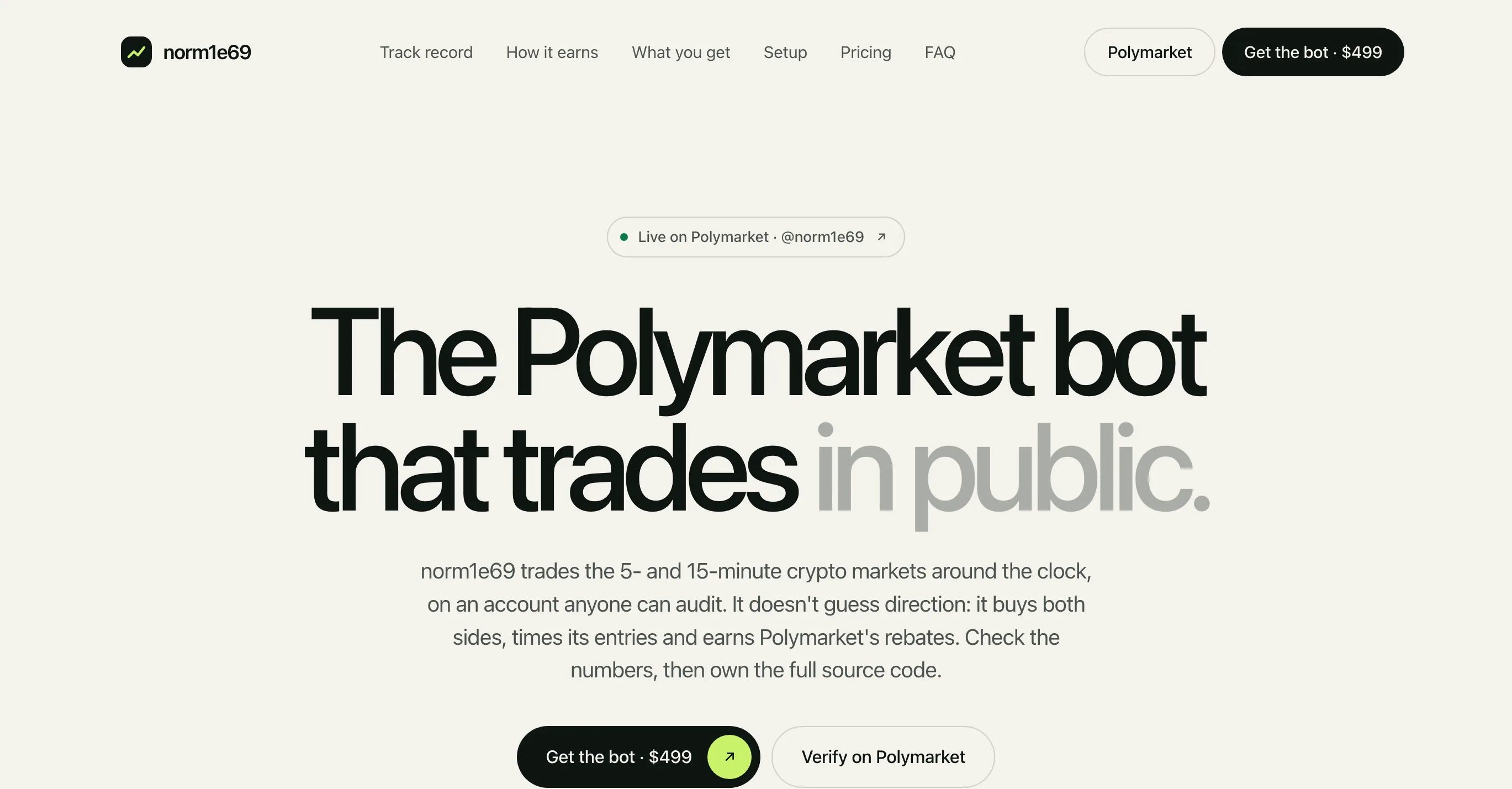
Self-hosted Python bot for Polymarket's 5- and 15-minute crypto Up or Down windows, sold as full source for a single payment and named after the public Polymarket account its seller points to as proof.
Compared with ZCL Bot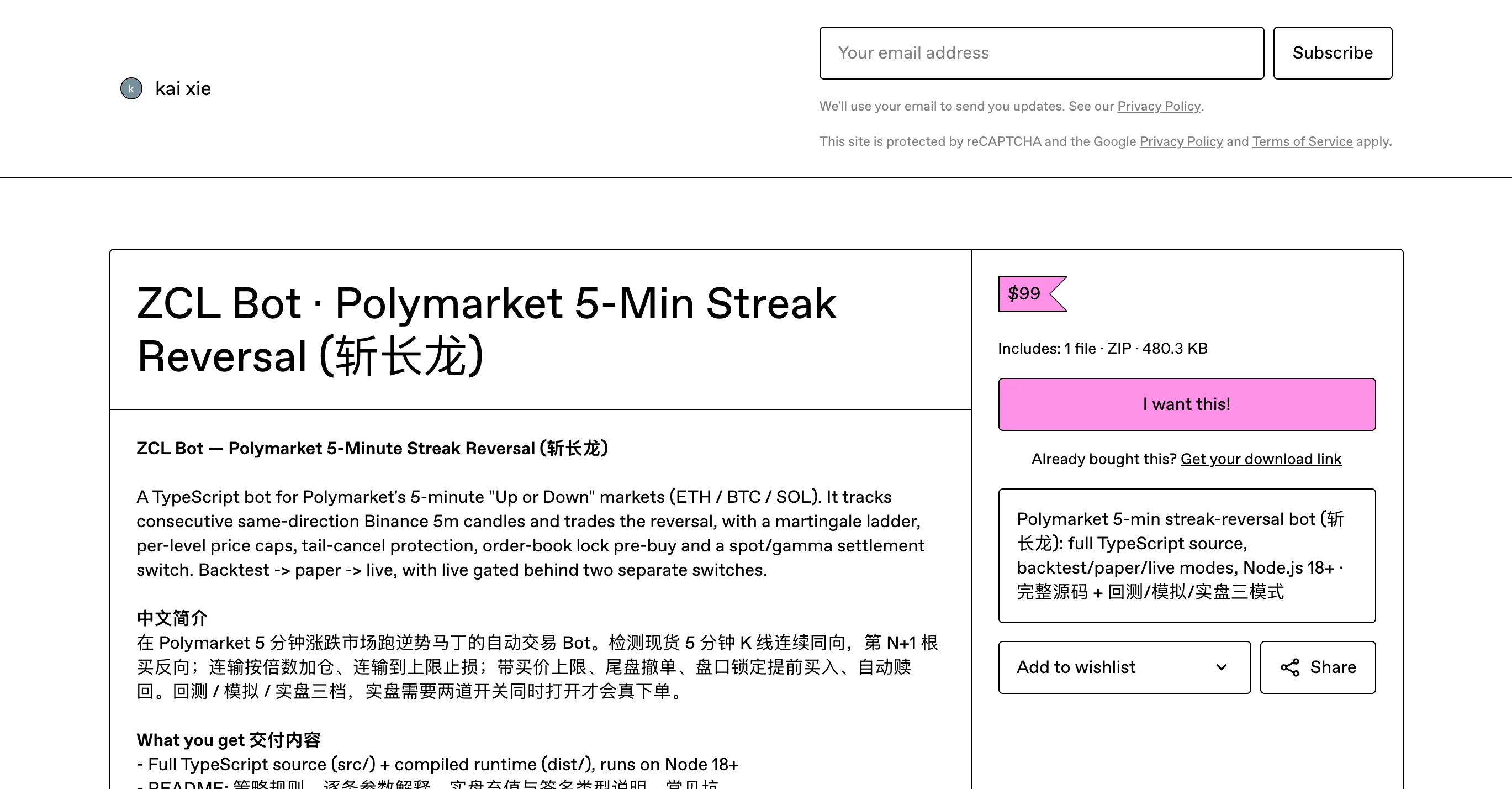
ZCL Bot
Verified PartnerSelf-hosted TypeScript bot for Polymarket's 5-minute crypto Up or Down markets on Bitcoin, Ethereum and Solana, sold on Gumroad as full source for $99 once.
Compared with norm1e69At a glance
| Fact | norm1e69 | ZCL Bot |
|---|---|---|
| Type | Automated bot | Automated bot |
| Category | Crypto Markets | Crypto Markets |
| Also listed in | Scalping | — |
| Pricing | Paid | Paid |
| Price | one-time | one-time |
| Risk rating | Low risk | High risk |
| Markets | BTC up/down · 5m, ETH up/down · 5m, SOL up/down · 5m and 1 more | BTC up/down · 5m, ETH up/down · 5m, SOL up/down · 5m |
| Source | Source included with purchase | Source included with purchase |
| Runs in Telegram | No | No |
| Listed since | Oct 2, 2026 | Nov 12, 2026 |
Highlighted rows differ
Key differences
- Both list BTC up/down · 5m and ETH up/down · 5m and 1 more; norm1e69 adds BTC up/down · 15m.
- norm1e69 is rated low risk, ZCL Bot high risk.
- Only norm1e69 is filed under Scalping.
Choose norm1e69 if…
- you trade BTC up/down · 15m
- you prefer the lower-risk profile (low vs high)
- your focus is Scalping
Choose ZCL Bot if…
On the published facts there is no clear-cut case either way — it comes down to the product. Read the description below and try ZCL Bot before funding it.
What norm1e69 does
Self-hosted Python bot for Polymarket's 5- and 15-minute crypto Up or Down windows, sold as full source for a single payment and named after the public Polymarket account its seller points to as proof. It does not predict direction: it buys both Up and Down through each window on Bitcoin, Ethereum and Solana, mostly at the ask, holds every position to settlement and redeems the winnings. By the vendor's own breakdown the timing of those buys roughly pays the taker fee, and more than half of the net comes from Polymarket's fee rebates at a high volume tier. Paper mode, a daily loss limit, an exposure cap and Telegram reports are built in.
Features- Full Python source, run on your own computer or VPS; the wallet key stays in a local .env file
- Buys both Up and Down across the whole window, mostly as taker orders with resting limit bids alongside; never sells, holds to settlement
- Paper mode: simulated orders against the live order book, settled with Polymarket's real results, with every fee charged and your own rebate tier applied
- Daily loss limit that cancels open orders, halts trading and messages you; exposure cap that pauses new buys
- Automatic redemption of winning shares after each window settles (needs a little POL for gas)
- The pitch is a public account instead of a screenshot, and the account checks out. On Oct 2, 2026 Polymarket's own APIs showed @norm1e69 opened on Aug 7, 2026, a profile profit curve at $206,805, about $14.6 million traded, sixth place on the month's Crypto leaderboard by profit and a deepest fall of $489 on the hourly curve — the figures the site prints. The last 500 activity rows were 486 buys and 14 redemptions with no sells, spread over BTC, SOL and ETH 5-minute windows and BTC 15-minute ones.
- Read the top number the way the vendor itself tells you to. The profile chart is before taker fees and without rebates. Over a four-day sample the site reports +$26,040 before fees, $20,262 paid in taker fees and $7,937 received in rebates: about $13,700 net, or 1.10% of volume. Polymarket's all-time leaderboard credits the same account with roughly $50,000, not $206,805. The site counts 56 of 56 days closed up; our cut of the same hourly series found one small down day, −$147 in mid-August.
- That result leans on size. The account trades more than $10 million a month and gets a large share of its taker fees back; a small account pays the same fee and gets 3% back at the lowest tier. The vendor says so plainly: you will probably not make the same profit, and at small size the fees can outweigh the edge. Run paper mode with your own tier before funding a wallet.
What ZCL Bot does
Self-hosted TypeScript bot for Polymarket's 5-minute crypto Up or Down markets on Bitcoin, Ethereum and Solana, sold on Gumroad as full source for $99 once. It watches Binance's 5-minute candles and, after a run of same-direction candles, buys the opposite side of the next window. A losing bet is followed by a bigger one on a martingale ladder until a set number of losses stops the chain, with a price cap for each step, cancelling of unfilled orders near the close and automatic redemption of winnings. Backtest, paper and live modes are built in, and live orders need two separate switches turned on. The name, 斩长龙, is Chinese for “slaying the long dragon”: betting against a streak.
Features- Full TypeScript source and a compiled build; runs on Node 18+ on Windows, macOS or Linux, with the wallet key kept on your machine
- Signal: N same-direction Binance 5-minute candles in a row, then a buy on the opposite side of the next window
- Martingale ladder: each loss multiplies the next stake by a set factor, up to a maximum number of steps, then the chain stops
- Maximum buy price for each step of the ladder
- Cancels orders still unfilled near the end of a window
- There is no record to check. The seller, “kai xie” on Gumroad, has no other products, no reviews, no stated sales count, no website and no Polymarket account or wallet linked to the bot, so the strategy has to be judged on its own. In the category where live results are the easiest to show, that is a gap.
- The signal is thin. We pulled 90 days of Binance 5-minute candles, Aug 14 to Nov 12, 2026, and counted how often the next candle reversed a run. After three to five candles the same way it reversed 51–56% of the time across the three coins: a slight lean toward reversal, not a strong one, and it did not grow steadily with longer runs. Polymarket's crypto taker fee at 50¢ is 3.5% of the money spent, so a buy at 50¢ needs a 51.75% hit rate to break even before the spread. The edge, if there is one, is about the size of the fee. Polymarket also settles these markets on Chainlink's price, not Binance's candle, so the two do not always agree.
- The martingale does not change that arithmetic; it changes the shape of the losses. Doubling from a $1 stake, a chain stopped after six losses costs $63 plus fees to win back $1, and long runs come in clusters on 5-minute candles. The seller says this plainly: the page gives the maximum loss of a chain as base stake × (factor^n − 1)/(factor − 1) plus fees, calls these markets close to coin flips and promises no return. Use the backtest and paper modes with Polymarket's current fee before funding a wallet, and size the base stake from the chain's maximum loss, not from the hoped-for win.
More head-to-heads
Every fact on this page is taken from the two listings as their authors publish them; POLBOTS verifies neither performance nor claims and has no stake in either tool. Nothing here is financial advice.