Olympus vs Whalidate
Olympus and Whalidate are both filed under Copy Trading and Sports Trading. Both are automated bots; Olympus is free to use with a per-trade fee, Whalidate is free with paid plans. Below: the facts side by side, where the two actually differ, and when each one is the better pick.
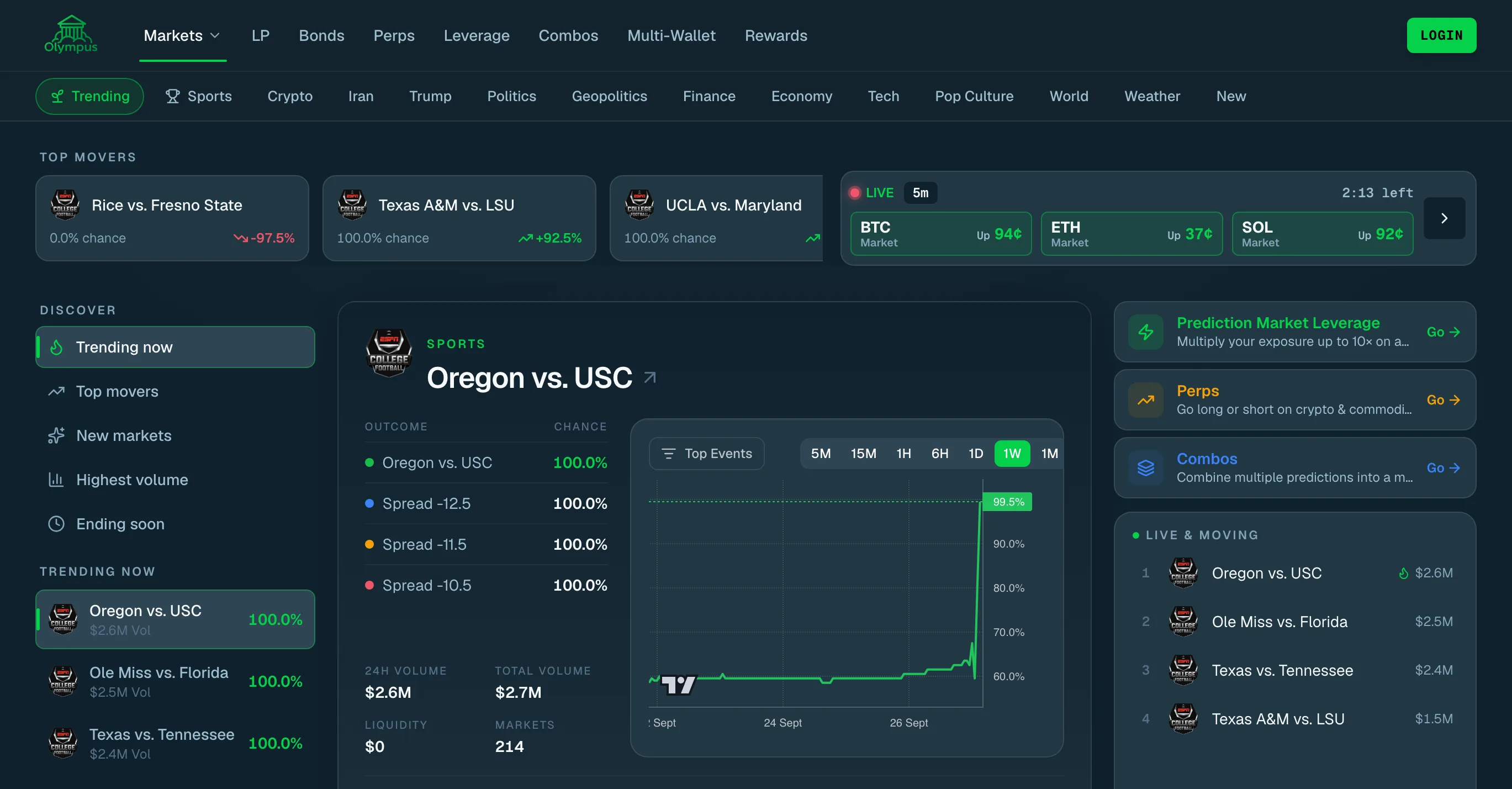
Polymarket web terminal built around copy trading that keeps running on Olympus's servers after you close the tab.
Compared with Whalidate
Whalidate
Verified PartnerCopy trading for Polymarket that checks how a wallet made its money before you follow it.
Compared with OlympusAt a glance
| Fact | Olympus | Whalidate |
|---|---|---|
| Type | Automated bot | Automated bot |
| Category | Copy Trading | Copy Trading |
| Also listed in | Market Making, Sports Trading, Crypto Markets | Platforms & Tools, Sports Trading |
| Pricing | Free to use, fee per trade | Free tier, paid plans |
| Price | free · 0.75% per trade | free on paper · 14 days live free · then from $49/mo |
| Risk rating | Medium risk | Medium risk |
| Markets | All Polymarket markets — sports with live scores, crypto price windows, current events, Polymarket Perps on crypto, equity indexes, gold and oil, up to 20x, Dimes Multiply positions on eligible crypto and sports markets, up to 10x and 1 more | All Polymarket markets the followed wallets trade, narrowed to the categories you allow and Strongest wallets in its pool on Sep 30, 2026: tennis, American football, Counter-Strike and Dota 2 |
| Source | Source not published | Source not published |
| Runs in Telegram | No | No |
| Listed since | Sep 27, 2026 | Oct 8, 2026 |
Highlighted rows differ
Key differences
- Olympus is free to use with a per-trade fee (free · 0.75% per trade); Whalidate is free with paid plans (free on paper · 14 days live free · then from $49/mo).
- They cover different markets: Olympus lists All Polymarket markets — sports with live scores, crypto price windows, current events and Polymarket Perps on crypto, equity indexes, gold and oil, up to 20x and 2 more, Whalidate lists All Polymarket markets the followed wallets trade, narrowed to the categories you allow and Strongest wallets in its pool on Sep 30, 2026: tennis, American football, Counter-Strike and Dota 2.
- Only Olympus is filed under Market Making and Crypto Markets, and only Whalidate is filed under Platforms & Tools.
Choose Olympus if…
- you trade All Polymarket markets — sports with live scores, crypto price windows, current events and Polymarket Perps on crypto, equity indexes, gold and oil, up to 20x and 2 more
- your focus is Market Making and Crypto Markets
Choose Whalidate if…
- you want to start without paying
- you trade All Polymarket markets the followed wallets trade, narrowed to the categories you allow and Strongest wallets in its pool on Sep 30, 2026: tennis, American football, Counter-Strike and Dota 2
- your focus is Platforms & Tools
What Olympus does
Polymarket web terminal built around copy trading that keeps running on Olympus's servers after you close the tab. Every followed wallet gets its own ratio, trade and market caps, odds, liquidity and volume filters, a price-deviation guard and a limit mode that buys at the leader's own fill price, with stop-loss, take-profit, counter-trading and combo copying; a backtest replays the leader's history through those exact settings first, and separate trading wallets keep strategies apart. Around the copier: a manual terminal with a sports hub, crypto price windows, combos and TP/SL on any position; Bonds, which ranks every outcome priced 97¢ or more by what it pays after fees, and Autobond, which buys them inside a budget and a loss limit; an LP Rewards desk that places maker orders on Polymarket's reward markets; Polymarket Perps to 20x and Dimes Multiply positions to 10x; and a REST trading API with wallet-scoped keys. The base fee is 0.75% per executed trade, sliding toward zero at extreme prices. Built by the team behind SOL Decoder and Valhalla.
Features- Per-wallet copy settings: ratio, max trade and max market size, trades per market and per day, odds, liquidity and 24h-volume filters, minimum trigger, price-deviation guard
- Limit-buy and limit-sell modes at the leader's fill price, fallback limit orders, counter-trading, split and merge copying, combo copying
- Backtest of any leader against your exact settings with slippage sensitivity and evidence gates; AI analysis of your real fills once you are live
- Bonds scanner for outcomes at 97¢ and up, ranked by net return after fees and time to resolution; Autobond with budget, stop and loss-limit controls
- LP Rewards desk: suggested maker levels on reward markets, automated placement, and a restore flow for orders Polymarket cancels after a fill
- The docs are candid about what copying costs. A market-style copy crosses the spread and pays taker fees, which compounds on fast, bot-like wallets — the app flags those and suggests limit mode instead — and the backtest models fills with an assumed spread because Polymarket publishes no historical order book; the FAQ itself says it is better at ruling a wallet out than at predicting what you will earn.
- Custody sits on their side, whatever the landing's “non custodial” says. New accounts get a Privy wallet; importing a Polymarket wallet means pasting its private key into Olympus, which encrypts and keeps it; copy trades, Autobond and API orders all execute with your browser closed, and the Terms (v2.0, Aug 2, 2026) let RST Tech LLC or its providers store, decrypt and use signing material to carry out your instructions. Keys can be exported behind a PIN — but the docs warn against logging into Polymarket with one, as that can spawn a new proxy wallet.
- Checkable from outside: Polymarket's builders Data API credits Olympus with $44.9M across 1,033 users since November 2025. It ranked 12th to 16th by monthly volume from launch through May, when it peaked at $9.35M; since June it has slid — $2.55M in August and $1.53M from Sep 1 to 27, rank 39, with 90 to 100 active users a day — so the landing's “Top 20 builder” is a spring figure. The public Bonds page refreshed within the minute and its prices matched Polymarket's book when we checked.
What Whalidate does
Copy trading for Polymarket that checks how a wallet made its money before you follow it. Its WhaleFinder replays each wallet's public history and scores the return on the money put in, the settled trades, the worst drawdown and how much of the profit came from one bet; on Sep 30, 2026, 166 of the 1,346 wallets scored in full passed its default checks. You pick the wallets and set the rules — price band, slippage cap, categories, caps and loss limits — and Whalidate copies only the new buys that pass. Paper trading is free with no time limit; live copying is free for 14 days on Starter, then from $49 a month with no fee per trade, either through a session key on your own Polymarket account that can trade but not withdraw, or from a trading wallet whose keys Whalidate holds.
Features- WhaleFinder: 15,371 leaderboard wallets scored on return, settled trades, worst drawdown, the share of profit from the best trade and the top five, steadiness and edge per trade. By default a wallet needs a 15% return, 30 settled trades, a drawdown of 25% or less and no more than half its profit from one trade; the checks can be changed
- Every rejected wallet shows why: profit resting on one trade, too short a record, too many copiers already
- Entry rules per strategy: the whale's stake, a price band, a slippage cap, time to resolution and categories; rules per whale on Pro and Elite
- Caps per market, per event, on total exposure and on the live budget; daily, weekly and drawdown loss limits stop new entries
- The order book is read again just before sending, then one fill-or-kill order goes out; on paid plans a limit order at the whale's price can wait in the book instead, 30 minutes by default. Copies under $5 are skipped
- Read the methodology, not the landing page. The home page's four whale cards, +$910 to +$5,296 over 120 days, are the best four of the 166 passing wallets. They come from a model with no fees or slippage that exits when the whale does, while the product holds each copy until your own exit or resolution. The methodology itself says copying all 166 came to about break-even. Since Nov 1, 2026, paper trades are priced from the live book and charged the taker fee. Paper still cannot show a live order failing, which happened about 3 times in 100 in October by the vendor's count.
- Preset cards are replays, not records, until a preset has 30 settled trades of its own, and on Nov 9, 2026 some cards annualised a few months into tens of thousands of percent a year. Whalidate sent us every trade behind two cards, and we rebuilt both; when we found the whale's own fee inside its prices, it corrected the cards down. Reef's +27% (Dec 2025 to May 2026, was +34%) uses today's wallets, but they were picked on their record through October. Current's +88% (Jul to Oct 2026, was +94%) re-picks wallets each month by rules tuned on those same months, and only 6 of its 196 copies came from today's wallets. Whalidate's own test of 1,036 wallets found that copying every whale buy lost money after costs; our guide “Does Polymarket copy trading work?” has the numbers.
- Live trading runs one of two ways. With your own Polymarket account, you sign a session key that can place and cancel orders but not withdraw. It lasts up to 180 days, and you can revoke it sooner. Your money stays on Polymarket, but a key that trades can still lose it, and the budget and loss limits are Whalidate's rules, not Polymarket's. Only Deposit Wallet accounts used through a wallet app such as MetaMask or Rabby can connect; e-mail and Google sign-ins cannot. The other way is custodial: you deposit USDC into a trading wallet whose key Whalidate holds, and its Risk Disclosure says a breach, a software mistake or a shutdown could delay or lose those funds, with no insurance. The Terms name no company, address or governing law, only a support email.
More head-to-heads
Every fact on this page is taken from the two listings as their authors publish them; POLBOTS verifies neither performance nor claims and has no stake in either tool. Nothing here is financial advice.