BTC 15-Min Bot vs Polymarket Algos
BTC 15-Min Bot and Polymarket Algos are both filed under Crypto Markets. Both are automated bots, and both are free. Below: the facts side by side, where the two actually differ, and when each one is the better pick.
Open-source Python bot for Polymarket's 15-minute Bitcoin up/down markets.
Compared with Polymarket Algos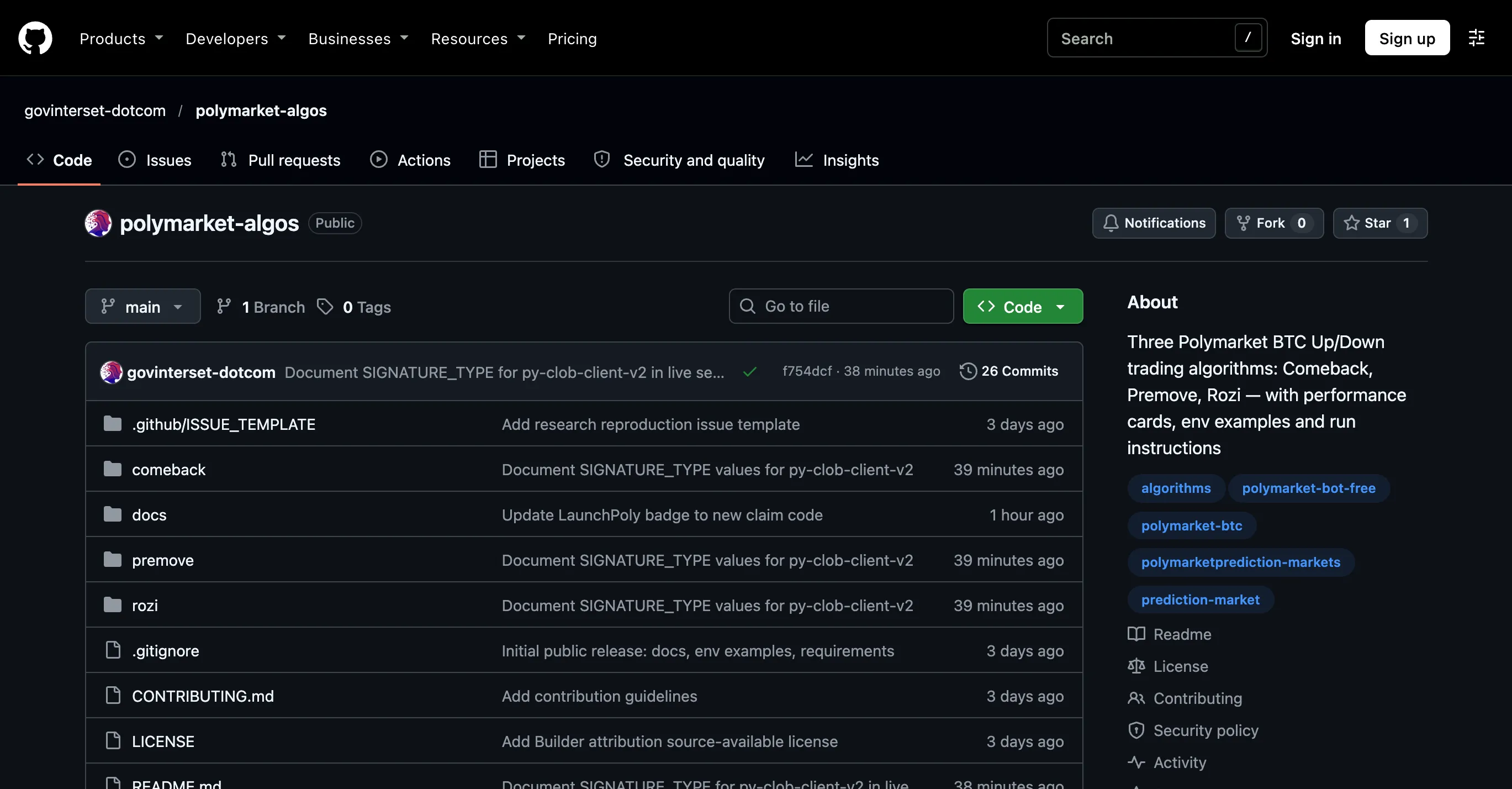
Three self-hosted Python bots for Polymarket's Bitcoin Up or Down markets, published with full source on GitHub.
Compared with BTC 15-Min BotAt a glance
| Fact | BTC 15-Min Bot | Polymarket Algos |
|---|---|---|
| Type | Automated bot | Automated bot |
| Category | Crypto Markets | Crypto Markets |
| Also listed in | Sentiment / News | Momentum, Hedging |
| Pricing | Free | Free |
| Price | open-source | free |
| Risk rating | Medium risk | Medium risk |
| Markets | BTC up/down · 15m | BTC Up or Down · 5m and BTC Up or Down · 15m |
| Source | Open-source | Source not published |
| Runs in Telegram | No | No |
| Listed since | Jul 3, 2026 | Nov 16, 2026 |
Highlighted rows differ
Key differences
- They cover different markets: BTC 15-Min Bot lists BTC up/down · 15m, Polymarket Algos lists BTC Up or Down · 5m and BTC Up or Down · 15m.
- BTC 15-Min Bot publishes its code under an open-source licence; Polymarket Algos does not publish its source.
- Only BTC 15-Min Bot is filed under Sentiment / News, and only Polymarket Algos is filed under Momentum and Hedging.
- BTC 15-Min Bot has been listed since Jul 3, 2026; Polymarket Algos joined on Nov 16, 2026.
Choose BTC 15-Min Bot if…
- you want to read — and keep running — the code yourself
- you trade BTC up/down · 15m
- your focus is Sentiment / News
Choose Polymarket Algos if…
- you trade BTC Up or Down · 5m and BTC Up or Down · 15m
- your focus is Momentum and Hedging
What BTC 15-Min Bot does
Open-source Python bot for Polymarket's 15-minute Bitcoin up/down markets. A 7-phase engine fuses spike detection, Fear & Greed sentiment and cross-exchange divergence via weighted voting. Runs live or in paper mode with Grafana dashboards.
Features- Full Python source (MIT license)
- Live + paper-trading modes
- Grafana + Prometheus dashboards
- Multi-signal weighted-voting engine
- Built-in risk caps & stop-loss
- Trades Polymarket's 15-minute Bitcoin “up or down” markets through a 7-phase signal pipeline.
- Fuses spike detection, Fear & Greed sentiment and cross-exchange price divergence via weighted voting.
- Self-optimizing signal weights — validate risk-free in paper mode before trading live.
What Polymarket Algos does
Three self-hosted Python bots for Polymarket's Bitcoin Up or Down markets, published with full source on GitHub. Comeback buys a side late in a 5-minute window when it had fallen to 10¢ or less and its ask climbs back to 85¢ or more. Premove watches for a sharp jump in the order book in the last seconds of one 5-minute market and bets the same direction in the next one. Rozi buys a side that drops fast into a low price tier, around 15¢ or 10¢, on 15-minute markets, with optional Binance volume and streak filters. Each runs in paper mode by default, writes a JSONL journal and places capped fill-and-kill taker orders with your own wallet key when switched to live.
Features- Three strategies in single Python files: comeback.py, premove_live.py and rozi.py
- Paper mode by default, with fills simulated against the live order book and Polymarket's taker fee
- Live trading through py-clob-client-v2 with capped fill-and-kill orders; Rozi also has a post-only mode
- JSONL journals of signals, fills and resolutions, with optional compounding from the journal
- Every threshold, stake and price cap set in a .env file next to each script
- All the performance figures are the author's own replays, not live results. Comeback's card shows 994 entries over 24 days in October and November 2026 with 96.9% won and +$293 at $10 a trade; Premove's shows 183 signals, 64.5% won and +$258; Rozi's about 50 signals over 35 days, about 30% won and about +$500. The README is unusually frank about the limits: Comeback's card used an 85–99¢ entry range while the shipped config buys only at 85–88¢, one Comeback loss wipes out about 16 average wins, and Premove's edge turns negative once the next market costs 65¢. The samples are a few weeks long and the parameters were chosen on the same data, which the README itself warns can overfit.
- The README says all three were also tested live, without publishing those trades. The Builder address written into the code belongs to a Polymarket account named Gozi, and the code labels it the same way. On Nov 16, 2026 Polymarket's leaderboard put that account at −$92,400 all time on $14.8M of volume, −$3,356 over the last month and −$155 over the last week, nearly all of it in BTC, ETH, SOL and XRP Up or Down markets since January 2026. We cannot tell which of those trades came from these scripts, but no public wallet shows the strategies making money live.
- The license is the catch for anyone who wants to adapt the code. The author's Builder code is hard-wired into all three scripts and deliberately kept out of the settings, and the license forbids removing it in live use, so every live order credits the author's Builder profile. That earns the author a share of Polymarket's Builder rewards, not a fee from you. On Nov 16, 2026 the code was not among the 628 builders on Polymarket's Builder leaderboard, so no attributed volume had been recorded yet.
More head-to-heads
Every fact on this page is taken from the two listings as their authors publish them; POLBOTS verifies neither performance nor claims and has no stake in either tool. Nothing here is financial advice.