On this page7 sections
The stack, top to bottom
When people ask what a bot costs they mean the price tag. That is one line of seven, and usually the smallest.
| Layer | What it is | Typical shape |
|---|---|---|
| Software | The bot or tool itself | Free / open-source; $49–$499 one-time with source; $14–$299 a month; 0.5–1% per trade |
| Polymarket taker fee | Charged when your order takes liquidity | C × rate × p × (1 − p): 1.75% at the mid on crypto, 1.25% sports and weather, 1% politics and finance, 0 geopolitics; makers pay nothing |
| Spread and slippage | The gap you cross and the price you move | 1–4 cents on thin books; grows with size |
| Hosting | A machine that does not sleep | $5–$20 a month for a small VPS; more for proximity |
| Data and models | Exchange feeds, news APIs, forecast ensembles, LLM tokens | Free to hundreds a month depending on strategy |
| Gas | On-chain settlement | Gasless for deposit, proxy and Safe wallets via the relayer; an EOA pays POL, pennies |
| Capital | What the strategy ties up, and for how long | Minutes on the minute markets; months on an election; plus the opportunity cost |
Two lines need no budget and cost the most when skipped: your time (a bot is a small operations job — see the 24/7 guide) and your records for tax.
Software: what the price tags actually mean
- Open-source, free. Poly-Maker, the BTC 15-minute bot, Polymarket Agents: free as in software. You supply the server, the keys, the maintenance and the judgement. Their own page.
- One-time with source. PolySnipe at $49, Uruguabot at $99, PolymTradeBot at $499: you can read every line and keep running it after the vendor is gone. Often the best value for long-term use — if you use it.
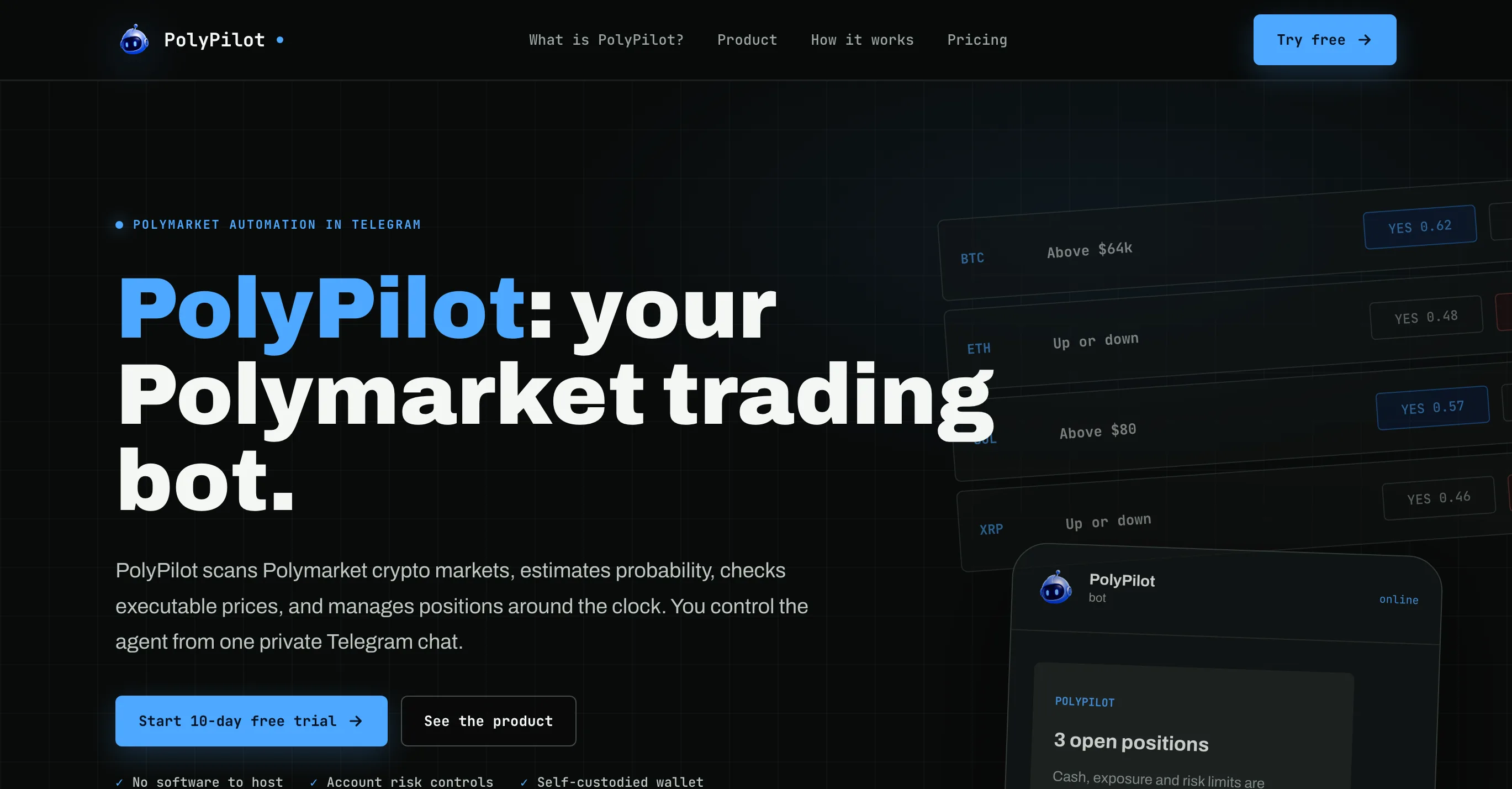
- Subscription. PolyPilot from $29 a month with a trial; terminals and analytics from $14 to $299. Cheap to start, expensive to forget about.
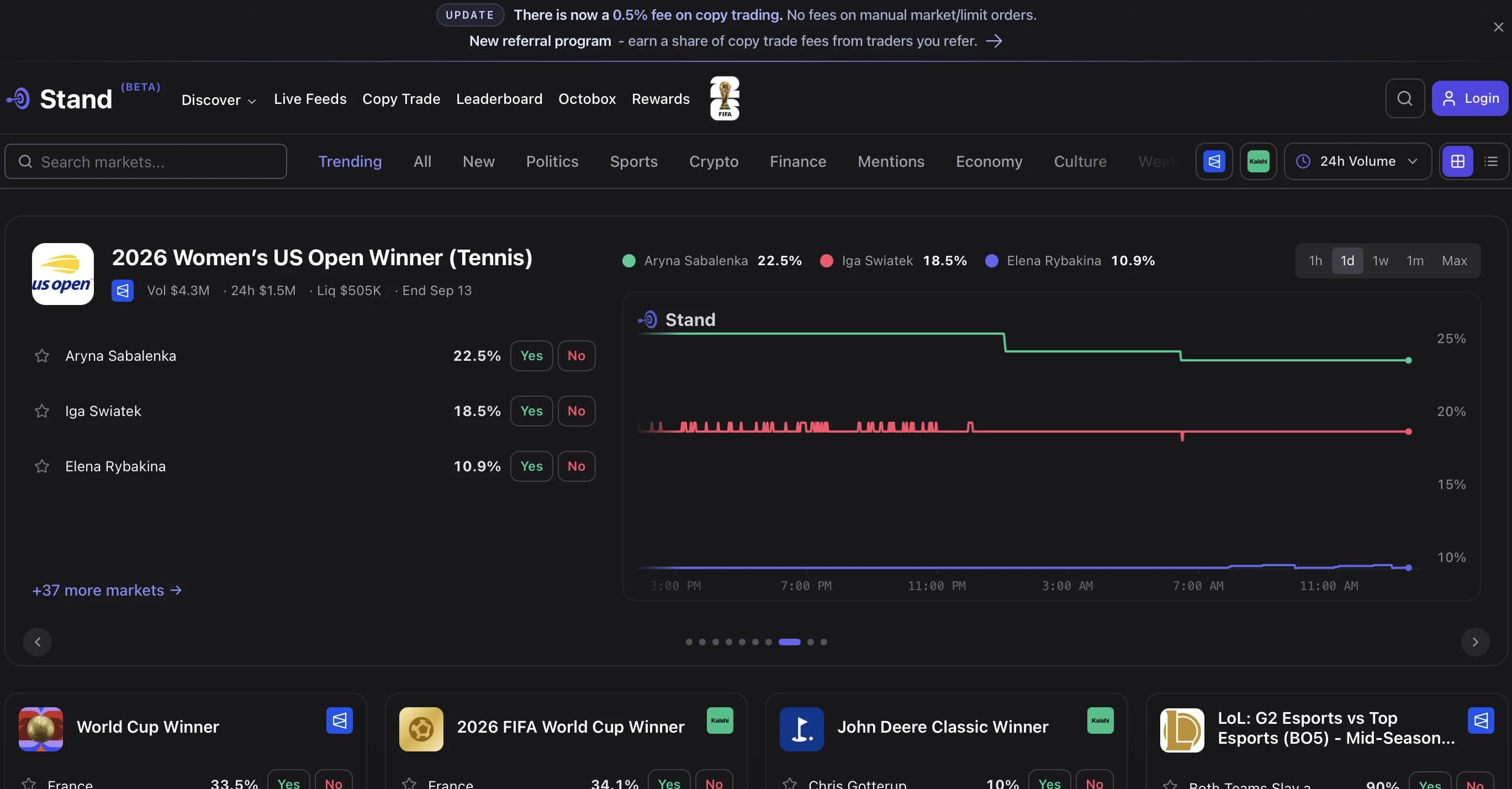
- Per trade. Stand's 0.5% copy fee, 1% per trade on several Telegram and mobile tools, a slice of profits on others. Nothing up front; at $50,000 of monthly volume a 1% fee is $500 a month — more than any subscription on the list.
- "Free" tiers. Usable for research, with execution or the good signals behind a paywall. The pricing note on each listing says what is gated; the free collection sorts all of it.
Polymarket's fee: the line people forget
Only takers pay. The fee on a fill of C shares at price p is C × rate × p × (1 − p), with the rate set by category — 0.07 for crypto, 0.05 for sports, economics, culture and weather, 0.04 for finance, politics, mentions and tech, and zero for geopolitics. It peaks at the mid:
| Category | Fee per taker fill at 0.50 | Round trip, taking both ways |
|---|---|---|
| Crypto | 1.75% | ~3.5% |
| Sports, weather | 1.25% | ~2.5% |
| Politics, finance | 1.00% | ~2.0% |
| Geopolitics | 0 | 0 |
Makers pay nothing and receive a rebate of a share of takers' fees; on selected markets they also earn liquidity rewards. That asymmetry is the largest cost lever a strategy has: the same idea executed with resting orders instead of crossings can be several percent a round trip cheaper.
Spread and slippage: the line nobody budgets
Every time you take you pay the spread; every time you take size you move the price against yourself. On a deep market that is a cent; on a thin weather or sports book your $500 order *is* the price. Backtests that fill at the last price hide this completely, which is why the backtesting guide exists.
Three worked examples
A taker bot on the 5-minute markets, $499 one-time, $10/month VPS. Say it trades 40 times a day at $50 a side, taking both ways at the mid: fee ≈ 3.5% × $50 × 40 = $70 a day before spread. To break even on fees alone it needs an edge of 3.5% per round trip; to pay back the software in a month it needs that plus about $17 a day. The price tag is a rounding error next to the fee line — which is why the honest records in this category look like coin flips.
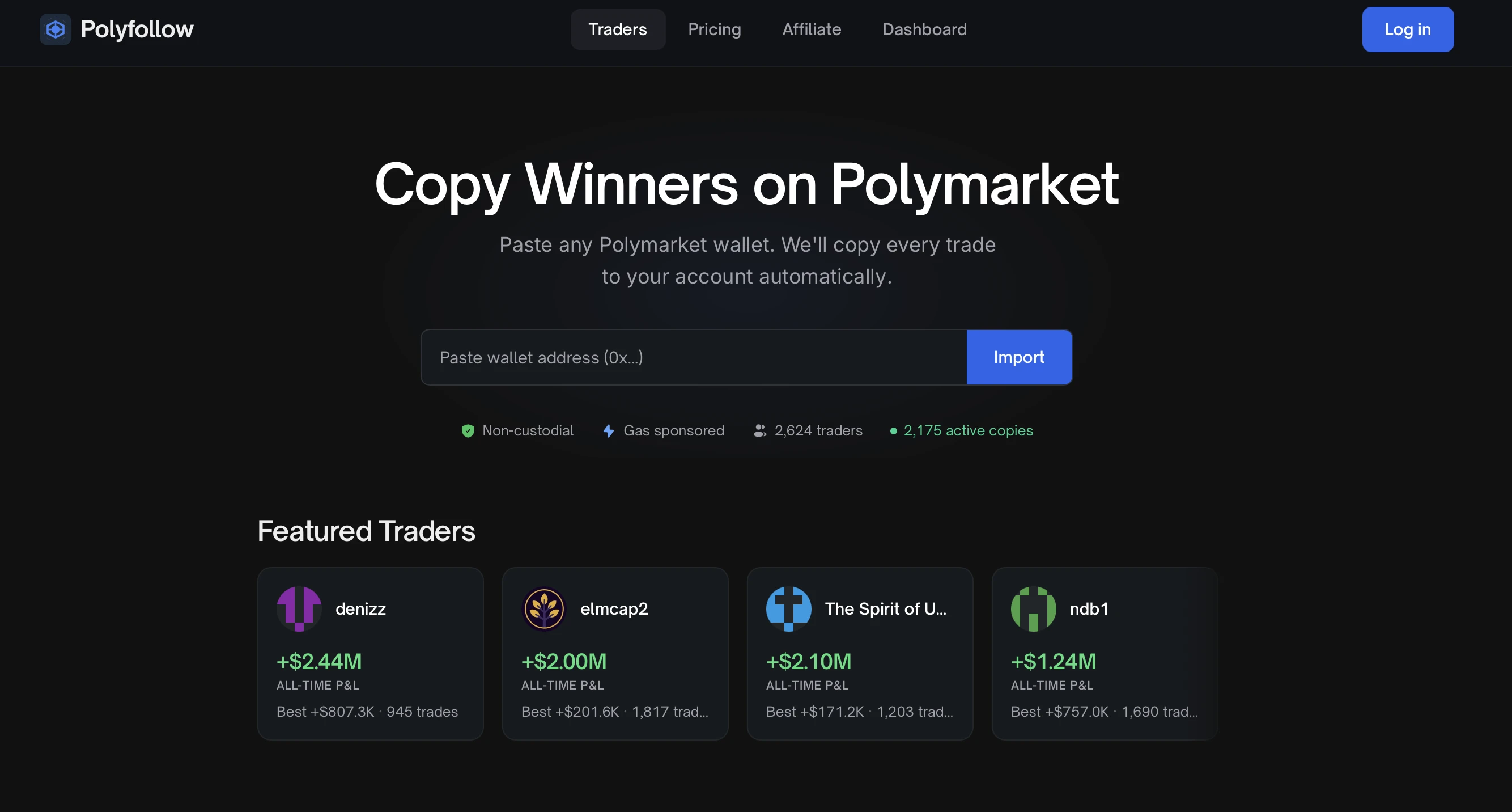
Copy trading with a 0.5% copy fee on a free terminal. Copying $20,000 a month: $100 in copy fees, plus Polymarket's fee on each fill (1% at the mid on politics, 1.75% on crypto), plus the slippage of filling after the leader moved the price. A leader averaging +2% a trade is a loss for a follower paying 2.5–3% a round trip.
A market maker on Poly-Maker, free, $10/month VPS. Pays no fee, earns rebates and — on eligible markets — rewards; its cost is inventory risk and capital. Returns scale with what it can leave resting; a few hundred dollars quotes, a few thousand earns.
Capital and lockup
A minute-market bot recycles capital every five minutes; a position on an election holds it for months at a return that must be annualised to mean anything; an arbitrage set pays a dollar at resolution and not before. Count the opportunity cost honestly, and never fund a bot with capital that has a better use or a deadline.
The honest summary
Software is the cheapest line, fees and spread the largest, and the difference between a strategy that works and one that does not is almost always in those two, not in the price tag. Buy the tool whose method you can check, run it small, and watch the fee line before the PnL line. POLBOTS does not verify any vendor's numbers, and this is not financial advice.
Uruguabot
Self-hosted Python bot for Polymarket's 5-minute BTC and ETH up/down markets, sold with its complete live trading record — losses included. A free GitHub repo publishes every fill from two generations of testing plus a 1,934-window study in which every automated signal scored roughly coin-flip against the human's 59%; the published numbers reproduce exactly from the raw CSVs, though the logs omit market ids, so the record is self-attested rather than on-chain verifiable. Both generations together lost about $270 — mostly execution and a since-fixed ghost-fill bug — while the configuration that ships as default closed its live run at +7.3% ROI on a 40% win rate over a small 25-trade sample: momentum entries, stop re-anchored to execution price minus 10¢, winners held to binary resolution. Dry-run is the default, with fills simulated from slippage measured on real trades; live mode takes two explicit flags and a dedicated wallet.
PolymTradeBot
Automated Python bot for Polymarket's 5- and 15-minute Bitcoin & Ethereum up/down markets. Trades live or in paper mode with configurable risk controls, self-hosted from full source.
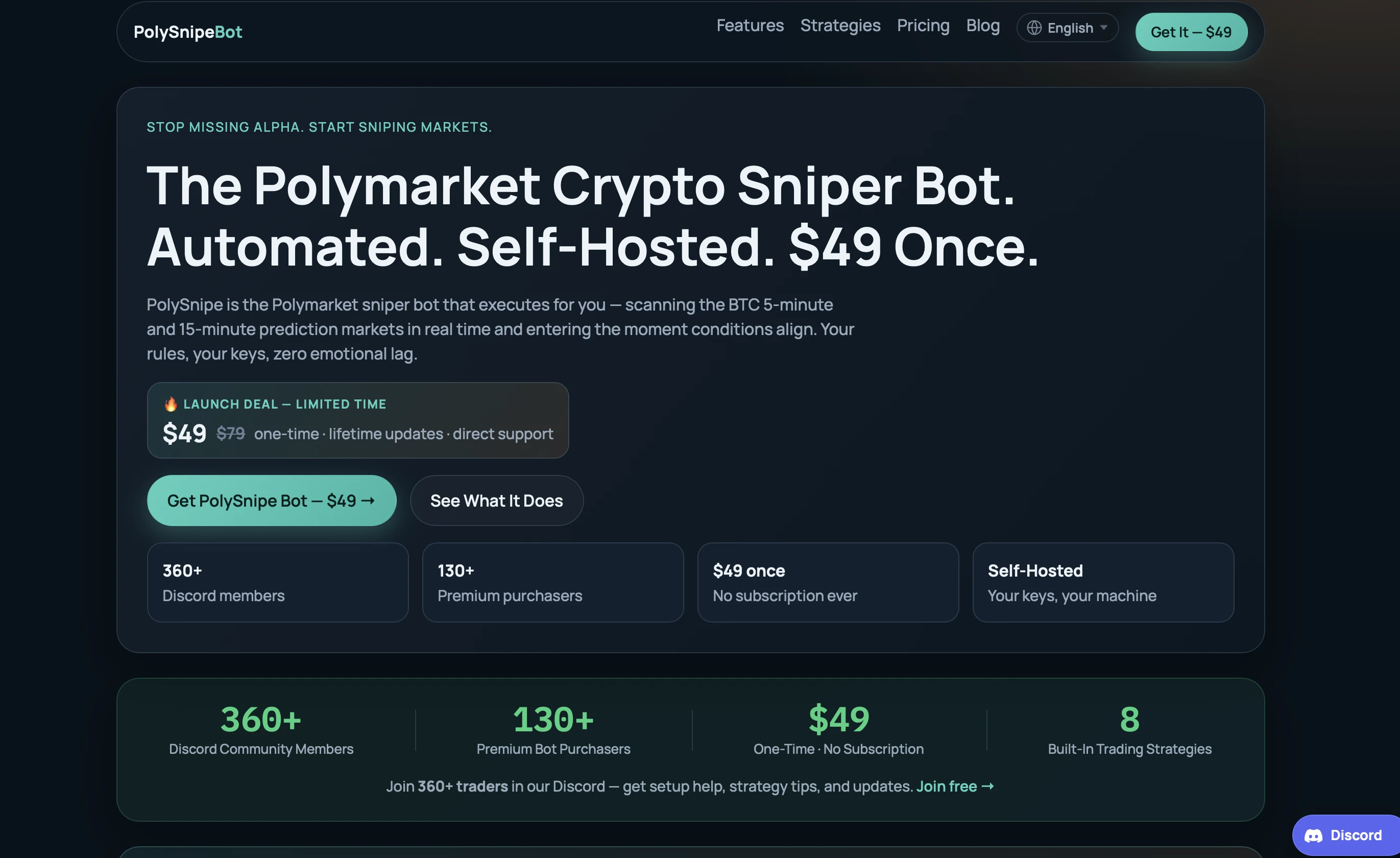
PolySnipe
Automated, self-hosted sniper bot for Polymarket's BTC 5- and 15-minute up/down markets. Scans in real time and enters in milliseconds the moment multiple independent signals align. Ships 8 configurable strategies, a setup wizard, backtesting and a full trade journal — full source code, one-time $49.
Poly-Maker
Open-source market-making bot for Polymarket. Quotes both sides of the book over WebSockets with configurable spreads, position merging and risk controls. Shared by its author as a reference implementation, not a turnkey money-maker.
Frequently asked questions
- Is a free Polymarket bot actually free?
- The software can be. The trading never is: every taker fill pays Polymarket's fee (1.75% of notional at the mid on crypto markets, 1% on politics, nothing on geopolitics), every crossing pays the spread, a self-hosted bot needs a server, and a per-trade-fee tool that charges 0.5–1% per fill costs more at volume than most subscriptions. The free collection sorts listings by which of these applies.
- One-time or subscription — which is cheaper?
- Over a year, a $499 one-time bot with source beats a $49-a-month subscription by a month or two and keeps running after that; a $14-a-month tool beats almost everything if you use it. The real comparison is against what the bot earns net of fees and spread — a bot that costs $0 and loses 1% a round trip is the most expensive thing on this page.
- How much capital do I need?
- Enough that fees, spread and the occasional losing streak do not wipe out the working size, and not more than you would write off. For a taker strategy on the minute markets that means hundreds of dollars to learn with and a few thousand to matter; for market making, returns scale with what you can leave resting; for copy trading, enough to take the same sizes as the leader without becoming the price on thin books.
- What about taxes?
- Yours, in every jurisdiction we know of, and not a topic this guide can advise on. Keep your own records — fills, fees, dates — from day one; the Data API and your bot's logs make that easy and a year-end reconstruction does not.