On this page8 sections
A bot is a program holding your keys
Strip away the landing pages and a Polymarket trading bot is a small program that does two things: it reads data from Polymarket — prices, order books, your positions — and it sends orders back, signed with credentials you gave it. It runs while you sleep, it never gets bored, and it does exactly what it was told, including the mistakes.
None of this is a hack. Polymarket's order book, the CLOB, has a public API, official software libraries, documentation written for developers and even an open-source framework for building AI agents that trade. Programmatic trading is a first-class use of the platform, not a grey area — the question of what is allowed is covered in a separate guide.
What a bot is not is a source of edge. It executes a strategy faster and more consistently than a person can. If the strategy is bad, the bot loses money faster and more consistently than a person would.
What every bot does, step by step
Whatever the strategy, the loop underneath is the same seven steps:
- Find markets. It asks Polymarket's discovery API (called Gamma) which markets exist, when they resolve, and which outcome tokens belong to them.
- Read prices. It pulls order books and last prices from the CLOB API, or — if it is any good — subscribes to a WebSocket feed so it hears about changes the moment they happen instead of asking every second.
- Decide. The strategy runs: a wallet it is copying just bought, two outcomes add up to less than a dollar, a headline hit, Bitcoin moved and the five-minute market has not caught up yet.
- Size and check risk. How much to buy, whether the position limit allows it, whether the daily loss cap has been hit, whether the book is deep enough to get out again.
- Sign and send. It builds an order, signs it with your key, and posts it — as a resting limit order, or one that fills immediately or dies.
- Track what happened. Fills arrive, partially or in full; positions change; the bot reconciles what it thinks it holds with what Polymarket says it holds.
- Handle failure. The API says "too many requests", the order was rejected for a price tick the market does not allow, the connection dropped. A bot that ignores this step is the one that wakes you with a surprise.
Steps 3 and 4 are the strategy. Everything else is plumbing, and the plumbing is most of the code.
The main kinds of bots
The catalog sorts bots by what their step 3 does. The table is the short version; each row links to the category page with every listing we have.
| Type | What it does | Who it suits |
|---|---|---|
| Copy trading | Mirrors the trades of wallets you pick, with your own size limits | People who want exposure to someone else's judgement |
| Arbitrage | Buys outcome sets that add up to less than a dollar, or the same event priced differently in two places | Capital-heavy, patient, latency-aware |
| Market making | Quotes both sides of a book and earns the spread (and sometimes Polymarket's liquidity rewards) | People who understand inventory risk |
| Crypto minute markets | Trades the 5- and 15-minute "BTC up or down" markets off live exchange data | Short-term traders who can sit through coin-flip streaks |
| Sentiment and news | Turns headlines, transcripts, model forecasts or an LLM's read of the news into orders | Event traders, agent builders |
| Sniping | Reacts first when a price dislocates or a new market opens | Latency specialists |
| Sports | Trades live game markets against odds feeds | People with a model, not a hunch |
| Telegram | Bots you operate from a chat — alerts, one-tap trades, wallet tracking | Phone-first traders |
Two things the table hides. First, most real bots are hybrids — a minute-market bot with a momentum filter is also a sentiment bot of sorts. Second, and more important: most of what gets called a "bot" is not one.
Bots versus platforms: the distinction that matters
Of the listings in this catalog at the time of writing, a large majority are platforms — terminals, screeners, wallet trackers, forecasting dashboards, alert services. They are useful, and they are not bots: you read what they show and you place the trade. Only a minority of listings actually sign orders on their own.
That distinction decides what you are risking. A platform that you connect read-only can show you bad information; a bot that holds your key can spend your money. The catalog marks the difference on every card, and the Platforms & Tools category collects the manual ones.
What they cost
Pricing in the catalog falls into a few shapes, and "free" is the most misleading word in the list:
- Open-source, free. A handful of bots publish their code under a free licence — Poly-Maker for market making, Polymarket Agents for AI agents, a few minute-market bots. Free as in software: you run them, you maintain them. They have their own page.
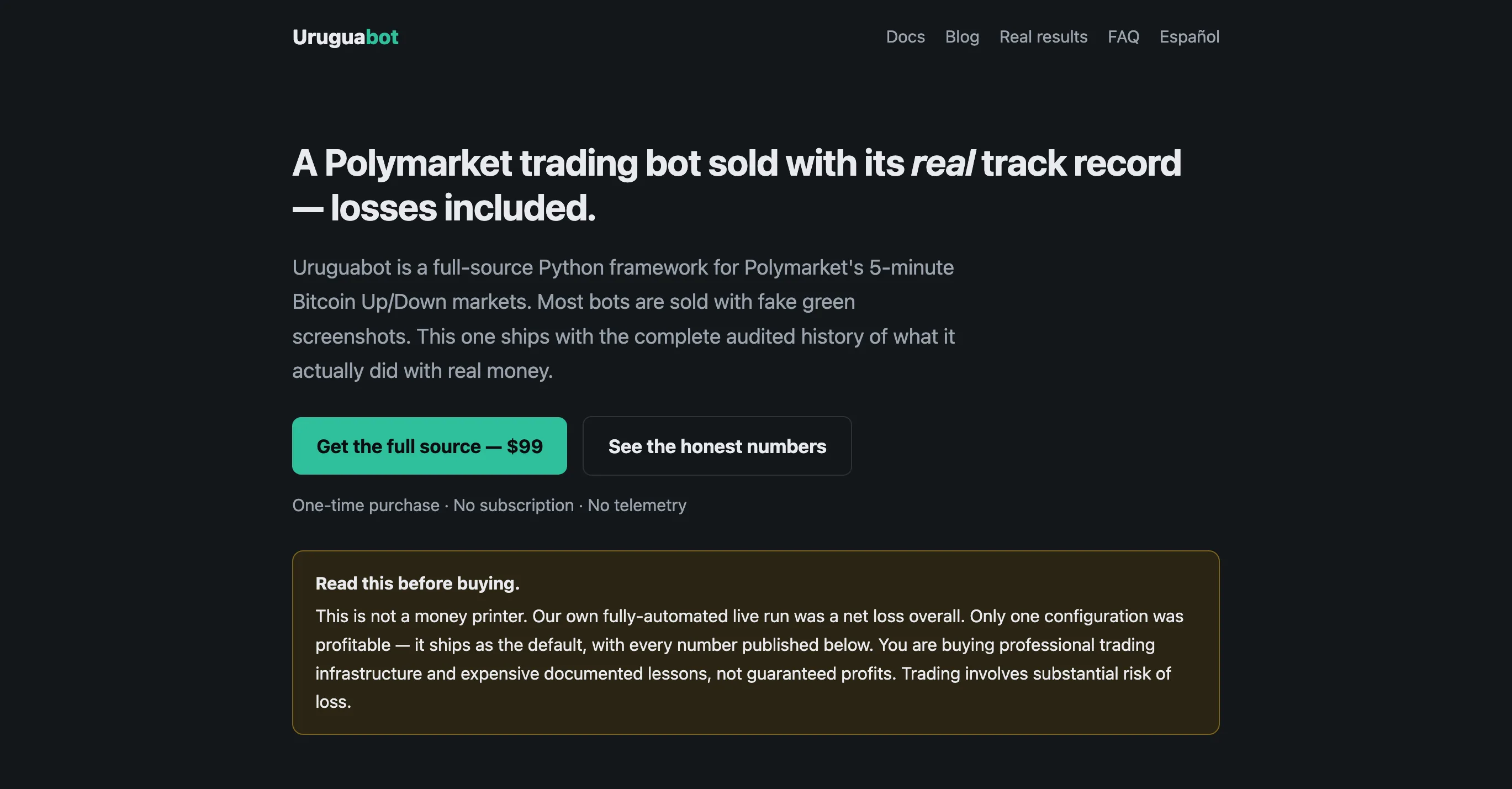
- One-time purchase with source. Roughly $49 to $499 buys the full code of a bot like PolymTradeBot or Uruguabot. No subscription; you can read every line.
- Subscription. From about $14 to $299 a month for hosted bots and terminals with a free tier underneath.
- Fee per trade. Nothing up front; the tool takes 0.5–1% of each trade or a slice of profits. Cheap to try, expensive at volume.
On top of the software: Polymarket's own fee — only takers pay it, it peaks at 50-cent prices and it depends on the category (crypto markets carry the highest rate, geopolitics none), while makers pay nothing and earn rebates — plus the spread you cross, and for a self-hosted bot, a server. The free collection sorts every listing by which of these applies.
What a bot cannot do
- It cannot invent an edge. It can only execute yours. Most of the strategies above worked better a year ago than they do today, because every edge on a public order book attracts more bots until it is gone.
- It cannot out-run faster bots. Sniping and arbitrage are latency games; a bot on a home connection loses them to one sitting next to the matching engine.
- It cannot avoid market risk. A market-making bot holds inventory; a copy bot buys what its target buys, at a worse price and a moment later; a minute-market bot has a 50/50 base rate to beat.
- It cannot change where you are. Geo-blocks apply to the API exactly as they apply to the website.
- It cannot verify itself. The ROI on a landing page is a claim. POLBOTS republishes what authors publish and marks the rest N/A — and only a few authors publish a record you can check trade by trade.
Is it safe? Keys and custody
Most bots here are non-custodial: the program runs on your machine or the vendor's, with your API credentials and, for signing orders, access to a key for your wallet. Non-custodial is better than handing over funds — and it still means a program can sign anything that key can sign. The sensible setup is a dedicated wallet that holds only what you are prepared to lose, credentials you can revoke, and — wherever the source is available — a read of the code before you fund it. How keys, proxies and wallets work is its own guide.
How to start
Pick the category that matches your temperament before you pick a bot: arbitrage and market making grind small edges with small drawdowns, minute markets and sports swing hard. Run anything with a paper mode in paper mode first. Fund it with a size whose total loss would annoy you and not more. Then read the bot's published record, if it has one, the way you would read a stranger's bank statement.
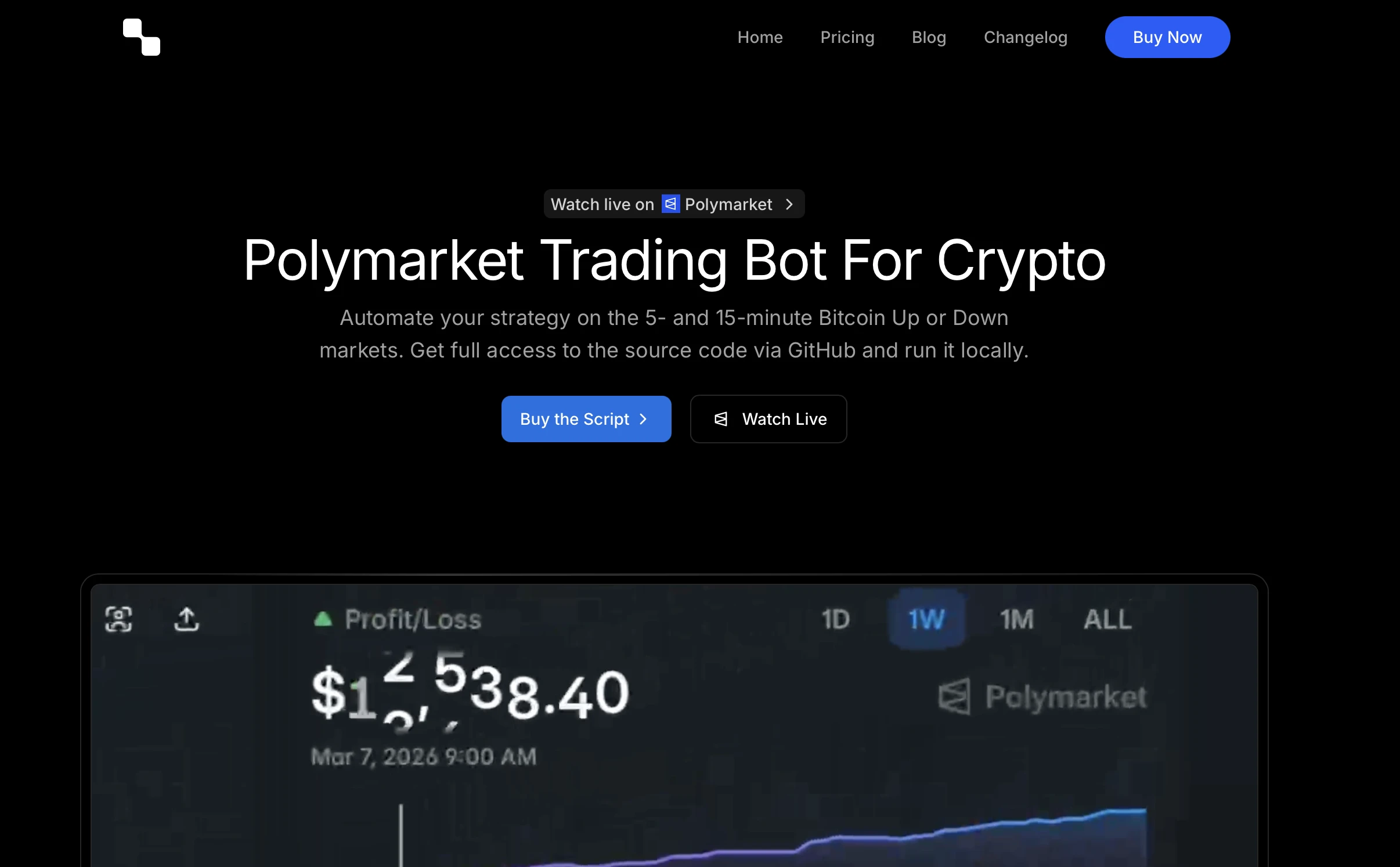
PolymTradeBot
Automated Python bot for Polymarket's 5- and 15-minute Bitcoin & Ethereum up/down markets. Trades live or in paper mode with configurable risk controls, self-hosted from full source.
Poly-Maker
Open-source market-making bot for Polymarket. Quotes both sides of the book over WebSockets with configurable spreads, position merging and risk controls. Shared by its author as a reference implementation, not a turnkey money-maker.
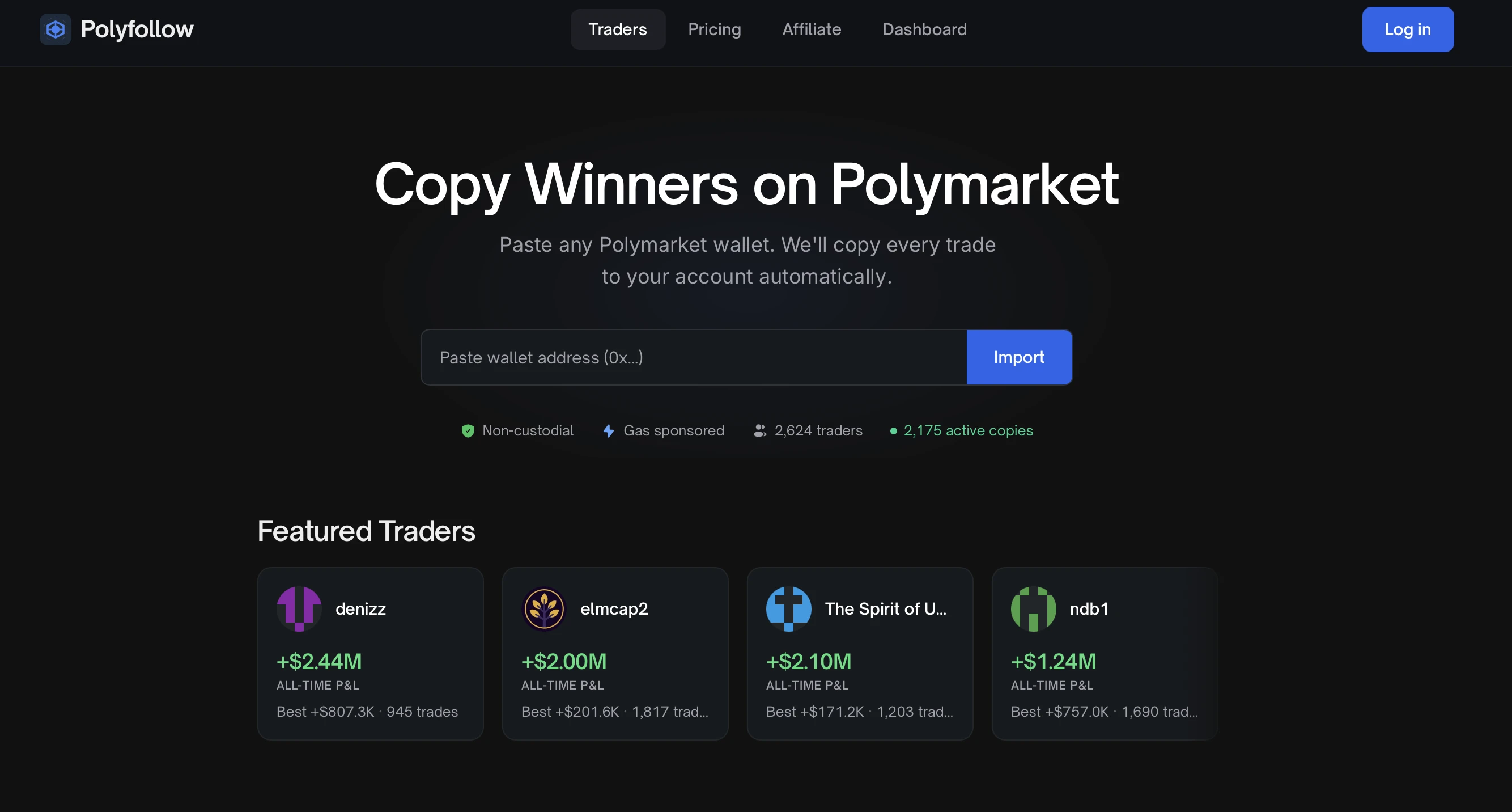
Polyfollow
Automated copy-trading for Polymarket. Follow proven top traders and replicate their positions automatically, so your book tracks theirs without manual order entry.
Polymarket Agents
Official open-source framework from Polymarket for building AI agents that trade autonomously. Combines Polymarket & Gamma market data, news and web-search sourcing, and RAG-powered LLM tooling so an agent can research a market and place trades from the command line.
If you would rather build than buy, the build guide walks through the whole loop above with the actual APIs.
Frequently asked questions
- Do Polymarket bots actually make money?
- Some do, for a while; most published claims are unverifiable. A bot automates a strategy — it does not create an edge on its own, and the edges that exist decay as more bots crowd into them. POLBOTS shows only the performance an author publishes and marks everything else N/A; treat that N/A as information.
- Do I need to code to use one?
- No. Most of the catalog is platforms and hosted bots you configure in a browser or in Telegram. You need to code only if you want to build your own, or to run an open-source bot, which means editing a config file and running a Python or Node program on a server.
- Is a bot the same as a trading platform or terminal?
- No, and the catalog keeps them apart. A bot places orders on its own according to rules. A platform — a terminal, screener, wallet tracker or alert service — gives you information and an interface, and you place the trades. Most listings on POLBOTS are platforms.
- Can a bot get around Polymarket's country restrictions?
- No. Trading on the international Polymarket order book is geo-blocked in the United States, the United Kingdom and several other jurisdictions, and a bot trades through exactly the same API under the same rules. Reading market data is open everywhere; placing orders is not.