On this page13 sections
- Why this niche is full of them
- 1. Guaranteed, risk-free, or "passive" returns
- 2. ROI without a trade record
- 3. A form, a chat, or a website that wants your seed phrase
- 4. No source and no paper mode
- 5. An anonymous author with no footprint
- 6. Pressure
- 7. Referral tiers
- 8. Impossible latency claims
- 9. Clones
- What a legitimate one looks like
- What we check before a bot is listed
- If you already paid
Why this niche is full of them
Prediction-market bots sit at the intersection of three things scammers love: crypto wallets, a promise of passive income, and a product whose quality is almost impossible to judge from a screenshot. Add Telegram — where a bot, a channel and an impersonator look identical — and the result is a market where the loudest landing pages belong to the worst products.
The good news is that scams are lazy. They lean on the same handful of tells, and once you know them they are hard to miss. Here are the nine we check before anything goes in the catalog.
1. Guaranteed, risk-free, or "passive" returns
No strategy on an order book is risk-free, and anyone telling you a bot "guarantees 5% a week" is telling you they either do not understand markets or hope you don't. Honest vendors write things like "the default configuration closed its live run at +7.3% on a 40% win rate over 25 trades" and then tell you the sample is small. That sentence — precise, modest, checkable — is the opposite of a guarantee, and it is the sentence you want.
2. ROI without a trade record
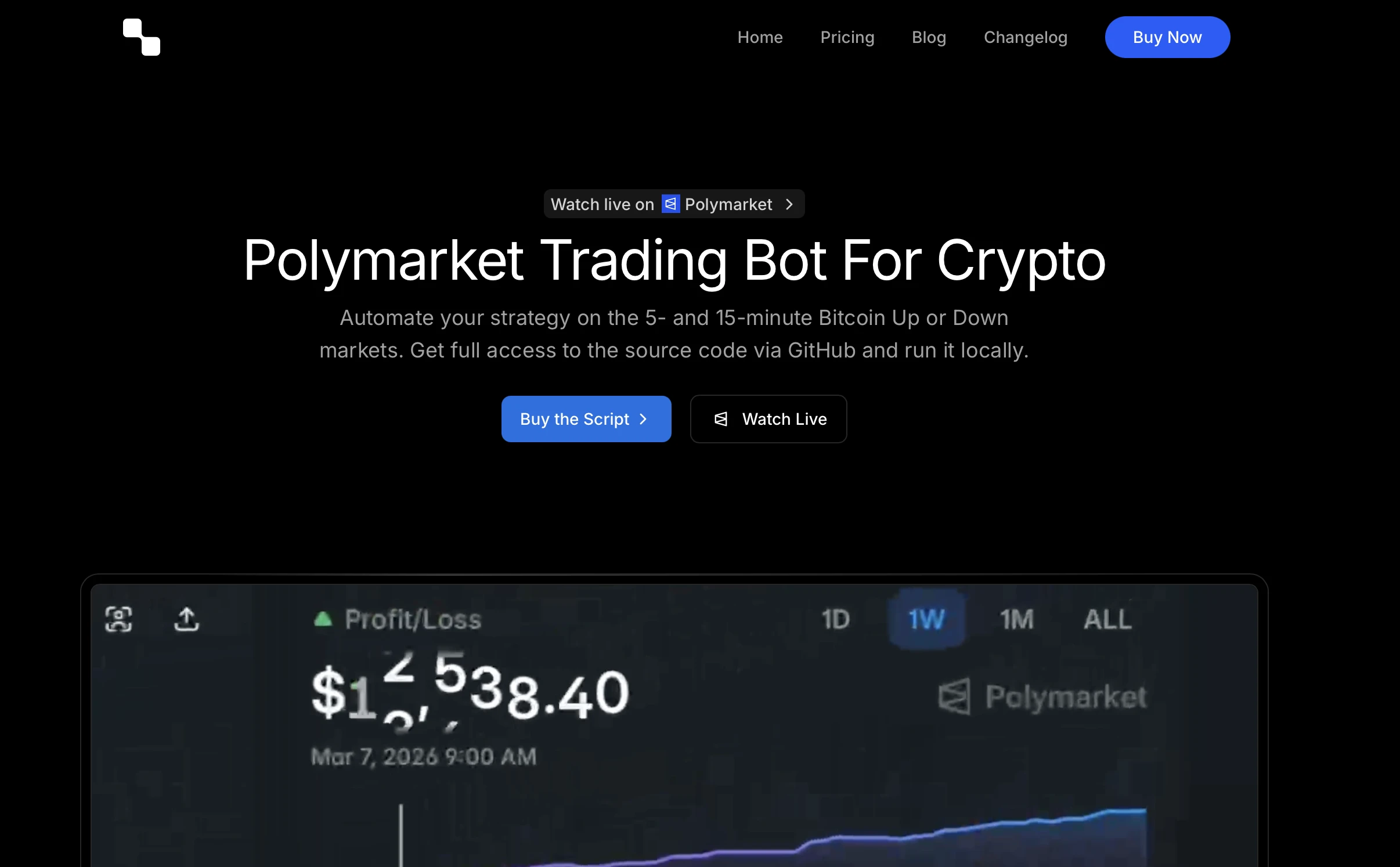
A number with no trades behind it is a decoration. The test is simple: can you get the fills? Dates, sizes, prices, outcomes — ideally as a downloadable file you could recompute the ROI from yourself. Screenshots of a dashboard, a green line with no axis, "results from our users" — none of that is a record.
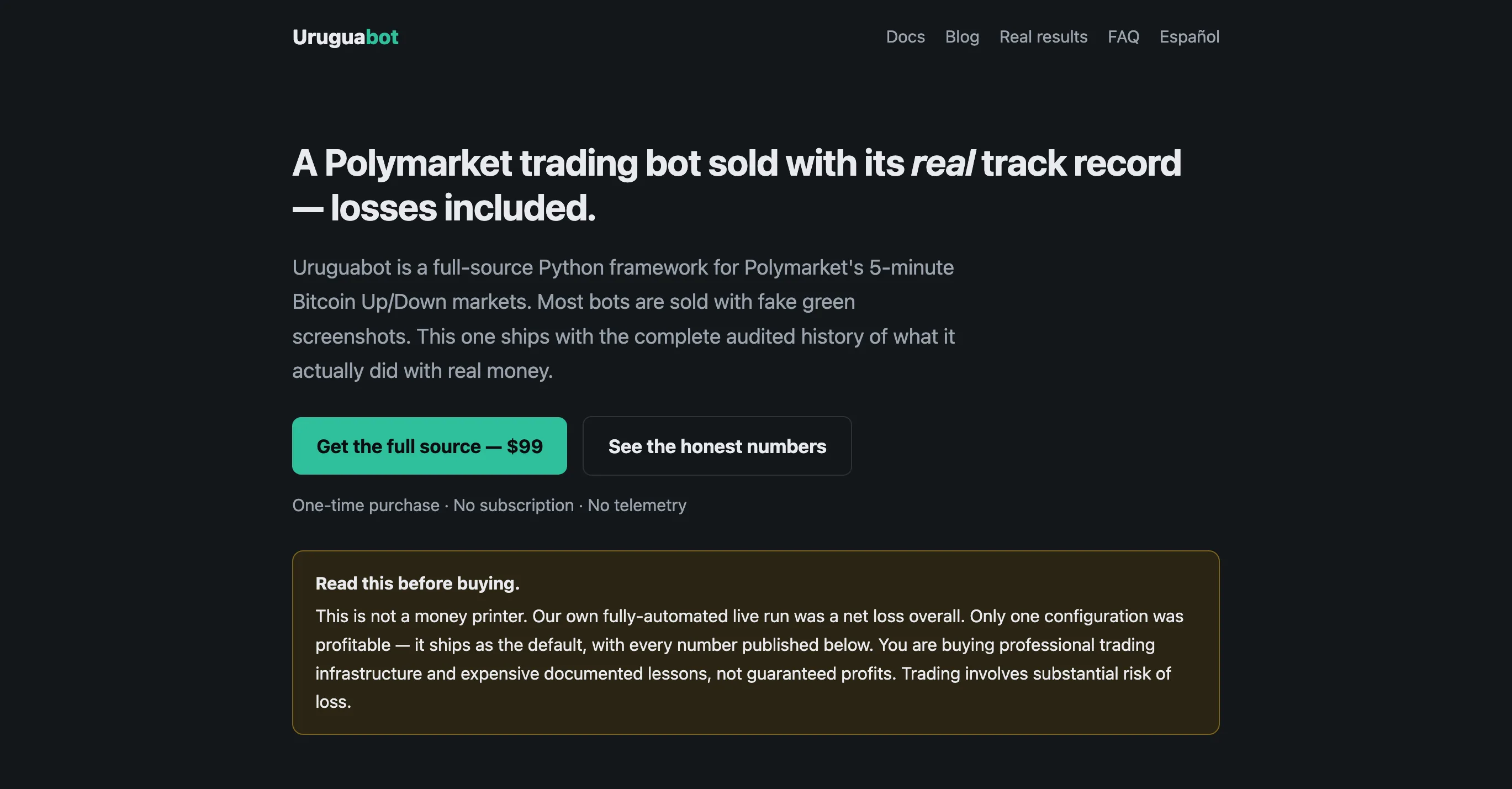
A few authors do it properly. Uruguabot publishes every fill from two generations of testing as raw CSVs on GitHub, losses included, and says in its own listing that the vendor's overall record is a net loss with one profitable configuration on a small sample. That is what honesty looks like in this niche, and it is rare enough that its absence should count against a product.
3. A form, a chat, or a website that wants your seed phrase
Self-hosted bots sign orders and need a key to do it — loaded from a config file on your own machine, for a dedicated wallet. That is normal. What is never normal: a website or a Telegram bot asking you to paste a private key or a seed phrase. A seed phrase is your entire wallet, forever, and no legitimate Polymarket tool needs it. Telegram clones of real bots exist specifically to harvest them. Keys and wallets covers what a bot legitimately needs and how to give it that and nothing more.
4. No source and no paper mode
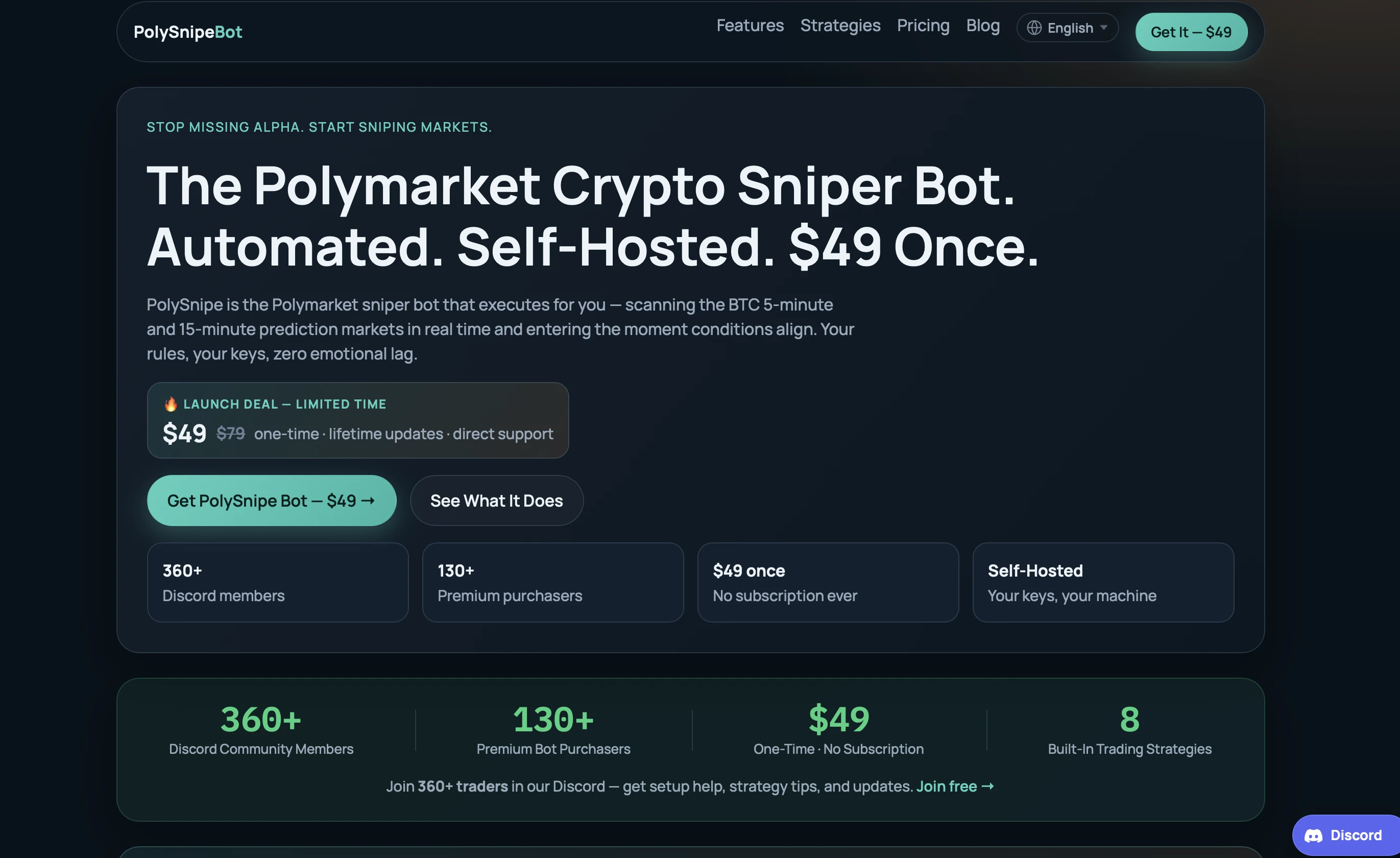
You cannot read it and you cannot test it, so you are asked to fund it on faith. Legitimate closed-source bots at least give you a dry-run or paper-trading mode so you can watch what it would do before it does it with money. Bots that ship full source — PolymTradeBot, PolySnipe, the free MIT-licensed minute-market bot — let you do both. "Trust us, it's proprietary" plus "no demo" is two flags at once.
5. An anonymous author with no footprint
Polymarket wallets are public. A bot author who claims to trade with their own product can show you the wallet. A vendor with no trading profile, no repository, no history on X or Discord, a domain registered last month and a Telegram handle as the only contact is asking you to trust a name that did not exist in spring.
6. Pressure
Countdown timers. "Only 3 licences left." "Price doubles Friday." A product that works does not need you to decide in the next eleven minutes. Launch discounts exist and are fine; a sales page built entirely from urgency is selling the urgency.
7. Referral tiers
If the way to make money is to recruit other buyers — commissions on their purchase, ranks, bonuses for "your team" — the product is the recruitment. Plenty of legitimate tools have an affiliate link; the line is crossed when the marketing is about the affiliate income rather than the trading.
8. Impossible latency claims
"Front-runs the block." "Sees orders before they hit the chain." Polymarket's CLOB matches orders off-chain and settles on-chain; there is no public mempool of pending matches to front-run. A bot can be fast — sniping is real, and it is won by proximity and good code — but claims that describe a mechanism the exchange does not have are describing fiction.
9. Clones
The last flag is about the *copy*, not the product. Real bots get impersonated: a Telegram username one character off, a domain with a hyphen, a "v2" channel. Always start from the link on the project's official site or verified social account, never from a search result, a group invite or a bot that messages you first — and check the handle character by character. Our Telegram category notes this on every listing for a reason.
What a legitimate one looks like
- A published record you can reproduce, including the losing periods.
- Source you can read, or at minimum a paper mode you can run.
- Keys that stay on your machine, in a wallet you can empty.
- An author with a footprint: a profile, a repo, a history.
- A price that is a price, not a countdown.
- A description that says what the bot does not do.
What we check before a bot is listed
Listings are free and placement is not for sale, and every entry goes through the same steps: we read everything the author published, we open the repository where there is one, we install and run the tool ourselves on a demo account or at small size, and we write it up in the same shape as every other listing so two bots can be compared side by side. The full method is on the about page. It catches the lazy scams; it does not guarantee a bot makes money, and nothing here is financial advice.
If you already paid
Act in this order: revoke, then record, then report. Rotate or revoke the API credentials it was given; move funds out of any wallet it could sign for; revoke token approvals on Polygon. Keep the receipt, the chat, the landing page. Use the buyer protection of wherever you paid, if there was any. And post the handle where the next person will search for it — the single most useful thing a scam's victims can do is make it findable.
Frequently asked questions
- Is a bot that asks for my private key automatically a scam?
- A self-hosted bot needs a signing key to place orders — that is how the CLOB works — but it should read it from a config file or environment variable on your machine. A bot that asks you to paste a private key or seed phrase into a website, a Telegram chat or a form is asking for your wallet, and nothing legitimate needs a seed phrase, ever.
- Can a bot really show 90% win rates?
- A win rate is easy to manufacture: take tiny profits often and one catastrophic loss rarely, and the percentage looks superb while the account bleeds. Ask for the full trade record with sizes and dates, not the rate. A bot that publishes losses — a few here do — is showing you something a scam never will.
- Does being listed on POLBOTS mean a bot is safe?
- No. It means we read what the author published, looked at the source where there was source, got it running, and wrote it up in the same shape as every other listing. We do not verify performance and we do not audit code. Listing is free and cannot be bought, which is the only reason the listing means anything at all.
- What if I already paid for one?
- Revoke whatever it has: rotate API credentials, move funds out of the wallet it could sign for, revoke token approvals on Polygon. Keep the receipts and the chat logs. If it was sold through a platform with buyer protection, use it; if it was a Telegram clone, report the handle so the next person finds the warning.