Kalshi AI Trading Bot
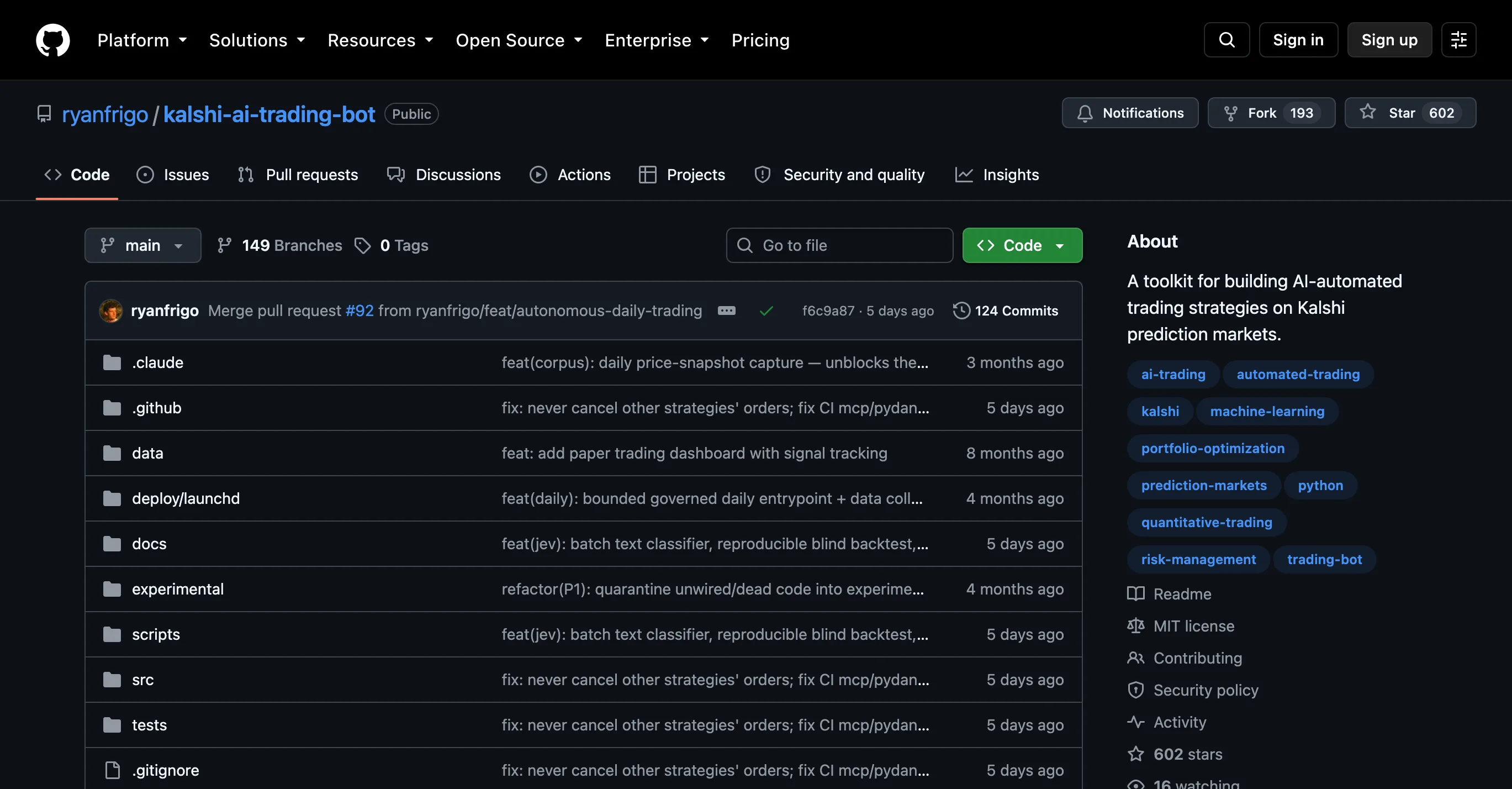
Open-source Python toolkit for automated trading on Kalshi, built around the question most bot repos skip: do you actually beat the book? An LLM reads each candidate market with a news summary, scores a probability through any model on OpenRouter, and the trade is sized at quarter-Kelly under a risk governor with a daily-loss limit and a drawdown kill switch. Every decision goes into a local journal; the edge harness then pulls Kalshi's own settlements, scores your settled trades by Brier score, log-loss and realised win rate against the price you paid, and refuses to call it an edge on fewer than ten trades that resolved after you bought. A policy step turns that record into a pre-trade gate that blocks categories you have lost money in. Ships a paper mode, a Streamlit dashboard, a Claude skill and an MCP server; MIT-licensed at github.com/ryanfrigo/kalshi-ai-trading-bot.
Overview
Open-source Python toolkit for automated trading on Kalshi, built around the question most bot repos skip: do you actually beat the book? An LLM reads each candidate market with a news summary, scores a probability through any model on OpenRouter, and the trade is sized at quarter-Kelly under a risk governor with a daily-loss limit and a drawdown kill switch. Every decision goes into a local journal; the edge harness then pulls Kalshi's own settlements, scores your settled trades by Brier score, log-loss and realised win rate against the price you paid, and refuses to call it an edge on fewer than ten trades that resolved after you bought. A policy step turns that record into a pre-trade gate that blocks categories you have lost money in. Ships a paper mode, a Streamlit dashboard, a Claude skill and an MCP server; MIT-licensed at github.com/ryanfrigo/kalshi-ai-trading-bot.
How it works
- Three example strategies ship, and the README says plainly that none is the answer. AI Directional asks one model per market for a probability and trades the difference; the README corrects its own earlier “5-model ensemble” claim, because the ensemble code is quarantined and not wired in. Safe Compounder needs no model: it rests NO orders a cent under the ask where YES last traded at 20¢ or less and the edge clears 5¢ — many small wins, and a rare loss that erases a run of them. Beast Mode drops the guardrails, and the README says running it lost real money.
- The author publishes the live account it runs on, losses included. On Sep 25, 2026 equity was $901.50, 69.7% below a $2,975.25 peak, and 170 settled markets had netted +$128.56 at a 66% win rate. That account is also traded by hand, and the verdict on the toolkit's own journal reads “insufficient data”: one settled journaled trade, none yet scorable. Treat it as a measuring instrument without a proven edge, which is how it describes itself.
- The code is real: 141 Python files with a test suite and CI, 124 commits since July 2025 from the author and two outside contributors, the last on Sep 26, 2026. Requests to Kalshi are signed with RSA-PSS from a key file on your machine, and outbound calls go to Kalshi, the model provider you configure and public RSS feeds. sentry-sdk is listed as a dependency but never initialised.
- We read the Kalshi client, the risk governor and the edge harness, and ran the keyless policy demo, which printed a gate from a bundled sample record. We did not connect a Kalshi account, since live mode needs a funded one.
Supported markets
- Kalshi — every open market, ingested through the Events API
Free under the MIT licence; clone the repo and run it on Python 3.12 or newer. It needs your own Kalshi API key and RSA private key, plus an OpenRouter key for the model calls, which are metered per token and held under a daily-cost cap in the code. Kalshi's trading fees apply on every fill. Nothing is hosted and nothing is sold.
Get Kalshi AI Trading Bot- `cli edge`: Brier score, log-loss and edge against the price you paid, scored on Kalshi's settlements and limited to trades that resolved after entry
- `cli improve`: re-derives a pre-trade gate from your settled record — blocks losing categories, warns on a losing side, shrinks overconfident estimates
- Risk governor on every live order: daily-loss limit, drawdown kill switch, manual halt, per-position cap, quarter-Kelly sizing
- Paper mode, and dry-run by default — `trade` and `close` only send orders with `--live`
- Signed Kalshi REST and WebSocket client, SQLite journal, Streamlit dashboard
- Agent tooling: atomic CLI commands, a Claude skill and an MCP server that runs on your own keys, read-only unless a call is confirmed
- Author
- Ryan Frigo
- Category
- Sentiment / News
- Risk level
- High risk
- Added
- Oct 1, 2026
Link to this page from your site and the listing gets the Verified Partner mark and a followed link back to you.
Get the badgeKalshi AI Trading Bot reviews
No one has reviewed Kalshi AI Trading Bot here yet. If you have run it, your write-up is the one the next reader will see.
Be the first to review Kalshi AI Trading Bot. Tell the next reader what it traded for you, what it cost and whether you would run it again.
Reviews are written by readers, not by us or by the bot's author. Each one is read by a human before it is published, and we never accept payment for a review or for a rating.
Kalshi AI Trading Bot alternatives
Polymarket Agents
Official open-source framework from Polymarket for building AI agents that trade autonomously. Combines Polymarket & Gamma market data, news and web-search sourcing, and RAG-powered LLM tooling so an agent can research a market and place trades from the command line.
Oracle Markets
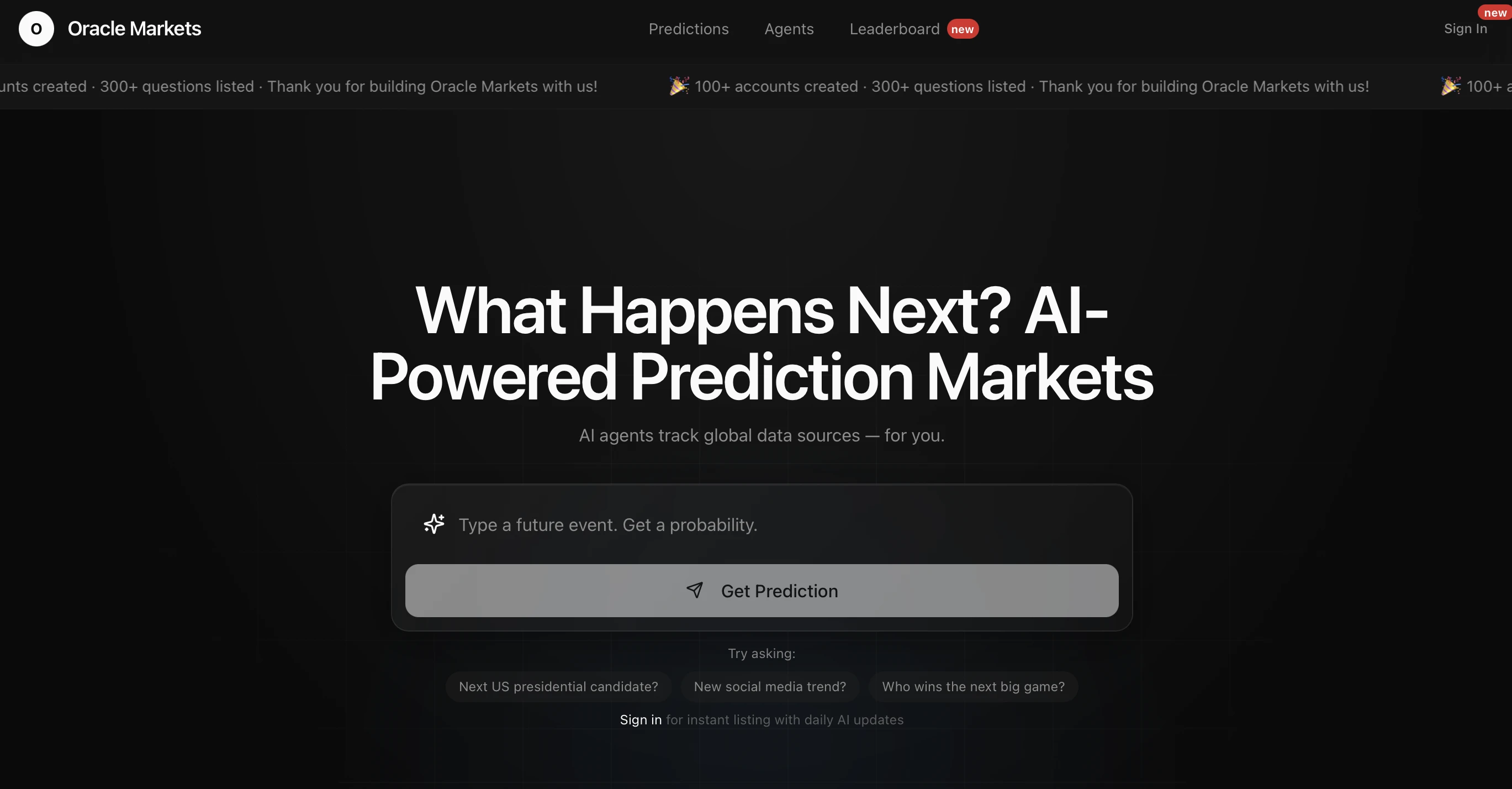
Open-source AI forecasting platform. Multiple independent AI agents analyze news, data and market signals daily to produce calibrated consensus probabilities on future events — with per-agent reasoning and an accuracy leaderboard. Scientific forecasting only, no monetary trading.
PredictPM
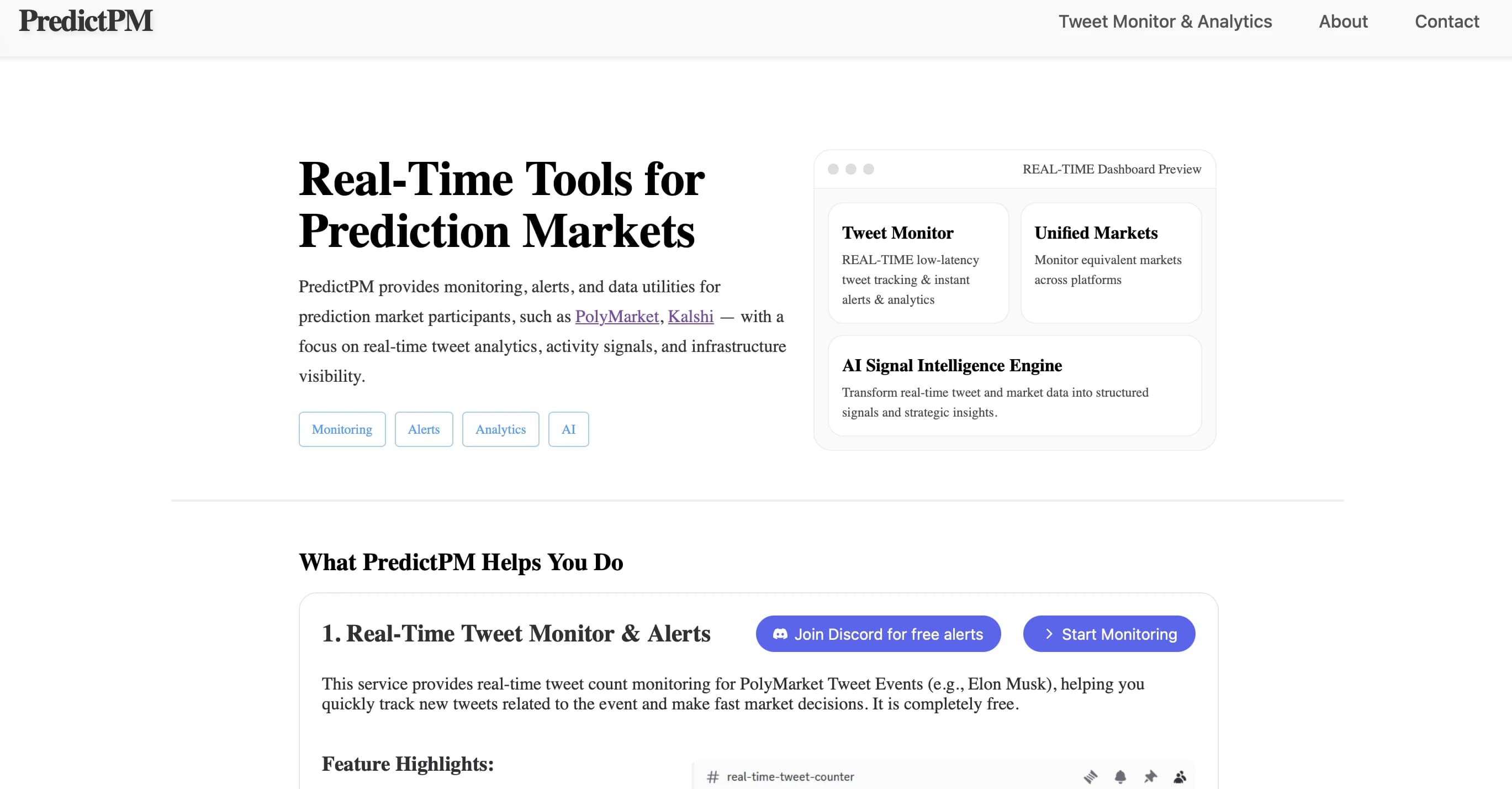
Real-time social and market monitoring for prediction markets. Tracks tweets with ~2-second alert latency, monitors equivalent markets across Polymarket and Kalshi at once, and runs AI signal intelligence over tweet and market data to surface structured, strategic insights.