Kalshi AI Trading Bot vs Polymarket Agents
Kalshi AI Trading Bot and Polymarket Agents are both filed under Sentiment / News. Both are automated bots, and both are free. Below: the facts side by side, where the two actually differ, and when each one is the better pick.
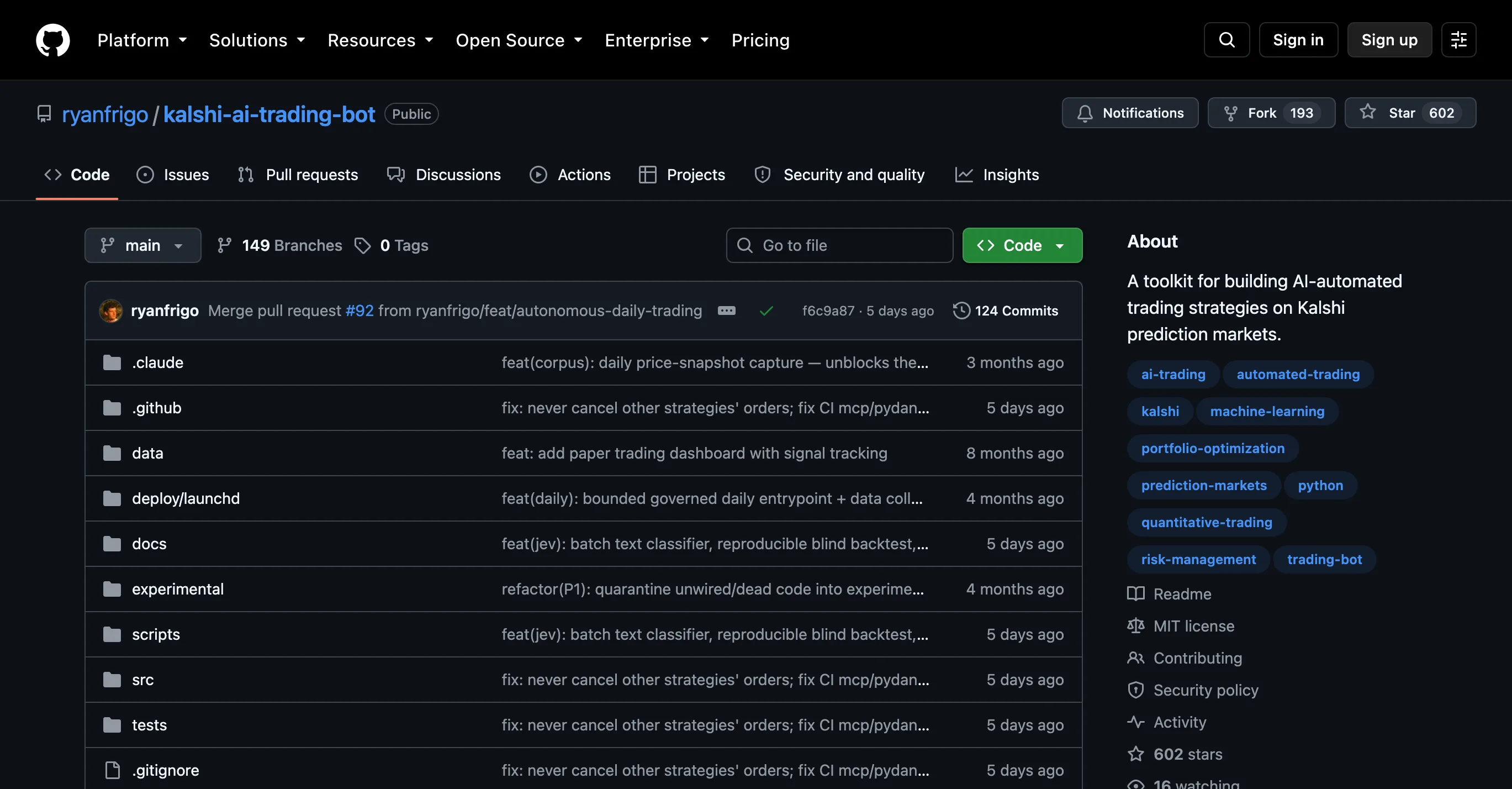
Open-source Python toolkit for automated trading on Kalshi, built around the question most bot repos skip: do you actually beat the book? An LLM reads each candidate market with a news summary, scores a probability through any model on OpenRouter, and the tra…
Compared with Polymarket AgentsOfficial open-source framework from Polymarket for building AI agents that trade autonomously.
Compared with Kalshi AI Trading BotAt a glance
| Fact | Kalshi AI Trading Bot | Polymarket Agents |
|---|---|---|
| Type | Automated bot | Automated bot |
| Category | Sentiment / News | Sentiment / News |
| Also listed in | — | Politics & Elections, Momentum, Sports Trading, Crypto Markets |
| Pricing | Free | Free |
| Price | free · MIT | open-source |
| Risk rating | High risk | High risk |
| Markets | Kalshi — every open market, ingested through the Events API | Politics, Crypto, Sports and 1 more |
| Source | Open-source | Open-source |
| Runs in Telegram | No | No |
| Listed since | Oct 1, 2026 | Jul 5, 2026 |
Highlighted rows differ
Key differences
- They cover different markets: Kalshi AI Trading Bot lists Kalshi — every open market, ingested through the Events API, Polymarket Agents lists Politics and Crypto and 2 more.
- Only Polymarket Agents is filed under Politics & Elections and Momentum and 2 more.
- Polymarket Agents has been listed since Jul 5, 2026; Kalshi AI Trading Bot joined on Oct 1, 2026.
Choose Kalshi AI Trading Bot if…
- you trade Kalshi — every open market, ingested through the Events API
Choose Polymarket Agents if…
- you trade Politics and Crypto and 2 more
- your focus is Politics & Elections and Momentum and 2 more
What Kalshi AI Trading Bot does
Open-source Python toolkit for automated trading on Kalshi, built around the question most bot repos skip: do you actually beat the book? An LLM reads each candidate market with a news summary, scores a probability through any model on OpenRouter, and the trade is sized at quarter-Kelly under a risk governor with a daily-loss limit and a drawdown kill switch. Every decision goes into a local journal; the edge harness then pulls Kalshi's own settlements, scores your settled trades by Brier score, log-loss and realised win rate against the price you paid, and refuses to call it an edge on fewer than ten trades that resolved after you bought. A policy step turns that record into a pre-trade gate that blocks categories you have lost money in. Ships a paper mode, a Streamlit dashboard, a Claude skill and an MCP server; MIT-licensed at github.com/ryanfrigo/kalshi-ai-trading-bot.
Features- `cli edge`: Brier score, log-loss and edge against the price you paid, scored on Kalshi's settlements and limited to trades that resolved after entry
- `cli improve`: re-derives a pre-trade gate from your settled record — blocks losing categories, warns on a losing side, shrinks overconfident estimates
- Risk governor on every live order: daily-loss limit, drawdown kill switch, manual halt, per-position cap, quarter-Kelly sizing
- Paper mode, and dry-run by default — `trade` and `close` only send orders with `--live`
- Signed Kalshi REST and WebSocket client, SQLite journal, Streamlit dashboard
- Three example strategies ship, and the README says plainly that none is the answer. AI Directional asks one model per market for a probability and trades the difference; the README corrects its own earlier “5-model ensemble” claim, because the ensemble code is quarantined and not wired in. Safe Compounder needs no model: it rests NO orders a cent under the ask where YES last traded at 20¢ or less and the edge clears 5¢ — many small wins, and a rare loss that erases a run of them. Beast Mode drops the guardrails, and the README says running it lost real money.
- The author publishes the live account it runs on, losses included. On Sep 25, 2026 equity was $901.50, 69.7% below a $2,975.25 peak, and 170 settled markets had netted +$128.56 at a 66% win rate. That account is also traded by hand, and the verdict on the toolkit's own journal reads “insufficient data”: one settled journaled trade, none yet scorable. Treat it as a measuring instrument without a proven edge, which is how it describes itself.
- The code is real: 141 Python files with a test suite and CI, 124 commits since July 2025 from the author and two outside contributors, the last on Sep 26, 2026. Requests to Kalshi are signed with RSA-PSS from a key file on your machine, and outbound calls go to Kalshi, the model provider you configure and public RSS feeds. sentry-sdk is listed as a dependency but never initialised.
What Polymarket Agents does
Official open-source framework from Polymarket for building AI agents that trade autonomously. Combines Polymarket & Gamma market data, news and web-search sourcing, and RAG-powered LLM tooling so an agent can research a market and place trades from the command line.
Features- Official Polymarket framework (MIT license)
- Polymarket + Gamma API market data integration
- Local & remote RAG (retrieval-augmented generation)
- News, betting-service & web-search data sourcing
- LLM tooling and a CLI to drive the agent
- Pulls live market metadata from the Polymarket and Gamma APIs.
- Sources relevant news, betting data and web search, then grounds it with RAG.
- Uses an LLM to reason over the evidence and decide trades autonomously.
More head-to-heads
Every fact on this page is taken from the two listings as their authors publish them; POLBOTS verifies neither performance nor claims and has no stake in either tool. Nothing here is financial advice.