Dome vs polyfees
Dome and polyfees are both filed under Platforms & Tools. Both are trading platforms, and both are free. Below: the facts side by side, where the two actually differ, and when each one is the better pick.
Prediction-market APIs and SDK for developers.
Compared with polyfees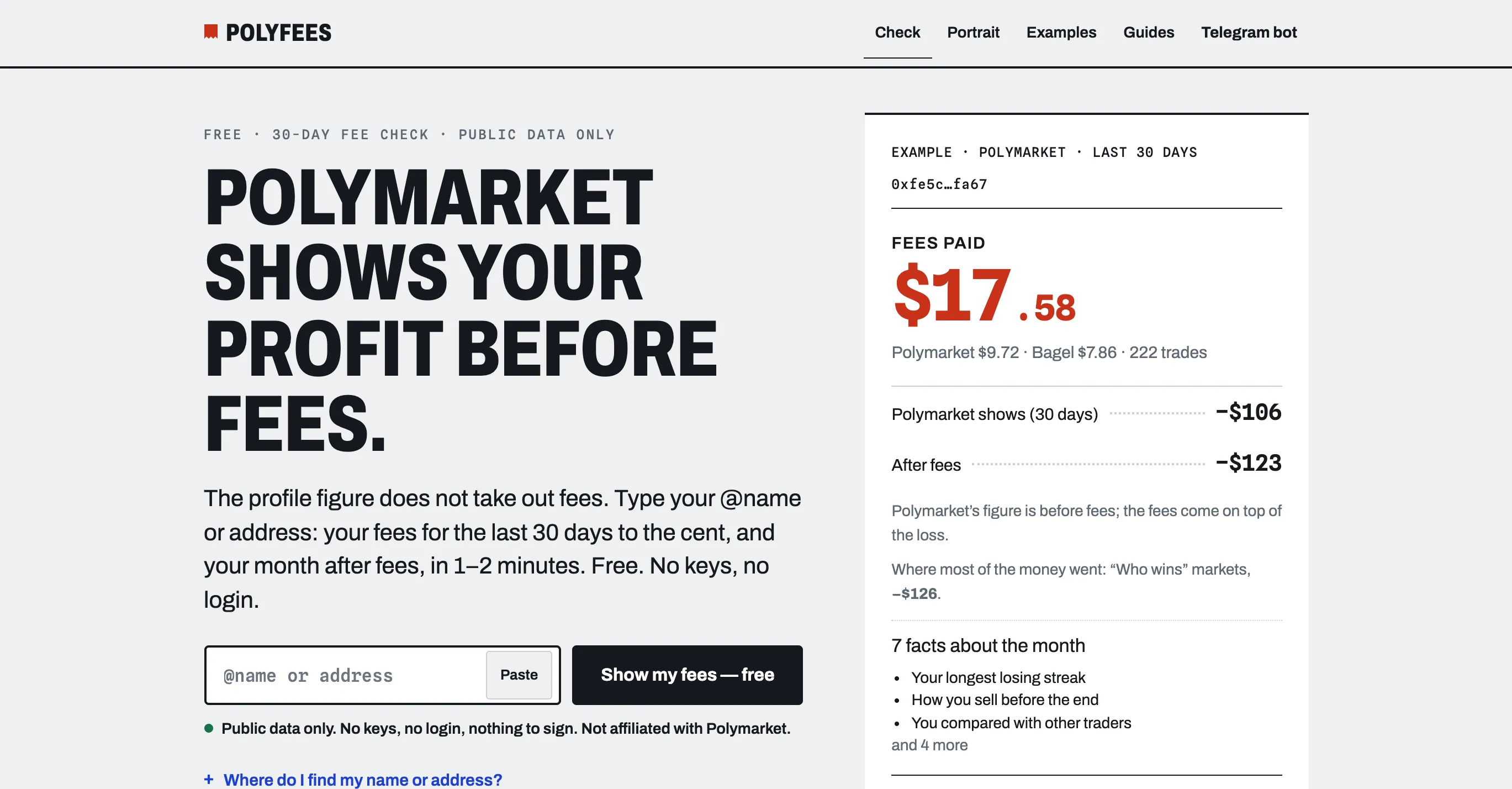
Free fee checker for Polymarket. Type a username or address and it adds up every fee the wallet paid over the last 30 days from the on-chain record of each trade, splits Polymarket's fee from the extra fee an app or bot charged on top, adds back the rebates P…
Compared with DomeAt a glance
| Fact | Dome | polyfees |
|---|---|---|
| Type | Trading platform | Trading platform |
| Category | Platforms & Tools | Platforms & Tools |
| Also listed in | — | Telegram, Sports Trading, Scalping |
| Pricing | Free | Free |
| Price | free sign-up | free |
| Risk rating | Medium risk | Medium risk |
| Markets | Polymarket, Kalshi, More platforms coming | All Polymarket markets |
| Source | Source not published | Source not published |
| Runs in Telegram | No | Yes |
| Listed since | Jul 3, 2026 | Nov 11, 2026 |
Highlighted rows differ
Key differences
- They cover different markets: Dome lists Polymarket and Kalshi and 1 more, polyfees lists All Polymarket markets.
- polyfees runs inside Telegram; Dome does not.
- Only polyfees is filed under Telegram and Sports Trading and 1 more.
- Dome has been listed since Jul 3, 2026; polyfees joined on Nov 11, 2026.
Choose Dome if…
- you trade Polymarket and Kalshi and 1 more
Choose polyfees if…
- you want it inside Telegram
- you trade All Polymarket markets
- your focus is Telegram and Sports Trading and 1 more
What Dome does
Prediction-market APIs and SDK for developers. One integration for Polymarket and Kalshi data — historical order books, real-time trade webhooks and WebSockets, and backtesting — via REST plus TypeScript and Python SDKs.
Features- Unified SDK for multiple prediction markets
- Historical order-book snapshots & pricing
- Real-time trades via webhooks & WebSockets
- Backtesting and market-analysis support
- REST API + TypeScript & Python SDKs
- Integrate once to pull data and execute across Polymarket and Kalshi.
- Access historical order books and pricing for research and backtesting.
- Stream real-time trades and market moves via webhooks and WebSockets.
What polyfees does
Free fee checker for Polymarket. Type a username or address and it adds up every fee the wallet paid over the last 30 days from the on-chain record of each trade, splits Polymarket's fee from the extra fee an app or bot charged on top, adds back the rebates Polymarket paid, and shows the month's profile result before and after fees. Wallets with 20 or more finished bets also get a “portrait” of a few facts about how they traded. A nightly table shows the fee each of the 112 apps with ten or more users adds to a trade, and a Telegram bot keeps up to five wallets and reminds you of uncollected winnings. There is no account, payment or wallet connection.
Features- 30-day fee total for any public wallet, read from each trade's on-chain record
- Polymarket's fee and the routing app's fee shown separately, with the app named
- Rebates, maker rewards and holding rewards added up for the same 30 days on their own line
- Month before and after fees, using Polymarket's own 30-day profile figure
- Trader portrait for wallets with 20+ finished bets, each fact marked with how far it can be trusted
- The app-fee table is the most useful page here and it lines up with Polymarket's data. It said 112 apps had ten or more users last month on Nov 11, 2026, and Polymarket's monthly builder leaderboard listed exactly 112 such builders that day; the user counts it gives differ by about 1%, which a rolling window would explain (polymtrade at 2,973 users against 3,002 on Polymarket). By its count 36 apps added nothing, and RedotPay, MetaMask and blockchain.com added 4% to every instant trade, on top of Polymarket's own fee.
- The method is set out plainly. Fees come from the fee field written into each trade on Polygon, which holds both Polymarket's part and the app's; polyfees works out Polymarket's part from the published formula and attributes the rest to the app named in the trade. The 30-day result is not its own: it quotes the figure from the Polymarket profile, which counts open positions at today's prices, and subtracts the fees. For very active wallets it reads only the latest 10,000 instant trades and says when that falls short of the month.
- The site's research claim, that pre-game prices on 34,065 sports and esports “who wins” markets between June and September 2026 were right almost everywhere, frames the product but is not something we checked. The portrait is careful in a way most wallet tools are not: each fact carries a note such as “this could still be chance”, facts with too few bets behind them are left out, and in-game and 5-minute trades are not judged against a reference price.
More head-to-heads
Every fact on this page is taken from the two listings as their authors publish them; POLBOTS verifies neither performance nor claims and has no stake in either tool. Nothing here is financial advice.