Dome vs PolyScope
Dome and PolyScope are both filed under Platforms & Tools. Both are trading platforms, and both are free. Below: the facts side by side, where the two actually differ, and when each one is the better pick.
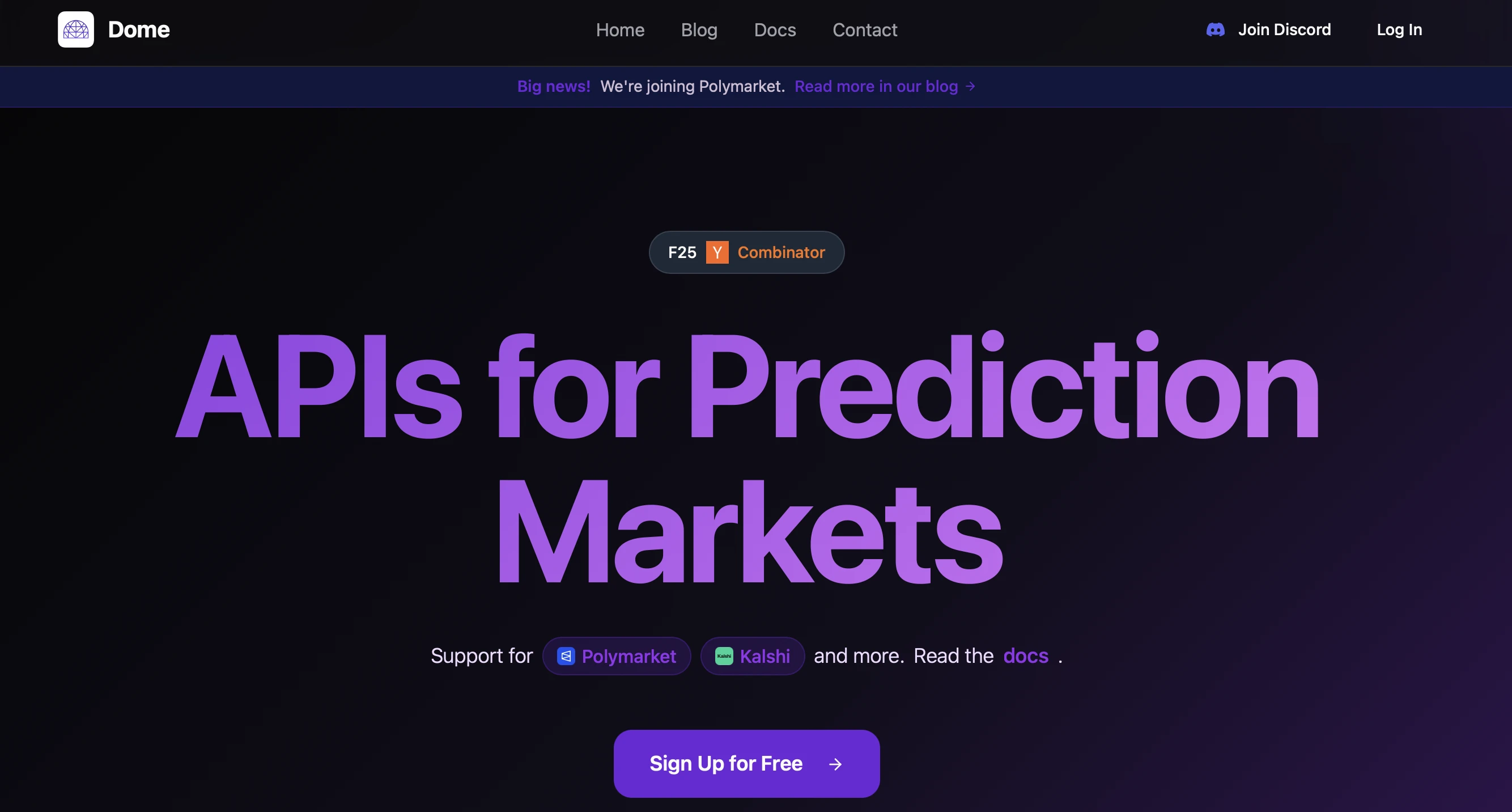
Prediction-market APIs and SDK for developers.
Compared with PolyScope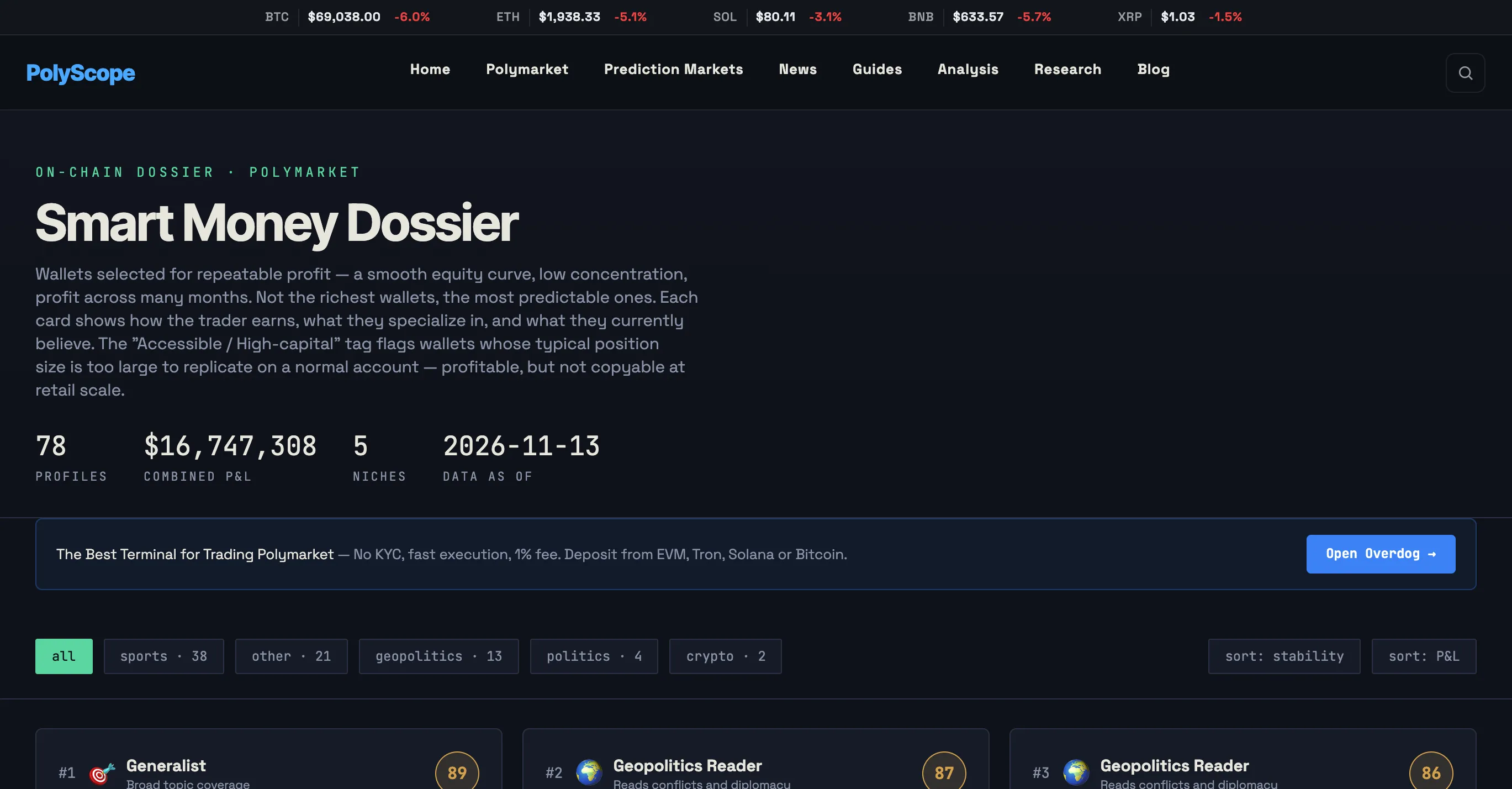
Free “Smart Money Dossier” on a Polymarket news and research site.
Compared with DomeAt a glance
| Fact | Dome | PolyScope |
|---|---|---|
| Type | Trading platform | Trading platform |
| Category | Platforms & Tools | Platforms & Tools |
| Also listed in | — | Copy Trading, Sports Trading, Politics & Elections, Crypto Markets, Sentiment / News |
| Pricing | Free | Free |
| Price | free sign-up | free |
| Risk rating | Medium risk | Medium risk |
| Markets | Polymarket, Kalshi, More platforms coming | All Polymarket markets |
| Source | Source not published | Source not published |
| Runs in Telegram | No | No |
| Listed since | Jul 3, 2026 | Nov 13, 2026 |
Highlighted rows differ
Key differences
- They cover different markets: Dome lists Polymarket and Kalshi and 1 more, PolyScope lists All Polymarket markets.
- Only PolyScope is filed under Copy Trading and Sports Trading and 3 more.
- Dome has been listed since Jul 3, 2026; PolyScope joined on Nov 13, 2026.
Choose Dome if…
- you trade Polymarket and Kalshi and 1 more
Choose PolyScope if…
- you trade All Polymarket markets
- your focus is Copy Trading and Sports Trading and 3 more
What Dome does
Prediction-market APIs and SDK for developers. One integration for Polymarket and Kalshi data — historical order books, real-time trade webhooks and WebSockets, and backtesting — via REST plus TypeScript and Python SDKs.
Features- Unified SDK for multiple prediction markets
- Historical order-book snapshots & pricing
- Real-time trades via webhooks & WebSockets
- Backtesting and market-analysis support
- REST API + TypeScript & Python SDKs
- Integrate once to pull data and execute across Polymarket and Kalshi.
- Access historical order books and pricing for research and backtesting.
- Stream real-time trades and market moves via webhooks and WebSockets.
What PolyScope does
Free “Smart Money Dossier” on a Polymarket news and research site. It picks 78 wallets for steady rather than large profit — a smooth equity curve, low concentration in a few markets, profit across many months — and shows each as a card with its niche (sports, geopolitics, politics, crypto or other), a stability score, its P&L, median position size, win rate, median return and share of profitable months, with a link to the full address. Cards flag wallets whose usual position is too big to copy on a normal account. Profiles are rebuilt overnight from Polymarket's data. There is no account, payment or alert; the site earns from referral links to the Overdog trading bot.
Features- 78 wallet profiles with combined P&L and a “data as of” date for the last rebuild
- Stability score and sorting by stability or P&L
- Filters by niche: sports, geopolitics, politics, crypto and other
- Per wallet: P&L, median position size, win rate, median ROI, concentration and share of profitable months
- “Accessible” or “High-capital” tag by median position size
- The selection idea is the right one for anyone thinking of copying: rank wallets by how evenly they made money, not by how much, and say outright which ones are too big to follow. The research page behind it describes cutting 512 profitable wallets to 314 and testing rules out of sample, and the about page promises limitations next to every result. Those are better habits than most wallet leaderboards show.
- The P&L figures are close to Polymarket's but not the same. On Nov 13, 2026 the top three cards showed $31,930, $30,537 and $332,175 of “true P&L”; Polymarket's all-time profit for the same addresses was $30,720, $30,056 and $279,484. The site does not define “true P&L”, so we cannot say which way the third, 19% apart, is right. Every card we saw showed a 100% win rate, and the “earns from” and “current conviction” fields were empty or “no open positions” on the cards we looked at, so for now the dossier tells you who did well, not what they hold.
- It is a free page on a content site, not a product with alerts or an API, and the commercial side is Overdog: a banner on the dossier and a review on the blog. The about page says referral links are marked rel="sponsored", and the disclaimer says the site is not affiliated with any platform it covers. Its editorial standards say it does not publish exact profit figures for traders it did not interview; the dossier, which publishes full addresses with exact P&L, does not follow that rule. A Polymarket builder named PolyScope with $548K of volume and 49 users appears in Polymarket's leaderboard; nothing on the site links to it.
More head-to-heads
Every fact on this page is taken from the two listings as their authors publish them; POLBOTS verifies neither performance nor claims and has no stake in either tool. Nothing here is financial advice.