Octagon vs Turbine
Octagon and Turbine are both filed under Platforms & Tools and Sentiment / News. Both are trading platforms, and both are paid. Below: the facts side by side, where the two actually differ, and when each one is the better pick.
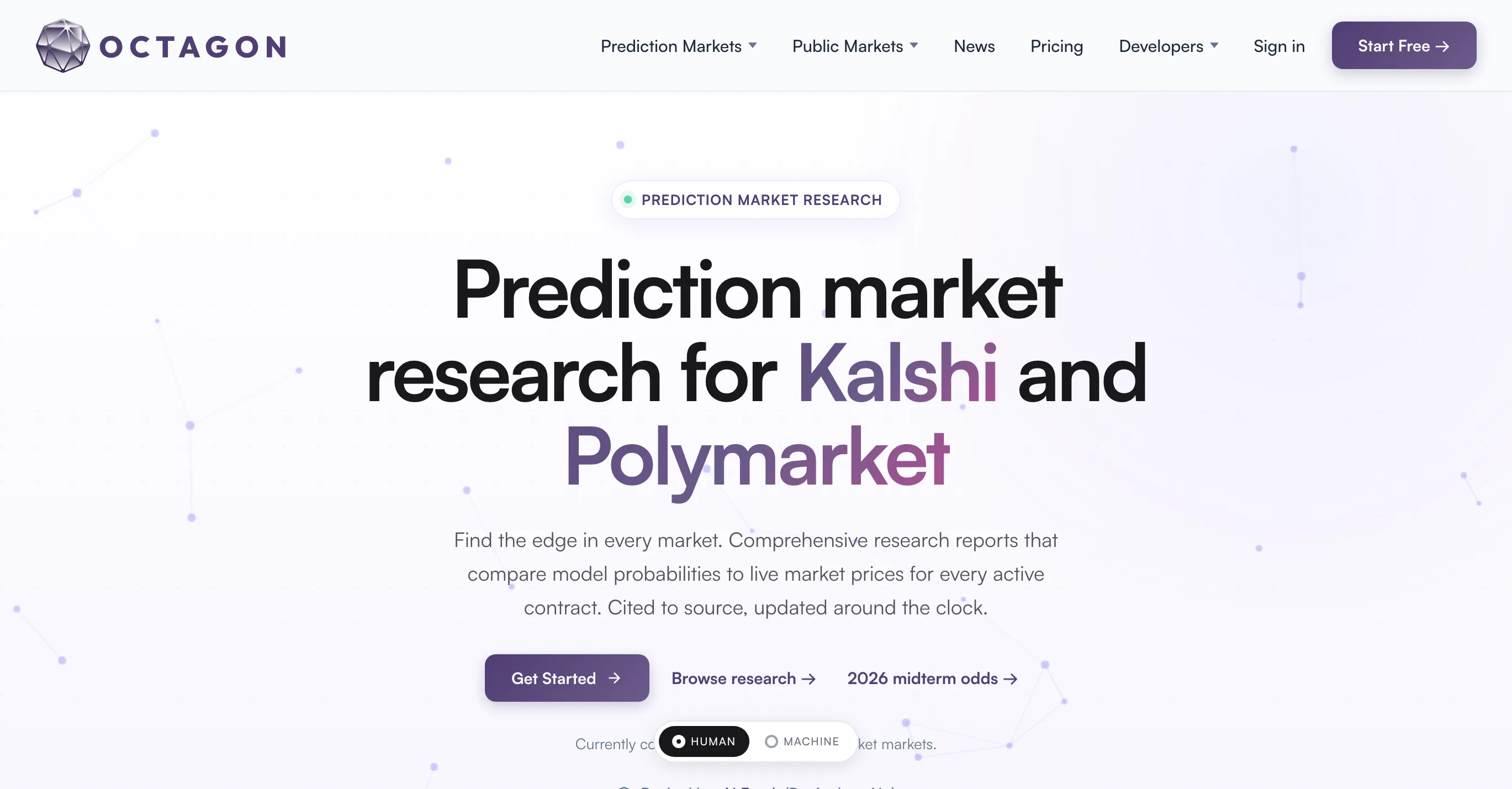
AI research for Kalshi and Polymarket, with an open-source command-line client that trades on Kalshi.
Compared with Turbine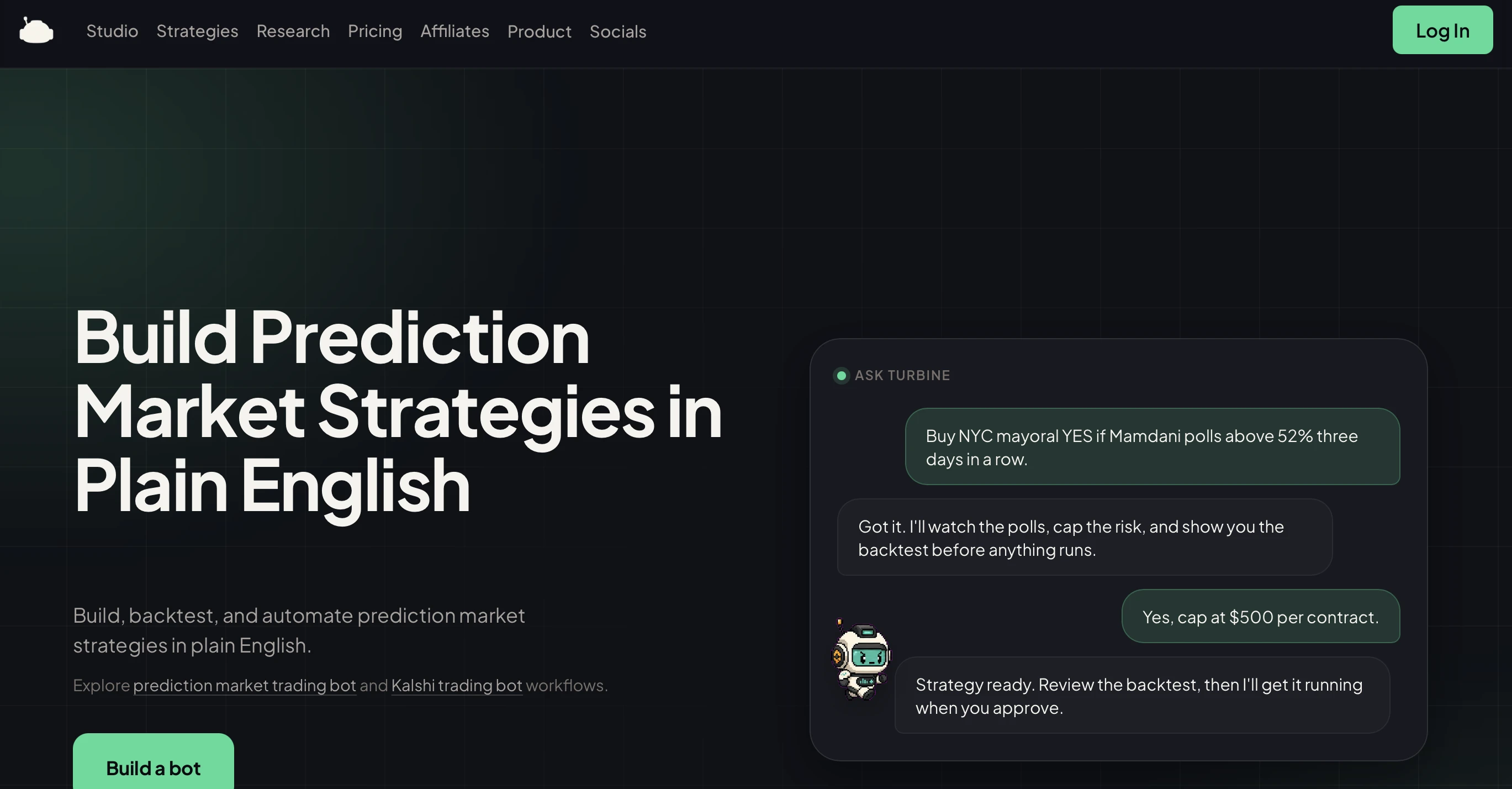
Build, backtest and deploy automated prediction-market strategies in plain English — no code.
Compared with OctagonAt a glance
| Fact | Octagon | Turbine |
|---|---|---|
| Type | Trading platform | Trading platform |
| Category | Platforms & Tools | Platforms & Tools |
| Also listed in | Sentiment / News | Sentiment / News, Momentum |
| Pricing | Paid | Paid |
| Price | free reports · from $17/mo | Basic $99/mo · Pro $299/mo |
| Risk rating | Medium risk | Medium risk |
| Markets | Kalshi — research reports, plus trading through the CLI and Polymarket — research reports | Kalshi, Polymarket, Prediction markets |
| Source | Source not published | Source not published |
| Runs in Telegram | No | No |
| Listed since | Oct 1, 2026 | Jul 3, 2026 |
Highlighted rows differ
Key differences
- Both are paid, but on different terms: Octagon is free reports · from $17/mo, Turbine is Basic $99/mo · Pro $299/mo.
- They cover different markets: Octagon lists Kalshi — research reports, plus trading through the CLI and Polymarket — research reports, Turbine lists Kalshi and Polymarket and 1 more.
- Only Turbine is filed under Momentum.
- Turbine has been listed since Jul 3, 2026; Octagon joined on Oct 1, 2026.
Choose Octagon if…
- you trade Kalshi — research reports, plus trading through the CLI and Polymarket — research reports
Choose Turbine if…
- you trade Kalshi and Polymarket and 1 more
- your focus is Momentum
What Octagon does
AI research for Kalshi and Polymarket, with an open-source command-line client that trades on Kalshi. For every active contract Octagon publishes a research report that sets its model's probability against the live price — a short answer, the drivers behind recent moves, cited sources, a price chart and past resolutions — and the reports are free to read on the site. Subscribers get the same engine through an API, an MCP server and the Kalshi Trading Bot CLI: an MIT-licensed terminal app that runs deep research on a market, computes the gap between model and book, sizes it at half-Kelly through a five-gate risk check and places the order from your own Kalshi account. Octagon AI Inc. was founded in 2023 by Ken So and says it is backed by AI Fund, Andrew Ng's venture firm.
Features- A free research report for every active contract: model probability against the live price, a short answer, price drivers, cited sources and past resolutions
- Kalshi Trading Bot CLI — open source (MIT), runs on Bun: deep research per market, edge as model minus book, half-Kelly sizing, a five-gate risk check before any order
- Orders go out from your own Kalshi account, with the API key and RSA key kept in a local file; a Kalshi demo mode trades without real money
- Research API, MCP server and agent SDK on the same credits
- Bring your own model: OpenAI by default, or Anthropic, Google, xAI, OpenRouter or a local Ollama
- This is research with an execution arm, not a strategy with a record. The CLI trades when Octagon's probability and the live book disagree by enough to clear its gates, and nothing on the site or in the repo publishes the results of trading that way. Reports can also agree with the market: the one we opened, on weekly US gas prices, concluded that the model and the price expected the same bracket and there was nothing to trade.
- Reports are generated, not edited. Each carries the line “Generated by Octagon's research engine from live market data and the cited sources. Not individually reviewed unless a reviewer is named”, and the gas-price report we read was last updated Aug 18 for a contract that expired Aug 24 — check the update date before acting on one.
- The CLI is real code: 278 commits from three contributors, 1.6 MB of TypeScript, MIT-licensed, last pushed Sep 30, 2026. It signs Kalshi requests with RSA-PSS from your own key file and sends market questions to api.octagonai.co for the research. It also reports anonymous usage events to Statsig by default — command names, the side of a trade, the model in use, never keys, tickers or sizes — and TELEMETRY_ENABLED=false in the .env switches that off.
What Turbine does
Build, backtest and deploy automated prediction-market strategies in plain English — no code. Describe a strategy, Turbine writes the rules, backtests them on 30 days of market data with fees and bid/ask modeled, then runs it 24/7 in a cloud sandbox. Covers Kalshi and Polymarket.
Features- Describe strategies in plain English — no code
- 30-day backtests with fees and bid/ask modeled
- 24/7 cloud execution in isolated sandboxes
- Read and edit all generated strategy logic
- Six templates: mean reversion, momentum fade, news reaction & more
- Turns a plain-English description into executable strategy rules.
- Backtests on 30 days of Kalshi/Polymarket data with realistic fills.
- Deploys winning strategies to run around the clock in the cloud.
More head-to-heads
Every fact on this page is taken from the two listings as their authors publish them; POLBOTS verifies neither performance nor claims and has no stake in either tool. Nothing here is financial advice.