OddsFantasy vs polymarket-tennis
OddsFantasy and polymarket-tennis are both filed under Sports Trading and Platforms & Tools. OddsFantasy is an automated bot that is free to use with a per-trade fee; polymarket-tennis is a trading platform that is free. Below: the facts side by side, where the two actually differ, and when each one is the better pick.
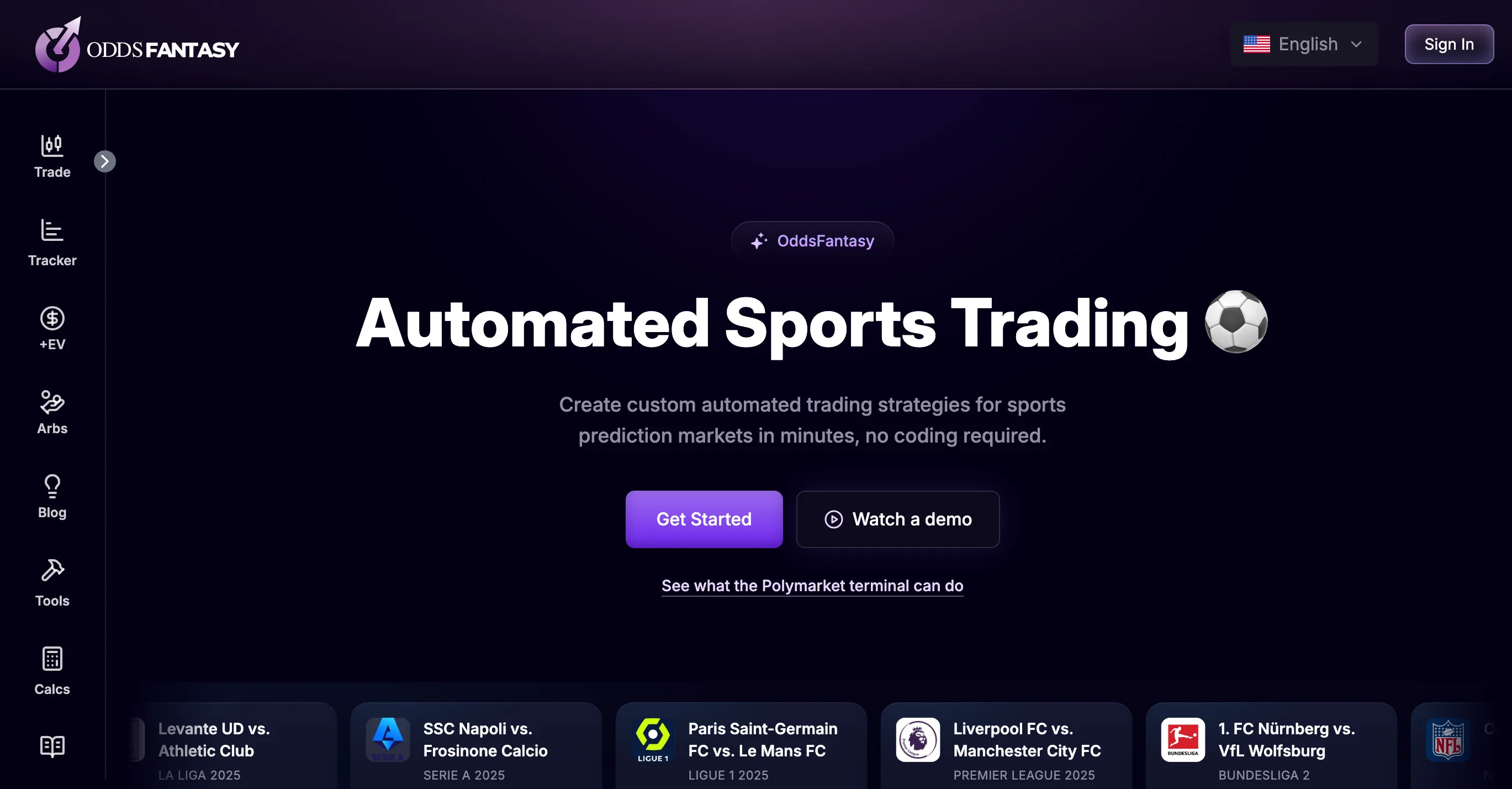
Trading terminal for Polymarket's sports markets that adds the orders Polymarket lacks — take-profit and stop-loss, closes scheduled for kickoff, two-sided quotes — and runs no-code entry and exit rules for you.
Compared with polymarket-tennis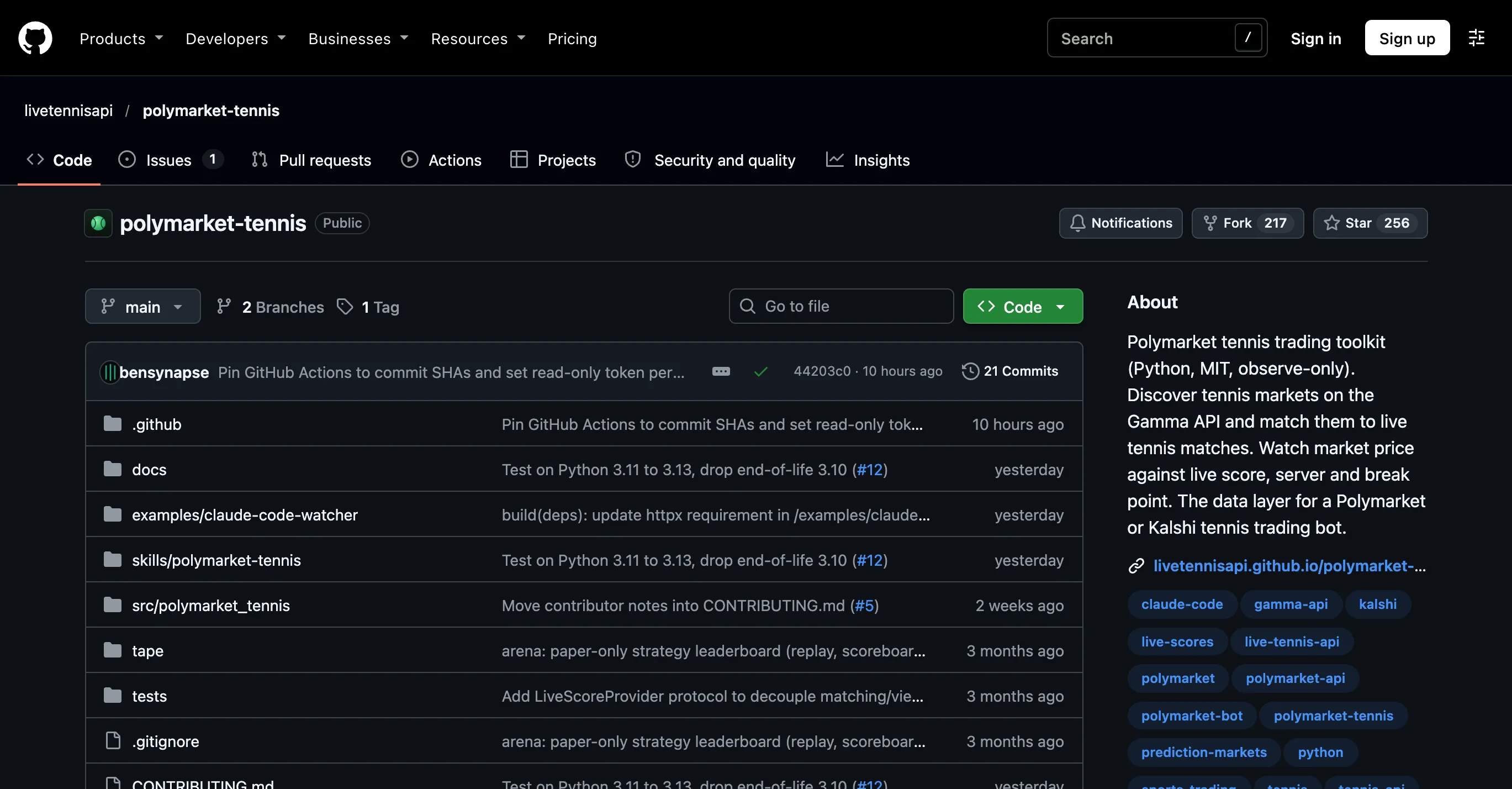
Open-source Python toolkit that lines up Polymarket's tennis markets with the matches they are about.
Compared with OddsFantasyAt a glance
| Fact | OddsFantasy | polymarket-tennis |
|---|---|---|
| Type | Automated bot | Trading platform |
| Category | Sports Trading | Sports Trading |
| Also listed in | Platforms & Tools, Arbitrage | Platforms & Tools |
| Pricing | Free to use, fee per trade | Free |
| Price | free · 1% fee per taker fill · $80/30 days | free · MIT |
| Risk rating | High risk | Low risk |
| Markets | Polymarket sports: football, American football, basketball, baseball, ice hockey, tennis, cricket, MMA, boxing, esports, golf, motorsports, rugby, darts, cycling and chess, Money line, handicap, totals, both teams to score, exact score, halves, corners and player or team props, pre-match and in-play, Bookmaker prices behind the +EV and arbitrage finders: Pinnacle as the fair-price reference, plus 1xBet, Bet365, Betano, Stake, SportyBet and five other books | Polymarket tennis markets: ATP, WTA, Challenger and ITF match winners, set winners, game totals and futures |
| Source | Source not published | Open-source |
| Runs in Telegram | No | No |
| Listed since | Oct 10, 2026 | Nov 9, 2026 |
Highlighted rows differ
Key differences
- OddsFantasy is an automated bot that places orders for you; polymarket-tennis is a manual platform — you decide every trade.
- OddsFantasy is free to use with a per-trade fee (free · 1% fee per taker fill · $80/30 days); polymarket-tennis is free (free · MIT).
- They cover different markets: OddsFantasy lists Polymarket sports: football, American football, basketball, baseball, ice hockey, tennis, cricket, MMA, boxing, esports, golf, motorsports, rugby, darts, cycling and chess and Money line, handicap, totals, both teams to score, exact score, halves, corners and player or team props, pre-match and in-play and 1 more, polymarket-tennis lists Polymarket tennis markets: ATP, WTA, Challenger and ITF match winners, set winners, game totals and futures.
- OddsFantasy does not publish its source; polymarket-tennis publishes its code under an open-source licence.
- OddsFantasy is rated high risk, polymarket-tennis low risk.
- Only OddsFantasy is filed under Arbitrage.
Choose OddsFantasy if…
- you want the trading automated rather than done by hand
- you trade Polymarket sports: football, American football, basketball, baseball, ice hockey, tennis, cricket, MMA, boxing, esports, golf, motorsports, rugby, darts, cycling and chess and Money line, handicap, totals, both teams to score, exact score, halves, corners and player or team props, pre-match and in-play and 1 more
- your focus is Arbitrage
Choose polymarket-tennis if…
- you want to start without paying
- you want to read — and keep running — the code yourself
- you want to stay in control of every order
- you trade Polymarket tennis markets: ATP, WTA, Challenger and ITF match winners, set winners, game totals and futures
What OddsFantasy does
Trading terminal for Polymarket's sports markets that adds the orders Polymarket lacks — take-profit and stop-loss, closes scheduled for kickoff, two-sided quotes — and runs no-code entry and exit rules for you. It grew out of a +EV and arbitrage toolkit for bookmakers, and the paid plan is still built around that: a finder that strips the margin from Pinnacle's odds to get a fair price, flags bookmaker and Polymarket prices above it and can buy the Polymarket ones for you within your limits. You sign in by email and trade from a Magic wallet, with gas paid by Polymarket's relayer. The site calls the terminal free; fills from it pay OddsFantasy a builder fee of 1% as a taker and 0.5% as a maker, and the +EV and arbitrage finders take the Classic plan, $80 for 30 days.
Features- Every Polymarket sports event on one screen: a sports bar, pre-match and live lists, search, and sorting and filters by date, volume and depth
- Trade window with candlestick or line charts, the live order book and the spread, and four order types: market with take-profit and stop-loss, limit with an expiry, quote — both sides at once, sized from your capital and target profit — and split
- Exits by market, by limit at your odds or at a set time such as just before kickoff; scheduled closes can be moved or cancelled from the Orders page
- Positions marked by exposure — red uncovered, yellow covered once a resting order fills, green fully offset — with one-click merging of opposite shares and redemption of settled ones
- Entry presets without code: odds band, spread, traded volume, book depth, a one-day reading of whether the odds are drifting out or shortening, and a stake per match; preview what passes, then run it now or on a schedule set around kickoff, before or during the match
- Free to use, not free to trade. The terminal page says placing and closing orders costs nothing, and the Terms speak of a 0.5% trading fee. Polymarket's public builder-fee registry — the rate the exchange applies when an order fills — lists OddsFantasy's code at 1% of each taker fill and 0.5% of each maker fill, the highest rates Polymarket allows, on top of Polymarket's own sports taker fee of 2.5% of the price at 50¢. A market order at 50¢ therefore starts about 3.5% behind; a resting order, 0.5%. The vendor's own blog works out that a 3% edge at 50¢ is worth about 0.5% after Polymarket's fee; with the terminal's 1% on top, the same entry at market loses money. The +EV automation enters with a resting order by default, which keeps the cost at 0.5%; switching it to market entry raises the bar.
- The idea behind the +EV side is argued in the vendor's own research, which is more candid than most. An Oct 8, 2026 post rebuilds 262 cycles of a two-sided spread preset traded with real money from Sep 14 to 26: −$17.40 in all, because only 59% of first fills were followed by the second when about 95% were needed to break even, and sharp wallets were about nine times more common among the takers who filled its quotes than in the market at large. Its conclusion is the product's premise — quote or buy only against an outside fair price, such as Pinnacle's odds with the margin removed, and judge the result by closing-line value rather than profit. The post names no wallet, so we could not recheck its figures.
- Usage is small. Polymarket's builders Data API lists OddsFantasy as a verified builder from Jan 16, 2026, with $19,509 traded through it by Oct 10, 2026 — $5,818 of it in September, the last on Oct 5 — and never more than five active accounts in a day, one or two a day since mid-September. What the terminal shows is Polymarket's own market: 48 of 48 outcome prices across the 20 events on its home page matched the prices Polymarket's API gave for the same markets when we checked on Oct 10. That record limits what the marketing can mean. A blog post and video from Oct 3 present an Over 2.5 goals preset with a 90% win rate and “about $2,300 profit in two months” at about 20% a trade; everything traded through OddsFantasy in August and September came to $9,765, buys and sells together, across all users — less than that profit would need in stakes alone. No wallet is named. The vendor asked for no performance figure on this listing, and it shows none.
What polymarket-tennis does
Open-source Python toolkit that lines up Polymarket's tennis markets with the matches they are about. It lists open tennis markets from Polymarket's public Gamma API, pairs each one with a live match or fixture and refuses to guess when the pairing is ambiguous, then prints the market price next to the score, the server and a break-point flag, with the age of each feed. It never places orders and holds no wallet or key; it is a data layer for a bot you write yourself. The scores come from Live Tennis API, the paid service of the same team, whose free key allows 100 requests a day. MIT-licensed at github.com/livetennisapi/polymarket-tennis.
Features- Finds open tennis markets through Polymarket's Gamma API, filtered to match markets and moneylines
- Pairs each market with a live match by player names and date, handling reversed order, accents and shared surnames
- Returns nothing rather than a guess when two candidates are close, only one player agrees or the date is off by more than a day
- One snapshot per market: both outcome prices beside the score line, the server, a break-point flag and the age of each feed
- pmtennis command line for discover, match and watch, and the same functions as a Python library
- The code does what it says, and it says honestly what it is not. The README discloses that the toolkit is written by the team selling the score feed and calls it “vendor-authored tooling”, and the boundary is plain: no order code, no wallet, no keys, and an arena whose rules state that a paper rank says nothing about real trading, where fees, fills and latency exist. The hard part it solves is the identity problem, deciding which live match a market is about, and the matching rules are written out and covered by tests. Its own budget table is candid too: watching once a minute spends one request a poll, so the free key lasts about 100 minutes a day.
- The popularity is not what it looks like. On Nov 9, 2026 the repo showed 256 stars and 217 forks, while the organisation's 29 other repositories had between none and two stars each. Of the 294 forks GitHub listed, all but two were made between Aug 18 and Aug 31, 2026, in daily bursts of up to 72, and 77 of their owners' accounts no longer exist; those still up mostly carry generated names such as a person's name with a number and a suffix. The two issues that prompted a code change came from accounts of the same kind. The package had 40 downloads from PyPI in the month to Nov 9. We read this as a paid boost, not a user base, and the star count should be ignored.
- Read it as a well-made sample for a data product. Everything past the snapshot, deciding when to trade and placing the order, is left to you, and a live strategy would need a faster score feed than the free tier, which is where the paid plans come in. The arena's first season was the 2026 US Open; the repo and its site publish no results as of Nov 9, 2026.
More head-to-heads
Every fact on this page is taken from the two listings as their authors publish them; POLBOTS verifies neither performance nor claims and has no stake in either tool. Nothing here is financial advice.