PMWallets vs PolyScope
PMWallets and PolyScope are both filed under Platforms & Tools and Copy Trading. Both are trading platforms; PMWallets is paid, PolyScope is free. Below: the facts side by side, where the two actually differ, and when each one is the better pick.
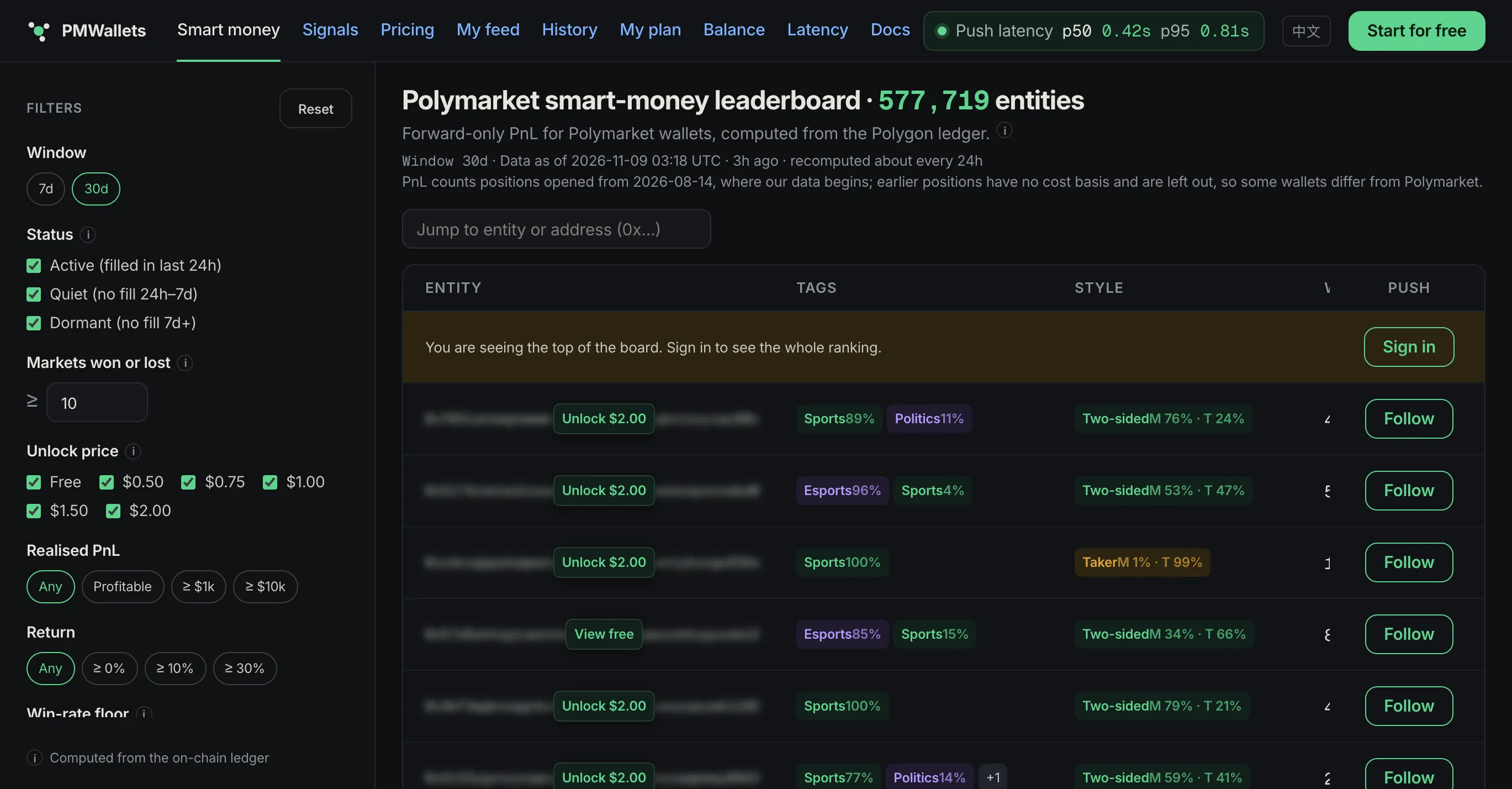
Polymarket wallet leaderboard computed from the Polygon chain rather than Polymarket's API.
Compared with PolyScope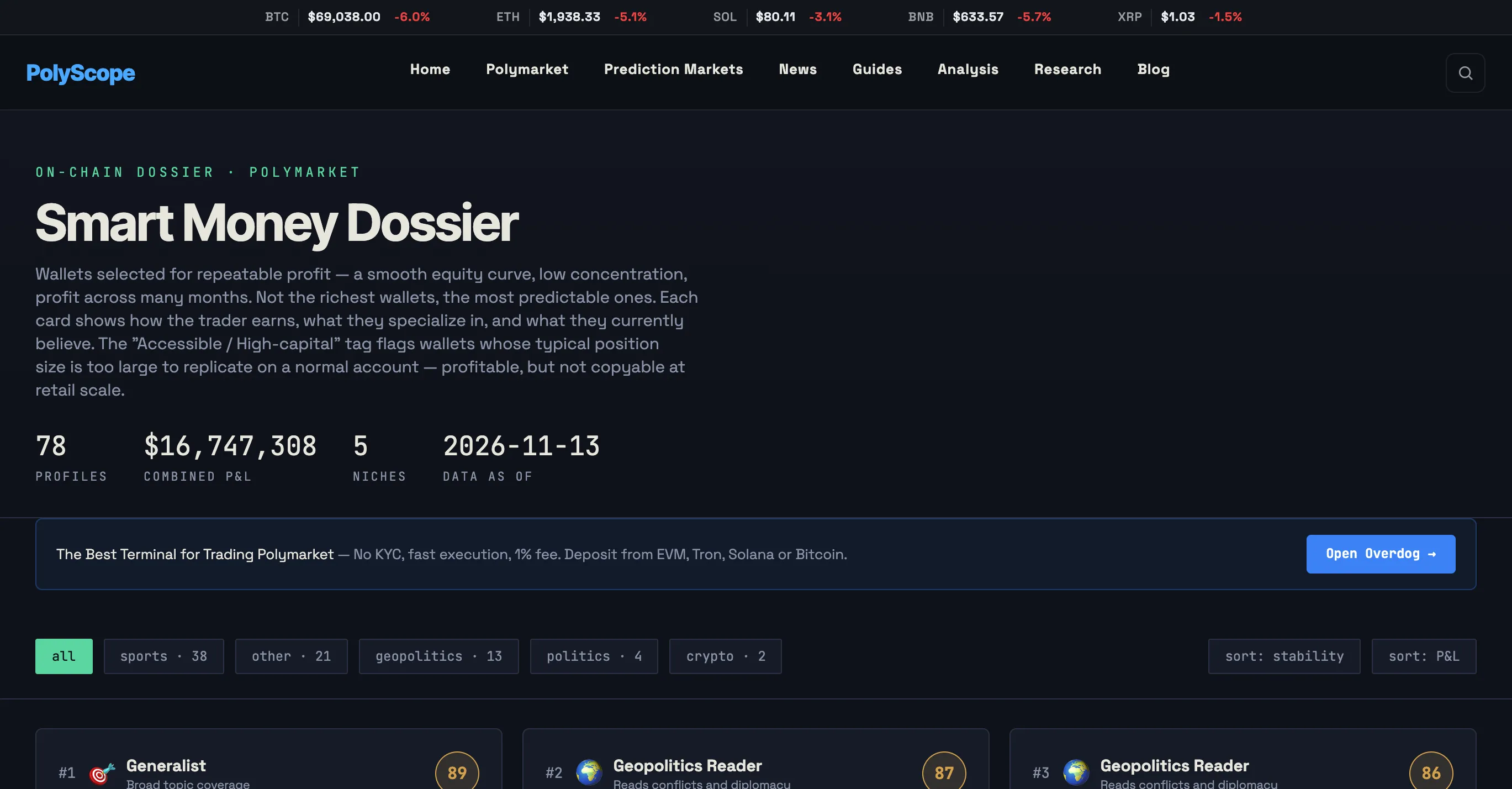
Free “Smart Money Dossier” on a Polymarket news and research site.
Compared with PMWalletsAt a glance
| Fact | PMWallets | PolyScope |
|---|---|---|
| Type | Trading platform | Trading platform |
| Category | Platforms & Tools | Platforms & Tools |
| Also listed in | Copy Trading | Copy Trading, Sports Trading, Politics & Elections, Crypto Markets, Sentiment / News |
| Pricing | Paid | Free |
| Price | from $4.99/mo | free |
| Risk rating | Medium risk | Medium risk |
| Markets | All Polymarket markets | All Polymarket markets |
| Source | Source not published | Source not published |
| Runs in Telegram | No | No |
| Listed since | Nov 9, 2026 | Nov 13, 2026 |
Highlighted rows differ
Key differences
- PMWallets is paid (from $4.99/mo); PolyScope is free (free).
- Only PolyScope is filed under Sports Trading and Politics & Elections and 2 more.
Choose PMWallets if…
On the published facts there is no clear-cut case either way — it comes down to the product. Read the description below and try PMWallets before funding it.
Choose PolyScope if…
- you want to start without paying
- your focus is Sports Trading and Politics & Elections and 2 more
What PMWallets does
Polymarket wallet leaderboard computed from the Polygon chain rather than Polymarket's API. It groups each trader's addresses into one entity, ranks them over 7 or 30 days by realized profit, and shows win rates with a 95% confidence interval and profit with the single best market removed. Addresses are masked until unlocked for $0.50 to $2 each, and you can follow an entity to get its fills over WebSocket or webhook within about a second of the block. A free account gives the whole board; plans cost $4.99 to $39.99 a month, and the feed can also be paid by the hour. The SDKs and a copy-trading bot are open source and run on your own machine.
Features- Leaderboard of 577,719 entities over 7 or 30 days, rebuilt from Polygon fills, splits, merges, redemptions and resolutions
- Signer and proxy addresses, and wallets shown to trade as one, merged into a single entity
- Win rate with its 95% confidence interval, and a filter on the interval's lower bound
- Profit without the single best market, and unrealized value kept apart from realized
- Filters by category, maker or taker style, fills, volume and activity
- The method is more careful than most leaderboards in this catalog. Win rates come with a confidence interval, so three wins out of three is not shown as a 100% trader; profit is also shown without the best single market, which separates one lucky call from a pattern; and each run scores a fixed block window and is never rewritten. The about page says plainly that a profitable wallet may have been lucky or may have had information you do not.
- The record behind it is short. The board says its data begins on Aug 14, 2026, and positions opened earlier have no cost basis and are left out, so its figures can differ from Polymarket's. Its 30-day leader showed +$6.3 million, where Polymarket's own monthly profit leaderboard was led by +$4.7 million on Nov 9, 2026; the difference may come from grouping addresses or from the window, and we could not compare the two directly because the addresses are masked until paid for. The domain was registered on Sep 17, 2026.
- The speed claim is real but narrower than it looks. The latency page reported 414,928 fills pushed in 30 days at a median of 0.35 s and a p95 of 0.83 s, measured from receiving the block to sending the fill. That clock starts after the trade is already on-chain, so a follower acting on the feed is still at least a block behind the trader and pays whatever the price has become. The SDKs, copy-trading bots and extension were published on GitHub under the MIT licence on Sep 24, 2026, and had no stars when we looked.
What PolyScope does
Free “Smart Money Dossier” on a Polymarket news and research site. It picks 78 wallets for steady rather than large profit — a smooth equity curve, low concentration in a few markets, profit across many months — and shows each as a card with its niche (sports, geopolitics, politics, crypto or other), a stability score, its P&L, median position size, win rate, median return and share of profitable months, with a link to the full address. Cards flag wallets whose usual position is too big to copy on a normal account. Profiles are rebuilt overnight from Polymarket's data. There is no account, payment or alert; the site earns from referral links to the Overdog trading bot.
Features- 78 wallet profiles with combined P&L and a “data as of” date for the last rebuild
- Stability score and sorting by stability or P&L
- Filters by niche: sports, geopolitics, politics, crypto and other
- Per wallet: P&L, median position size, win rate, median ROI, concentration and share of profitable months
- “Accessible” or “High-capital” tag by median position size
- The selection idea is the right one for anyone thinking of copying: rank wallets by how evenly they made money, not by how much, and say outright which ones are too big to follow. The research page behind it describes cutting 512 profitable wallets to 314 and testing rules out of sample, and the about page promises limitations next to every result. Those are better habits than most wallet leaderboards show.
- The P&L figures are close to Polymarket's but not the same. On Nov 13, 2026 the top three cards showed $31,930, $30,537 and $332,175 of “true P&L”; Polymarket's all-time profit for the same addresses was $30,720, $30,056 and $279,484. The site does not define “true P&L”, so we cannot say which way the third, 19% apart, is right. Every card we saw showed a 100% win rate, and the “earns from” and “current conviction” fields were empty or “no open positions” on the cards we looked at, so for now the dossier tells you who did well, not what they hold.
- It is a free page on a content site, not a product with alerts or an API, and the commercial side is Overdog: a banner on the dossier and a review on the blog. The about page says referral links are marked rel="sponsored", and the disclaimer says the site is not affiliated with any platform it covers. Its editorial standards say it does not publish exact profit figures for traders it did not interview; the dossier, which publishes full addresses with exact P&L, does not follow that rule. A Polymarket builder named PolyScope with $548K of volume and 49 users appears in Polymarket's leaderboard; nothing on the site links to it.
More head-to-heads
Every fact on this page is taken from the two listings as their authors publish them; POLBOTS verifies neither performance nor claims and has no stake in either tool. Nothing here is financial advice.