blue.birds vs Uruguabot
blue.birds and Uruguabot are both filed under Crypto Markets. Both are automated bots, and both are paid. Below: the facts side by side, where the two actually differ, and when each one is the better pick.
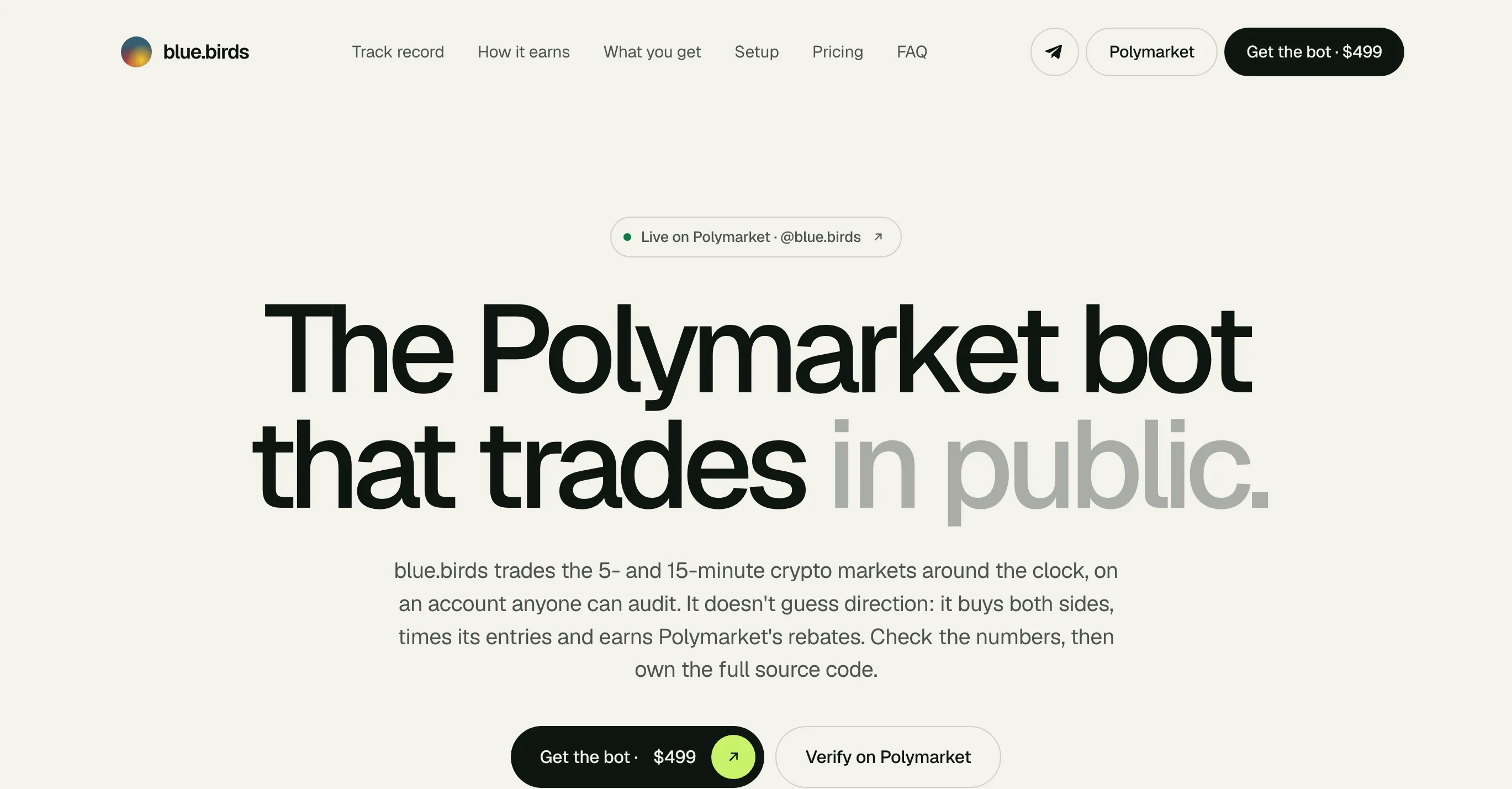
Self-hosted Python bot for Polymarket's 5- and 15-minute crypto Up or Down windows, sold as full source for $499 once and backed by the public Polymarket account its seller runs it on, @blue.birds.
Compared with Uruguabot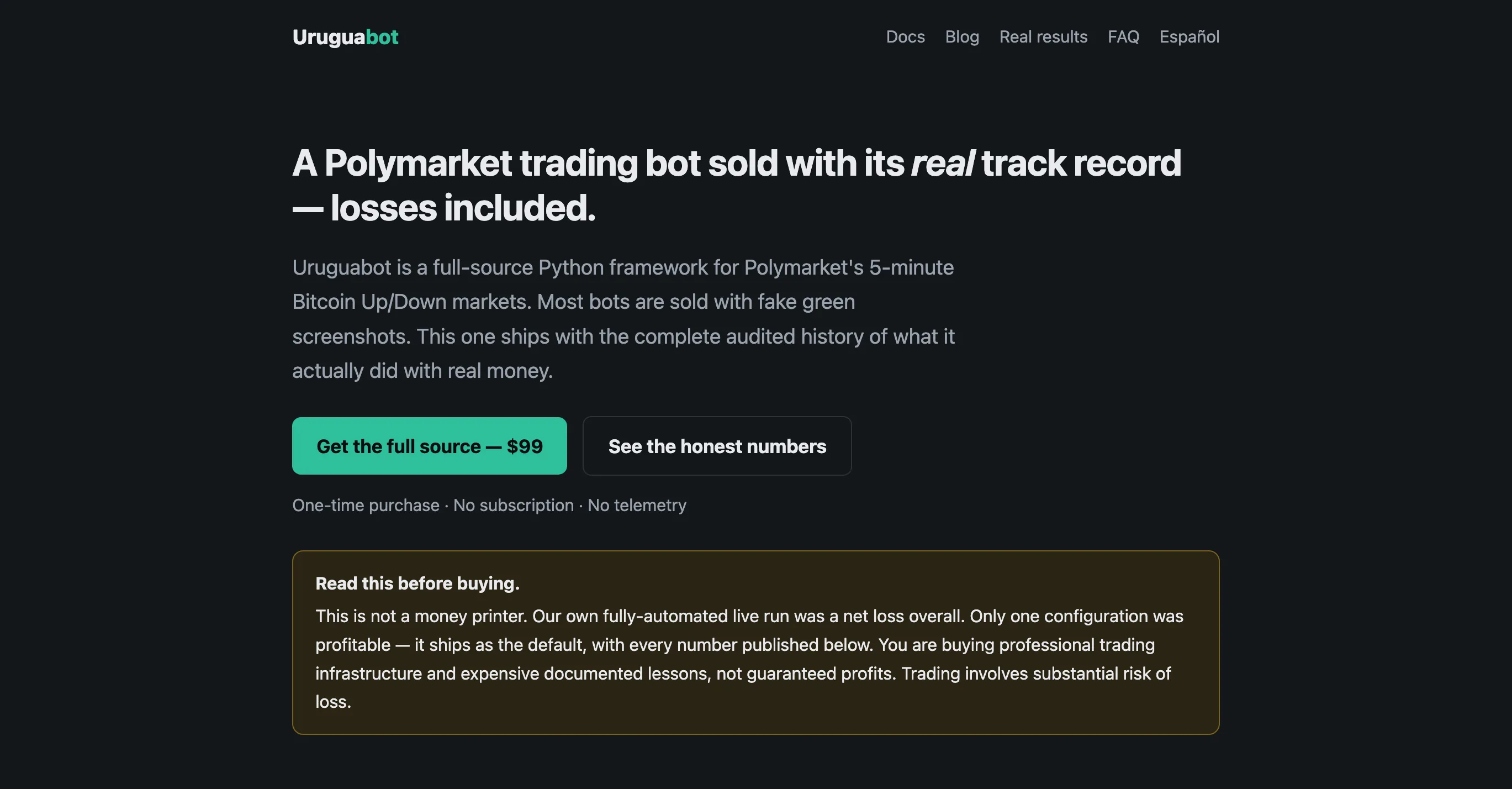
Uruguabot
Verified PartnerSelf-hosted Python bot for Polymarket's 5-minute BTC and ETH up/down markets, sold with its complete live trading record — losses included.
Compared with blue.birdsAt a glance
| Fact | blue.birds | Uruguabot |
|---|---|---|
| Type | Automated bot | Automated bot |
| Category | Crypto Markets | Crypto Markets |
| Also listed in | Scalping | Momentum |
| Pricing | Paid | Paid |
| Price | one-time | one-time |
| Risk rating | Low risk | High risk |
| Markets | BTC up/down · 5m, ETH up/down · 5m, SOL up/down · 5m and 1 more | BTC up/down · 5m, ETH up/down · 5m, BTC/ETH up/down · 15m (tested in gen 1) |
| Source | Source included with purchase | Source included with purchase |
| Runs in Telegram | No | No |
| Listed since | Nov 23, 2026 | Aug 20, 2026 |
Highlighted rows differ
Key differences
- Both list BTC up/down · 5m and ETH up/down · 5m; blue.birds adds SOL up/down · 5m and BTC up/down · 15m; Uruguabot adds BTC/ETH up/down · 15m (tested in gen 1).
- blue.birds is rated low risk, Uruguabot high risk.
- Only blue.birds is filed under Scalping, and only Uruguabot is filed under Momentum.
- Uruguabot has been listed since Aug 20, 2026; blue.birds joined on Nov 23, 2026.
Choose blue.birds if…
- you trade SOL up/down · 5m and BTC up/down · 15m
- you prefer the lower-risk profile (low vs high)
- your focus is Scalping
Choose Uruguabot if…
- you trade BTC/ETH up/down · 15m (tested in gen 1)
- your focus is Momentum
What blue.birds does
Self-hosted Python bot for Polymarket's 5- and 15-minute crypto Up or Down windows, sold as full source for $499 once and backed by the public Polymarket account its seller runs it on, @blue.birds. It does not predict direction: it buys both Up and Down through each window on Bitcoin, Ethereum and Solana, mostly at the ask with resting bids alongside, holds every position to settlement and redeems the winnings. On the account's own record, the timing of those buys roughly pays the taker fee and most of the net comes from Polymarket's fee rebates. Paper mode, a daily loss limit, an exposure cap and Telegram reports are built in, and the sale is capped at 15 copies.
Features- Full Python source, run on your own computer or VPS; the wallet key stays in a local .env file
- Buys both Up and Down across the whole window, mostly as taker orders with resting limit bids alongside; never sells, holds to settlement
- Paper mode: simulated orders against the live order book, settled with Polymarket's real results, with every fee charged and your own rebate tier applied
- Daily loss limit that cancels open orders, halts trading and messages you; exposure cap that pauses new buys
- Automatic redemption of winning shares after each window settles
- The account checks out. @blue.birds is Polymarket wallet 0xb958…f513, opened on Oct 4, 2026. On Nov 23 Polymarket's P&L feed had it at +$104,300 on the profile chart and $13.3 million traded over 40,166 predictions, with one red day in 50 on that chart, −$88 on Nov 20, and 42nd place on the month's Crypto leaderboard. The site's live panel reads these figures straight from Polymarket, and a five-second recording signed in to the account shows the same wallet from the owner's side.
- Read the top number the way the site tells you to: the profile chart is before taker fees and without rebates. After $96,200 of taker fees, trading alone is up $8,100, the figure Polymarket's all-time leaderboard credits it with. Rebates add $35,400, $26,700 of them for taker fills and $8,800 for resting orders, for a net of about +$43,500, or 0.33% of volume: about four-fifths of the profit is rebates. October and November so far each added roughly $21,000–23,000 of that net, and the deepest fall of the daily net curve was about $1,100.
- That result leans on size. The rebate share grows with 30-day volume, and @blue.birds now sits at Gold, 18% of taker fees back, on $971,000 of weighted volume; a small account starts at Bronze and gets 3%. At Bronze the same fills would have netted about $19,800 instead of $43,500, and a smaller account also sits further back in the queue for the resting bids. Run paper mode with your own tier before funding a wallet.
What Uruguabot does
Self-hosted Python bot for Polymarket's 5-minute BTC and ETH up/down markets, sold with its complete live trading record — losses included. A free GitHub repo publishes every fill from two generations of testing plus a 1,934-window study in which every automated signal scored roughly coin-flip against the human's 59%; the published numbers reproduce exactly from the raw CSVs, though the logs omit market ids, so the record is self-attested rather than on-chain verifiable. Both generations together lost about $270 — mostly execution and a since-fixed ghost-fill bug — while the configuration that ships as default closed its live run at +7.3% ROI on a 40% win rate over a small 25-trade sample: momentum entries, stop re-anchored to execution price minus 10¢, winners held to binary resolution. Dry-run is the default, with fills simulated from slippage measured on real trades; live mode takes two explicit flags and a dedicated wallet.
Features- Full Python source, one-time purchase, bilingual EN/ES docs
- Published trade-by-trade record on GitHub: 4,086 gen-1 trades, 97 live gen-2 fills, raw CSVs under CC BY 4.0
- Dry-run simulator calibrated with slippage distributions measured from real fills, not zero-friction backtests
- Ghost-fill detection via USDC balance delta with on-chain fallback — the bug it fixes cost more than the strategy earned
- Asymmetric exits: stop at execution minus 10¢, winners held to $1 resolution
- Enters on multi-timeframe momentum consensus (30s/1m/5m) with entry gates — but the published audit shows the edge came from exit asymmetry, not prediction accuracy.
- Cuts losers at execution price minus 10¢ and holds winners to binary resolution, so average wins run about 3× average losses at a 40% win rate.
- Simulates first by default using friction measured from its own real fills, then requires deliberate opt-in for live trading.
More head-to-heads
Every fact on this page is taken from the two listings as their authors publish them; POLBOTS verifies neither performance nor claims and has no stake in either tool. Nothing here is financial advice.