Bobot vs SpectralEdge
Bobot and SpectralEdge are both filed under Crypto Markets and Sentiment / News. Bobot is an automated bot that is priced on its own site; SpectralEdge is a trading platform that is free with paid plans. Below: the facts side by side, where the two actually differ, and when each one is the better pick.
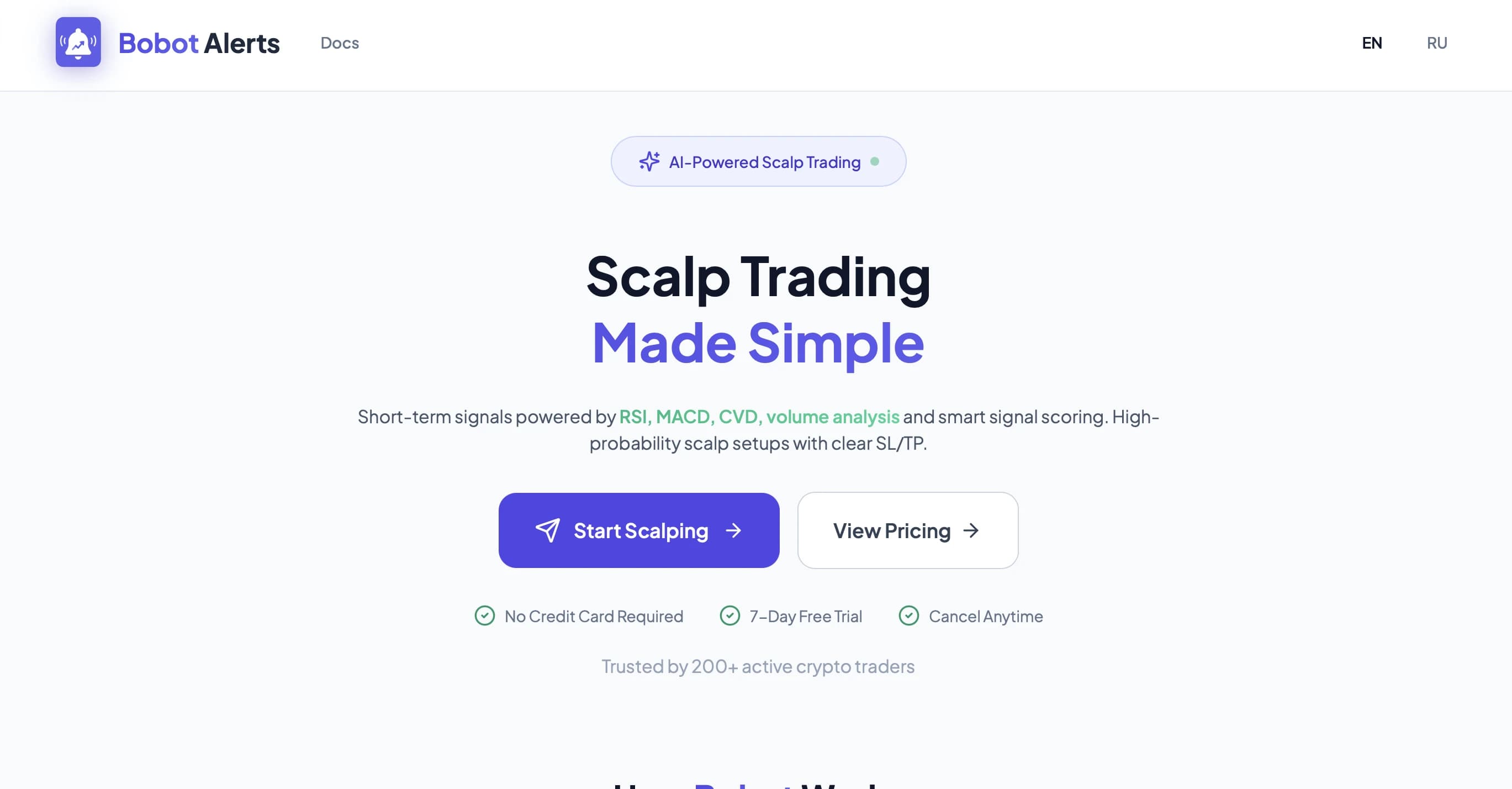
Polymarket trading bot focused on signal quality.
Compared with SpectralEdge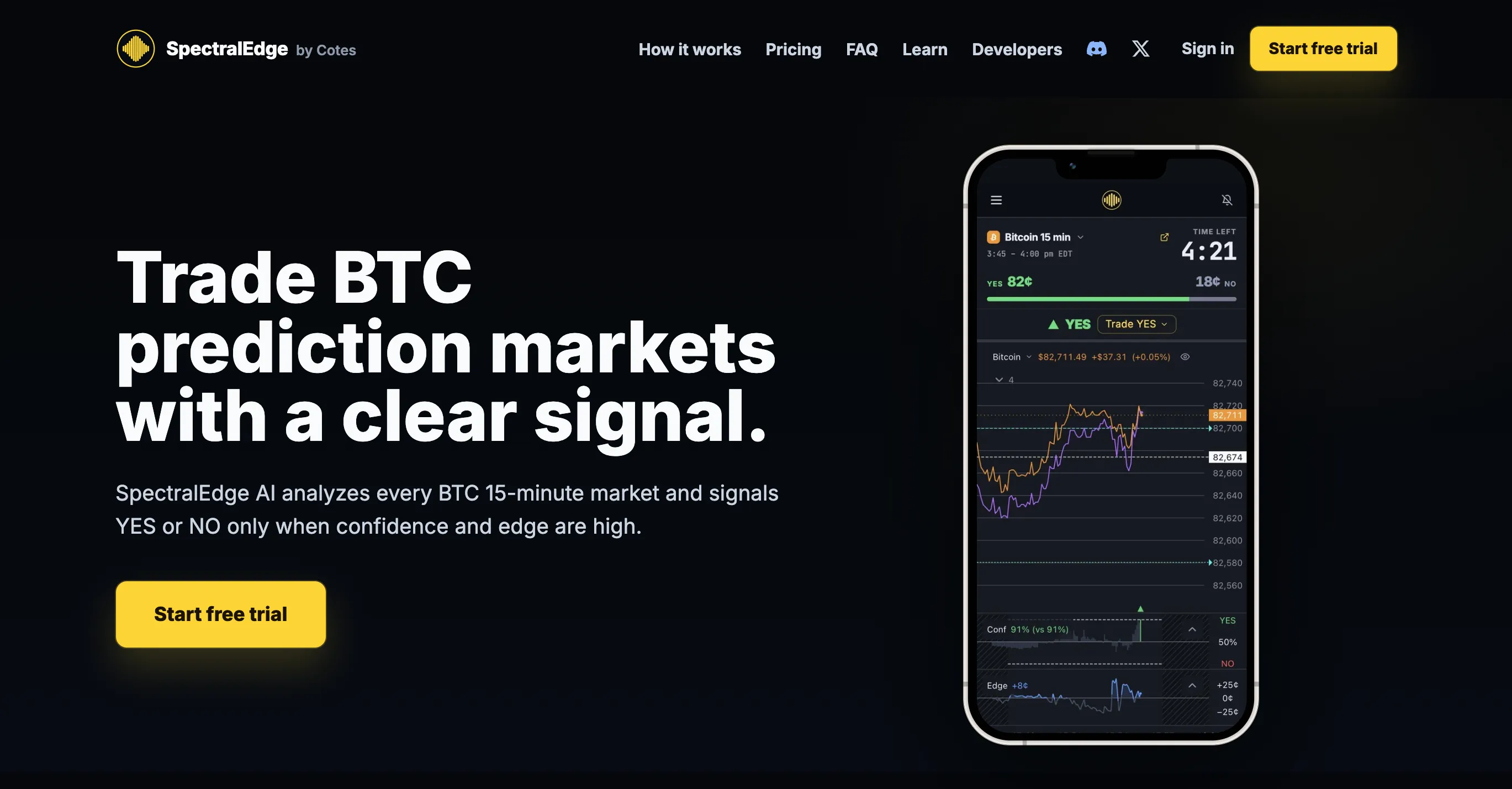
Signal service for Kalshi's Bitcoin 15-minute markets, from Cotes AI, Inc.
Compared with BobotAt a glance
| Fact | Bobot | SpectralEdge |
|---|---|---|
| Type | Automated bot | Trading platform |
| Category | Crypto Markets | Crypto Markets |
| Also listed in | Sentiment / News | Platforms & Tools, Sentiment / News |
| Pricing | Pricing on site | Free tier, paid plans |
| Price | see site | free trial · price undisclosed |
| Risk rating | Medium risk | Medium risk |
| Markets | Crypto markets, BTC / ETH up-down, Polymarket | Kalshi Bitcoin 15-minute markets (series KXBTC15M) |
| Source | Source not published | Source not published |
| Runs in Telegram | No | No |
| Listed since | Jul 3, 2026 | Nov 5, 2026 |
Highlighted rows differ
Key differences
- Bobot is an automated bot that places orders for you; SpectralEdge is a manual platform — you decide every trade.
- Bobot is priced on its own site; SpectralEdge is free with paid plans (free trial · price undisclosed).
- They cover different markets: Bobot lists Crypto markets and BTC / ETH up-down and 1 more, SpectralEdge lists Kalshi Bitcoin 15-minute markets (series KXBTC15M).
- Only SpectralEdge is filed under Platforms & Tools.
- Bobot has been listed since Jul 3, 2026; SpectralEdge joined on Nov 5, 2026.
Choose Bobot if…
- you want the trading automated rather than done by hand
- you trade Crypto markets and BTC / ETH up-down and 1 more
Choose SpectralEdge if…
- you want to start without paying
- you want to stay in control of every order
- you trade Kalshi Bitcoin 15-minute markets (series KXBTC15M)
- your focus is Platforms & Tools
What Bobot does
Polymarket trading bot focused on signal quality. Validates trading signals, filters out noise and explains why each alert fires — so you act on context rather than blindly following pings. Community top-voted among Polymarket bots.
Features- Trading signals for Polymarket
- Signal validation to cut noise
- Explains why each alert triggers
- Community top-voted bot tool
- Generates and validates trading signals for Polymarket markets.
- Filters out low-quality noise before an alert reaches you.
- Explains the reasoning behind each signal so you can act with context.
What SpectralEdge does
Signal service for Kalshi's Bitcoin 15-minute markets, from Cotes AI, Inc. Every 5 seconds a model re-reads each open market and calls YES or NO only when its calibrated confidence clears a fixed threshold and the price still leaves a minimum edge; about half of all markets get no signal. Each signal shows its side, confidence, entry price and edge, and is graded at settlement. You place trades yourself on Kalshi, and the service never connects to your account. The same feed is available as a JSON and streaming API. It starts with a free trial; the subscription price is not published.
Features- A fresh read of each market every 5 seconds, with confidence calibrated separately for each point in the market
- Signals carry side, confidence, entry price and estimated edge, and link straight to the Kalshi market
- Only the first signal in a market is scored, against Kalshi's settlement
- Public replays of the last ten settled markets, with no sign-up
- REST and Server-Sent Events API with graded settled history and an OpenAPI contract
- The headline is accuracy, and the company itself says accuracy alone proves nothing: its own guides explain that a 90¢ contract needs to win more than 90% of the time, and its notes for AI assistants ask that any win rate be quoted with the average entry price. It does not publish that average. Its public replay feed showed 1,220 wins and 199 losses over the trailing 30 days on Nov 5, 2026, or 86.0%, across about half of the markets in that period, in line with the 85.8% on the home page.
- The last ten markets in that feed give a first look at price. Seven drew a signal, all seven won, and they entered at 81¢ to 92.6¢, averaging about 88¢. All ten settlements matched Kalshi's public API. Seven signals are far too few to judge, but an 86% win rate at an 88¢ average entry would lose money even before Kalshi's fee, so the number to check is the average entry across the full history. Trial users can compute it from the API's entry price and outcome fields. The signal also has to be tradable: you act by hand, in a market that can reprice within a minute.
- The sample sizes vary from page to page: 15,000+ markets of out-of-sample validation, a backtest of 8,085 first signals at 88.5%, “Trained & tested on 7,654 markets” on the parent site, and more than 30,000 settled markets in a founder interview. They may describe different stages, but the site does not reconcile them. The backtest is simulated and carries the CFTC hypothetical-performance notice. “Physics-trained AI” here means decomposing Bitcoin's price into component waves, which the company says is covered by five provisional patent applications; we did not verify that.
More head-to-heads
Every fact on this page is taken from the two listings as their authors publish them; POLBOTS verifies neither performance nor claims and has no stake in either tool. Nothing here is financial advice.