PolyEdgeFinder vs SpectralEdge
PolyEdgeFinder and SpectralEdge are both filed under Crypto Markets and Platforms & Tools and 1 more. Both are trading platforms; PolyEdgeFinder is free, SpectralEdge is free with paid plans. Below: the facts side by side, where the two actually differ, and when each one is the better pick.
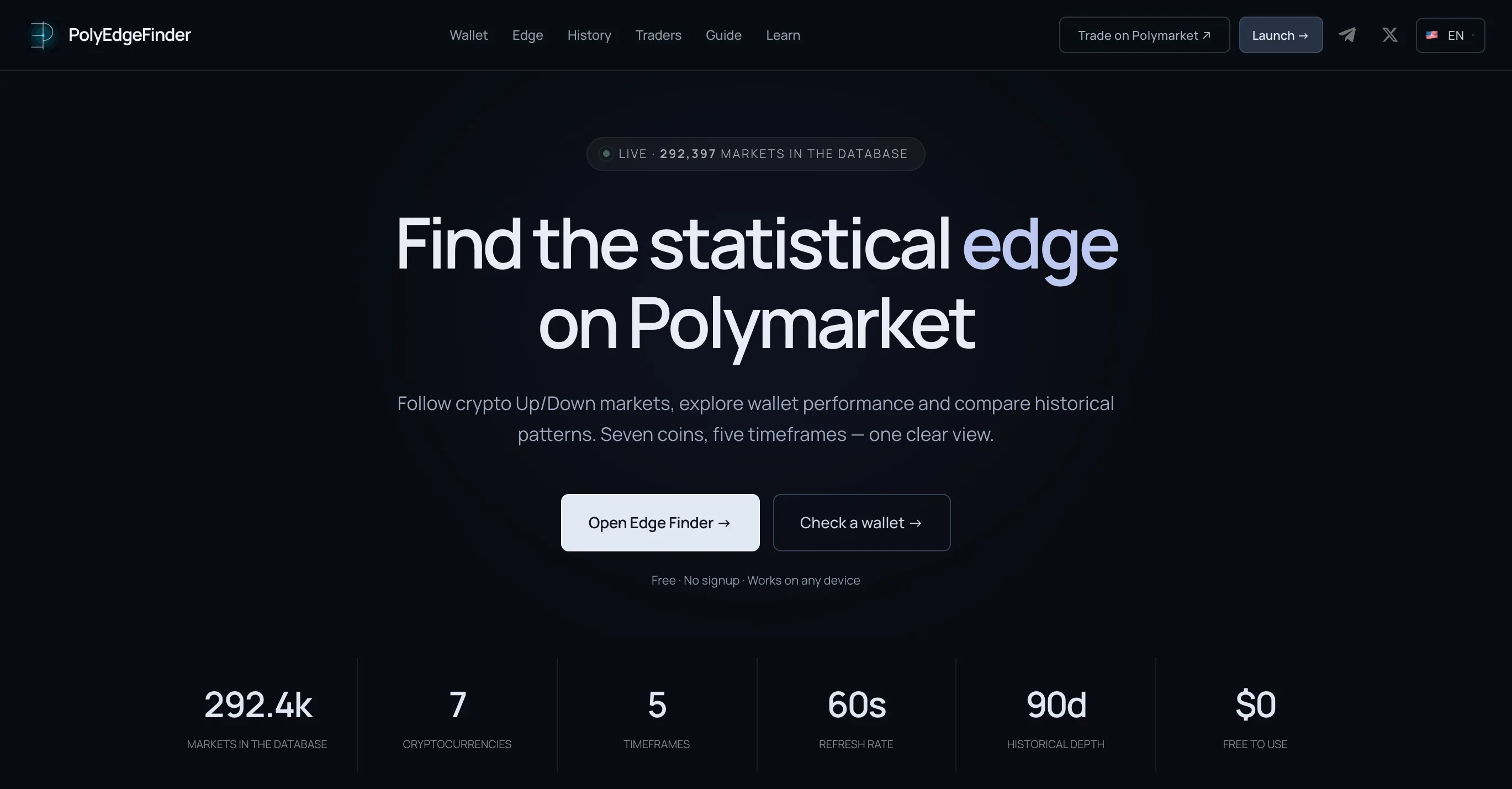
Free statistics site for Polymarket's crypto Up or Down markets, covering BTC, ETH, SOL, XRP, DOGE, BNB and HYPE on timeframes from 5 minutes to 1 day.
Compared with SpectralEdge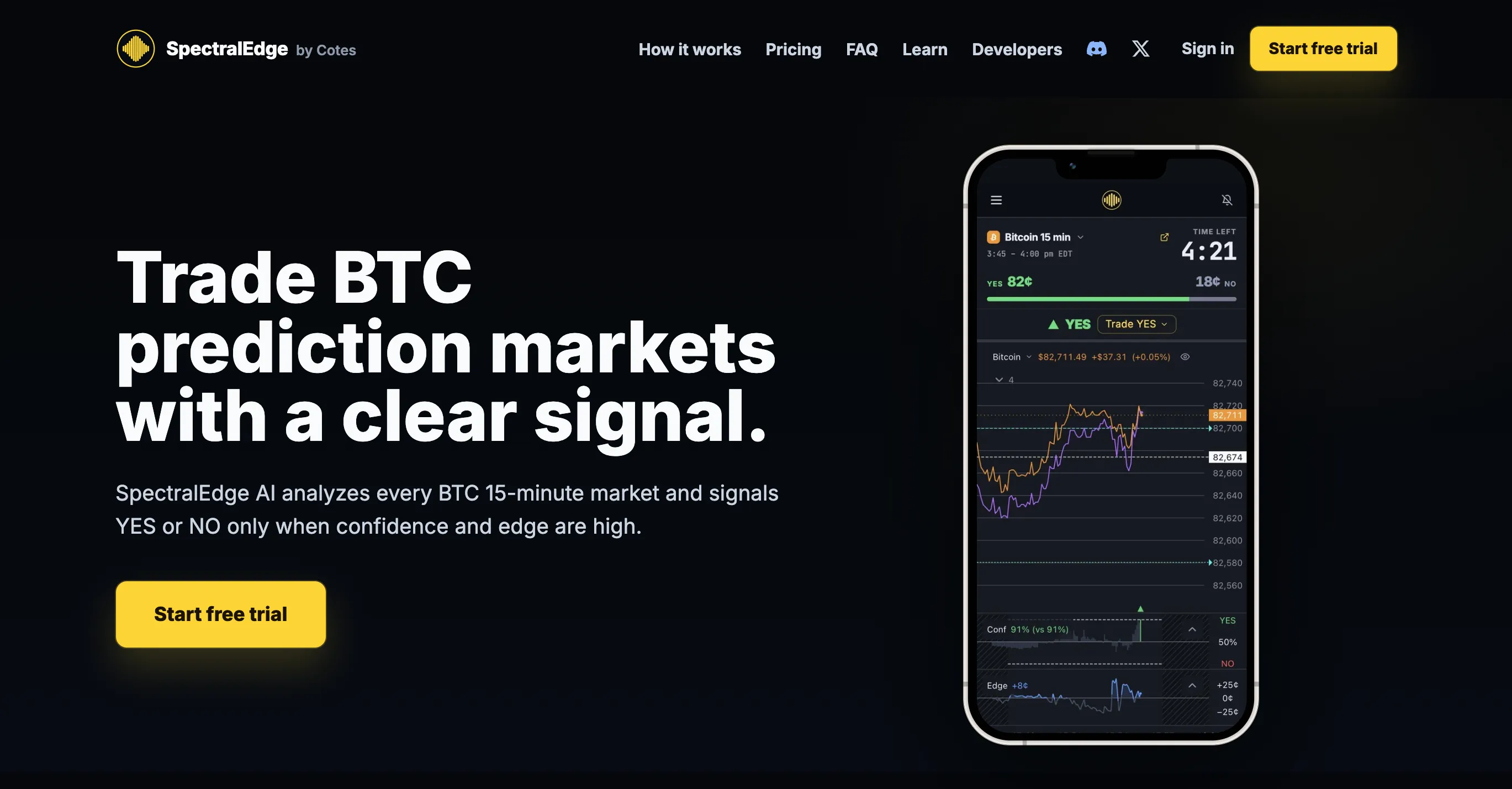
Signal service for Kalshi's Bitcoin 15-minute markets, from Cotes AI, Inc.
Compared with PolyEdgeFinderAt a glance
| Fact | PolyEdgeFinder | SpectralEdge |
|---|---|---|
| Type | Trading platform | Trading platform |
| Category | Crypto Markets | Crypto Markets |
| Also listed in | Platforms & Tools, Telegram, Sentiment / News | Platforms & Tools, Sentiment / News |
| Pricing | Free | Free tier, paid plans |
| Price | free | free trial · price undisclosed |
| Risk rating | Medium risk | Medium risk |
| Markets | Polymarket crypto Up or Down markets: BTC, ETH, SOL, XRP, DOGE, BNB and HYPE, at 5m, 15m, 1h, 4h and 1d | Kalshi Bitcoin 15-minute markets (series KXBTC15M) |
| Source | Source not published | Source not published |
| Runs in Telegram | Yes | No |
| Listed since | Nov 7, 2026 | Nov 5, 2026 |
Highlighted rows differ
Key differences
- PolyEdgeFinder is free (free); SpectralEdge is free with paid plans (free trial · price undisclosed).
- They cover different markets: PolyEdgeFinder lists Polymarket crypto Up or Down markets: BTC, ETH, SOL, XRP, DOGE, BNB and HYPE, at 5m, 15m, 1h, 4h and 1d, SpectralEdge lists Kalshi Bitcoin 15-minute markets (series KXBTC15M).
- PolyEdgeFinder runs inside Telegram; SpectralEdge does not.
- Only PolyEdgeFinder is filed under Telegram.
Choose PolyEdgeFinder if…
- you want it inside Telegram
- you trade Polymarket crypto Up or Down markets: BTC, ETH, SOL, XRP, DOGE, BNB and HYPE, at 5m, 15m, 1h, 4h and 1d
- your focus is Telegram
Choose SpectralEdge if…
- you trade Kalshi Bitcoin 15-minute markets (series KXBTC15M)
What PolyEdgeFinder does
Free statistics site for Polymarket's crypto Up or Down markets, covering BTC, ETH, SOL, XRP, DOGE, BNB and HYPE on timeframes from 5 minutes to 1 day. It counts how often each time slot has resolved up or down over the last 30 or 90 days, and scores upcoming slots from 0 to 10 for how strong that pattern is. It also has a wallet dashboard, a trader leaderboard and a Telegram bot that alerts you before strong slots. You trade by hand on Polymarket. There is no sign-up and no wallet connection.
Features- Edge Finder: upcoming slots ranked by historical up or down rate, sample size, z-score and a 0–10 signal strength
- History by time of day and weekday, with each market's outcome, volume and price path
- Wallet dashboard for any address: P&L, win rate, profit factor, best and worst days, and a day-by-hour heat map
- Trader leaderboard filtered by coin, timeframe and period
- Live page with current odds on every timeframe
- The site's most useful page argues against its own headline. The home page says “Find the statistical edge”; the track record says that picking the side is close to a coin flip. Since Aug 15, 2026 it has logged every BTC 15-minute signal of 8 or more before the slot starts, with a simulated $100 stake. On Nov 7, 2026 its data showed 1,548 settled signals. Those built on 30 days of history won 50.1% of 991 and lost $818; those built on 90 days won 49.0% of 557 and lost $1,527. Together that is -$2,346, or -1.5%, at an average entry of 50.5¢. Twelve recent results we checked matched Polymarket.
- That result is what you would expect from the method. A day has 96 quarter-hour slots, each with about 30 results in a 30-day window; a recent 9.2 signal rested on 29 markets. Across that many slots, some will look lopsided by chance alone, and the site's own warning is that 8/10 does not mean an 80% chance of winning. Sample alerts on the home page such as “68% DOWN” should be read with that in mind. In the log, signals of 9 or more won about 50%, and those of 8 to 8.5 won 49.4%.
- The page's advice is to enter below its 49.7¢ break-even, and its table shows the same signals earning 10.4% at 45¢. That table changes the price and keeps the outcomes, so it is arithmetic and not a result: nothing shows such prices can be had on these signals. The experiment covers BTC 15-minute markets only, so the other coins and timeframes have no record. The how-it-works text still describes a 52¢ assumption, while the figures use market prices.
What SpectralEdge does
Signal service for Kalshi's Bitcoin 15-minute markets, from Cotes AI, Inc. Every 5 seconds a model re-reads each open market and calls YES or NO only when its calibrated confidence clears a fixed threshold and the price still leaves a minimum edge; about half of all markets get no signal. Each signal shows its side, confidence, entry price and edge, and is graded at settlement. You place trades yourself on Kalshi, and the service never connects to your account. The same feed is available as a JSON and streaming API. It starts with a free trial; the subscription price is not published.
Features- A fresh read of each market every 5 seconds, with confidence calibrated separately for each point in the market
- Signals carry side, confidence, entry price and estimated edge, and link straight to the Kalshi market
- Only the first signal in a market is scored, against Kalshi's settlement
- Public replays of the last ten settled markets, with no sign-up
- REST and Server-Sent Events API with graded settled history and an OpenAPI contract
- The headline is accuracy, and the company itself says accuracy alone proves nothing: its own guides explain that a 90¢ contract needs to win more than 90% of the time, and its notes for AI assistants ask that any win rate be quoted with the average entry price. It does not publish that average. Its public replay feed showed 1,220 wins and 199 losses over the trailing 30 days on Nov 5, 2026, or 86.0%, across about half of the markets in that period, in line with the 85.8% on the home page.
- The last ten markets in that feed give a first look at price. Seven drew a signal, all seven won, and they entered at 81¢ to 92.6¢, averaging about 88¢. All ten settlements matched Kalshi's public API. Seven signals are far too few to judge, but an 86% win rate at an 88¢ average entry would lose money even before Kalshi's fee, so the number to check is the average entry across the full history. Trial users can compute it from the API's entry price and outcome fields. The signal also has to be tradable: you act by hand, in a market that can reprice within a minute.
- The sample sizes vary from page to page: 15,000+ markets of out-of-sample validation, a backtest of 8,085 first signals at 88.5%, “Trained & tested on 7,654 markets” on the parent site, and more than 30,000 settled markets in a founder interview. They may describe different stages, but the site does not reconcile them. The backtest is simulated and carries the CFTC hypothetical-performance notice. “Physics-trained AI” here means decomposing Bitcoin's price into component waves, which the company says is covered by five provisional patent applications; we did not verify that.
More head-to-heads
Every fact on this page is taken from the two listings as their authors publish them; POLBOTS verifies neither performance nor claims and has no stake in either tool. Nothing here is financial advice.