Cohven vs TrueOdds
Cohven and TrueOdds are both filed under Platforms & Tools and Copy Trading and 1 more. Both are trading platforms, and both are paid. Below: the facts side by side, where the two actually differ, and when each one is the better pick.
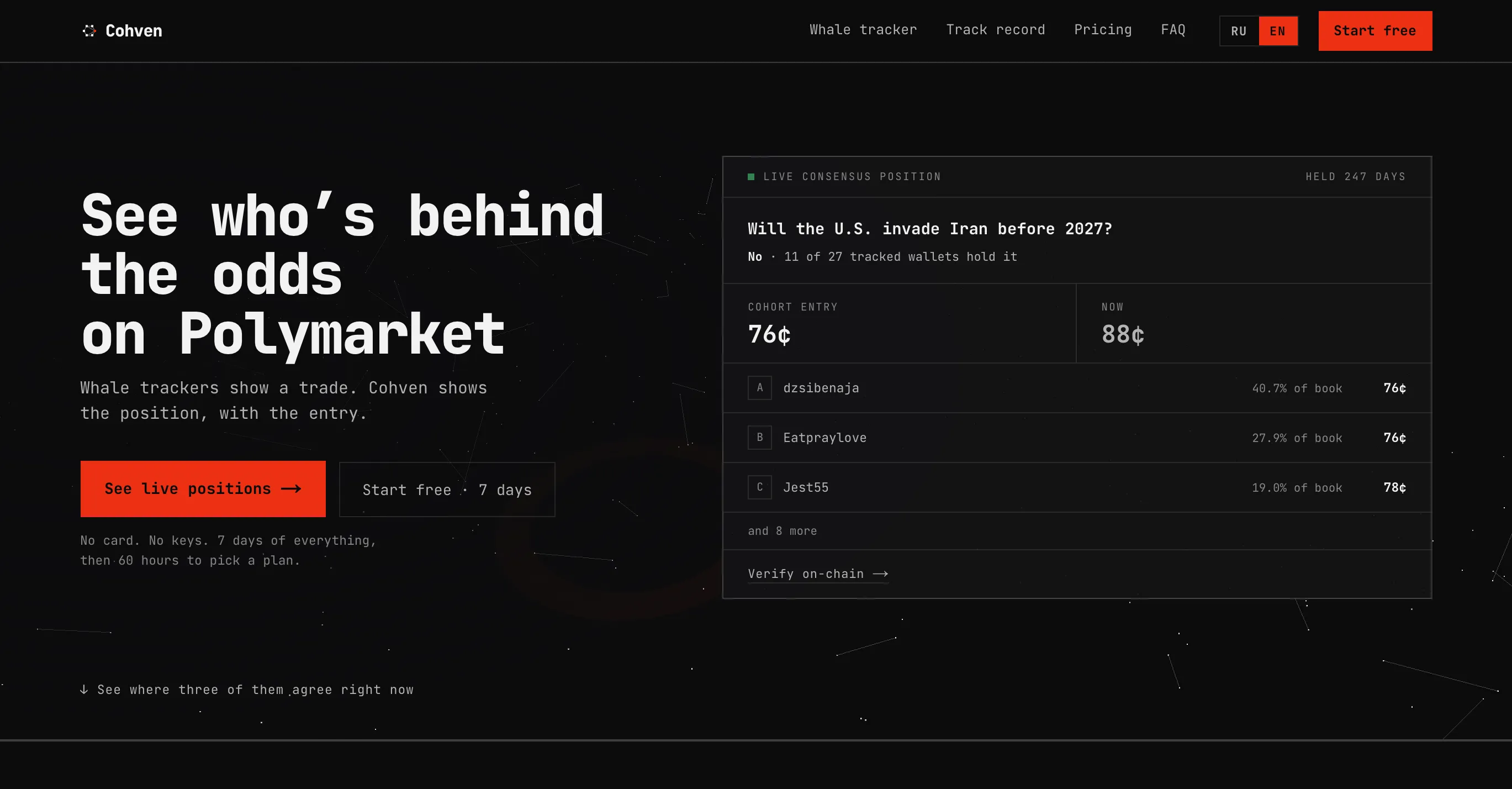
Polymarket wallet tracker that shows positions rather than single trades.
Compared with TrueOdds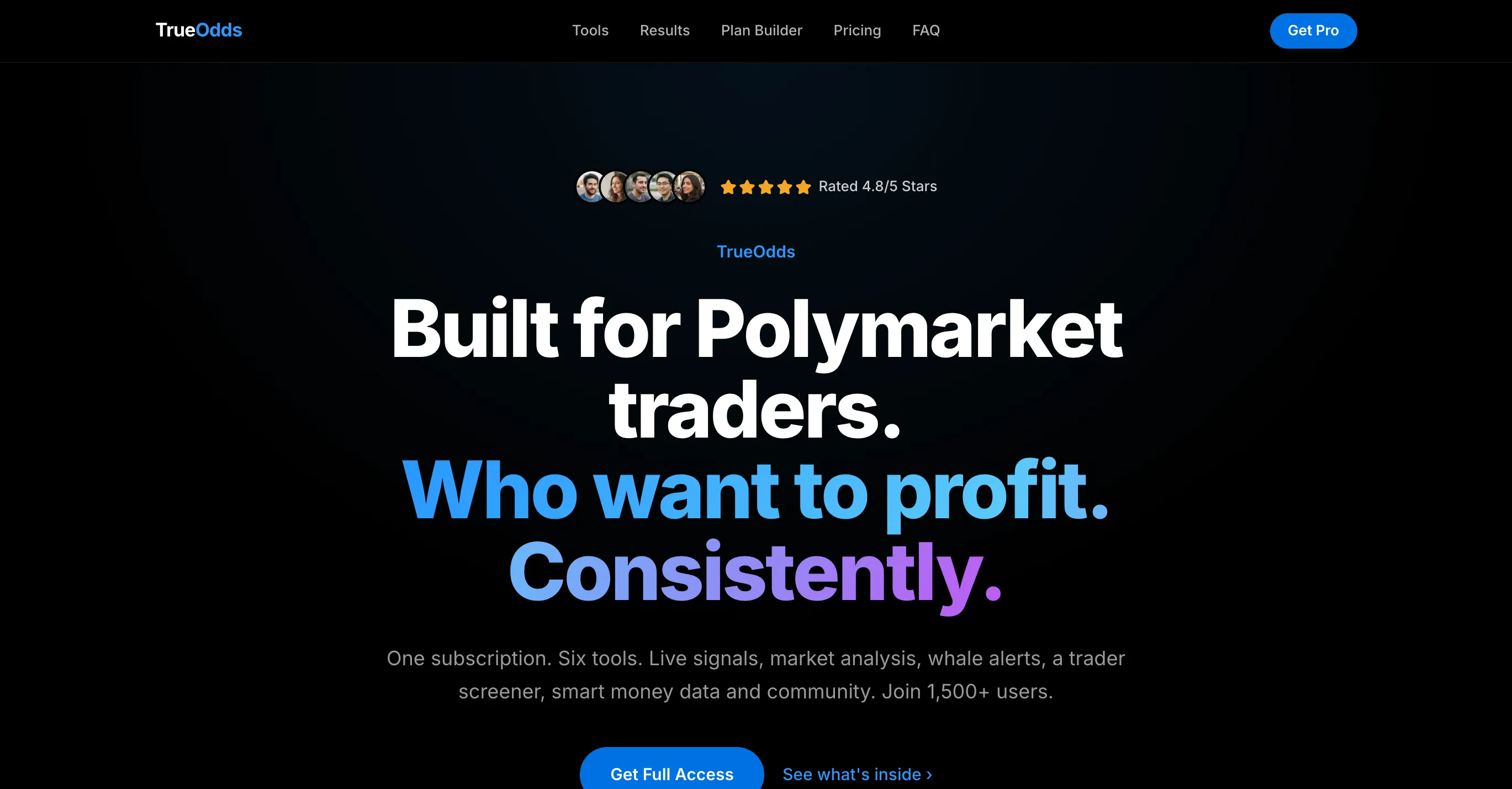
Polymarket signal and research site sold as one $29-a-month subscription.
Compared with CohvenAt a glance
| Fact | Cohven | TrueOdds |
|---|---|---|
| Type | Trading platform | Trading platform |
| Category | Platforms & Tools | Platforms & Tools |
| Also listed in | Copy Trading, Sentiment / News, Hedging | Copy Trading, Telegram, Politics & Elections, Crypto Markets, Sentiment / News, Sniping, Weather Markets |
| Pricing | Paid | Paid |
| Price | from $29/mo | per month |
| Risk rating | Medium risk | Medium risk |
| Markets | Polymarket markets held by the wallets you track | All Polymarket markets |
| Source | Source not published | Source not published |
| Runs in Telegram | No | Yes |
| Listed since | Nov 7, 2026 | Nov 13, 2026 |
Highlighted rows differ
Key differences
- Both are paid, but on different terms: Cohven is from $29/mo, TrueOdds is per month.
- They cover different markets: Cohven lists Polymarket markets held by the wallets you track, TrueOdds lists All Polymarket markets.
- TrueOdds runs inside Telegram; Cohven does not.
- Only Cohven is filed under Hedging, and only TrueOdds is filed under Telegram and Politics & Elections and 3 more.
Choose Cohven if…
- you trade Polymarket markets held by the wallets you track
- your focus is Hedging
Choose TrueOdds if…
- you want it inside Telegram
- you trade All Polymarket markets
- your focus is Telegram and Politics & Elections and 3 more
What Cohven does
Polymarket wallet tracker that shows positions rather than single trades. You add up to 30 public addresses; Cohven rebuilds each portfolio from Polygon, lists every position that three or more of them hold at once, and works out how far your own account is from that group, in shares and dollars. You place any trades yourself. A whale tracker page and a track record are free to read. The app starts with a 7-day trial on an email address, with no card, and then costs $29 to $149 a month depending on how many wallets you follow, prepaid in USDC.
Features- Portfolios rebuilt from trades, splits, merges and redemptions on Polygon, with entry prices
- A position counts as consensus once 3 wallets hold the same side, and the count is shown on every row
- Each position shown as a share of its owner's equity, so wallets of different sizes compare
- Gap view: the difference between your book and the group in shares and dollars, with the group's average and worst entry
- Alerts when the group moves
- The public record is the best thing here, and it is more modest than its headline. We downloaded the CSV on Nov 7, 2026: 3,307 resolved positions, 71.2% on the group's side, +$14.5 million of realised P&L. But the average entry was 69.5¢, so a 71% win rate is roughly what those prices already implied. Held to resolution, that is about 1.8¢ per share before fees. The realised P&L is 2.5% on $570 million of cost, and the 33 best positions, 1% of the list, made nearly half of it.
- Agreement did not help on cheap outcomes. The 850 positions entered under 50¢ paid 23.2¢ on average and won 15.1% of the time, a loss of about 8¢ a share if held to resolution; the realised figure for that group is close to flat, because wallets also sold before the end. Some of these may be hedges rather than bets, and the CSV does not say.
- The history also needs reading with care. The domain dates from Aug 22, 2026, while the record runs back to Jul 2024, using wallets that were picked later and that were already known to have done well. Only 386 positions were first bought after the domain existed: they won 72.5% at a 69.2¢ average entry and made 2.8% on cost, which is a fairer sample but a short one. The site does say the group is chosen by users, that past results guarantee nothing, and that wallets of very different sizes are added together. A follower also never gets the group's entry. The delay is deliberate, and rows on the site show entries of 57¢ and 75¢ with prices now at 91¢ and 98¢. The account-size calculator on the home page, which shows +11.5% in three months, is labelled a model.
What TrueOdds does
Polymarket signal and research site sold as one $29-a-month subscription. A model puts a fair value and a target price on markets and sorts them into five lists: Moonshots (cheap outcomes far below the model's price), Bankers (near-certain outcomes ranked by yearly return), Snipers (model and profitable wallets on the same side), Smart Money and Swing (markets closing within 10 days). Around them sit a whale and insider feed, a screener of 10,000+ tracked traders with Telegram messages when a followed trader bets, a smart-money split on every market and a Telegram community chat. Pasting any Polymarket link into the analyzer is free without an account. You place every trade on Polymarket yourself.
Features- Fair value and target price for markets, from a model the site describes as an AI engine fed by public data such as NOAA and the Federal Reserve
- Five ranked signal lists: Moonshot, Banker, Sniper, Smart Money and Swing (10 days or less)
- Analyzer: paste any Polymarket link for the fair value, the gap to target, the smart-money split and a price chart
- Whale and insider radar of large trades from wallets tagged with win rate and P&L, on screen and in Telegram
- Screener of 10,000+ traders by win rate, P&L and streak, with a Telegram message when a followed trader bets
- The results page is a gallery of winners, not a track record. On Nov 13, 2026 it listed 413 signals with a return each, and not one was negative; each card shows the gain from the signal price to the target or the later high. The one we checked is real as far as it goes: TrueOdds flagged YES on Brazil's 2026 inflation landing between 4.50% and 4.99% on Oct 28 at 3¢ with a 16¢ target, and Polymarket's price history shows 3.1¢ that day and 21–24¢ on Nov 13. What the page does not show is how many Moonshots stayed at 3¢ and expired worthless, and the site's own table says about one Moonshot in three hits. The “+80% last month ROI” and “74% win rate” on the landing page come with no method or list behind them.
- The lists themselves are clearly explained, and the strategy behind each is ordinary. Bankers are the familiar buy-near-a-dollar trade sorted by yearly return; Snipers and Smart Money lean on the same profitable-wallet signal that the free whale trackers in this catalog sell; Moonshots are long shots where the model's price is several times the market's. The fair-value model is presented as a black box: the about page speaks of data from NASA, NOAA and the Federal Reserve and a “two-layered attack on the market”, and gives no calibration figures. The playbook still says Polymarket charges 0% on most markets, although taker fees now apply to several market types, crypto among them.
- Social proof is thin and inconsistent. The landing page says 1,500+ users and 4.8 stars with no source for the rating; the dashboard banner says the community chat has 1,000+ traders. TrueOdds is not in Polymarket's builder leaderboard, which is expected for a site that does not route trades. The partner page pays 50% of each subscription for life, which explains much of what is written about it elsewhere.
More head-to-heads
Every fact on this page is taken from the two listings as their authors publish them; POLBOTS verifies neither performance nor claims and has no stake in either tool. Nothing here is financial advice.