PolyMM vs Predict & Profit
PolyMM and Predict & Profit are both filed under Arbitrage and Weather Markets. Both are automated bots; PolyMM is free, Predict & Profit is paid. Below: the facts side by side, where the two actually differ, and when each one is the better pick.
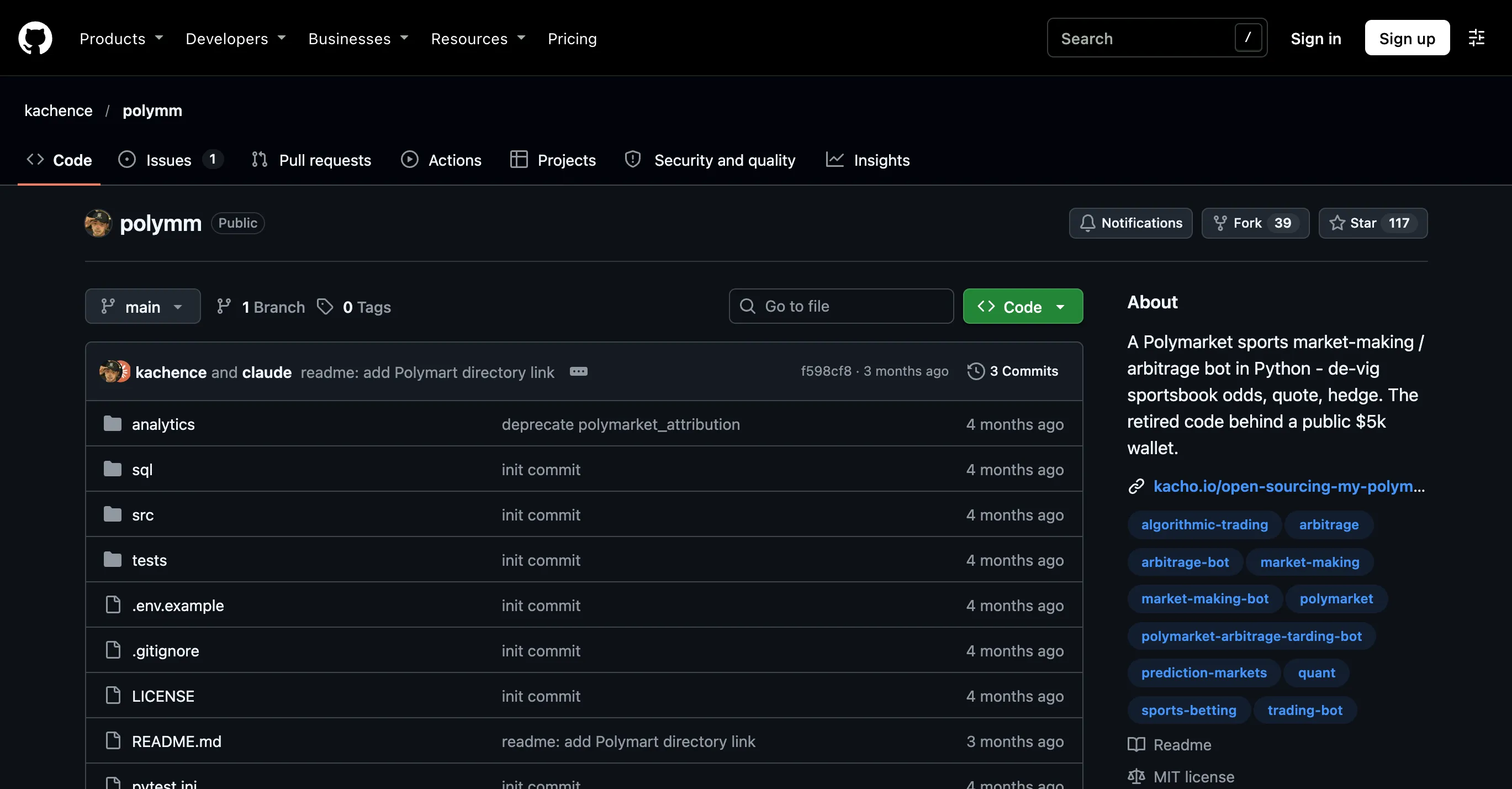
Open-source Python bot for Polymarket's sports and esports markets, released by the person who ran it.
Compared with Predict & Profit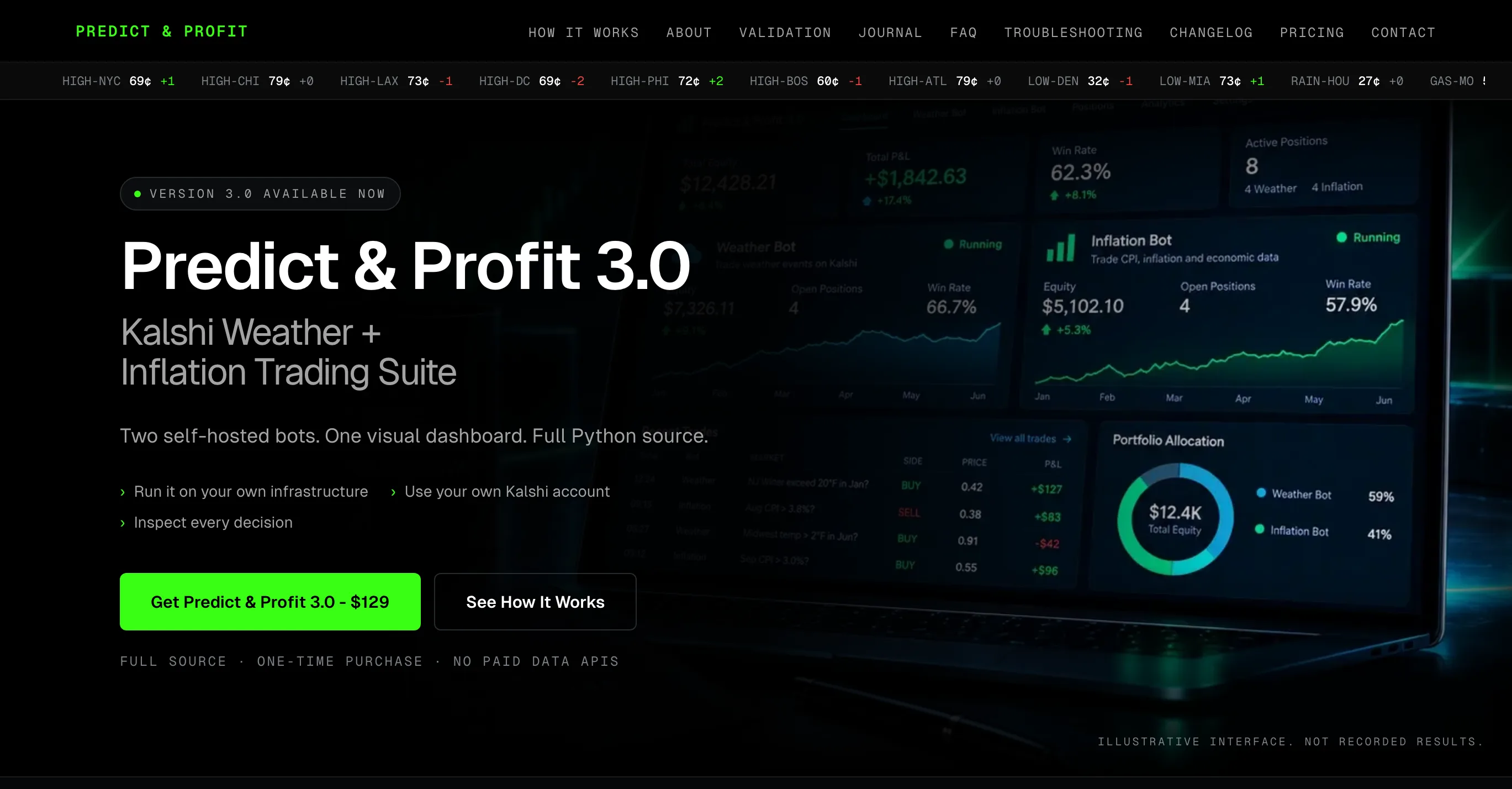
Self-hosted Python suite for Kalshi weather and inflation markets — two bots, a monitoring dashboard and one shared risk engine, installed and managed as a single system.
Compared with PolyMMAt a glance
| Fact | PolyMM | Predict & Profit |
|---|---|---|
| Type | Automated bot | Automated bot |
| Category | Market Making | Weather Markets |
| Also listed in | Sports Trading, Arbitrage, Politics & Elections, Hedging, Weather Markets | Arbitrage |
| Pricing | Free | Paid |
| Price | free · MIT | one-time |
| Risk rating | High risk | Medium risk |
| Markets | Polymarket sports and esports match markets and Bookmaker odds through the-odds-api, or a source you supply | Kalshi weather · 20 US cities and CPI / Core CPI / PCE |
| Source | Open-source | Source included with purchase |
| Runs in Telegram | No | No |
| Listed since | Nov 5, 2026 | Jul 16, 2026 |
Highlighted rows differ
Key differences
- PolyMM is free (free · MIT); Predict & Profit is paid (one-time).
- They cover different markets: PolyMM lists Polymarket sports and esports match markets and Bookmaker odds through the-odds-api, or a source you supply, Predict & Profit lists Kalshi weather · 20 US cities and CPI / Core CPI / PCE.
- PolyMM publishes its code under an open-source licence; Predict & Profit ships the full source with the purchase.
- PolyMM is rated high risk, Predict & Profit medium risk.
- Only PolyMM is filed under Market Making and Sports Trading and 2 more.
- Predict & Profit has been listed since Jul 16, 2026; PolyMM joined on Nov 5, 2026.
Choose PolyMM if…
- you want to start without paying
- you trade Polymarket sports and esports match markets and Bookmaker odds through the-odds-api, or a source you supply
- your focus is Market Making and Sports Trading and 2 more
Choose Predict & Profit if…
- you trade Kalshi weather · 20 US cities and CPI / Core CPI / PCE
- you prefer the lower-risk profile (medium vs high)
What PolyMM does
Open-source Python bot for Polymarket's sports and esports markets, released by the person who ran it. It strips the margin from sportsbook odds to get a fair price, posts limit orders a cent above the best bid where the gap is large enough, and when one side fills, tries to buy the other outcome so both sides cost under $1. The code is free under the MIT licence, and its author says it is a foundation to build on, not a plug-and-play earner: the private odds scrapers are left out and it needs your own wallet, a paid the-odds-api key and a Supabase project.
Features- De-vigs bookmaker odds into a fair probability for each side
- Quotes a cent above the best bid when the edge clears a minimum, 7% in the pre-match config
- Hedges a fill by placing the opposite outcome, to hold both sides for under $1 a share
- Fill and order-book websockets, with an edge-lost event that cancels resting orders when fair value moves
- Starts at 10 shares per order
- Most bot repos come with a promise. This one comes with a public wallet and an autopsy. The author's write-ups put the January to April 2026 run at about $5k net: +$8,293 on completed arbitrages and -$3,184 on the forced directional bets left when a hedge did not fill. We checked the wallet @b00k13 against Polymarket's data: position P&L stood at $4,960 on May 1, 2026, matching the $4,960.77 on the author's profile screenshot. The total was $5,904 on Nov 5, 2026, but the author says the bot running now is a Rust rewrite, which is not in this repo.
- The candid part is why it faded. Those directional bets each carried at least a 7% edge on paper and still lost, and the author traces that to adverse selection: odds up to 30 minutes old meant the edge was often gone by the time a quote filled. In the author's words the bot “got too slow” to defend its edge, and running it unchanged means donating to quicker bots. The scrapers that the author calls half the edge are not included, so what you get is the stale-odds version of the problem, unless you bring faster data.
- Treat the code as a study piece. The author says it was built almost entirely with AI in spare time and that bugs are likely. It ships with a test suite, but the history is three commits, the last from Aug 16, 2026, so it is a one-off release rather than a maintained project; the repo has 117 stars and 39 forks. The README gives a 5% default minimum edge, while the config sets 7% before a match, 8% for live play and 5¢ only for a separate weather-market spread bot.
What Predict & Profit does
Self-hosted Python suite for Kalshi weather and inflation markets — two bots, a monitoring dashboard and one shared risk engine, installed and managed as a single system. Version 3.0 prices temperature contracts from NOAA's National Blend of Models, the calibrated station-level guidance published for exactly the stations Kalshi settles on, at 0.75 weight; GFS, AIGEFS, ECMWF IFS, AIFS and HRRR hold the remaining 0.25 as a disagreement check rather than as the model. Settlement stations come from Kalshi's own series metadata across 20 cities — Chicago settles on Midway, Houston on Hobby — and any market NBM does not cover is skipped, which rules out every same-day contract, because NBM coverage starts at forecast hour 24. The inflation half scores CPI, Core CPI and PCE against the Cleveland Fed's nowcast and an internal weighted one. Candidates then pass a four-signal gate — spread 30%, volume 20%, order-book imbalance 25%, model mispricing 25% — and the author says over 95% of scanned contracts are rejected. There is no public performance record: the trade log the earlier version published was retired with 3.0, and the site now publishes release and validation status instead of a P&L scoreboard.
Features- NOAA National Blend of Models at 0.75 weight — mean, sigma and percentiles for the settlement station, interpolated with normal tails beyond P10/P90 and sigma × 1.15 for fat tails
- GFS, AIGEFS, ECMWF IFS, AIFS and HRRR at 0.25 combined, kept as a disagreement check; AIGEFS and HRRR are pulled as byte ranges out of GRIB2 files on S3
- 20 Kalshi cities, with the settlement station read from Kalshi's series metadata instead of guessed from the city name
- Inflation bot on CPI, Core CPI and PCE against the Cleveland Fed's nowcast and an internal weighted one, with FRED and BLS inputs when their free keys are configured
- One account-risk engine across both bots: cost cap per trade, per-city and per-series exposure limits, and a daily-loss kill switch
- Prices every temperature contract from NOAA's published percentiles for the station that contract settles on.
- Declines any market NBM cannot price, including every same-day contract.
- Scores spread, volume, order-book imbalance and model mispricing into one composite before an order goes out.
More head-to-heads
Every fact on this page is taken from the two listings as their authors publish them; POLBOTS verifies neither performance nor claims and has no stake in either tool. Nothing here is financial advice.