PolyVexa vs Whalidate
PolyVexa and Whalidate are both filed under Copy Trading. Both are automated bots; PolyVexa is paid, Whalidate is free with paid plans. Below: the facts side by side, where the two actually differ, and when each one is the better pick.
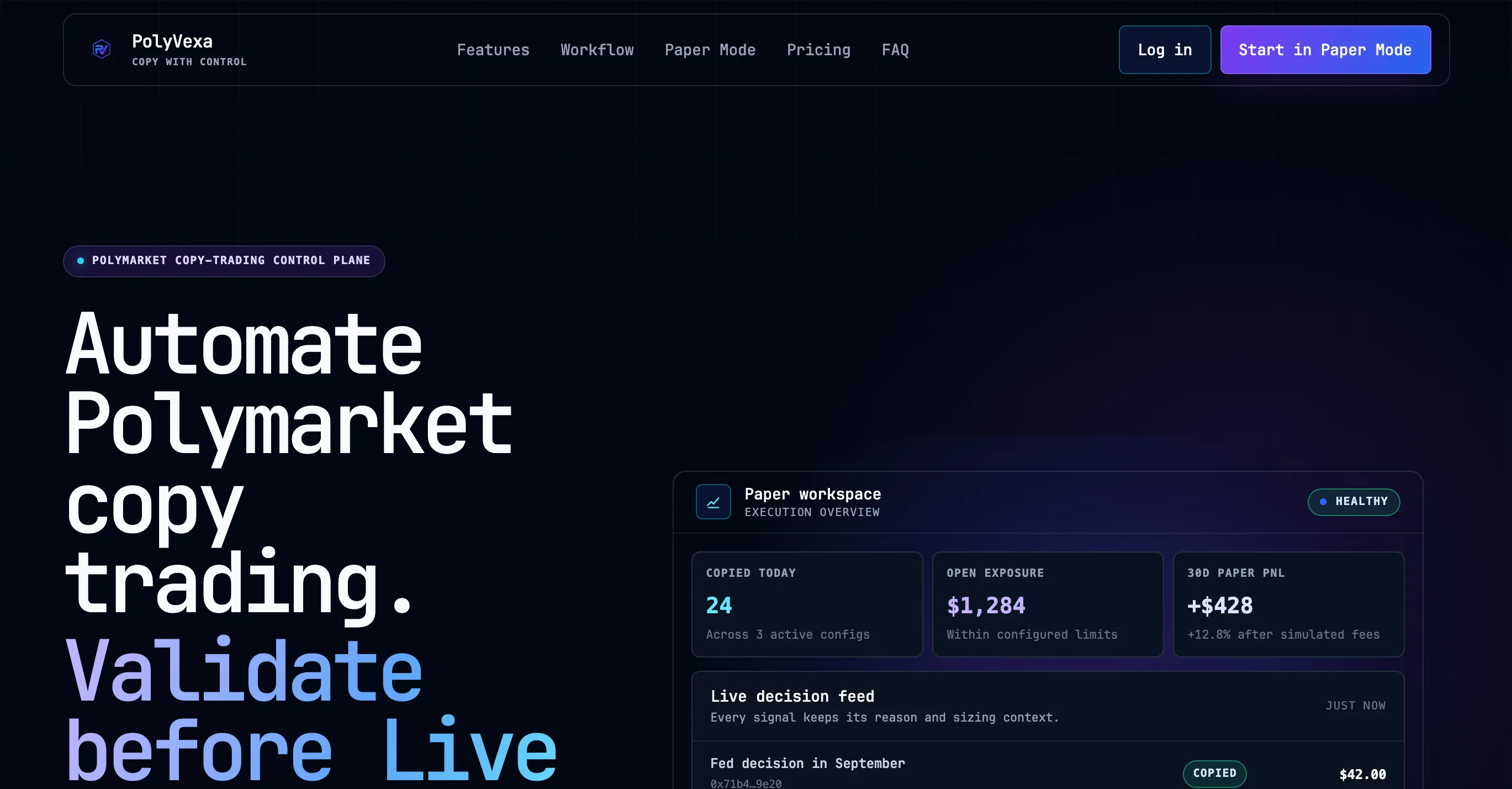
Polymarket copy-trading service built around a paper stage.
Compared with Whalidate
Whalidate
Verified PartnerCopy trading for Polymarket that checks how a wallet made its money before you follow it.
Compared with PolyVexaAt a glance
| Fact | PolyVexa | Whalidate |
|---|---|---|
| Type | Automated bot | Automated bot |
| Category | Copy Trading | Copy Trading |
| Also listed in | Politics & Elections | Platforms & Tools, Sports Trading |
| Pricing | Paid | Free tier, paid plans |
| Price | from $49/mo | free on paper · 14 days live free · then from $49/mo |
| Risk rating | Medium risk | Medium risk |
| Markets | Polymarket markets traded by the wallets you follow, narrowed by your market filters | All Polymarket markets the followed wallets trade, narrowed to the categories you allow and Strongest wallets in its pool on Sep 30, 2026: tennis, American football, Counter-Strike and Dota 2 |
| Source | Source not published | Source not published |
| Runs in Telegram | No | No |
| Listed since | Nov 2, 2026 | Oct 8, 2026 |
Highlighted rows differ
Key differences
- PolyVexa is paid (from $49/mo); Whalidate is free with paid plans (free on paper · 14 days live free · then from $49/mo).
- They cover different markets: PolyVexa lists Polymarket markets traded by the wallets you follow, narrowed by your market filters, Whalidate lists All Polymarket markets the followed wallets trade, narrowed to the categories you allow and Strongest wallets in its pool on Sep 30, 2026: tennis, American football, Counter-Strike and Dota 2.
- Only PolyVexa is filed under Politics & Elections, and only Whalidate is filed under Platforms & Tools and Sports Trading.
Choose PolyVexa if…
- you trade Polymarket markets traded by the wallets you follow, narrowed by your market filters
- your focus is Politics & Elections
Choose Whalidate if…
- you want to start without paying
- you trade All Polymarket markets the followed wallets trade, narrowed to the categories you allow and Strongest wallets in its pool on Sep 30, 2026: tennis, American football, Counter-Strike and Dota 2
- your focus is Platforms & Tools and Sports Trading
What PolyVexa does
Polymarket copy-trading service built around a paper stage. You pick a Polymarket wallet to follow and write a copy config for it — markets, sizing, a budget, a maximum order size, cooldowns and filters — and PolyVexa first runs it on paper, logging every trade it would have copied, every one it skipped and why, the simulated positions and P&L. Only on a paid plan can a config be promoted to live trading, which the docs call a managed beta behind invite, tier, balance and credential checks. The free trial runs up to three paper configs with no card; Pro costs $49 a month, with the first month at half price, for 15 paper and 5 live configs.
Features- Copy configs per followed wallet with market filters, sizing rules, budget, maximum order size and cooldowns
- Paper Mode: simulated copied trades, positions, balances and P&L, kept apart from live orders
- A log of every copied, skipped, blocked and failed decision with the rule that caused it
- Several configs for the same wallet, to compare stricter and looser rules side by side
- Live trading on paid plans only, off by default, with single-trade and daily limits
- The idea is sound and simple: run a copy config on paper long enough to see what it would have done before you put money behind it. Paper fills are not real fills, and the terms say so — slippage, fees, latency and thin books can make the live result worse than the paper one, especially when you copy a wallet that trades large into shallow markets.
- Most of what the site shows is illustration. The workspace on the home page — 24 trades copied today, $1,284 of exposure, +$428 or 12.8% of paper profit over 30 days, and copied trades on a Fed decision and ETH above $4k — is labelled an example, and the site publishes no customer or paper results of its own. Much of the rest is guide pages written around search terms. We found no Polymarket builder record under its name.
- Read the custody answer carefully. Asked whether it holds your funds, the FAQ replies that PolyVexa is “built around controlled wallet and managed-account workflows”; the docs call live trading “managed” and say paper mode involves no private keys, which implies that live mode does. The site does not say who holds the key that signs your live orders or where it is stored, so treat live trading as handing the service control of a trading account until it does.
What Whalidate does
Copy trading for Polymarket that checks how a wallet made its money before you follow it. Its WhaleFinder replays each wallet's public history and scores the return on the money put in, the settled trades, the worst drawdown and how much of the profit came from one bet; on Sep 30, 2026, 166 of the 1,346 wallets scored in full passed its default checks. You pick the wallets and set the rules — price band, slippage cap, categories, caps and loss limits — and Whalidate copies only the new buys that pass. Paper trading is free with no time limit; live copying is free for 14 days on Starter, then from $49 a month with no fee per trade, either through a session key on your own Polymarket account that can trade but not withdraw, or from a trading wallet whose keys Whalidate holds.
Features- WhaleFinder: 15,371 leaderboard wallets scored on return, settled trades, worst drawdown, the share of profit from the best trade and the top five, steadiness and edge per trade. By default a wallet needs a 15% return, 30 settled trades, a drawdown of 25% or less and no more than half its profit from one trade; the checks can be changed
- Every rejected wallet shows why: profit resting on one trade, too short a record, too many copiers already
- Entry rules per strategy: the whale's stake, a price band, a slippage cap, time to resolution and categories; rules per whale on Pro and Elite
- Caps per market, per event, on total exposure and on the live budget; daily, weekly and drawdown loss limits stop new entries
- The order book is read again just before sending, then one fill-or-kill order goes out; on paid plans a limit order at the whale's price can wait in the book instead, 30 minutes by default. Copies under $5 are skipped
- Read the methodology, not the landing page. The home page's four whale cards, +$910 to +$5,296 over 120 days, are the best four of the 166 passing wallets. They come from a model with no fees or slippage that exits when the whale does, while the product holds each copy until your own exit or resolution. The methodology itself says copying all 166 came to about break-even. Since Nov 1, 2026, paper trades are priced from the live book and charged the taker fee. Paper still cannot show a live order failing, which happened about 3 times in 100 in October by the vendor's count.
- Preset cards are replays, not records, until a preset has 30 settled trades of its own, and on Nov 9, 2026 some cards annualised a few months into tens of thousands of percent a year. Whalidate sent us every trade behind two cards, and we rebuilt both; when we found the whale's own fee inside its prices, it corrected the cards down. Reef's +27% (Dec 2025 to May 2026, was +34%) uses today's wallets, but they were picked on their record through October. Current's +88% (Jul to Oct 2026, was +94%) re-picks wallets each month by rules tuned on those same months, and only 6 of its 196 copies came from today's wallets. Whalidate's own test of 1,036 wallets found that copying every whale buy lost money after costs; our guide “Does Polymarket copy trading work?” has the numbers.
- Live trading runs one of two ways. With your own Polymarket account, you sign a session key that can place and cancel orders but not withdraw. It lasts up to 180 days, and you can revoke it sooner. Your money stays on Polymarket, but a key that trades can still lose it, and the budget and loss limits are Whalidate's rules, not Polymarket's. Only Deposit Wallet accounts used through a wallet app such as MetaMask or Rabby can connect; e-mail and Google sign-ins cannot. The other way is custodial: you deposit USDC into a trading wallet whose key Whalidate holds, and its Risk Disclosure says a breach, a software mistake or a shutdown could delay or lose those funds, with no insurance. The Terms name no company, address or governing law, only a support email.
More head-to-heads
Every fact on this page is taken from the two listings as their authors publish them; POLBOTS verifies neither performance nor claims and has no stake in either tool. Nothing here is financial advice.