On this page6 sections
What it is
Polymarket Agents is Polymarket's own open-source framework — "Trade autonomously on Polymarket using AI Agents" — published under the MIT licence, written in Python (3.9 and up). It is the official answer to a question a lot of people ask the catalog: is there a sanctioned starting point for an LLM that researches markets and trades them? Yes; this is it; and it is a starting point, not a strategy.
What is in the repository
The useful way to read the repo is as the plumbing from the news-and-sentiment pipeline — ingest, interpret, estimate, compare, execute — done once with the official APIs:
- Connectors. A Gamma connector for market metadata (events, markets, outcomes, end dates), an exchange connector for interacting with Polymarket's order book, a Chroma connector for the vector database that backs retrieval, and a set of data objects that the rest of the code passes around.
- Sourcing. Utilities that pull news and web-search results into the agent's context, so "research a market" means more than "ask the model what it thinks".
- Retrieval (RAG). Documents and market data go into the vector store; the agent retrieves what is relevant to the market it is reasoning about and reasons over that instead of over its training data.
- LLM tooling. Prompting and tool definitions that let the model call the connectors — list markets, read a book, place a trade.
- A CLI. The primary interface: commands such as listing all markets with a limit and a sort order, and the entry points that run an agent and trade.
What is not in the README, and therefore not in this guide: a diagram of the agent loop, a risk module, a backtester, or a claim that any of it makes money.
Setup, in the order the README gives it
- Clone the repository and create a Python 3.9 virtual environment.
pip install -r requirements.txt.- Copy
.env.exampleto.envand set two variables:POLYGON_WALLET_PRIVATE_KEYandOPENAI_API_KEY. - Fund the wallet.
- Run the CLI, for example:
python scripts/python/cli.py get-all-markets --limit 10 --sort-by volumeThree notes a careful reader adds to that list. The private key goes in a file on your machine: make it a dedicated wallet funded only with what the agent may lose, never your main account — the wallets guide explains why a key is the whole account. The OpenAI key is a metered cost: an agent that reasons over hundreds of markets a day spends real money on tokens before it places a trade. And the README's own disclaimer applies to the agent exactly as to you: Polymarket's terms prohibit US persons and some other jurisdictions from trading via UI or API, agents included.
What it does well
It removes the plumbing tax. Authentication, market discovery, reading books, placing orders, storing and retrieving documents — the part of a bot that is most of the code and none of the edge — is done, by the people who run the exchange.
It is honest about being a framework. Nothing in it pretends to be a product. You get a CLI and modules, not a dashboard with a green line.
It is the right shape for breadth. An agent can watch two hundred markets and thirty sources at once; that is where LLM traders have a natural advantage over humans, and the framework's retrieval layer is built for exactly that kind of wide, shallow research.
What it leaves to you
- The edge. An agent with a model and a news feed has the same information as everyone else with a model and a news feed. The framework gives it hands; the question of why its probability should beat the price is yours.
- The risk layer. No position caps, loss limits, stale-data guards or kill switches ship with it. Build them first — the build guide lists the set — because a language model is entirely capable of being confidently wrong forty times before breakfast.
- Calibration. A model that says "82%" has not been measured. Log every estimate against the eventual resolution, and do not trade size until you know what its 80% actually means.
- Keeping up with the venue. The order book moved to CLOB V2 in April 2026, the old Python client was archived, the unified SDK replaced even the interim packages. Check which client the exchange connector pins before you expect it to trade, and plan to maintain it — an official framework is still a repository someone has to update.
How it compares to the alternatives
If you want the same idea with less assembly, the catalog has it in several shapes. The Polymarket Bot Skill turns an AI coding agent into a bot builder with modular scripts for the Gamma and CLOB APIs — less framework, more generator. Virae AI and PolymarketAlpha are products: agents already built, with strategies and an interface, and the usual caveat that you are trusting their record. Oracle Markets is the research half only — calibrated multi-agent probabilities with per-agent reasoning, no trading — and a good way to see what disciplined agent forecasting looks like before you wire one to a wallet.
Polymarket Agents
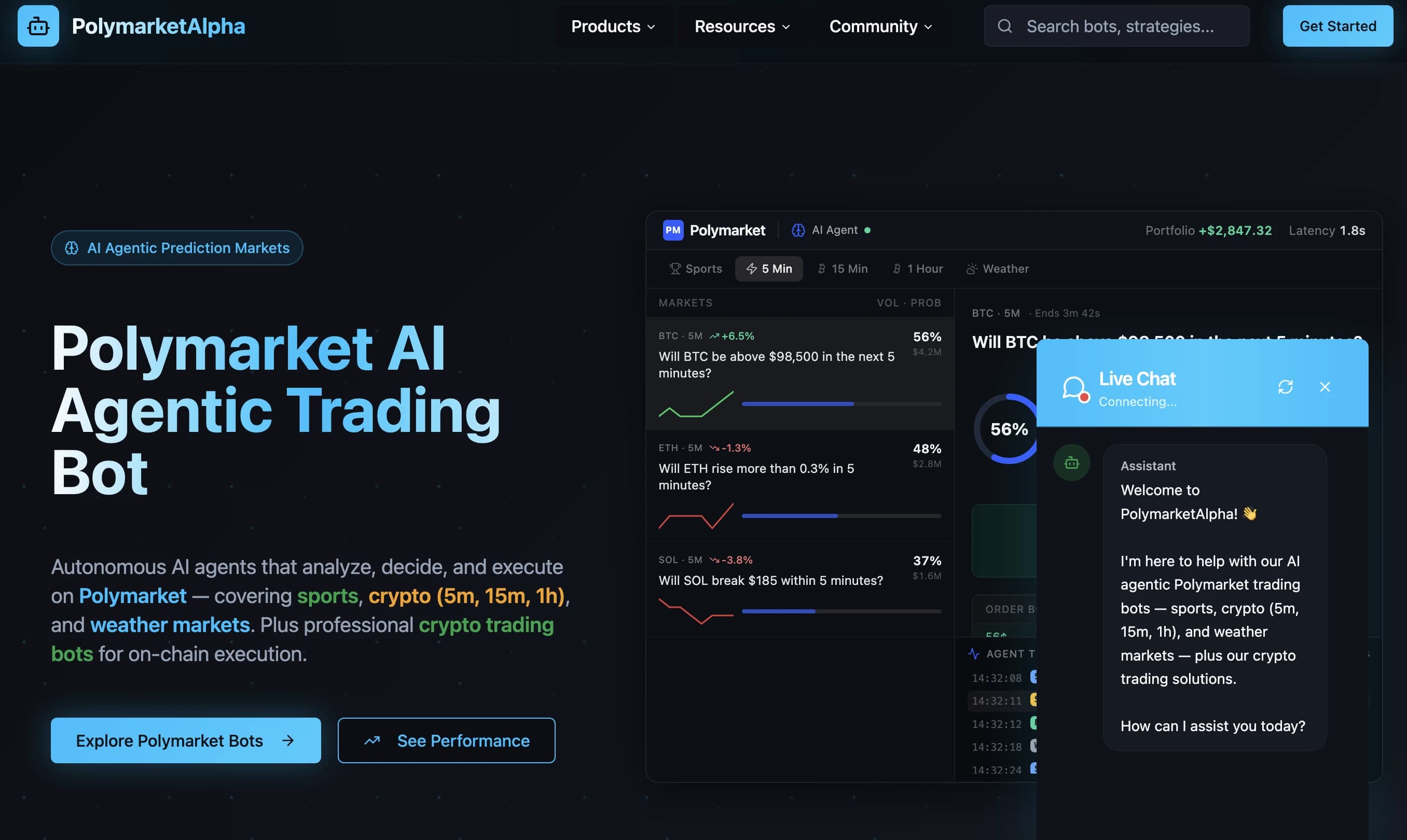
Official open-source framework from Polymarket for building AI agents that trade autonomously. Combines Polymarket & Gamma market data, news and web-search sourcing, and RAG-powered LLM tooling so an agent can research a market and place trades from the command line.
Polymarket Bot Skill
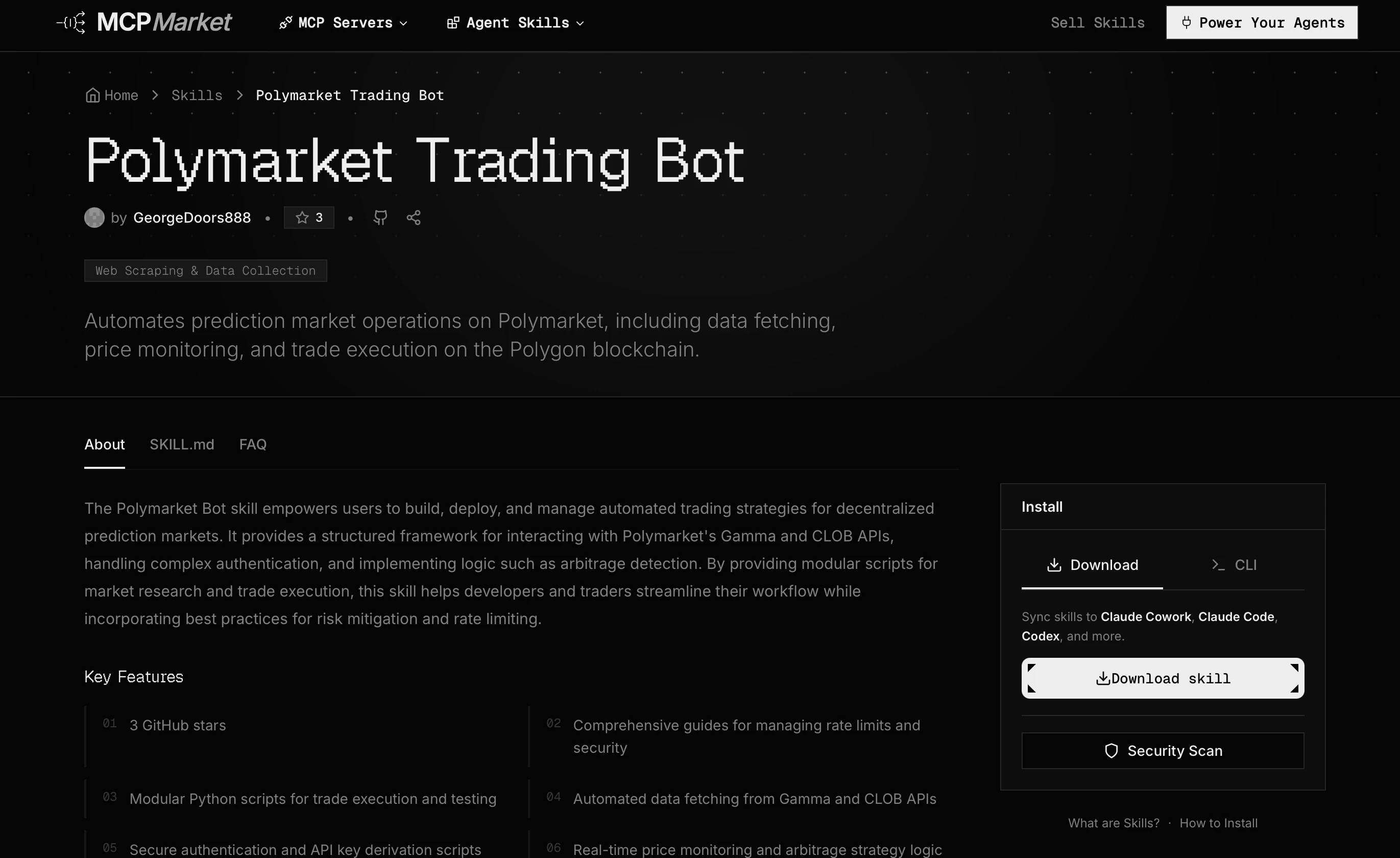
Claude Code skill that turns an AI coding agent into a Polymarket bot builder. Ships modular Python scripts for the Gamma and CLOB APIs — market research, price monitoring, arbitrage detection and trade execution — with built-in auth, key derivation and rate-limit handling. Installs into Claude Code, Cowork, Codex and other agents.
Virae AI
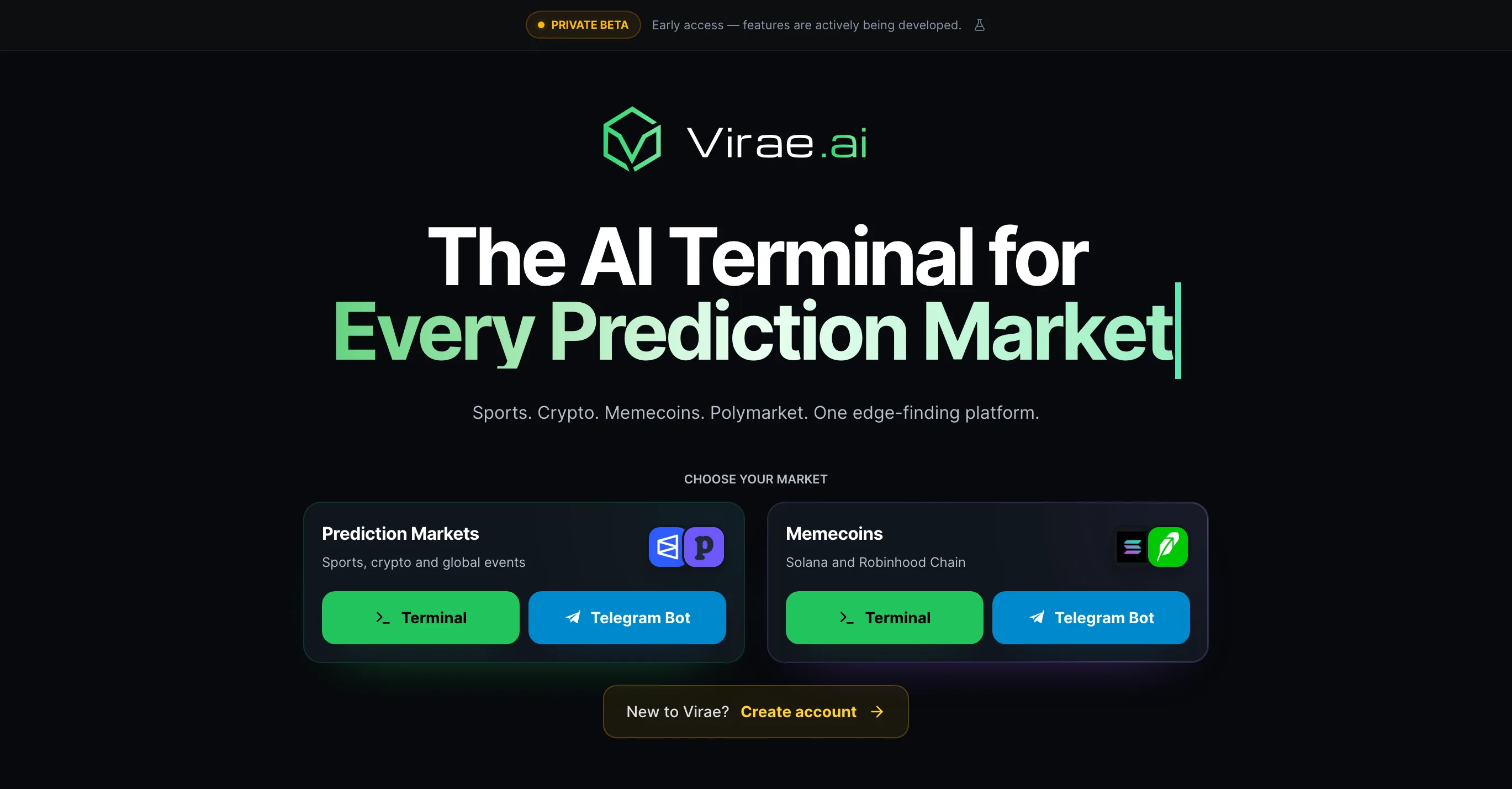
AI trading terminal for Polymarket, in private beta: market discovery with live trending topics and order-book prices, a whale leaderboard ranking tracked wallets by PnL, volume, win rate and Sharpe with one-click copy tasks, and seven trading Agents across four strategy types — end-of-round BTC/ETH price-distance, pre-market maker ladders, weather-model probabilities and Musk tweet counts. Agents watch every eligible round and only place orders when sizing, liquidity and entry rules all pass; each ships with recorded paper performance clearly labelled as simulation, and the strategy-evaluation core is open source on GitHub. Turnkey-backed non-custodial wallets, web app plus Telegram bots, and a separate Solana memecoin terminal.
Oracle Markets
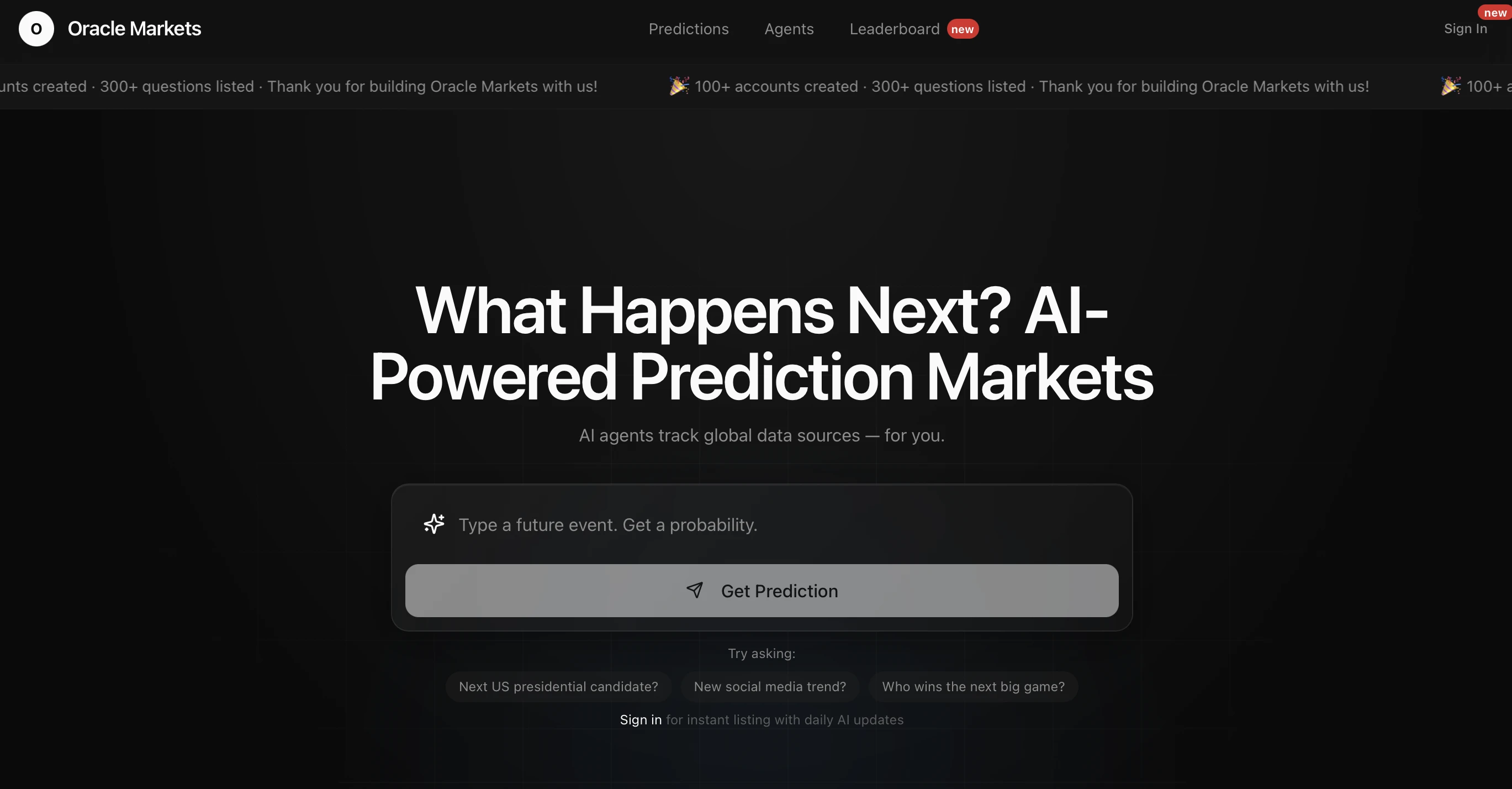
Open-source AI forecasting platform. Multiple independent AI agents analyze news, data and market signals daily to produce calibrated consensus probabilities on future events — with per-agent reasoning and an accuracy leaderboard. Scientific forecasting only, no monetary trading.
The framework is worth reading even if you never run it: it is the clearest public statement of how the exchange itself expects agents to talk to it. What it is not is a reason to skip the parts above that it leaves out. POLBOTS does not verify any agent's performance, and nothing here is financial advice.
Frequently asked questions
- Is Polymarket Agents a trading bot?
- It is a framework for building one: the plumbing between Polymarket's APIs, a language model, a retrieval store and a CLI, with the decision logic left to you. Out of the box it can list markets and run an agent that reasons about them; whether that agent should ever hold your money is a question it does not answer.
- Which model does it use?
- It is wired for OpenAI by default — the setup asks for an OpenAI key — and the retrieval layer uses a Chroma vector store. The model is a dependency you choose and pay for per token; swapping it is part of making the framework your own.
- Can US users run it?
- The README says it plainly: Polymarket's terms prohibit US persons, and persons in certain other jurisdictions, from trading on Polymarket through the UI and the API, agents included. You can read the code anywhere; you can trade with it only where the venue accepts new orders.
- Is it up to date with CLOB V2?
- Check before you trade. The order book moved to V2 on 28 April 2026 and the old Python client stopped working; any project that pins the archived py-clob-client cannot place orders until it is ported to the unified polymarket-client SDK. Look at the pinned dependencies and the exchange connector, and run it in a dry mode first.