On this page9 sections
The short answer
Copying a Polymarket wallet one to two minutes late costs less than people think. In our replay it cost under a cent a share, and the copier kept about three quarters of the leader's profit. Whether copying pays comes down to the wallet you pick, and most wallets on the leaderboards cannot be copied at all.
We took every wallet that has made the top 100 of any of Polymarket's four PnL leaderboards: all-time and this month, overall and in Crypto. That came to 407 wallets. For each one we asked what the leaderboard doesn't show: is it still trading, is it a bot a copier can't follow, is its record more than one lucky market, and is it making money now. 36 passed. 21 of those made money for a simulated copier over the last 30 days.
Then we asked the question that matters: if you had followed this list a month ago, would it have paid? The answer depended on the day we asked: +15.8% on October 13, −5.3% on October 15. The test rests on six to ten wallets, and one of them decided whether the number was positive or negative. So that part of the study is a reason to keep watching, not a result.
What we measured
We took the top 100 of four boards: overall all-time, overall this month, Crypto all-time and Crypto this month. We added every wallet that has appeared on any of them since we started measuring on October 11, because once a wallet is in our registry it stays there. That makes 407 distinct wallets.
For each wallet we pulled the following, with no account and no key:
- its leaderboard PnL, after fees and before rebates;
- its fills over the last 90 days;
- its latest 500 fills, split into maker and taker;
- its open positions, and its best and worst closed markets;
- its maker rebates and liquidity rewards;
- its daily PnL series.
The PnL series is for the shape of the record, not the totals: 30- and 90-day change, drawdowns, and how many weeks were up.
Where 407 wallets went
Each wallet ends up either copyable or rejected, with the reasons listed. The table counts each wallet at the first rule it breaks, in the order a copier would ask:
| Check | Rule | Out | Left |
|---|---|---|---|
| Still trading | a fill in the last 14 days | 168 | 239 |
| Not a market maker | out if half or more of its fills rest on the book and it also quotes both sides, fills 100+ times a day or trades 50+ markets a day | 97 | 142 |
| One-sided | buys both outcomes in under half of the markets it trades more than once | 29 | 113 |
| Human pace | 200 fills a day or fewer, under half of them in 5- and 15-minute crypto windows | 29 | 84 |
| More than one market | its best single market is under half its all-time PnL | 22 | 62 |
| A real record | 30 markets or more | 7 | 55 |
| Making money now | up over the last 90 days | 11 | 44 |
| Making money overall | up all-time | 8 | 36 |
Most wallets break several rules at once; only 80 break exactly one. Counted rule by rule, the numbers are bigger:
- 168 inactive;
- 164 flat or down over 90 days;
- 138 too fast;
- 126 market makers;
- 98 carried by a single market;
- 77 with fewer than 30 markets;
- 42 losing all-time;
- 30 buying both sides.
Finding 1: the all-time leaderboard is a museum
74 of the all-time top 100 have not traded in two weeks. Sixteen of them last traded between September and November 2024. All sixteen are politics wallets, and their trading stopped with the US election. The top of the board reads like an archive:
| Rank | Wallet | All-time PnL | Last trade | Why a copier can't follow |
|---|---|---|---|---|
| 1 | Theo4 | $22.05M | Nov 13, 2024 | inactive, fewer than 30 markets |
| 2 | swisstony | $18.42M | Aug 26, 2026 | inactive, and too fast when it did trade |
| 3 | Fredi9999 | $16.62M | Oct 24, 2024 | inactive, one market is half the record |
| 4 | RN1 | $13.05M | still trading | market maker, about 2,500 fills a day |
| 5 | kch123 | $11.35M | Jun 29, 2026 | inactive |
| 6 | mintblade | $9.11M | Jun 16, 2026 | inactive, one market, fewer than 30 markets |
| 7 | fishalive | $9.00M | Jun 15, 2026 | inactive, one market, fewer than 30 markets |
| 8 | frostrizz | $8.80M | Jun 20, 2026 | inactive, one market, fewer than 30 markets |
| 9 | Len9311238 | $8.71M | Nov 6, 2024 | inactive, fewer than 30 markets |
| 10 | sparklingwater123 | $8.35M | Jun 25, 2026 | inactive, one market, fewer than 30 markets |
Ranks 6 to 10 include four sports wallets that look alike. Each traded fewer than 30 markets, one market makes up at least half of each record, and each made its last fill in June 2026. A board ranked by lifetime profit rewards one great call and never forgets it. Of the all-time top 100, 6 pass every check, and 3 made money for a copier last month.
Finding 2: the monthly leaderboard is mostly machines
The 30-day board has the opposite problem. Everyone on it is active, but most of them are not people clicking buttons. 54 of the monthly top 100 are market makers or speed bots; on the Crypto monthly board, 76 are. Across all four boards, 239 wallets are still trading, and 148 of them (62%) are one or the other.
Two examples:
- RN1 fills about 2,500 times a day, and 89% of its fills rest on the book.
- breakthebank, #2 this month at $4.22M, fills 534 times a day, essentially all of them as the maker.
There is nothing to copy there. A market maker makes its money from the spread by posting the price you would be taking, and part of its income never shows up as a trade. The 126 market makers in our set collected $3.75M in maker rebates and $1.12M in liquidity rewards over 90 days; RN1 alone took $455K in rebates. A copier gets none of it. Our market-making guide explains where that income comes from.
Speed is the other wall. Some wallets trade the 5- and 15-minute BTC windows, or fill hundreds of times a day. By the time a copy lands, they have already moved on. The minute-markets guide explains why those markets come down to speed.
Finding 3: being late is cheap, picking the wrong wallet is not
We replayed every fill the 36 copyable wallets made over the last 30 days, twice:
- At the price the wallet got.
- At the price a copier would have got. That is Polymarket's one-minute midpoint after the delay, plus half a typical spread and the market's taker fee.
Sizes and exits are the same in both runs. Anything still held is valued at resolution, or at today's price if the market is open. 33 of the 36 had enough fills to replay.
| Delay | Extra cost per share (median) | Winning leader's profit kept (median) | Copier in profit |
|---|---|---|---|
| almost instant | 0.7¢ | 82% | 21 of 33 |
| 1–2 minutes | 0.8¢ | 78% | 21 of 33 |
| about 5 minutes | 0.8¢ | 75% | 21 of 33 |
The column that never moves is the last one. 21 leaders made money over the month and 12 lost money. At every delay, the copier made money on the same 21 and lost on the same 12. In this sample, a delay never turned a winning wallet into a losing copy.
Pooled, the 33 leaders made 5.5% on $22.6M of buys. The copier made 3.8% one to two minutes late and 3.3% five minutes late. The tail is wider than the median: for the worst tenth of winning wallets, a copier one to two minutes behind kept 36% of the leader's profit or less.
So being late has a real but small cost. Following the wrong wallet can cost you everything you put in. Picking is the strategy.
What the 21 look like
By specialty: sports 7, crypto 6, politics 5, economics 2, and one with no clear specialty. The median wallet among them:
- trades 34 times a day across 690 markets;
- has a median fill of $77 and buys at 57¢;
- has given back at most 26% of its peak;
- was up in 65% of its weeks.
Twelve of them place most of their orders as resting limit orders. A copier who takes liquidity pays the spread those wallets were being paid. Four have had drawdowns deeper than half their peak, and three were up in fewer than half their weeks.
Finding 4: the forward test is too small to trust
To check whether the filter picks anything at all, we rebuild the list as it would have looked 30 days earlier. That list holds wallets in the overall all-time top 100 that break no structural rule, were trading at the time, and were up over the 90 days before. Then we score the next 30 days: did the wallet stay in profit, and would a copier one to two minutes behind have made money? Every daily run repeats the test:
| Run | Wallets on last month's list | Up the next 30 days | Copier in profit | Pooled return on money spent |
|---|---|---|---|---|
| Oct 11 | 10 | 8 | 7 of 9 | +15.3% |
| Oct 13 | 9 | 7 | 6 of 9 | +15.8% |
| Oct 14 | 9 | 7 | 6 of 9 | +10.3% |
| Oct 15 | 6 | 3 | 4 of 6 | −5.3% |
The difference between October 14 and 15 is mostly one wallet. On the 14th, kch-temp (#51 all-time, #4 this month) took $7.05M of the $13.25M a copier would have put to work. It also brought in +$1.47M, more than the list's whole profit of +$1.37M. Without it, the other eight returned −1.7%.
Overnight, the pace of its latest fills jumped from 32 to 330 a day, essentially all as the maker. Our rules now call it a market maker, so it left the list. Two other wallets dropped out too:
- ndb1 was reclassified the same way. Copying it would have lost $233K on $1.56M.
- weflyhigh fell off when its prior 90 days slid into a loss.
Six wallets remained, and three made money.
So, honestly:
- Six to ten wallets, one month. The daily runs are not separate tests. They show the same month from neighbouring days, and their windows overlap by 29 days.
- One wallet can decide the sign. Pooled returns are weighted by money spent, and one big wallet can be half the money.
- The list is rebuilt with today's eyes. Structural traits like maker share and pace are measured now, and we assume they held a month ago. A wallet that became a market maker this month disappears from last month's list. That can make the result look better or worse.
- The replay is generous. It leaves out the copier's own price impact and partial fills. Copying $7M of a market maker's fills one to two minutes late would not get you the midpoint plus half a cent.
The data does support two things: the delay is not what kills copy trading, and most of the leaderboard cannot be copied at all. It does not yet support the claim that a filtered list of leaderboard wallets keeps making money after you pick it. Weigh any copy-trading pitch that says otherwise with that in mind, and that includes a hot month on our own list.
If you copy anyway
- Start from wallets that pass, not from the top of the board. The all-time top is mostly inactive and the monthly top is mostly bots. Our list of wallets worth copying and the Crypto list run the checks above every day.
- Check pace and maker share yourself. Every wallet's fills are public. If it fills hundreds of times a day, or buys both outcomes of the same market, a copy has nothing to reproduce.
- Look past the headline month. Look for profit over 90 days, at least 30 markets, no single market worth half the record, and more up weeks than down weeks.
- Size as if your evidence is one month. It is.
- Cap your slippage. Our replay assumed half a cent of spread. A copy tool that sends market orders into a thin book pays more.
These catalog tools place the copy trades for you, rather than just alerting you to them. Our copy trading guide covers what each kind of tool costs. POLBOTS sells no copy trading.
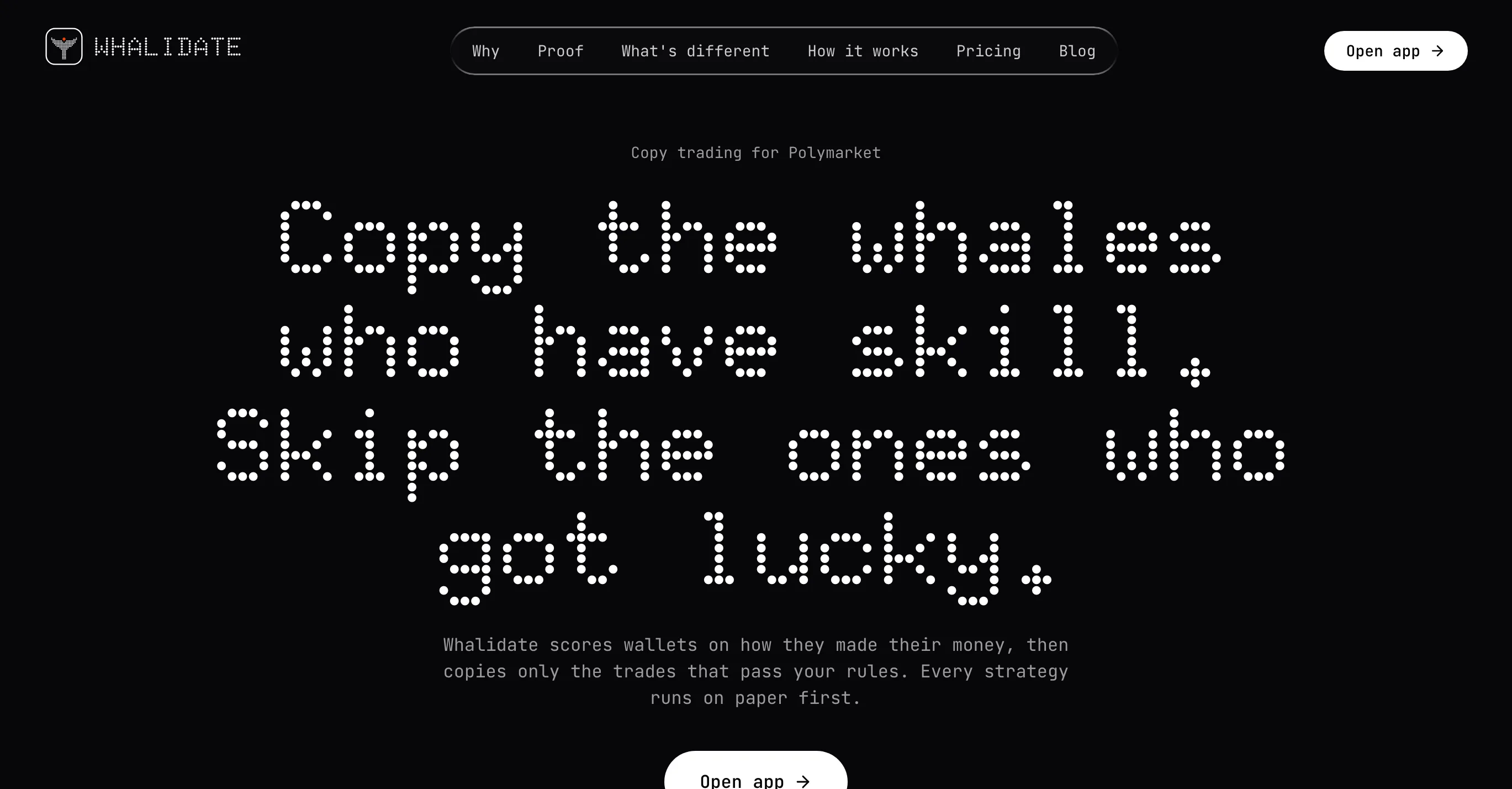
Whalidate
Verified PartnerCopy trading for Polymarket that starts with the question a profit leaderboard skips: how did the wallet make its money? Its WhaleFinder tool replays each wallet's public history and scores the return on the money put in, the number of settled trades, the worst drawdown and how much of the profit came from a single bet. By default a wallet needs a 15% return, 30 settled trades, a drawdown of 25% or less and no more than half its profit from one trade; on Sep 30, 2026, 166 of the 1,346 wallets scored in full passed. You pick the wallets and set the rules — entry price band, slippage cap, market categories, caps per market and per event, daily, weekly and drawdown loss limits — and Whalidate copies only the new buys that pass, with a fill-or-kill order at the price the book offers. Every strategy runs on paper for free with no time limit. Live copying needs a paid plan from $49 a month, takes no fee per trade, and runs from a trading wallet whose keys Whalidate holds.
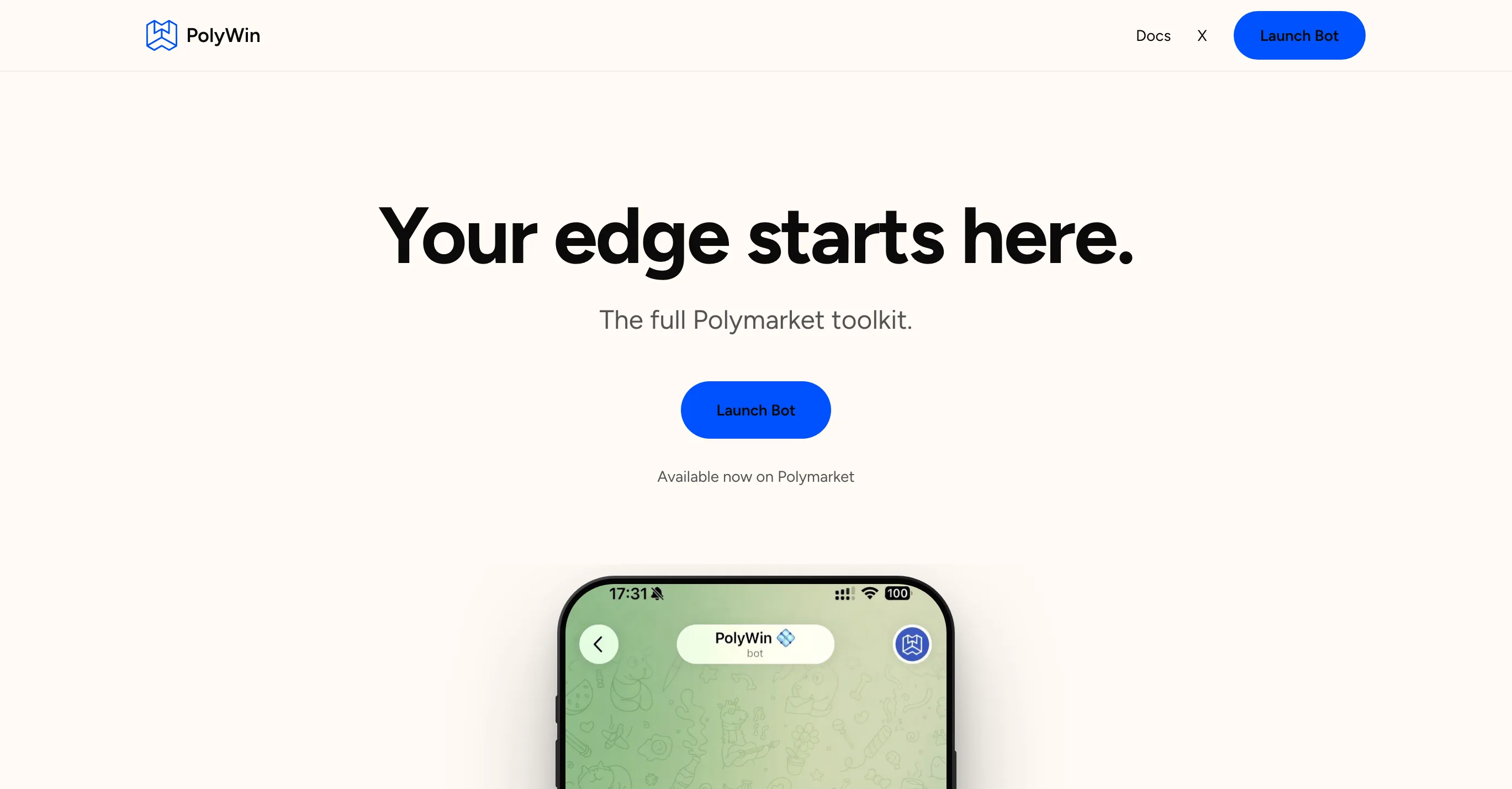
PolyWin
Verified PartnerTelegram bot that puts the whole Polymarket workflow in one chat: copy trading, two snipers, backtests and AI trader discovery. Copy Trade mirrors — or counter-trades — any wallet you pick, sized as a fixed USD amount, a percentage of the leader’s stake, or portfolio-weighted so your allocation matches theirs with a 0.01–10× multiplier, under category, price-range, market-volume and daily-spend limits with take-profit and stop-loss on every copied fill. Final Snipe fires a market order the second your entry conditions pass; Reversal Snipe ladders limit orders into an overreaction and cancels unfilled rungs about five seconds before resolution — both across BTC, ETH, SOL, XRP, BNB, DOGE and HYPE on 5m, 15m, 1h and 4h. Every snipe strategy can be backtested against a pre-computed pool of parameter combinations first, returning Most Profitable, Fast and Safest variants. AI Picks re-scores Polymarket traders every six hours, discarding wallets that show wash trading or leaderboard farming. Non-custodial: a Polygon wallet is deployed on first start, keys are encrypted per wallet and exportable, and TOTP 2FA gates withdrawals and key exports. No KYC, and deposits from ten chains auto-bridge to USDC.

Infinity
Verified PartnerA full trading terminal inside Telegram, covering two venues at once: Polymarket prediction markets on the live CLOB order book, and Hyperliquid perps and spot — plus copy-trading on top. There is no baked-in strategy; Infinity is the execution layer, so you decide and it fills. Each account gets its own dedicated wallet per venue, AES-256-GCM encrypted at rest and exportable at any time. Written in Rust, translated into 8 languages, and running on mainnet with on-chain fills anyone can verify.
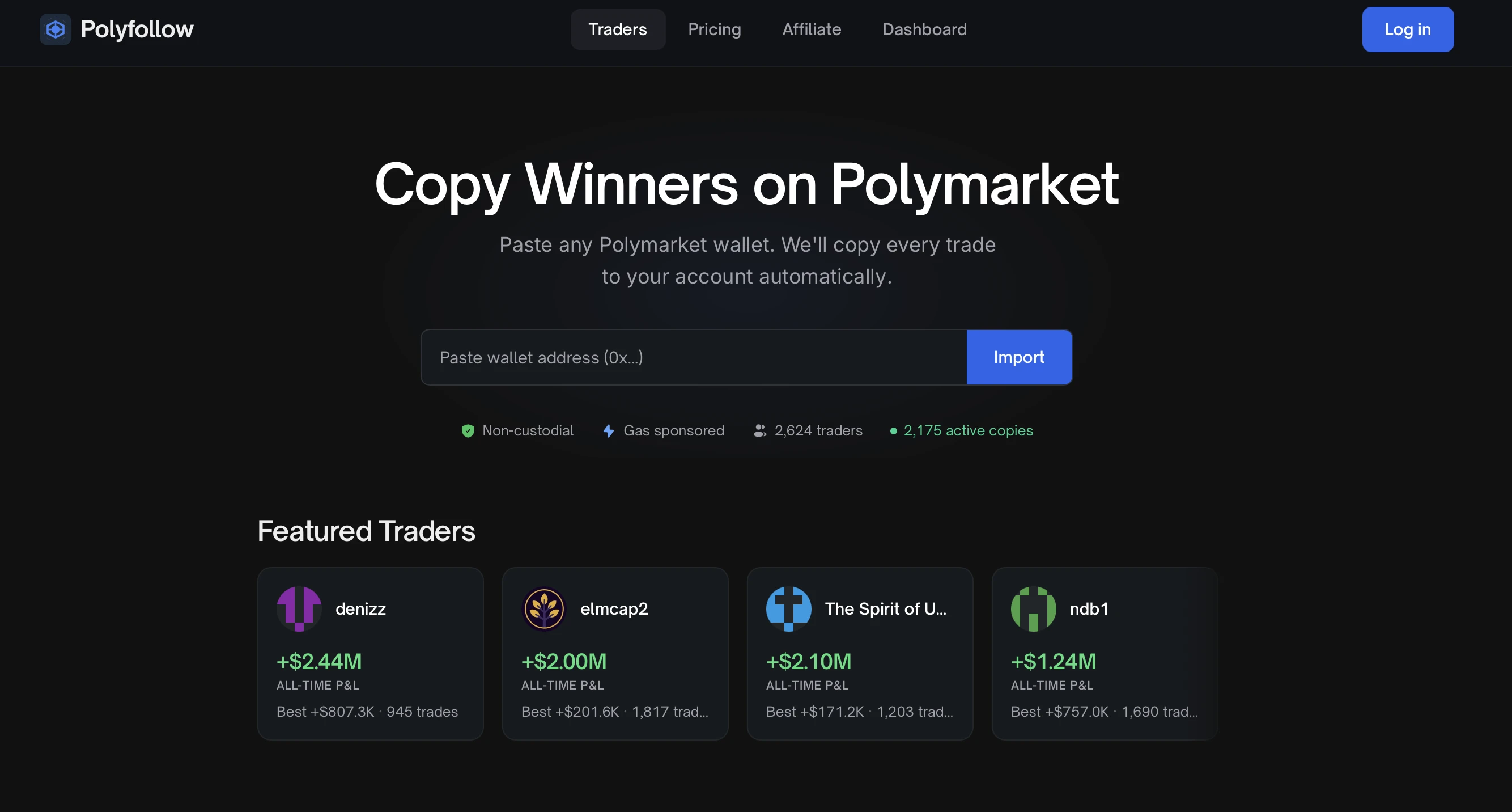
Polyfollow
Automated copy-trading for Polymarket. Follow proven top traders and replicate their positions automatically, so your book tracks theirs without manual order entry.
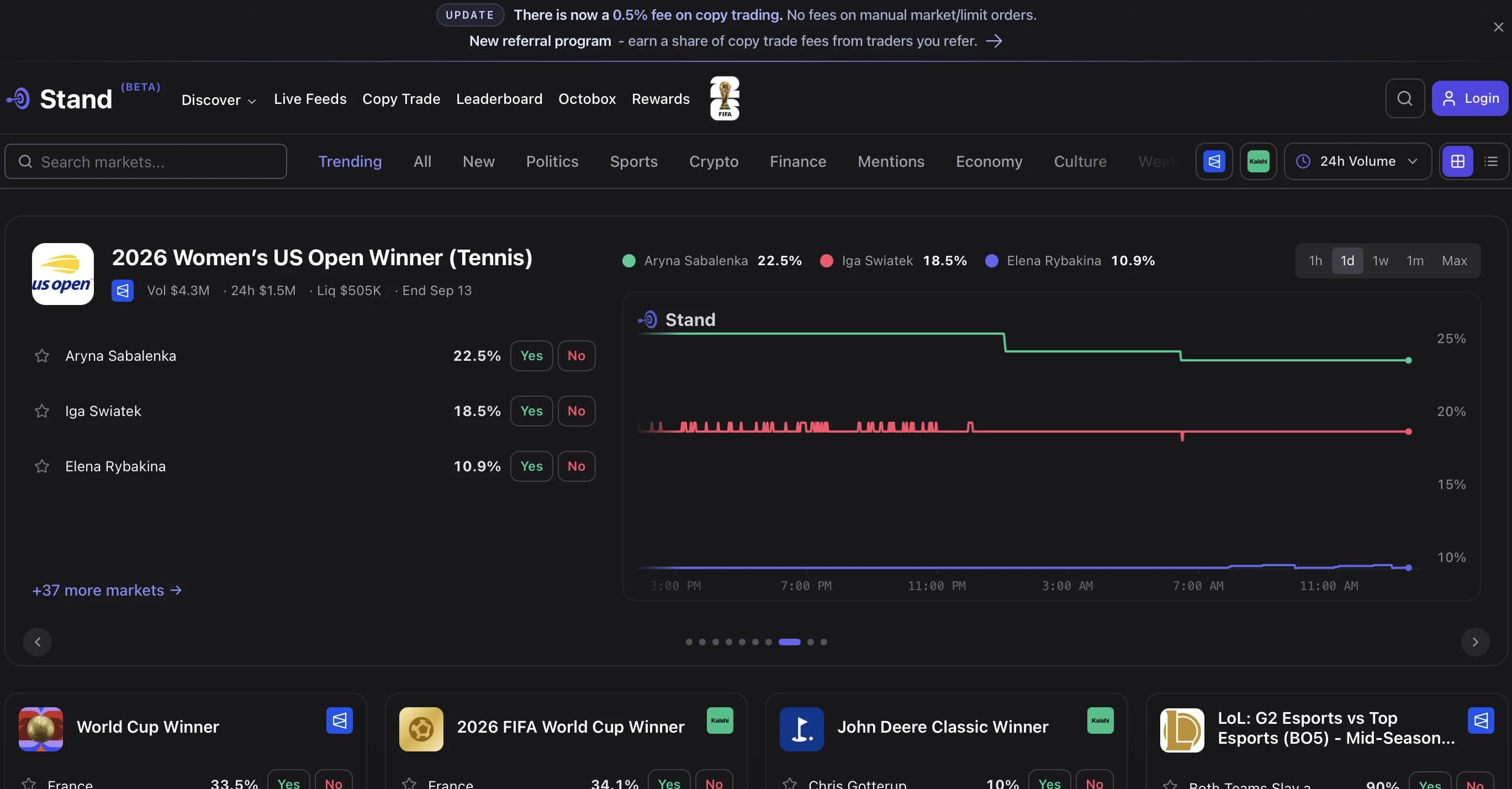
Stand
Advanced trading terminal and aggregator for prediction markets. Pulls Polymarket and Kalshi into one trade-first interface with live volume, liquidity and open interest, whale copy-trading, TP/SL and stop orders, and an Octobox that watches up to eight markets at once. Non-custodial via Privy, no fees on manual orders.
Method, in full
- Data. We use Polymarket's public Data API for leaderboards (PnL after fees, before rebates), trades and activity, open and closed positions, traded-market counts, maker rebates and rewards. The replay also uses market data and one-minute price history from Polymarket's CLOB. No account and no API key are needed.
- Profile PnL series. This is daily and counted before taker fees. It drives the 30- and 90-day change, drawdowns, weekly win rate, and the forward test's "up the next 30 days". We remove one-day spikes in the series.
- Maker share. We compare the wallet's latest 500 fills with its taker-only fills over the same window.
- Replay. We take up to 1,000 fills from the last 30 days. The copy price starts from the first one-minute midpoint at or after the delay (+1 s, +60 s or +300 s). On top of that comes half a spread: 0.5¢, or 0.2¢ when the price is below 10¢ or above 90¢, and never less than half a tick. Then comes the taker fee, rate × p × (1 − p), with the rate read off the wallet's own taker fills in that market, or 3% where it never took liquidity. Sells only close what was bought inside the window. Price impact and partial fills are not modelled.
- Forward test. Last month's list holds wallets in the overall all-time top 100 that break no structural rule, have a fill within the last 44 days, were up over the 90 days before the last 30, and were up all-time before that.
Each wallet's own numbers — fills, markets, drawdowns, its copy replay — are on its page under /wallets.
Frequently asked questions
- Does Polymarket copy trading work?
- The copying part does. In our October 2026 test a copier one to two minutes behind paid a median 0.8¢ a share more than the wallet it followed and kept about 78% of a winning wallet's profit. The hard part is the picking. Only 36 of 407 leaderboard wallets could be copied at all, and a list built a month earlier returned anywhere from +15.8% to −5.3% depending on the day we measured. The mechanics hold up. Nobody has shown yet that the picks keep winning.
- How much does copying a wallet a minute late cost?
- Less than most people assume. Across 33 copyable wallets replayed over 30 days, the median extra cost was 0.7¢ a share copying almost instantly, 0.8¢ at one to two minutes and 0.8¢ at five minutes. A copier kept a median 82%, 78% and 75% of a winning wallet's profit at those delays. In this sample the delay never turned a winning wallet into a losing copy.
- Why not just copy the top of the leaderboard?
- Because the all-time top is mostly people who stopped trading, and the monthly top is mostly bots. 74 of the all-time top 100 had not traded in two weeks, and 16 of them last traded during the 2024 US election. 54 of the monthly top 100 are market makers or speed bots, and on the Crypto monthly board that rises to 76.
- Can you copy a market maker or a speed bot?
- No. A market maker makes money from the spread by posting the very price a copier would be taking, plus rebates and rewards that never show up as a trade. The 126 market makers in our set collected $3.75M in maker rebates and $1.12M in liquidity rewards over 90 days. A speed bot trades 5- and 15-minute crypto windows or fills hundreds of times a day, so its position is closed before a copy lands.
- How reliable is the forward test?
- Not very, and we say so. It rests on six to ten wallets and one month, and the daily runs overlap by 29 days, so they are not separate tests. On October 14 a single wallet was more than half the money a copier would have spent and brought in more than the list's entire profit. The next day it was reclassified as a market maker and dropped out, and the pooled return went from +10.3% to −5.3%.