On this page7 sections
Why copy trading exists on Polymarket at all
On most exchanges you cannot see who is trading. On Polymarket you can: every position is held by a wallet on Polygon, every fill is public, and Polymarket's own data API will hand you any wallet's positions and trade history without asking who you are. Leaderboards rank wallets by profit; trackers flag when a "whale" buys. Copy trading is the obvious next step: pick wallets that seem to know something, and have software mirror them.
It is the most popular category in the catalog after platforms, and the one where the gap between the pitch and the mechanics is widest.
How a copy bot actually works
- Watch. The bot polls or streams the trades of the wallets you chose. Public data, no permission needed.
- Filter. Your rules: which markets to copy (or skip), minimum liquidity, maximum price, whether to copy sells.
- Size. Proportional to the leader, fixed per trade, or capped per market and per day.
- Execute. It places your order — a market order to get filled now, or a limit near the leader's price and hope.
- Unwind. When the leader sells, it sells; or it holds to resolution; or it stops out on your own rules. Tools differ here more than anywhere.
The two facts that decide whether this makes money sit in steps 1 and 4. You see the leader's fill *after* it happened, and you buy *after* their buying moved the price. The delay may be seconds; the price damage can be larger than the leader's entire edge, especially on thin books.
Picking wallets: what the leaderboard does not tell you
Sample size. A wallet up $40,000 on six resolved markets is a lottery ticket that hit. A wallet up $4,000 on four hundred trades across a year is a track record. The second is worth more.
Where the profit came from. Sort the trades. If most of the gain is one election market that resolved their way, the "edge" was a single opinion. If gains are spread across many markets and months, something repeatable may be happening.
The shape of the losses. Many small wins and one catastrophic loss is a strategy with a hidden tail — it looks wonderful right up until the month it doesn't. Drawdowns, not win rate, tell you what following this wallet will feel like.
Whether you can copy it at all. A wallet that quotes both sides of a book is a market maker. It earns the spread; copying its buys without its sells just gives you its inventory risk. Leaderboards are full of them.
Whether it is real. Wash trading between a leader wallet and its own followers is how some "top traders" are manufactured. A copy platform that also runs the leaderboard has an incentive problem; prefer wallets you found yourself over wallets a platform is promoting.
The cost stack
| Cost | Where it comes from | Typical shape |
|---|---|---|
| Copy fee | The copy tool | 0.5–1% of each copied trade, or a slice of profit |
| Subscription | The copy tool | Free tier to follow a few wallets; paid for more, or for auto-execution |
| Polymarket fee | The market itself | Set per market by the protocol at match time — check before sizing |
| Slippage | The order book | You fill later and worse than the leader; grows with copier count and thin books |
| Latency | Your setup | Polling interval plus execution; seconds to minutes |
Run the numbers before you follow anyone. A leader averaging +2% per trade becomes a loss for a follower paying 1% to copy, crossing a 1% spread and eating Polymarket's fee on top. The better tools let you see the fee schedule and set a maximum entry price; use both.
Risk controls that matter
- Cap per trade, per market, per leader, per day. A single leader having a bad week should not be a bad month for you.
- Skip thin markets. Below a few thousand dollars of depth, your copy order *is* the price move.
- Decide the exit in advance. Copy the sell, hold to resolution, or stop out at a loss you set — pick one before the first trade, not during it.
- Stop copying on drawdown. A leader whose style changed, or who got lucky and now is not, shows up as a drawdown first. Have a rule that pauses them.
- Separate wallet, revocable access. The copy bot signs orders; give it a wallet with only the capital you are copying with.
Tools in the catalog
The copy trading category lists every tool we have reviewed. A few that show the range:
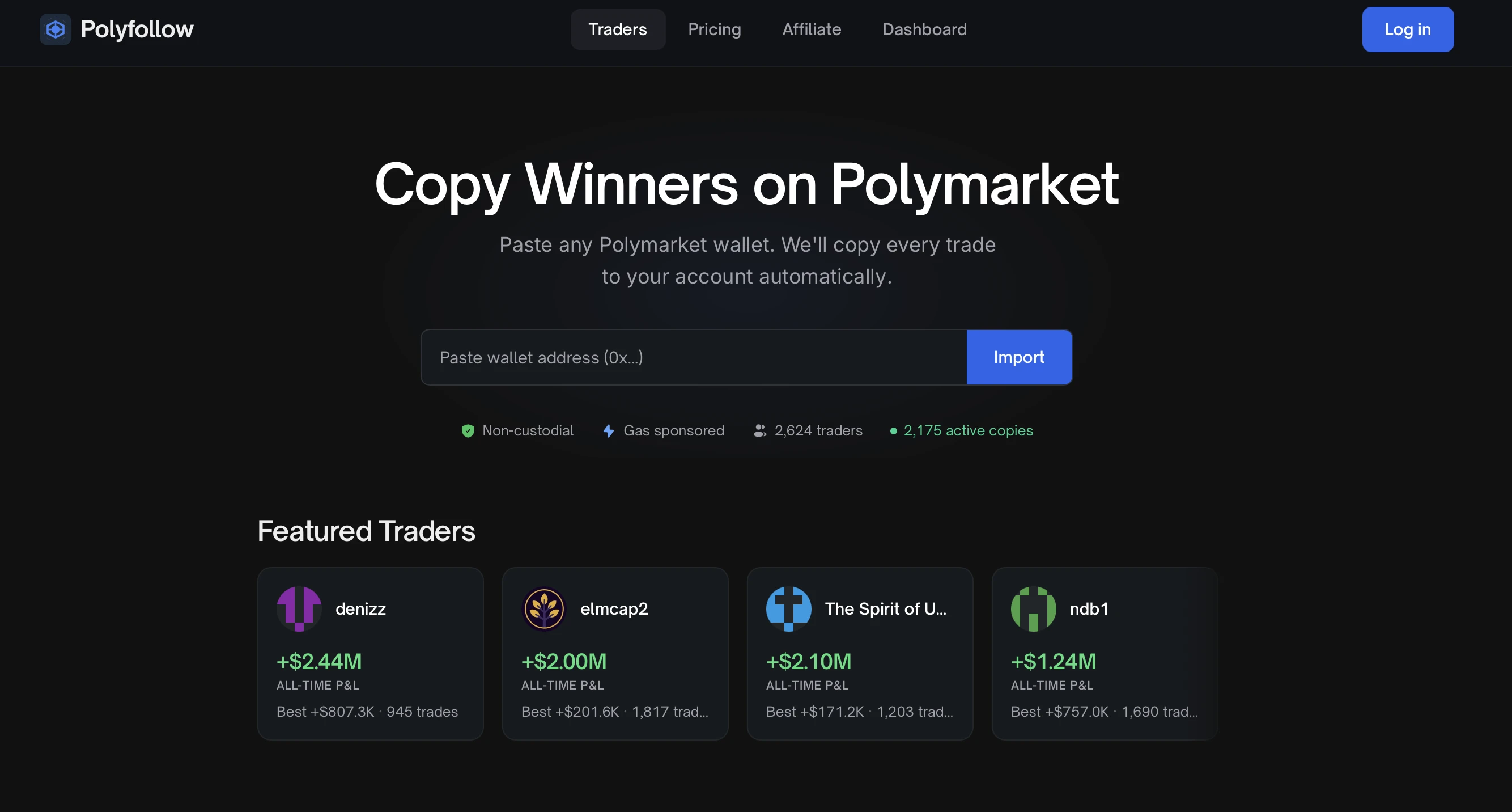
Polyfollow
Automated copy-trading for Polymarket. Follow proven top traders and replicate their positions automatically, so your book tracks theirs without manual order entry.
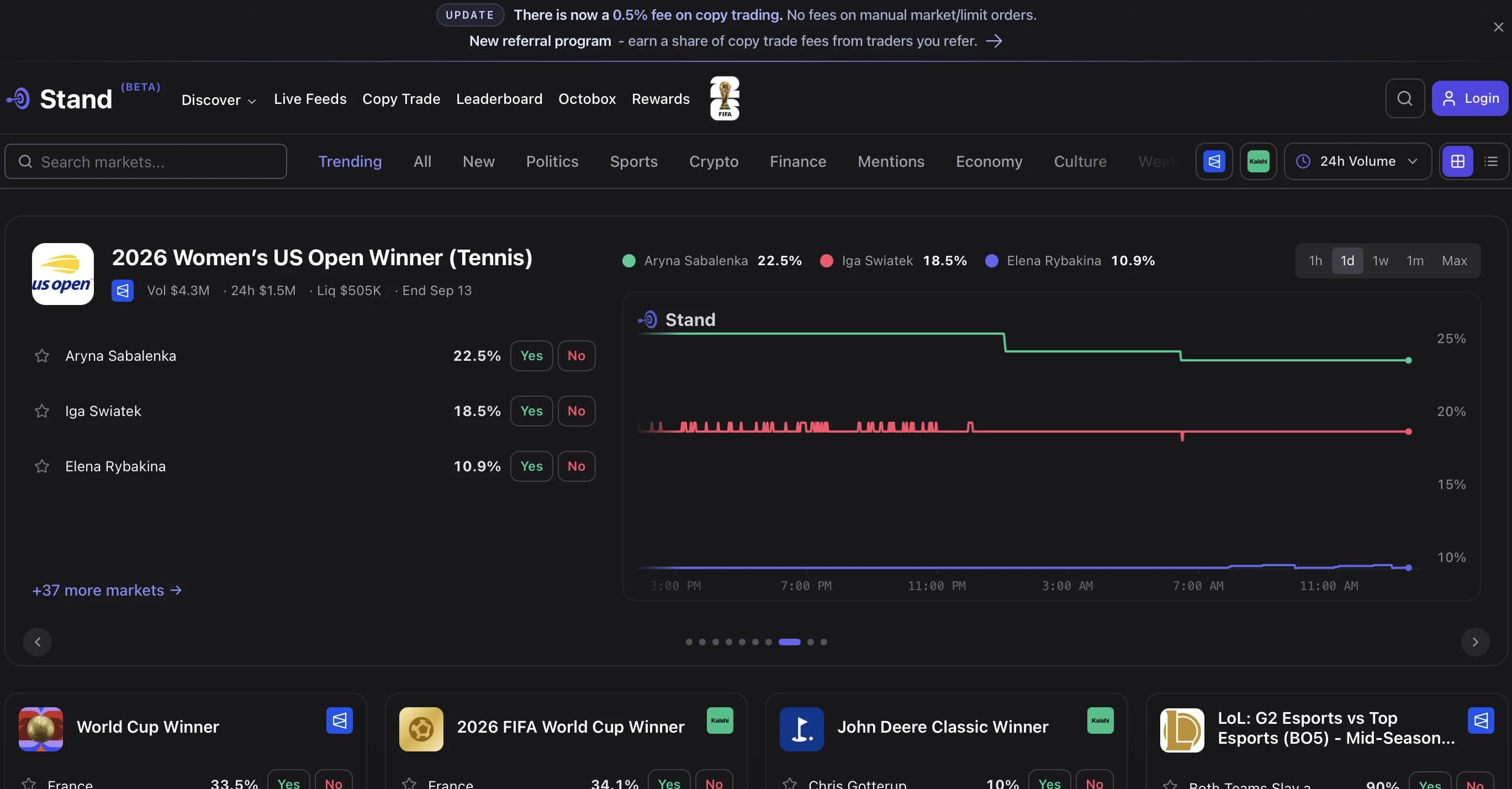
Stand
Advanced trading terminal and aggregator for prediction markets. Pulls Polymarket and Kalshi into one trade-first interface with live volume, liquidity and open interest, whale copy-trading, TP/SL and stop orders, and an Octobox that watches up to eight markets at once. Non-custodial via Privy, no fees on manual orders.
Infinity
A full trading terminal inside Telegram, covering two venues at once: Polymarket prediction markets on the live CLOB order book, and Hyperliquid perps and spot — plus copy-trading on top. There is no baked-in strategy; Infinity is the execution layer, so you decide and it fills. Each account gets its own dedicated wallet per venue, AES-256-GCM encrypted at rest and exportable at any time. Written in Rust, translated into 8 languages, and running on mainnet with on-chain fills anyone can verify.

Virae AI
AI trading terminal for Polymarket, in private beta: market discovery with live trending topics and order-book prices, a whale leaderboard ranking tracked wallets by PnL, volume, win rate and Sharpe with one-click copy tasks, and seven trading Agents across four strategy types — end-of-round BTC/ETH price-distance, pre-market maker ladders, weather-model probabilities and Musk tweet counts. Agents watch every eligible round and only place orders when sizing, liquidity and entry rules all pass; each ships with recorded paper performance clearly labelled as simulation, and the strategy-evaluation core is open source on GitHub. Turnkey-backed non-custodial wallets, web app plus Telegram bots, and a separate Solana memecoin terminal.
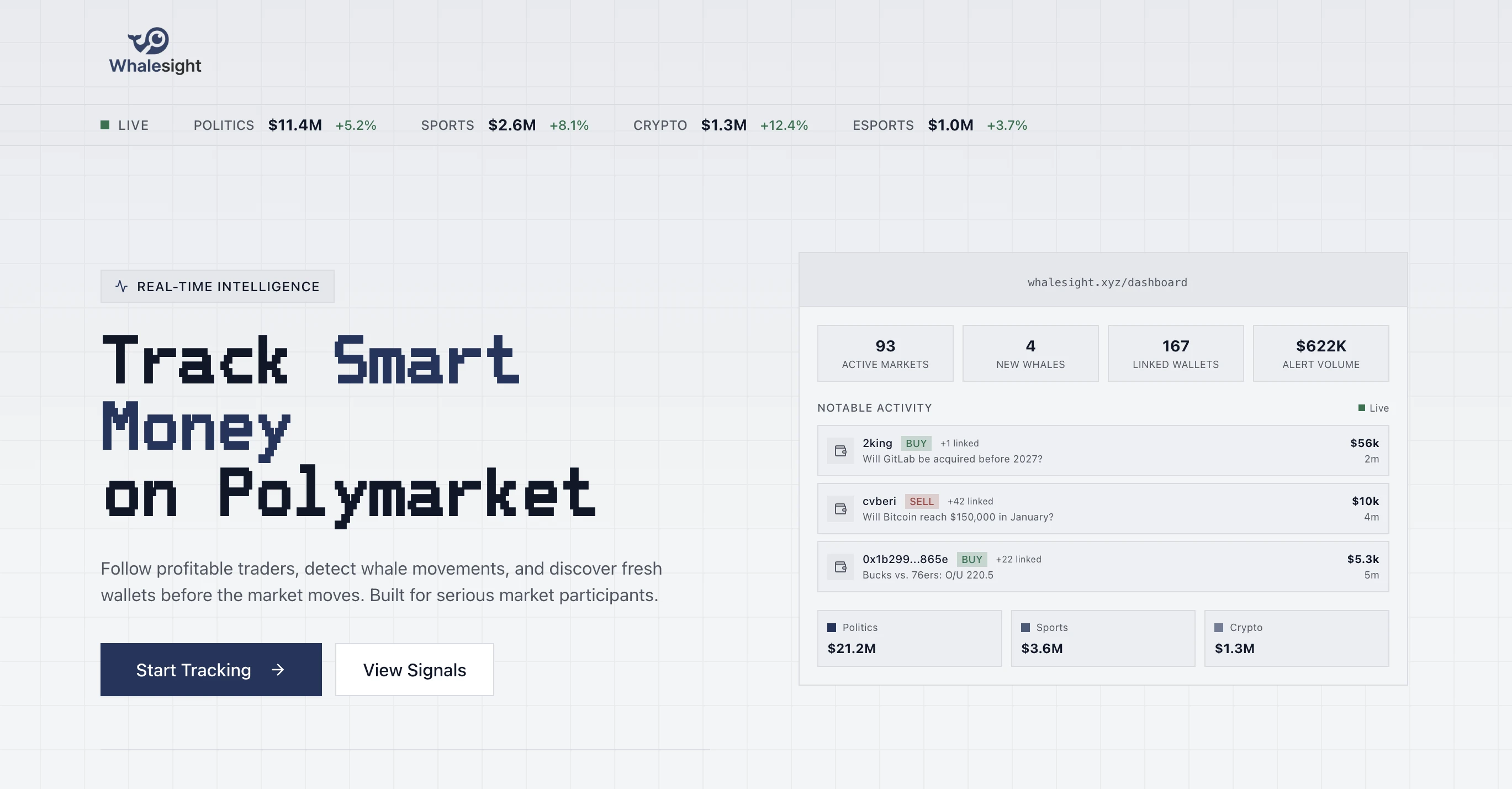
Polyfollow and Stand are copy-first platforms — Stand charges a 0.5% copy-trade fee and covers Kalshi too; Infinity and Virae AI are terminals where copying sits next to wallet leaderboards, alerts and, in Virae's case, AI agents. For tracking without trading, Whalesight and the Telegram tracker PolySpy watch wallets and tell you; you decide.
The honest summary
Copy trading is the easiest strategy to start and one of the hardest to make pay, because everyone who follows a wallet pays the same latency and the same slippage, and the wallets worth following know they are being watched. It works best small, selective and with leaders you researched yourself. It works worst as "set it and forget it", which is exactly how it is sold. As with everything here: POLBOTS does not verify anyone's performance, and none of this is financial advice.
Frequently asked questions
- Is copy trading on Polymarket legal?
- Yes, in the sense that the data is public and mirroring someone's trades breaks no rule. The usual limits apply: you must be in a jurisdiction where trading on the venue is permitted, and the copy tool must not be wash-trading or manipulating to climb the leaderboard it sells you.
- Why are my results worse than the wallet I copy?
- Because you buy after they did, at the price their buying moved. Every copier pays latency and slippage, and the more copiers a wallet has, the worse each one fills. Add the copy fee and the Polymarket fee on the market, and a wallet that is mildly profitable becomes a loss for its followers.
- How do I know a top wallet isn't faking it?
- You mostly don't, from the leaderboard alone. Look at the shape of the record: hundreds of small wins and one ruinous loss, or profit concentrated in one resolved market, is luck or theatre. Look at whether the wallet quotes both sides, which means it is a market maker you cannot copy. And distrust anything a copy platform itself is promoting.
- Can I copy trade from Telegram?
- Several tools do it — alerts on a wallet's fills, and one-tap or automatic mirroring. The convenience is real and so is the risk: a Telegram bot that trades for you holds credentials. Start from the project's official link, never from a bot that messages you first, and give it a wallet you can afford to empty.