On this page10 sections
What this is
POLBOTS lists a hundred-odd Polymarket bots, and every one of them was opened, poked at and written up before it went in. Most submissions pass. Some do not, and the most common reason is not a bad bot — it is that there is no bot: a marketing page with pricing, testimonials and a dashboard mockup, and nothing behind any of it.
In August 2026 four such sites turned up that were clearly built by the same hand. This guide is the evidence, the method, and the commands so you can run the same checks on anything before you pay.
The four domains
Plain text on purpose — none of these are links.
| Domain | Registered | What it claims to be |
|---|---|---|
| polytradingbot.net | Feb 2, 2026 | Polymarket copy-trading, tiers $99–$499 |
| polydexlab.com | Feb 1, 2026 | "Six modules" trading suite, tiers $99–$499 |
| polycopytrade.space | Apr 22, 2026 | Copy trading; later rebuilt as the next line |
| polysyncer.com | May 7, 2026 | "Poly Syncer", wallet-connect dashboard, a large SEO blog |
They share the same copy patterns, the same hosting fingerprint, and — the tell that first made us look — the same rating: 4.7 out of 5 on all of them.
Check 1: where do the buttons actually go?
The fastest check in the book. Pull every link on the page and look at the destinations:
curl -s https://example.com | grep -oE 'href="[^"]*"' | sort -u | head -20On a real product you see /login, /signup, /docs, an app subdomain, an App Store link. On polytradingbot.net and polydexlab.com, every call to action — "Launch", "Choose plan", "Open dashboard" — resolves to an in-page anchor: #how, #pricing, #dashboard, #wallets. The buttons scroll you further down the same page. There is no second page to reach.
Check 2: pricing with no checkout
All three of the live sites publish tiers — $99, $299, $499. Count the payment surfaces on the page:
curl -s https://example.com | grep -coE '<form|/checkout|stripe|paddle|gumroad'polytradingbot.net: zero. polydexlab.com: zero. A product that wants $499 and offers no way to give it is not a product yet; it is a page about a product.
Check 3: a rating nobody left
All four embed aggregateRating in their structured data — the markup that asks Google to print stars next to a search result:
curl -s https://example.com | grep -oE '"ratingValue"[^,]*|"reviewCount"[^,]*'polydexlab.com returns 4.7 from 342 reviews; polysyncer.com, 4.7 from 24; polytradingbot.net, 4.7 with no count at all. Then search the same page for the mechanism that collected them — a review form, a testimonials widget, a Trustpilot embed:
curl -s https://example.com | grep -coiE 'leave a review|customer review|trustpilot'Zero on all of them. There is no way for a customer to leave a review on any of these sites, and there never was. The stars are a number typed into a template — which is precisely what Google's structured-data policy calls out, and precisely what a shopper reading a SERP has no way to see.
Check 4: subdomains that answer but hold nothing
"But app.theirsite.com returns 200" proves less than it looks. Test a subdomain that cannot possibly exist:
curl -s -o /dev/null -w "%{http_code}\n" https://zzqq-test.example.comOn polysyncer.com that nonsense host answers 200 — wildcard DNS, catching everything. And the real-looking ones are hollow: app.polysyncer.com and app.polydexlab.com both return a 163-byte stub with no title and no application. Meanwhile /login on polysyncer.com is a 404, and /login on polytradingbot.net is a 404 too. The one page that does exist, polysyncer.com/dashboard, is a "Connect wallet" screen — it asks for a wallet connection before it shows you anything, which is a login wall with no account behind it.
Check 5: the paper trail
Match the claims against the domain's age. polysyncer.com was registered on May 7, 2026 and advertises figures in the tens of millions "mirrored" across tens of thousands of copiers, plus a team with names and photographs. A three-month-old domain with no checkout, no login and a wildcard DNS did not process that. Wayback and whois are enough to date the gap:
curl -s "https://web.archive.org/cdx/search/cdx?url=example.com*&limit=5"
whois example.com | grep -i "creation\|registrar"
What we are not saying
We did not find evidence that anyone lost money to these sites, and we are not alleging a crime. We never reached a payment step, so we cannot tell you what happens after one. Sites also change hands and get rebuilt; a domain that fails these checks today may host something real next quarter.
What we are saying is narrow and checkable: as of August 26, 2026 there is no product we could reach behind any of these four domains, and some of the claims on them — the ratings in particular — describe things that could not have happened. If we are wrong, we will publish the correction with the same prominence.
Two names deserve protecting, because the niche is full of near-identical domains: polytradingbot.com is an unrelated directory of Polymarket tools, and polytradingbot.xyz is a separate no-code bot builder. Neither is part of what is described here.
Why a catalog cares
Every listing on POLBOTS carries an outbound link, and links are the currency of search. Listing a site with nothing behind it would do two things: send a reader toward a $499 tier that cannot be bought, and hand a page that fabricates its own reviews a vote of confidence from a catalog that claims to check things. Declining costs us an entry. Listing would cost the reader more.
That is the whole reason the vetting checklist is public and the declines are documented rather than quietly dropped. The same checks live in the contributing guide of our open list, and anything that fails them gets the evidence rather than a rejection.
The five-minute version
Before you pay for any Polymarket bot, in any order:
- Pull every
hrefon the page. If the buttons are anchors, stop. - Count checkout surfaces. Pricing with no payment path is a mockup.
- Grep for
aggregateRating, then look for the review mechanism. No mechanism, no rating. - Curl a nonsense subdomain. If it answers, "app." answering means nothing.
- Date the domain against its biggest number.
Anything that survives all five is worth your time — and if it is a Polymarket bot, we would like to see it. Bots that pass our checks are in the catalog; the two below publish their full trade records, losses included, which is the opposite end of the spectrum from everything in this guide.
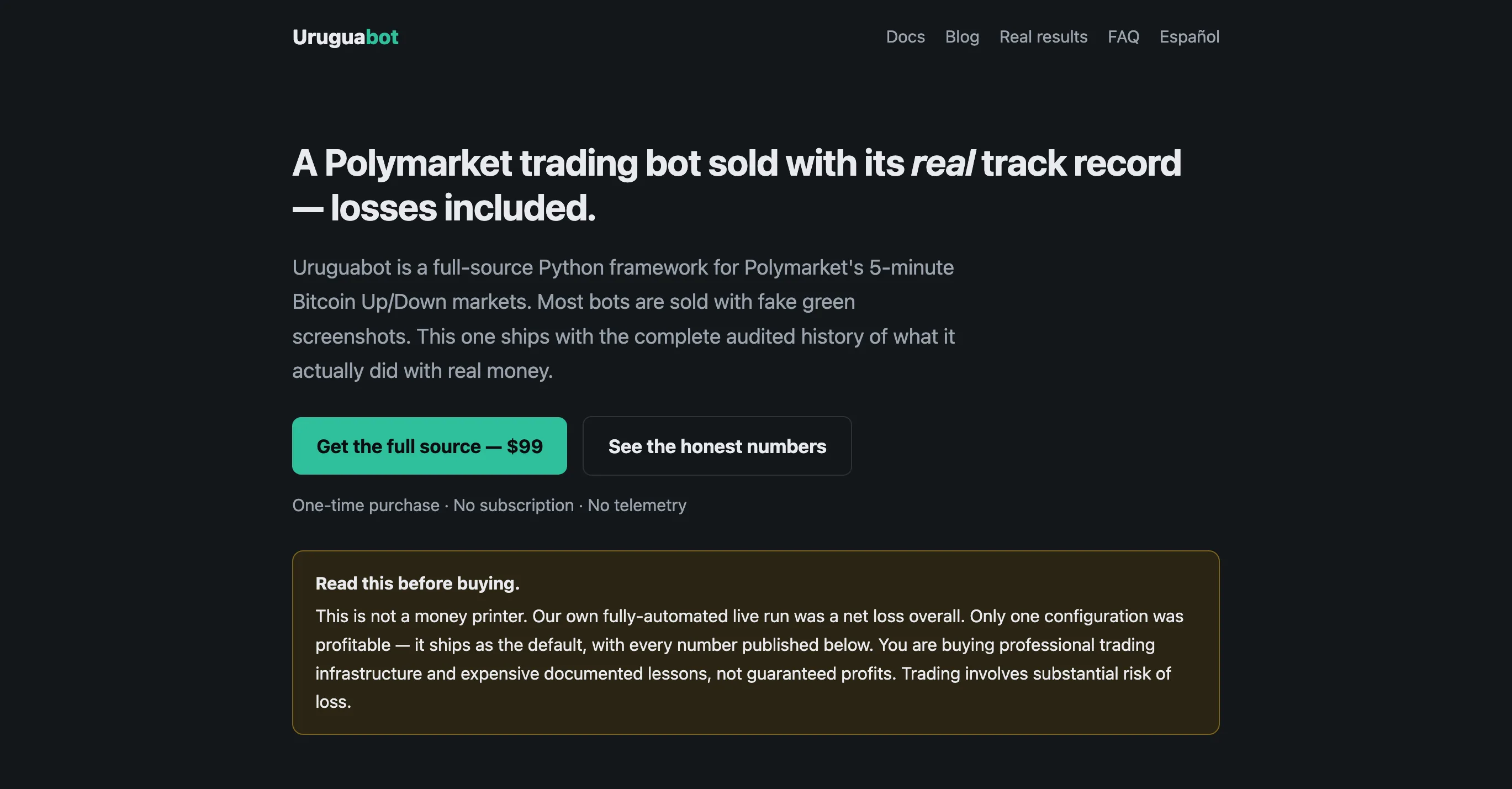
Uruguabot
Verified PartnerSelf-hosted Python bot for Polymarket's 5-minute BTC and ETH up/down markets, sold with its complete live trading record — losses included. A free GitHub repo publishes every fill from two generations of testing plus a 1,934-window study in which every automated signal scored roughly coin-flip against the human's 59%; the published numbers reproduce exactly from the raw CSVs, though the logs omit market ids, so the record is self-attested rather than on-chain verifiable. Both generations together lost about $270 — mostly execution and a since-fixed ghost-fill bug — while the configuration that ships as default closed its live run at +7.3% ROI on a 40% win rate over a small 25-trade sample: momentum entries, stop re-anchored to execution price minus 10¢, winners held to binary resolution. Dry-run is the default, with fills simulated from slippage measured on real trades; live mode takes two explicit flags and a dedicated wallet.
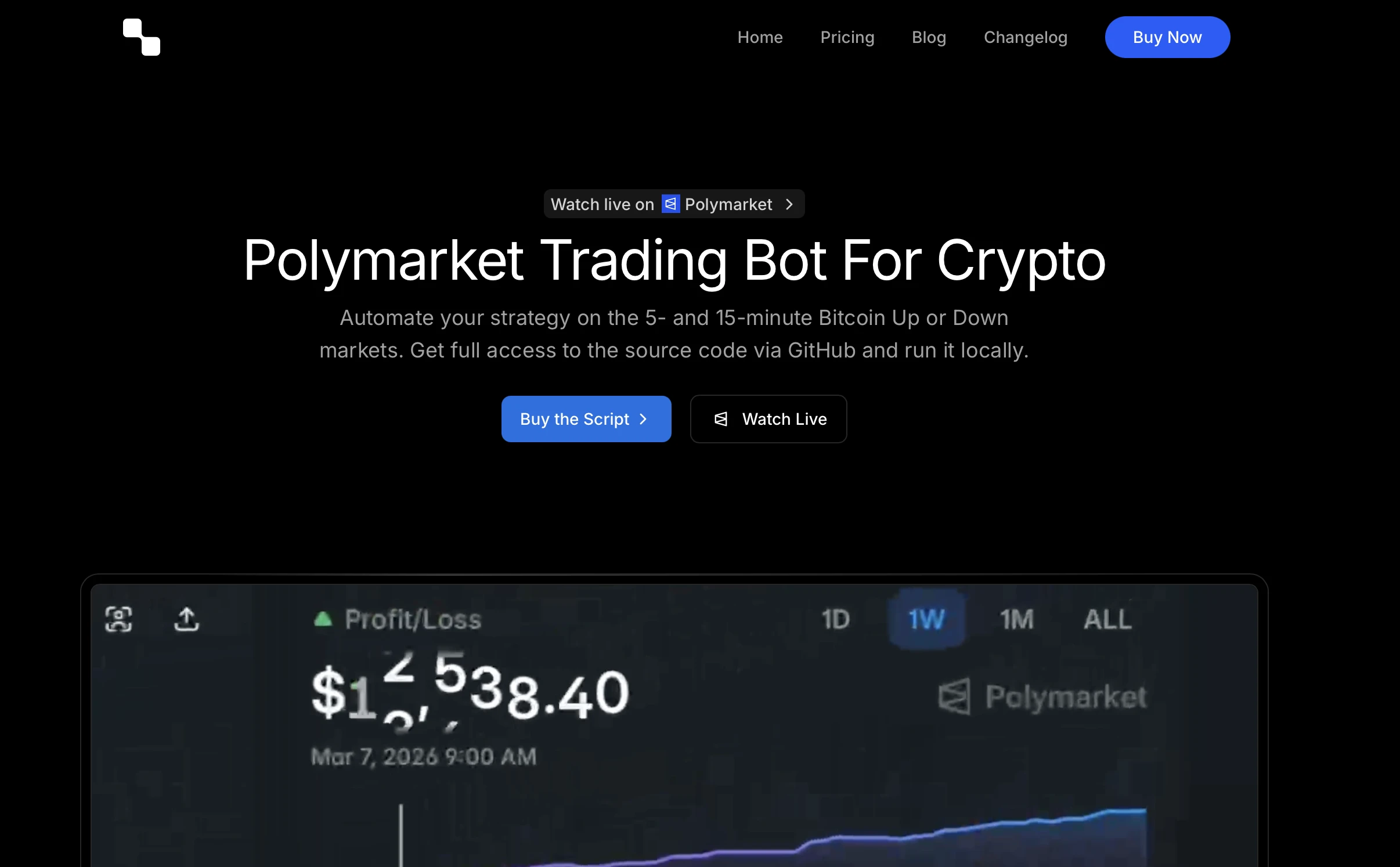
PolymTradeBot
Editor's ChoiceAutomated Python bot for Polymarket's 5- and 15-minute Bitcoin & Ethereum up/down markets. Trades live or in paper mode with configurable risk controls, self-hosted from full source.
Frequently asked questions
- Are these sites stealing money?
- We are not claiming that, and we have no evidence of it. What we can show is narrower and checkable: we could not find a product behind the marketing. The pricing tiers have no checkout, the buttons lead back up the same page, and the ratings count reviews that no mechanism on the site could have collected. Whether anything happens after you pay, we cannot say — we never got to a payment step.
- Is Poly Syncer legit?
- We could not reach a product behind it. As of August 26, 2026 polysyncer.com has no working login (that path is a 404), its app subdomain returns a 163-byte stub, a nonsense subdomain answers 200 because the DNS is wildcarded, and the only page that loads asks you to connect a wallet. It advertises tens of millions of dollars mirrored on a domain registered in May 2026, and shows a 4.7 rating from 24 reviews with no review mechanism anywhere on the site. We declined to list it. Run the five checks below and judge for yourself.
- Is PolyDexLab or PolyTradingBot.net a scam?
- We are not making that call, because we never reached a payment step — but neither one passed the checks. Both publish $99–$499 tiers with zero checkout surfaces on the page, every call to action resolves to an in-page anchor rather than an app, and both carry the same 4.7 aggregateRating as their sister sites with no way for a customer to have left a review. Whatever they are, they are not a product you can buy today.
- How do I check a site like this myself?
- Five commands, no account needed: list where the buttons go, probe /login and /dashboard, look for aggregateRating in the page source, test a nonsense subdomain to see whether the DNS answers everything, and compare the domain's age against its claims. All five are in this guide, and they take about five minutes.
- Is polytradingbot.com the same as polytradingbot.net?
- No, and the distinction matters. The .com is an unrelated third-party directory of Polymarket tools; polytradingbot.xyz is a separate no-code bot builder. Only the .net belongs to the group described here. Similar names are a hazard of the niche, not evidence of anything.
- What if one of these sites is real and you missed something?
- Then we would like to know, and we will publish the correction. Every observation here is dated, reproducible from the commands in the guide, and made from the outside — if there is a working product behind a login we never reached, show us and the listing question reopens.