On this page10 sections
- The short answer
- How to read a Polymarket book
- The spread: tight where the volume is
- Depth: the number that matters, and how little there is
- What a market order actually costs
- The price you see, and two fields not to trust
- Is the depth still there when you get to it?
- Why thin books eat bots
- How a bot should read the book
- Method
The short answer
Polymarket's order book is where every price comes from. Most bots read it once, as a single number. We read the full book of every market that traded in the last 24 hours to see what a bot actually trades against when it sends an order. For the order types themselves, start with Polymarket order types.
- The depth near the price is tiny. The median two-sided book had $21 within 2¢ of its midpoint. The 100 busiest had $8,874.
- The big totals are walls far from the price. Of the $8.4 billion resting in all the books, 86% sat more than 10¢ from the midpoint and 0.2% within 2¢.
- A market order on a typical book pays a lot. On books priced 10–90¢, a $1,000 market buy cost a median 42% against the midpoint, fee included. In the 200 busiest it cost 5.8%.
- The price you see isn't the price you get. Polymarket shows the midpoint, or the last trade when the spread is over 10¢. The book's own
last_trade_pricefield showed the other outcome's price on at least 37% of books. - The busy books hold still. Re-reading the 200 busiest every 30 seconds, the median book kept all of its near-price depth from one read to the next. The risk is not flickering liquidity. It is how little there is.
How to read a Polymarket book
Each outcome of a market has its own book. A bid is an offer to buy that outcome, and an ask is an offer to sell it. Buying "Yes" at 30¢ and selling "No" at 70¢ are the same trade, so the two books of a binary market mirror each other. Reading one is enough.
Four numbers matter:
| Number | What it is | Why a bot cares |
|---|---|---|
| Best bid / best ask | The highest buy and lowest sell resting now | A market buy pays the ask, a market sell gets the bid |
| Spread | Best ask − best bid | What a round trip costs before fees, at the smallest size |
| Midpoint | (best bid + best ask) ÷ 2 | What Polymarket displays as the price, unless the spread is over 10¢ |
| Depth | Dollars resting within some distance of the mid | How much you can trade before the price runs away from you |
The REST book (GET /book?token_id=…) lists bids in ascending order and asks in descending order, so the best price on each side is the last entry, not the first. A bot that takes bids[0] as the best bid is reading the 1¢ wall. Each response also carries a hash of the book's state. Compare it with the previous one to see whether anything changed.
The spread: tight where the volume is
| Spread | Two-sided books | Share of books | Share of 24h volume |
|---|---|---|---|
| 1¢ or less | 4,064 | 36.7% | 82.7% |
| 1–2¢ | 1,844 | 16.7% | 9.0% |
| 2–5¢ | 2,573 | 23.3% | 5.5% |
| 5–10¢ | 1,201 | 10.9% | 1.8% |
| Over 10¢ | 1,381 | 12.5% | 1.1% |
Another 1,318 markets (10.6% of those that traded) had a book with only one side, or none at all, at the moment we looked.
Most of the money trades in books that are a cent wide, and the spread looks like a solved problem there. It isn't, for two reasons. A cent is a lot of a cheap outcome: at 10¢, a 1¢ spread is 10% of the price. And the spread only prices the first few dollars. Past those, depth decides what you pay.
Depth: the number that matters, and how little there is
Median depth by how busy the market was:
| Markets, by 24h volume | Books | Spread | At the touch | Within ±1¢ | Within ±2¢ | Within ±5¢ | 24h volume |
|---|---|---|---|---|---|---|---|
| Top 100 | 100 | 0.6¢ | $576 | $3,631 | $8,874 | $16K | $94K |
| Ranks 101–1,000 | 900 | 1.0¢ | $103 | $287 | $865 | $2,211 | $5,665 |
| The other 10,063 | 10,063 | 2.0¢ | $21 | $0 | $12 | $99 | $72 |
"At the touch" is the best bid level plus the best ask level. "Within ±2¢" counts both sides. A buyer only reaches the asks: in the top 100, the median book had $3,638 of asks within 2¢ of the mid, against $341 for ranks 101–1,000 and $5 for the rest.
Two things follow for a bot.
The tail is untradeable at any size. Ten thousand markets that traded in the last day had a median of $12 near the price. A bot that scans "every market with volume" for signals will mostly find books it can't fill.
Busy books turn over many times a day. The top 100 traded a median of 12 times their ±2¢ depth in 24 hours, and ranks 101–1,000 6.6 times. Liquidity there is refilled constantly, by market makers who cancel and requote. When they step back, around news or a game start, the depth goes with them.
Where the big numbers come from
Add up every resting order and Polymarket looks deep: $8.4 billion across these 12,381 books. Almost none of it is near a price:
| Where the resting dollars sit | Amount | Share |
|---|---|---|
| More than 10¢ from the mid | $7.29B | 86.3% |
| Within ±2¢ of the mid | $19.9M | 0.2% |
Most of it is walls at the edges, such as asks at 99.9¢ and bids at 0.1¢: orders nobody expects to fill unless the market resolves. The median book had 99% of its resting dollars more than 10¢ away. Any "liquidity" figure that sums the whole book, whether on a dashboard, in a bot's marketing or in your own code, tells you nothing about what you can trade.
What a market order actually costs
We walked each book with a market buy and a market sell of $100, $1,000 and $10,000 and compared the average fill with the midpoint, adding the market's taker fee on each level filled. The figures are the cost as a share of the money traded. They cover books priced 10–90¢, where most strategies trade:
| Order | All 5,820 books, 10–90¢ | 200 busiest, 10–90¢ |
|---|---|---|
| $100 buy | 11.8% (9.1% price, 2.4% fee) | 4.4% (1.8% price, 2.6% fee) |
| $1,000 buy | 41.9% (40.3% price, 1.5% fee) | 5.8% (3.1% price, 2.5% fee) |
| $10,000 buy | 67.4%, and only 38% of books could fill it | 14.1%, 92% could fill it |
| $1,000 sell | 31.3%, 67% could fill it | 6.1%, 96% could fill it |
The fee share falls as the order grows because the walk pushes the price toward 99¢, where the fee curve is lowest. That is no comfort.
Where the last share of a $1,000 buy filled, against the midpoint:
| Last fill above the mid | All books, 10–90¢ | 200 busiest |
|---|---|---|
| Within 1¢ | 5.7% | 40.5% |
| Within 2¢ | 12.9% | 62.5% |
| Within 5¢ | 23.2% | 74.5% |
| 5–10¢ | 6.1% | 9.5% |
| More than 10¢ | 62.4% | 15.5% |
| Not filled at all | 8.2% | 0.5% |
17% of all books priced 10–90¢ filled the last share of a $1,000 buy at 95¢ or higher. That is what a "market order" with no price limit does on Polymarket: it keeps buying until it hits the wall. An SDK helper or a bot that sends a buy at 99¢ to "make sure it fills" is buying at whatever the book offers.
By kind of market
Books priced 10–90¢, medians:
| Kind | Books | Spread | Within ±2¢ | $1,000 buy cost |
|---|---|---|---|---|
| Sports | 2,557 | 2.0¢ | $212 | 16.9% |
| Crypto (daily and longer) | 356 | 3.0¢ | $114 | 28.6% |
| Fee-free (geopolitics) | 207 | 2.0¢ | $93 | 68.7% |
| Politics | 727 | 4.0¢ | $13 | 78.2% |
| Finance & economics | 748 | 5.0¢ | $0 | 88.9% |
| Everything else | 1,207 | 4.0¢ | $2 | 96.9% |
Sports books are the deepest of these, because market makers quote games against sportsbook odds. Politics and finance have a few very deep books and a long tail of empty ones. The 5- and 15-minute crypto windows are missing from this table: only 18 were open at the moment of the pull, since each lives for minutes.
Same day, two books
Two examples from the pull show how wide the gap is:
| Market | Mid | Spread | Within ±2¢ | 24h volume | What it costs |
|---|---|---|---|---|---|
| "Will Marine Le Pen win the 2027 French presidential election?" | 45.6¢ | 0.1¢ | $91K | $168K | $10,000 buy: 2.7% |
| "Will Anthropic's IPO valuation be between $1.25T and $1.50T?" | 14.0¢ | 3.9¢ | $32 | $111K | $1,000 buy: 136% |
Both traded six figures that day. One absorbs a $10,000 order for under 3%. On the other, a $1,000 buy pays more than double the midpoint on average. Volume doesn't tell you which kind of book you are in. Only the book does.
The price you see, and two fields not to trust
The displayed price is the midpoint, until it isn't. Polymarket's docs say the price shown is the midpoint, or the last traded price when the spread is wider than 10¢. That rule applied to 1,396 books in our pull, 12.6% of those with two sides. Where we could read their last trade cleanly, it sat a median 8.8¢ from the midpoint, and at least 5¢ away in 73% of them. A bot that takes its prices from the site or from Gamma's outcomePrices is trading on a number that may be far from both the bid and the ask.
The book's `last_trade_price` is often the other outcome's. On at least 4,056 of 11,063 two-sided books (36.7%), and 42 of the 100 busiest, the last_trade_price in the book response sat much closer to 1 − midpoint than to the midpoint. One Fed market's book was at 2.2–2.3¢ and reported a last trade of 97.8¢. A separate call to GET /last-trade-price for the same token returned 2.3¢. It looks as if the book field carries the market's last trade, from whichever outcome it happened on. Read the last trade from /last-trade-price or from the WebSocket's last_trade_price events, and never infer a price from the book's field.
The batch endpoint cuts lists at 100. POST /books with 200 or 500 tokens returned exactly 100 books, with no error. A bot that sends its whole watchlist in one call and doesn't check the count is trading on missing books for everything after the hundredth.
Is the depth still there when you get to it?
A common worry is that the depth on the screen is fake: orders that vanish before a taker can reach them. We re-read the 200 busiest books priced 10–90¢ eleven times, 30 seconds apart, for five minutes:
| Over 2,000 thirty-second intervals | Result |
|---|---|
| Best bid or ask changed | 10.4% of intervals |
| Dollars within ±2¢ still at the same price 30s later | Median 100%, bottom tenth 82% |
| Depth within ±2¢ fell by half or more | 1.6% of intervals |
The books were live. On the busiest one, the hash changed on 16 of 19 reads one second apart. But the changes were small relative to the depth. In a quiet hour, what a busy book shows is mostly what you can trade.
Two caveats. Five minutes on a Thursday morning, UTC, is not a game ending or a headline, and the busiest books are exactly where makers pull quotes when something happens. Our sports guide and sniping guide cover those moments. And a 30-second snapshot can't see orders that come and go within a second. For a slow bot, the lesson is that the depth is real but small. For a fast one, the cancels that matter are faster than this test.
Why thin books eat bots
Every strategy loses something to the book, in a different way:
- Copy trading. The wallet you follow takes the depth first. If it buys $5,000 on a book with $3,600 of asks within 2¢, you buy after it, at the prices its order left behind. That is why a copier's fills are worse than the leader's, and why copy tools let you cap slippage per trade. BlockRotate sets a maximum slippage per bot and a "dynamic slippage ladder" on its higher plan. Polyvexa's terms warn that thin books can make live copying worse than its paper stage.
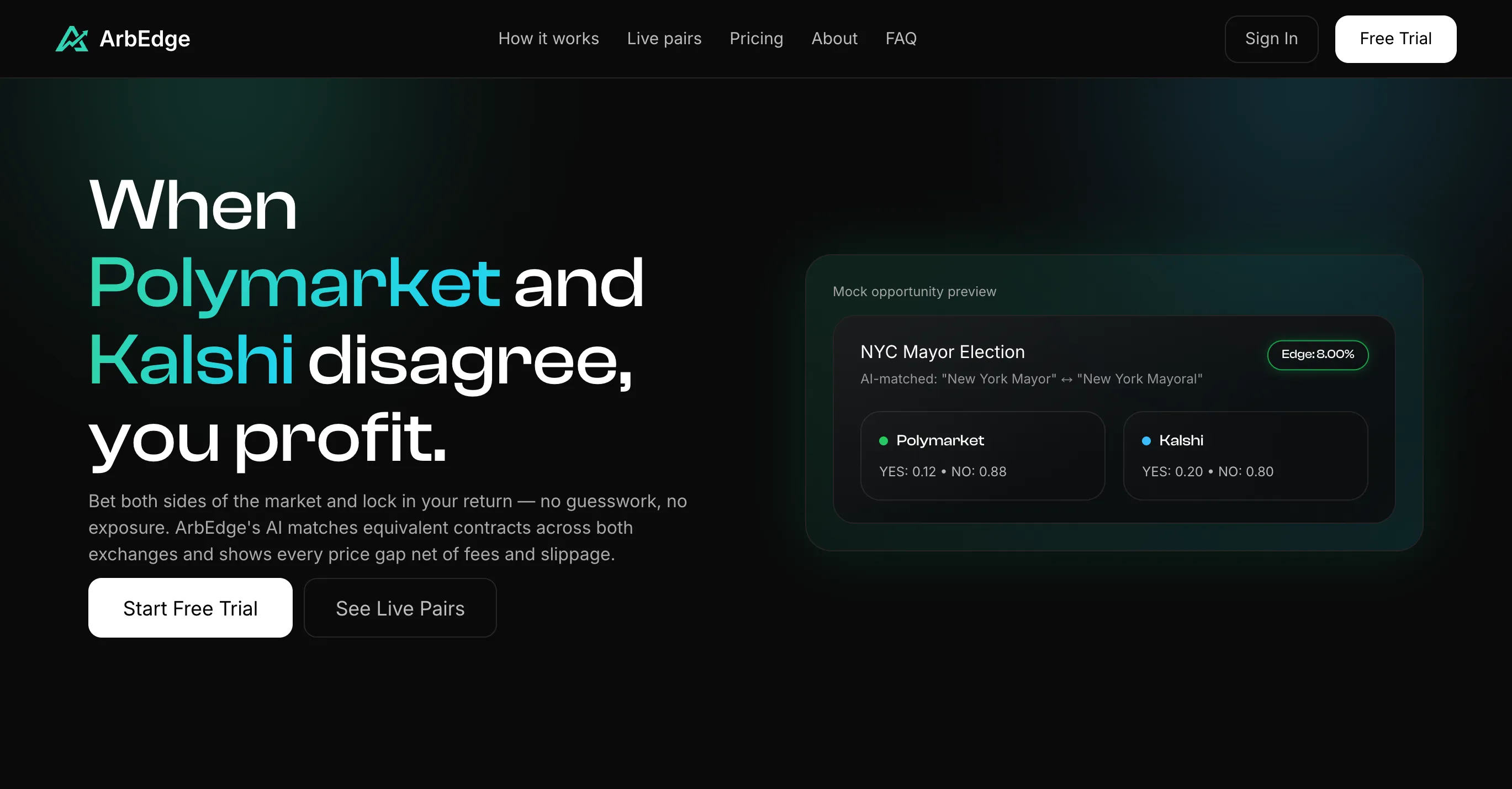
- Arbitrage. A price gap is only worth the depth behind it. When we matched 88 races across Polymarket and Kalshi, 51 crossed and the depth on offer paid $372 in all. ArbEdge prices every pair at the cost of filling 100 contracts and drops the pairs too thin for that.
- Market making. Thin books are where a maker earns the widest spread and takes the worst fills. A taker who sweeps a $12 book usually knows something. Our market-making guide covers that inventory risk.
- Scalping and momentum. A round trip in a politics book with the median 4¢ spread pays the 4¢ plus a taker fee each way, before any size. On a 50¢ outcome that is 8% of the price, and the edge has to beat it before the trade breaks even.
- Backtests. A test that fills at the last price, or at the mid, assumes depth that wasn't there. Historical depth isn't published, so you have to record it yourself. Uruguabot calibrates its dry-run fills from slippage measured on real trades.
BlockRotate
Hosted copy-trading bot for Polymarket sold on speed. You sign in with Google, paste the wallet of a trader to follow, choose the markets and a copy ratio, set a slippage cap, a momentum filter and a daily loss limit…
ArbEdge
Polymarket × Kalshi arbitrage scanner. Every 5 minutes it re-prices each pair of markets that ask the same question on both venues — matched by an AI pipeline that reads the full resolution rules — at the average cost…
Uruguabot
Verified PartnerSelf-hosted Python bot for Polymarket's 5-minute BTC and ETH up/down markets, sold with its complete live trading record — losses included.
How a bot should read the book
- Walk the book for your size before every taker order. Add up the asks until your dollars run out. The average price, plus the fee at each level, is your real entry. The fee formula is in our fee guide.
- Send a worst price, always. A FAK or FOK with a limit a cent or two past the touch caps slippage at a level you chose. Our order types guide covers which type each strategy uses.
- Size to the depth, not the volume. A simple rule: never take more than a set share of the depth within 1–2¢ on your side. If the order has to be bigger, rest part of it, or split it over time and re-read the book between pieces.
- Skip books you can't fill. Filter your market list by depth within ±2¢, not by 24h volume. In our pull, 6,987 of the 11,063 two-sided books had less than $100 that close.
- Keep a live book, not a polled one. Subscribe to the market channel of the WebSocket. You get a full
booksnapshot, thenprice_changeevents with each level's new total size (0 means the level is gone). Use thehashto check that your copy matches, re-snapshot when it doesn't, and handletick_size_change. The best bid and ask arrive as their ownbest_bid_askevent only when you setcustom_feature_enabled. Running a bot 24/7 covers reconnects. - Take prices from the book, not the page. Compute the mid yourself from the best bid and ask, and read the last trade from
/last-trade-priceor the WebSocket.
poly-maker, the open-source market maker in our catalog, keeps its books over WebSockets this way. Its code is a good place to see a maintained local book in practice.
Method
- Markets. Every market on Polymarket's Gamma API that was active, open, accepting orders and had any volume in the previous 24 hours, paged on November 19, 2026 (10:02 UTC): 12,381. Fee rate and category come from Gamma's
feeScheduleandfeeType. Crypto minute windows were picked out by their slugs. - Books. The full CLOB book of each market's first outcome, read through
POST /booksin batches of 100. A book is two-sided if it has both a bid and an ask (11,063). - Depth. Dollars are price × size at each level, counted within 1¢, 2¢ and 5¢ of the midpoint, on both sides unless we say otherwise.
- Market orders. For $100, $1,000 and $10,000, we walked the asks (buys) or the bids (sells, sized at the midpoint) with no price limit. Cost is (average price − midpoint) ÷ midpoint, plus the taker fee (rate × p × (1 − p) per share at each level) as a share of the money traded. An order counts as filled only if the book could take all of it. Medians are taken over the books that filled.
- Last trade. We count a book's
last_trade_priceas the other outcome's when it is more than 5¢ from the midpoint and closer to 1 − midpoint. That undercounts: near 50¢ the two can't be told apart. We checked 40 of the busiest books againstGET /last-trade-price. On all 14 where the book's field was flipped, the endpoint returned a price within a cent of that token's own bid and ask. - Snapshots. The 200 busiest two-sided books priced 10–90¢, read 11 times 30 seconds apart. "Still there" counts, level by level within ±2¢ of the first read's midpoint, the smaller of the two sizes at each price, over the first read's total.
- Rules. Polymarket's docs on prices and the order book, reading books and prices and the market WebSocket channel, read on November 19, 2026.
- Script.
scripts/order-book-depth.mjsin our repository does the pull, and--summaryprints every table above. It is plain Node with no keys. A book is a snapshot: rerun it at another hour and the tail will look the same, but the busiest books will be different markets.
Frequently asked questions
- How much liquidity does a Polymarket market have?
- Far less near the price than the totals suggest. On November 19, 2026 we read the books of all 12,381 markets that had traded in the previous 24 hours. Together they held $8.4 billion of resting orders, but 86% of it sat more than 10¢ from the price and 0.2% within 2¢. The median two-sided book had $21 within 2¢ of its midpoint. The 100 busiest had a median of $8,874, and markets ranked 101 to 1,000 had $865.
- What is the spread on Polymarket?
- The gap between the best bid and the best ask. In our pull, 37% of two-sided books were 1¢ wide or less, and they carried 83% of the day's volume. 12.5% were wider than 10¢. The median spread was 0.6¢ in the 100 busiest books, 1¢ in the next 900 and 2¢ in the rest.
- What is slippage on Polymarket, and how do I limit it?
- Slippage is the difference between the price you see and the average price you pay once your order eats through the book. A market order on Polymarket is a limit order priced to fill at once, so the price you attach is your slippage limit: the order walks the book up to it and no further. Read the depth for your size before you send it, and send FAK or FOK with a worst price rather than a price of 99¢.
- Why is the price on Polymarket different from what I paid?
- The price Polymarket displays is the midpoint between the best bid and the best ask, or the last trade if the spread is wider than 10¢. A buy pays the ask, not the midpoint, and a bigger buy pays every ask it reaches. On the median book priced 10–90¢ in our pull, even a $100 buy paid an average of 3.3¢ above the midpoint.
- How do I get the Polymarket order book through the API?
- GET https://clob.polymarket.com/book?token_id=… returns one outcome's full book, and POST /books takes a list of tokens. In our tests the batch call returned at most 100 books, with no error, when we asked for 200 or 500. Bids come ascending and asks descending, so the best price is the last entry on each side. For a live book, subscribe to the market WebSocket: a book snapshot, then price_change events that carry each level's new total size.